


Orders
.png&w=48&q=75 "login")
Profile


Wallet

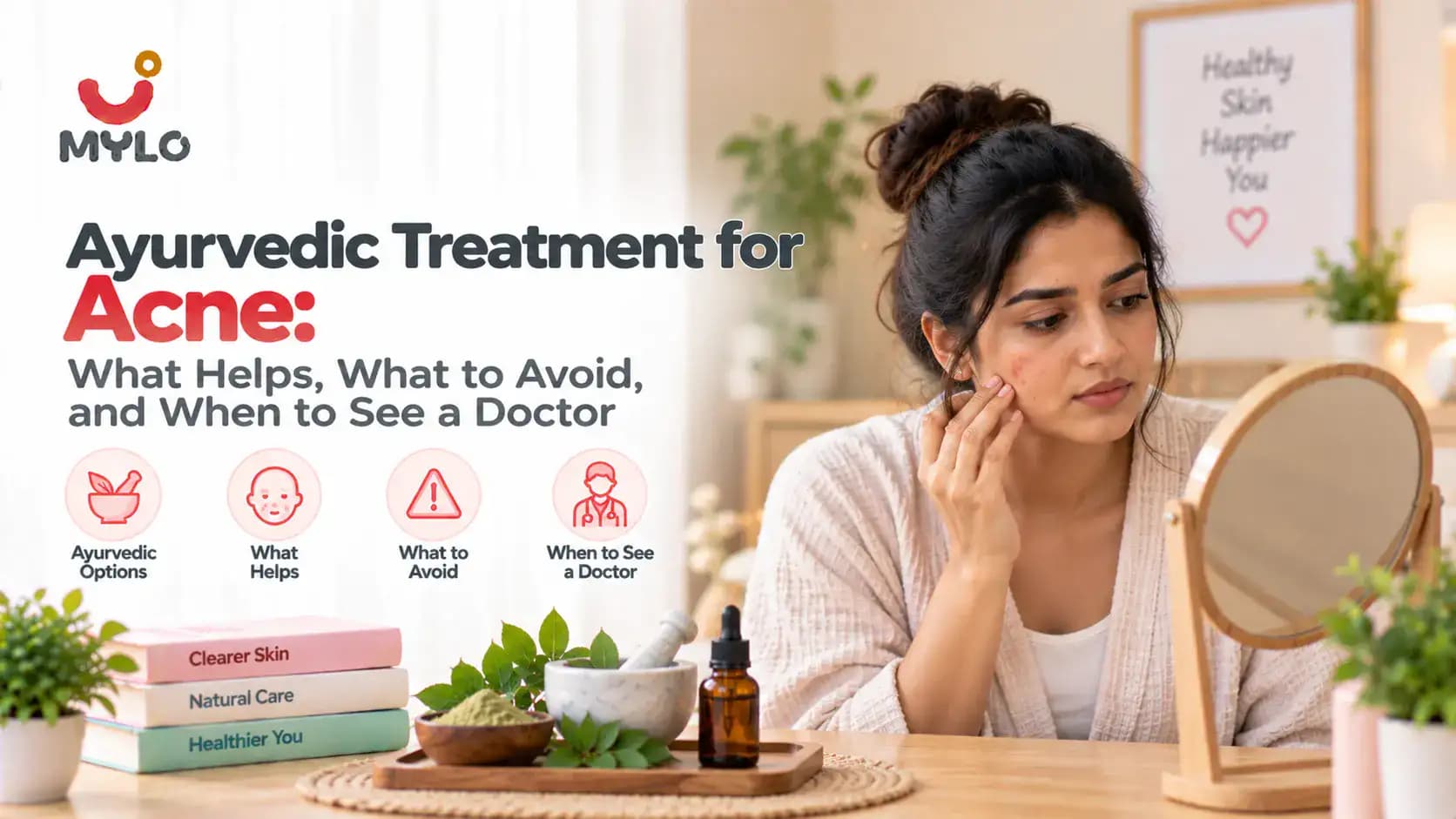
Ayurvedic Treatment for Acne: What Helps, What to Avoid, and When to See a Doctor


RMNCH+A, MCH & Midwifery, Program Management & National Trainer (ToT/ToN), WHO, MoHFW, ECHO Model · 11 years experience
 11 min
Quick answer
Some Ayurvedic ingredients can help mild acne. Tea tree oil has the best evidence, and neem, turmeric and aloe vera may soothe skin, though proof is limited. But acne is not caused by "toxins in the blood," so "detox" and "blood-purifying" claims do not reflect how acne actually works. Avoid harsh home remedies, especially lemon juice on the skin, which can burn and darken it. For moderate, painful, cystic or scarring acne, see a dermatologist early, because proven treatments work well and prevent scars.
Key takeaways
Acne is a common skin condition, caused by clogged pores, oil, bacteria, inflammation and hormones, not by being "dirty" or having "toxins" in the blood.
Tea tree oil is the best-supported natural option for mild acne, but it must be diluted and can irritate skin.
Neem, turmeric, aloe vera and sandalwood may soothe or mildly help, but the evidence is limited and they are not a cure.
Do not put lemon juice on your skin or scars. It can cause burns and worsen dark marks, especially on Indian and brown skin.
Never pop or squeeze pimples. This is a leading cause of scarring.
See a dermatologist for acne that is painful, cystic, widespread, scarring, persistent or distressing. Early treatment prevents permanent scars.
If you are pregnant, some acne treatments are unsafe, so check with your doctor before using anything.
What actually causes acne?
To treat acne well, it helps to know what really drives it. Acne forms when the tiny pores in your skin become blocked by a mix of excess oil (sebum) and dead skin cells. Bacteria that normally live on the skin then multiply in the blocked pore, and the body responds with inflammation, which is what makes spots red, swollen and sometimes painful. Hormones (which is why acne is common in teenage years, around periods, and in conditions like PCOS), genetics and stress all play a part.
Ayurveda traditionally explains acne through "dosha" imbalance and a build-up of "toxins" needing "blood purification." It is worth being honest here: acne is not caused by toxins in your blood, and you do not need to "detox" to clear it. Your liver and kidneys handle that already. Some Ayurvedic ingredients can still help the skin directly, but through their effect on oil, bacteria and inflammation, not by cleansing the blood.
Which Ayurvedic ingredients actually help acne?
Ingredient | Traditional claim | What the evidence shows |
|---|---|---|
Tea tree oil | Antibacterial, clears pimples | Best evidence of the group. Diluted tea tree oil can help mild acne, working a bit like a gentler benzoyl peroxide, though more slowly. Must be diluted. |
Neem | Antibacterial, purifies skin | Has antibacterial properties in the lab. Limited human evidence for acne, but may help as part of a gentle routine. |
Turmeric | Anti-inflammatory, antibacterial | May reduce inflammation, evidence is limited. Can stain skin and, rarely, cause irritation. |
Aloe vera | Soothes and hydrates | Genuinely soothing and non-greasy. Helps calm irritated skin; not a standalone acne cure. |
Sandalwood | Cooling, antimicrobial | Traditional soothing use, little robust acne evidence. Can cause allergy in some. |
Manjistha | "Blood purifying," clear skin | Traditional use. No good human evidence that it clears acne, and acne is not a blood-purification issue. |
Oral formulations such as guggul, triphala, Chandanasava or Haridra Khanda have weak and limited evidence for acne, and should only be taken under a qualified practitioner's guidance.
The honest summary: a few of these, especially tea tree oil, can help mild acne, but none is a powerful or guaranteed treatment.
Remedies to avoid: what can harm your skin
Some popular "natural" acne and scar remedies do more harm than good. Please avoid these:
Lemon juice on the skin or scars. This is the most important warning. Lemon juice is acidic and can cause chemical burns, and it makes skin far more sensitive to sunlight, leading to dark patches and worse pigmentation, especially on Indian and brown skin. It does not remove scars.
Undiluted essential oils. Tea tree and other essential oils must be diluted. Applied neat, they can badly irritate or burn the skin.
Toothpaste, baking soda or harsh scrubbing. These disrupt the skin barrier and worsen acne.
Popping or squeezing pimples. This pushes oil and bacteria deeper, increases inflammation, and is a leading cause of permanent scars.
Always do a patch test on a small area before trying any new product or ingredient, and stop if it stings, burns or causes a rash.
A note on acne scars and marks
The dark marks left after a pimple (post-inflammatory hyperpigmentation) are very common on Indian skin and usually fade slowly over months. To help them safely:
Protect your skin from the sun with sunscreen. Sun exposure darkens marks and is the single biggest thing that slows their fading.
Be patient and gentle. Avoid harsh DIY treatments that inflame the skin and deepen marks.
See a dermatologist for true scars. Pitted or raised scars do not respond to home remedies. Proven options include prescription creams, chemical peels, microneedling and laser, all best guided by a dermatologist.
Lemon juice, despite its popularity for scars, is not effective and can make pigmentation worse.
"Natural" does not always mean safe
Herbal and Ayurvedic skin products are not automatically gentle. They can cause irritation or allergic reactions, essential oils can burn if used undiluted, and some unregulated oral Ayurvedic products have been found contaminated with heavy metals. Choose carefully, patch test, and treat "natural" as a reason to be careful, not a guarantee of safety.
What works for acne, beyond herbs
The most reliable results combine a gentle routine with proven treatments where needed:
Approach | Why it helps |
|---|---|
A gentle skincare routine | Wash twice daily with a mild cleanser, avoid harsh scrubbing, and use non-comedogenic (non-pore-clogging) products. |
Proven over-the-counter actives | Benzoyl peroxide and salicylic acid have strong evidence for mild to moderate acne. |
Not picking or popping | Protects against scarring. |
Sun protection | Prevents dark marks from worsening. |
Managing triggers | Reducing very high-sugar foods and, for some, dairy may help. Managing stress and sleep supports skin. |
Treating hormonal causes | For women with PCOS or hormonal acne, treating the underlying cause helps. |
Dermatologist treatment | For anything moderate or worse: prescription retinoids, antibiotics, hormonal treatments, or isotretinoin for severe acne. |
Ayurvedic lifestyle habits that overlap with this, like a balanced diet, good sleep and stress management, are safe and worthwhile.
Acne during pregnancy
Acne is common in pregnancy because of hormonal changes, and this is relevant for many Mylo readers. Importantly, some acne treatments are not safe in pregnancy, including oral and topical retinoids and high-dose salicylic acid, and some oral Ayurvedic products are best avoided too. If you have acne while pregnant or breastfeeding, ask your doctor which treatments are safe rather than self-treating. Gentle cleansing, and pregnancy-safe options your doctor recommends, are the way to go.
When should you see a dermatologist?
See a dermatologist, rather than persisting with home remedies, if your acne is:
Moderate to severe, with many spots or widespread breakouts.
Painful, deep, cystic or nodular (large, tender lumps under the skin).
Leaving scars or dark marks.
Not improving after a couple of months of gentle care.
Causing distress or affecting your confidence.
Linked to other symptoms such as irregular periods and extra hair growth (possible PCOS).
Early treatment is the best way to prevent permanent scarring, and modern acne treatment is safe and highly effective.
Mylo Readers Asked
Can Ayurveda cure acne permanently?
No treatment, Ayurvedic or modern, "cures" acne permanently, because acne is driven by oil, hormones and genetics that change over time. Some Ayurvedic ingredients like tea tree oil can help mild acne, but ongoing gentle care and, for moderate or severe acne, a dermatologist's treatment give the best control.
Is neem good for acne?
Neem has antibacterial properties and may help as part of a gentle routine, though human evidence is limited. It can be a reasonable mild option, but it is not a strong treatment, and it will not clear moderate or severe acne on its own.
Can I use lemon juice for acne or scars?
No, please avoid it. Lemon juice can burn the skin and make dark marks worse, especially on Indian and brown skin, and it does not remove scars. Use sun protection and see a dermatologist for scars instead.
Is it safe to leave an Ayurvedic or herbal cream on overnight?
Only if it is meant for that and does not irritate your skin. Always patch test first, dilute essential oils, and stop if you get redness, stinging or a rash. When in doubt, follow the product instructions or ask a doctor.
How effective is tea tree oil for acne?
Diluted tea tree oil has the best evidence among natural options and can help mild acne, working somewhat like a gentler benzoyl peroxide, though more slowly. It must be diluted, as neat tea tree oil can irritate or burn the skin.
Why does acne leave dark marks on Indian skin?
Indian and brown skin is more prone to post-inflammatory hyperpigmentation, the dark marks left after a spot. They usually fade over months, faster with sun protection and gentle care, and slower if you pick at spots or use harsh remedies.
The bottom line
Ayurveda offers a few genuinely useful tools for mild acne, tea tree oil most of all, and its emphasis on a balanced diet, good sleep and stress management is sound. But acne is a skin condition of oil, bacteria, inflammation and hormones, not a matter of "toxins" needing purifying, and some traditional remedies, especially lemon juice on the skin, can actively harm you. Treat mild acne gently and patiently, never pop your spots, protect your skin from the sun, and see a dermatologist early for anything painful, cystic, scarring or stubborn. That combination, gentle natural care plus proven medical treatment when needed, is what gives you genuinely clear skin without damage.
References
American Academy of Dermatology. Acne: causes, treatment and skin care.
PubMed Central. Tea tree oil for acne: evidence review.
DermNet. Post-inflammatory hyperpigmentation.
American Academy of Dermatology. Phytophotodermatitis: lime and lemon juice skin burns.
US FDA. Heavy metal poisoning from certain unapproved Ayurvedic products.
Related reads on Mylo
This article is for information only and does not replace advice from a doctor or dermatologist.

Article Posted Under
Related Articles




Related Topics
.webp&w=32&q=75)
Medical Disclaimer
This content is for informational purposes only and should not replace professional medical advice. Consult with a physician or other health care professional if you have any concerns or questions about your health. If you rely on the information provided here, you do so solely at your own risk.


AWARDS AND RECOGNITION

Mylo wins Forbes D2C Disruptor award

Mylo wins The Economic Times Promising Brands 2022
AS SEEN IN













- Mylo Care: Effective and science-backed personal care and wellness solutions for a joyful you.
- Mylo Baby: Science-backed, gentle and effective personal care & hygiene range for your little one.
- Mylo Community: Trusted and empathetic community of 10mn+ parents and experts.


Product Categories
Baby Carrier | Baby Soap | Baby Wipes | Stretch Marks Cream | Baby Cream | Baby Shampoo | Baby Massage Oil | Baby Hair Oil | Stretch Marks Oil | Baby Body Wash | Baby Powder | Baby Lotion | Diaper Rash Cream | Newborn Diapers | Teether | Baby Kajal | Baby Diapers Pants | Cloth Diapers | Laundry Detergent | Lactation Granules |