


Orders
.png&w=48&q=75 "login")
Profile


Wallet

What Are Diaper Pants? When to Switch and How to Use Them
 1 Likes|
 21 min
Key Takeaways
Quick overview in 30 seconds.webp&w=32&q=75)
- Diaper pants are pull-on style diapers with elastic waistbands, designed like underwear for quick changes and a snug, leak-proof fit on active babies.
- They suit various stages from infancy to toddlerhood, work well for nighttime use, and make potty training easier with their tear-away sides and pull-on design.
- Key benefits include convenience, secure fit, freedom of mobility, reliable overnight protection, less disruption during play, and availability in sizes for every growth stage.
- Looking for comfy diaper pants for your little one? Explore our Adjustable & Reusable Cloth Diaper - Red & Blue - Pack of 2.
Quick Answer
Diaper pants are pull on diapers with a stretchy elastic waistband and no tapes, worn like underwear. They suit babies from about the time they start rolling, sitting and crawling, usually around 6 months, because you can change them without laying your baby down. Absorbency is the same as a taped diaper of the same size. The difference is how it goes on and comes off.
Key Takeaways
Diaper pants have no tapes. You pull them up like underwear, which is why they suit a baby who will not lie still.
Switch when your baby starts fighting nappy changes, rolling over mid change, or standing up, rather than at a fixed age.
To remove a soiled pant without a mess, tear the side seams. They are designed to rip. Do not pull it back down the legs.
Pants leak for different reasons than taped diapers do, and it is almost always size or how high the back is sitting.
They do not prevent rash and they do not speed up potty training. Both are common claims with nothing behind them.
"Pant style", "pull up" and "diaper leggings" all describe the same product category.
What Are Diaper Pants?
A diaper pant is a disposable diaper built as a closed loop, with a stretchable elastic waistband instead of adhesive tapes. Your baby steps into it or you pull it up over their legs, exactly like a pair of underpants.
Inside, the construction is the same as any modern disposable:
Layer | What it does |
|---|---|
Top sheet | The soft non woven layer touching the skin, which lets urine pass inward |
Acquisition or distribution layer | Spreads urine across the core instead of letting it pool in one spot |
Absorbent core | Super absorbent polymer plus wood pulp, which converts urine to gel and holds it below the surface |
Back sheet | The waterproof outer layer that keeps clothes dry |
Elastic waistband and leg cuffs | What replaces the tapes, and what creates the seal |
Tearable side seams | Bonded seams designed to rip open so you can remove a soiled pant downward |
Wetness indicator | On many pants, a strip that changes colour as it gets wet |
The important thing to understand is that the absorbent core in a pant is not different from the core in a taped diaper of the same size. Absorbency claims are about the core, so a pant does not hold more or less than a tape diaper because of its shape. What changes is the fit mechanism and the way you handle it.
How Are They Different From Standard Taped Diapers?
Three practical differences, and none of them is about absorbency.
How it goes on. A taped diaper is laid flat under a baby lying down and fastened. A pant is pulled up, which you can do with a baby standing, sitting or being held.
How the fit is set. With tapes you adjust the tightness each time. With a pant, the fit is fixed by the size and the elastic, so choosing the right size matters more.
How it comes off. A taped diaper is unfastened. A pant has to be torn at the seams if it is soiled.
Neither format is better in general. They suit different stages, and most families use tapes early and pants later. If you are deciding between the two right now, our full comparison is here: taped diapers versus diaper pants.
Pant Style, Pull Up, Diaper Leggings: Do These Mean Different Things?
No, they all describe the same product. The naming is inconsistent across brands and retailers, which causes a fair amount of confusion when you are shopping.
Term you will see | What it actually means |
|---|---|
Diaper pants, pant style diaper | The standard term in India for a pull on disposable diaper |
Pull ups, pull up diapers | The same product. In some markets this term is reserved for training pants aimed at older toddlers |
Diaper leggings | An informal term some listings use. It is the same pull on diaper, not a legging with a diaper built in |
Diaper panty | Another informal Indian usage for the same thing |
Training pants | Genuinely different. These are thinner, less absorbent pants intended for potty training, and they are meant to let a child feel wetness |
Cloth diaper pants | Different again. A reusable cloth shell with a removable insert. See our cloth diaper guide |
The one distinction worth holding on to is the last two. If a product is described as a training pant, expect lower absorbency by design. If you buy it expecting a normal diaper, it will leak.
When Should You Switch Your Baby to Diaper Pants?
When changing a taped diaper starts becoming a wrestling match, which for most babies is somewhere around 6 to 9 months. Go by behaviour rather than by a number.
Signs your baby is ready:
They roll over the moment you lay them down for a change
They are sitting up on their own, crawling, or pulling to stand
They actively resist being laid flat
You are changing them in places where laying them down is awkward, such as travel
They can bear weight on their legs enough to step into a pant, or stand while you pull it up
Reasons to stay with taped diapers for now:
Newborns and the first weeks. Tapes let you adjust the fit precisely on a small body and fold the front below a healing umbilical stump. A pant cannot be adjusted that finely.
A baby who is not yet mobile. There is no advantage to a pant if your baby lies still, and you lose the fit adjustment.
Frequent stools. In the early months, when stools come several times a day, unfastening tapes is cleaner than tearing seams each time.
A baby between sizes. Tapes tolerate an in-between weight better than a fixed elastic waistband does.
There is no need to switch permanently either. Plenty of families use pants during the day and tapes at night, or pants at home and tapes for travel.
How Do You Put On a Diaper Pant?
Two methods, depending on what your baby is doing.
Standing, for a mobile baby or toddler:
Open the pant out fully and hold the waistband wide with both hands.
Have your child step one foot in, then the other. Giving them something to hold on to helps.
Pull it up evenly on both sides to avoid twisting the core.
Settle the waistband so it sits below the navel, and make sure the back is pulled high enough to cover the whole bottom.
Run a finger inside each leg opening and pull the cuff outward so it sits flat in the thigh crease rather than folded inward.
Lying down, for a younger baby:
Bunch the pant up like a sock, so the leg openings are easy to find.
Slip both feet through, then draw it up over the legs.
Lift the hips gently and pull the back up high.
Check the leg cuffs are flat and turned outward, and that two fingers slide in at the waist.
The step people skip: the leg cuffs. On a pant, the cuff is doing the job that tapes and side panels do on a taped diaper. A cuff that is folded inward is the single most common cause of leg leaks, and running a finger around each opening takes two seconds.
How Do You Take a Soiled Pant Off Without a Mess?
Tear the side seams. This is the thing nobody explains and everybody learns the hard way.
Diaper pants are built with bonded side seams designed to rip. When there is stool in the pant, do not pull it back down over the legs, because it drags the mess down both thighs.
Lay your baby down, or keep them standing if that is easier and they are steady.
Find the side seam, which runs vertically at each hip.
Tear it downward on both sides. It takes very little force.
The pant now opens flat like a taped diaper. Fold the front down and away, and remove it downward and backward.
Clean, dry, and put the fresh pant on.
For a wet only pant, pulling it down the legs is perfectly fine and quicker.
Once it is off, roll it inward, fasten it with the torn seams tucked in, and wrap it. Since April 2026 India's waste rules classify used diapers as sanitary waste to be kept separate, which we cover in how to dispose of used diapers.
Why Do Diaper Pants Leak, and How Do You Stop It?
Almost always size or positioning, not absorbency. Because the fit is fixed by the elastic rather than adjustable, a pant is less forgiving of the wrong size than a taped diaper.
Where it leaks | Most likely cause | Fix |
|---|---|---|
Around the thighs | Leg cuff folded inward instead of sitting flat in the thigh crease | Run a finger inside each leg opening and pull the cuff outward. Do this at every change |
Up the back, usually overnight | The back is not pulled high enough. Lying down sends urine backward | Pull the back panel higher before you settle the waistband |
Out of the front, more often on boys | Not enough coverage at the front | Point downward when dressing, and check the waistband is not sitting too low |
Everywhere, with the pant heavy and swollen | Capacity. It is full, or the size is too small for the volume | Change more often, or move up a size |
Red marks at the waist or thighs, and leaks | Size too small. A tight pant does not seal better, it channels urine out | Move up one size |
Leaks in a pant that is clearly not full | Fit problem, not capacity | Check cuffs and back height before changing anything you buy |
The core has shifted to one side | Pulled up unevenly, so the absorbent pad is not centred | Pull up both sides together rather than one at a time |
If your baby is at the top of a weight range and leaking overnight, that is a capacity problem and the answer is the next size up. Our diaper size and weight chart has the ranges by weight.
Can You Use Diaper Pants Overnight?
Yes, and for most babies over about 3 months a well fitted pant in a high absorbency line handles one long overnight stretch.
Two things to get right. Use the size that matches your baby's current weight, going up rather than down if they are between sizes. And pull the back up high before you settle the waistband, because overnight leaks in pants escape upwards far more often than at the legs.
One correction worth making, because it causes real harm: an absorbency figure quoted in hours describes leak protection, not a recommended wear time. A pant rated for 12 hours is not meant to be worn for 12 hours. Use high absorbency for the one stretch you cannot interrupt, and change on the normal schedule the rest of the day. See how often to change your baby's diaper.
Do Diaper Pants Help With Potty Training?
Not on their own, and the claim that they do is not supported.
The logic sounds reasonable: a pant goes on and off like underwear, so a toddler learning to use a potty can manage it more independently. That part is genuinely useful in the practical sense. But the diaper still absorbs urine and keeps the surface dry, which means your child does not feel the consequence of going, and feeling it is a large part of how the association forms.
Two things actually relevant to potty training:
Training pants, a different product, are deliberately less absorbent so a child does notice wetness. If potty training is your goal, that is the product designed for it.
Cloth diapers also let a child feel wetness, which is one reason some parents use them during potty learning.
Choose a diaper pant because it is easier to change on a mobile baby, which is a real benefit. Do not choose it expecting it to bring potty training forward.
Do Diaper Pants Prevent Diaper Rash?
No. No diaper of any format prevents diaper rash.
Irritant diaper rash develops when three things happen together: skin stays damp and over hydrated, it rubs against a wet surface, and it sits in urine and stool that raise the skin's pH and activate enzymes which break down its barrier. What interrupts all three is changing promptly. Guidance from the NHS, the American Academy of Pediatrics and the Indian Academy of Pediatrics comes down to the same instruction.
Where a pant can help indirectly is that it is quicker to change, so in practice some parents change more often. And where it can hurt is that because it is quicker, it is also easier to leave on without checking. A wetness indicator is genuinely useful for that reason.
If your baby has a rash now, see how to treat diaper rash. During an active rash, a slightly larger and looser pant plus more frequent changes is the right approach.
Getting the Size Right, and Where Mylo Fits
Size matters more with pants than with tapes, because you cannot adjust the fit. Weigh your baby rather than guessing, and if they fall between two sizes, take the larger one for overnight.
Two fit checks that take five seconds: two fingers should slide in at the waist, and the leg cuff should sit flat in the thigh crease without leaving a deep mark.
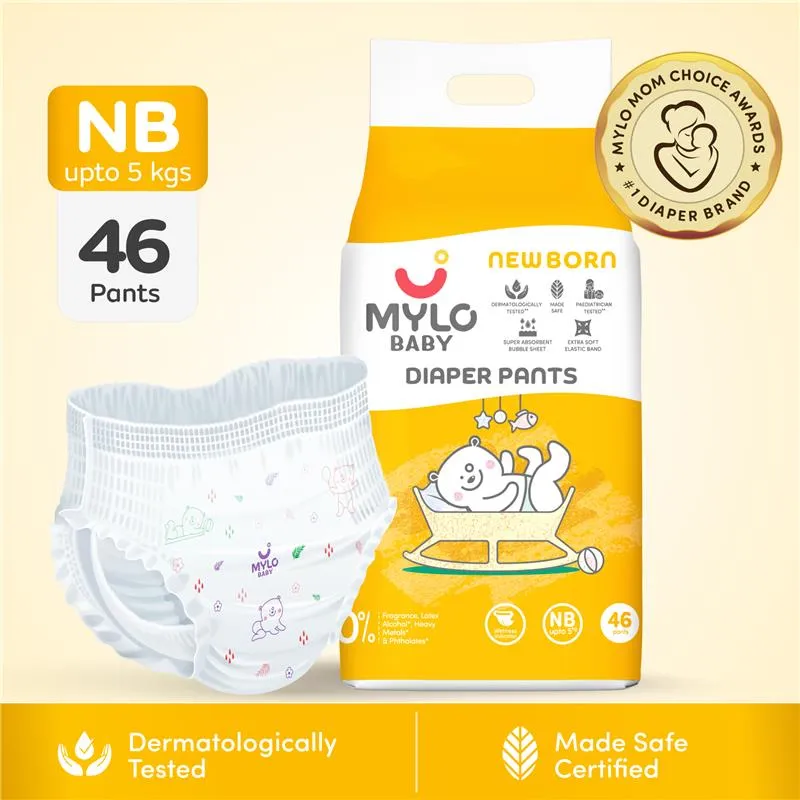
If your baby is not mobile yet, or the stump is healing, tapes are the better format for now. Mylo makes a New Born tape style diaper for up to 5 kg. There is also a New Born pant, in 46 count and 92 count, if you prefer the pull on format from the start.
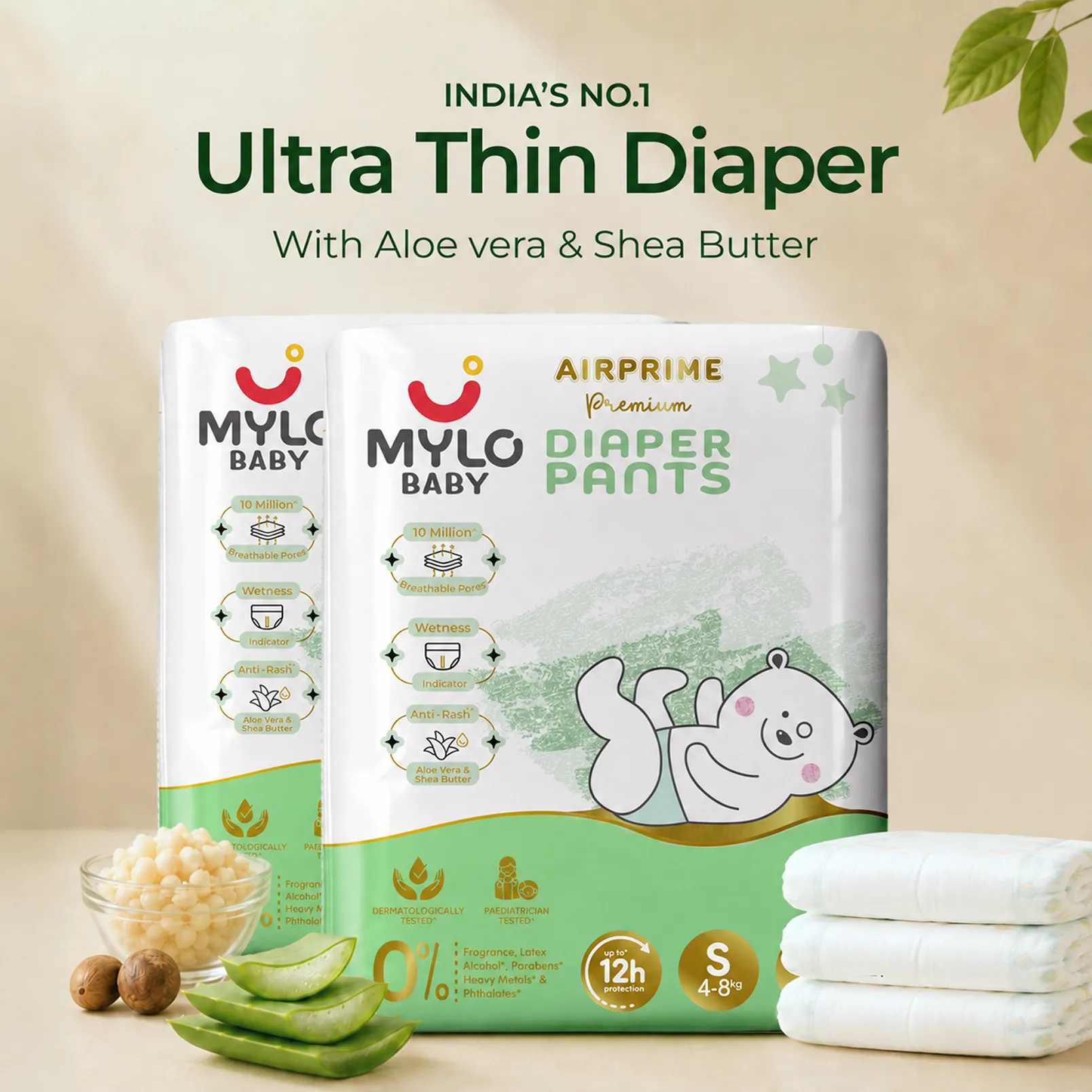
Through the mobile months, Mylo Baby Diaper Pants run S at 4 to 8 kg, M at 7 to 12 kg and L at 9 to 14 kg. Jumbo packs lower the price per diaper once your baby settles into a size, but buy small packs while sizes are still changing quickly.
For heavier toddlers, the Airprime Premium pants continue into XL at 12 to 17 kg, in 24 count, 48 count and 96 count, and XXL at 15 to 25 kg, in 24 count, 48 count and 96 count. This matters because many ranges stop at L, which is where parents of big toddlers get stuck.
Compare the full range in the baby diaper pants collection.
What a pant will not do: prevent rash, remove the need to check your baby, or speed up potty training. Absorbency figures describe capacity under test conditions, not how long the pant should stay on.
Mylo Parents Asked
What are diaper pants, in simple terms?
A disposable diaper with no tapes, made as a closed loop with a stretchy waistband, that you pull up like underwear. The absorbent core inside is the same as a taped diaper of the same size. Only the way it goes on and comes off is different.
At what age should I switch to diaper pants?
Most babies move across somewhere between 6 and 9 months, but go by behaviour. If your baby rolls over the moment you lay them down, or is sitting, crawling or pulling to stand, a pant will make changes far easier. Before they are mobile there is no real advantage, and you lose the fit adjustment tapes give you.
How do I take off a diaper pant when there is poop in it?
Tear the side seams at each hip. They are designed to rip with very little force, and the pant then opens flat like a taped diaper so you can remove it downward and backward. Never pull a soiled pant down over the legs.
How do I stop diaper pants from leaking?
Check three things in order. Run a finger inside each leg opening and pull the cuff outward so it sits flat in the thigh crease, which fixes most leg leaks. Pull the back up higher, which fixes most overnight leaks. Then check the weight against the size range, because a pant at the top of its range runs out of capacity. Only after all three is it worth trying a different product.
Can I use diaper pants overnight?
Yes, for most babies over about 3 months, in the correct size and a high absorbency line, with the back pulled high. But remember that an absorbency figure in hours means leak protection, not a wear time.
Do diaper pants prevent rash?
No. No diaper prevents rash. Changing promptly is the thing with real evidence behind it. A pant is quicker to change, which can help in practice, but it is also easier to leave on unchecked, which is why a wetness indicator is useful.
Are diaper pants the same as pull ups or diaper leggings?
Yes, those all describe the same pull on disposable diaper. Training pants are the genuine exception: they are deliberately less absorbent so a child feels wetness during potty training, so do not buy those expecting normal absorbency.
Do diaper pants help my toddler potty train faster?
There is no good evidence for that. A pant is easier for a toddler to pull up and down, which helps with independence, but it still absorbs urine and keeps the surface dry, so your child does not feel the consequence. Training pants or cloth are the options designed around that.
Are diaper pants more expensive than taped diapers?
It varies by brand, pack size and current offers rather than by format. Compare price per diaper, dividing pack price by count, in the same size on the day you buy.
When Should You Speak to a Doctor?
Diaper format is not a medical decision, but contact your paediatrician if you notice:
A rash that has not improved within 2 to 3 days of frequent changing and barrier cream
Blisters, open sores, pus, yellow crusting or bleeding in the diaper area
A bright red rash with a clear border and small spots spreading beyond it
Fever alongside a rash in the diaper area
Deep marks or broken skin at the waist or thighs that do not settle after moving up a size
Far fewer wet diapers than usual, or a baby who is unusually drowsy or hard to rouse
This article is general information and does not replace an examination.
Bottom Line
Diaper pants are pull on diapers with no tapes, and the core inside is no different from a taped diaper of the same size. Switch when your baby becomes too mobile to lie still, usually around 6 to 9 months, and stay with tapes before that. Tear the side seams to remove a soiled one. If it leaks, check the leg cuffs, then the height at the back, then the size, before you blame the product. And do not expect a pant to prevent rash or speed up potty training, because neither claim holds up.
References
NHS, UK. Nappy rash.
AAP, HealthyChildren.org. Common Diaper Rashes and Treatments.
Stamatas GN, Tierney NK. Diaper dermatitis. Pediatric Dermatology. 2014;31(1):1-7.
Indian Academy of Pediatrics. IAP Guidelines for Pediatric Skin Care. Indian Pediatrics. 2021.
StatPearls. Diaper Dermatitis.
Solid Waste Management Rules, 2026, Government of India, in force from 1 April 2026.

Article Posted Under
Related Articles
Hair Colour During Pregnancy: Is It Safe? Trimester Guide, Mehndi and Safer Options
 14 min
 Mylo: The Made-in-India Pregnancy and Parenting App Built for Indian Parents
 7 min
7 min Diwali During Pregnancy: Safety Tips for Pregnant Women on Crackers, Sweets and Diet
 17 min
 Best Pregnancy and Parenting App in India: 5 Must-Have Features to Look For (2026)
 20 min
Related Topics
.webp&w=32&q=75)
Medical Disclaimer
This content is for informational purposes only and should not replace professional medical advice. Consult with a physician or other health care professional if you have any concerns or questions about your health. If you rely on the information provided here, you do so solely at your own risk.


AWARDS AND RECOGNITION

Mylo wins Forbes D2C Disruptor award

Mylo wins The Economic Times Promising Brands 2022
AS SEEN IN













- Mylo Care: Effective and science-backed personal care and wellness solutions for a joyful you.
- Mylo Baby: Science-backed, gentle and effective personal care & hygiene range for your little one.
- Mylo Community: Trusted and empathetic community of 10mn+ parents and experts.


Product Categories
Baby Carrier | Baby Soap | Baby Wipes | Stretch Marks Cream | Baby Cream | Baby Shampoo | Baby Massage Oil | Baby Hair Oil | Stretch Marks Oil | Baby Body Wash | Baby Powder | Baby Lotion | Diaper Rash Cream | Newborn Diapers | Teether | Baby Kajal | Baby Diapers Pants | Cloth Diapers | Laundry Detergent | Lactation Granules |