


Orders
.png&w=48&q=75 "login")
Profile


Wallet

What is Birth Control Patch?
 15 min
TL;DR
The birth control patch is a small sticky patch, worn on the skin, that releases two hormones estrogen and progestin to prevent pregnancy (). It mainly works by stopping ovulation. With perfect use it is about 99% effective, but with typical real-world use it is about 93% effective roughly 7 in 100 users become pregnant in a year (). It does NOT protect against sexually transmitted infections only condoms do that. The patch is not right for everyone: it is generally avoided if you smoke and are 35 or older, have a history of blood clots, stroke or certain migraines, and it works less well at higher body weight (BMI 30+) () (). It is a prescription method talk to a doctor to see if it suits you.
Quick Answer
The birth control patch is a weekly skin patch that releases estrogen and progestin to prevent pregnancy, mainly by stopping the ovaries from releasing an egg. It is about 99% effective with perfect use and about 93% with typical use. You wear a new patch each week for 3 weeks, then have a patch-free week. It does not protect against STIs use condoms for that. It is not suitable for everyone (for example, smokers aged 35+ or people with a history of blood clots) and is less effective at higher body weight. It needs a prescription, so consult a doctor.
Author: Mylo Editorial Team, Mylo Parenting Desk Medically reviewed by: Mylo Editorial Board, aligned with CDC, NHS and FOGSI guidance Last updated: 6 July 2026
Medical Disclaimer: This article is for informational purposes only and is not a substitute for professional medical advice. The birth control patch is a prescription method with important safety considerations. Discuss your full medical history with a doctor before starting it, and seek urgent care for warning signs such as chest pain, breathlessness, severe leg pain or swelling, or a sudden severe headache.
Key Takeaways
The patch is a weekly skin patch releasing estrogen and progestin to prevent pregnancy ()
It works mainly by stopping ovulation, plus thickening cervical mucus
About 99% effective with perfect use; about 93% with typical use (≈7 in 100 pregnant per year) ()
It does NOT protect against STIs use condoms for that ()
Worn 3 weeks on (changed weekly), then 1 patch-free week ()
Less effective at higher body weight (BMI 30+ or over ~90 kg/198 lb) ()
NOT suitable for smokers aged 35+ or people with a history of blood clots, stroke or certain migraines ()
It is a prescription method a doctor should confirm it is right for you
What Is the Birth Control Patch?
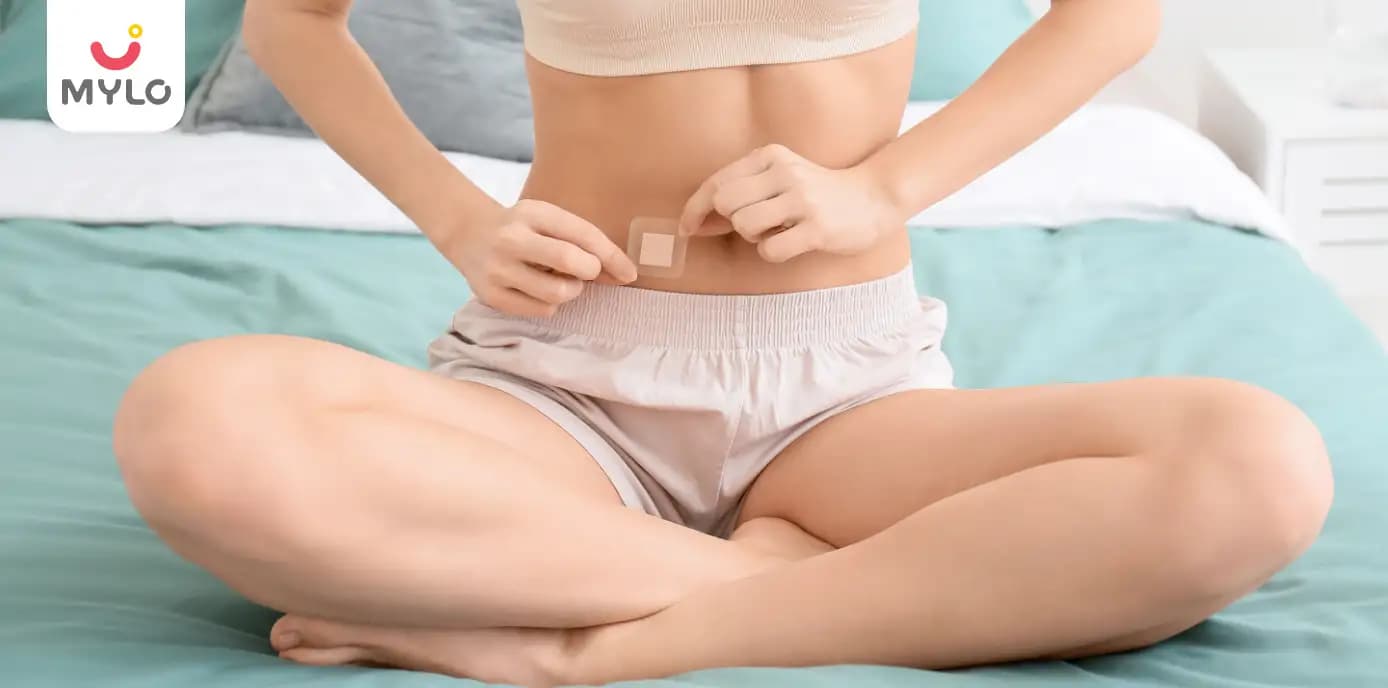
The birth control patch is a thin, sticky patch a bit like a small plaster/band-aid that you wear on your skin. It is a type of combined hormonal contraception, meaning it contains two hormones, estrogen and progestin, which are absorbed through the skin into the bloodstream to prevent pregnancy ().
It is a convenient option for people who prefer not to take a daily pill, because it only needs changing once a week. It is not a "safest for everyone" choice, though like all methods it has pros, cons and safety limits, and the right method depends on your health and preferences.
How Does the Birth Control Patch Work?
The patch releases estrogen and progestin, which prevent pregnancy in up to three ways ():
Mechanism | How It Prevents Pregnancy |
|---|---|
Stops ovulation (main action) | The hormones prevent the ovary from releasing an egg with no egg, pregnancy cannot occur |
Thickens cervical mucus | Thicker mucus makes it harder for sperm to reach an egg |
Thins the uterine lining | May make the lining (endometrium) less receptive, though stopping ovulation is the primary effect |
How Effective Is the Birth Control Patch?
Effectiveness depends heavily on using it correctly and on time ():
Type of Use | Effectiveness | What It Means |
|---|---|---|
Perfect use (exactly as directed, every time) | About 99% | Fewer than 1 in 100 users pregnant per year |
Typical use (real-world, allowing for mistakes) | About 93% | About 7 in 100 users pregnant per year |
The most common reason effectiveness drops is forgetting to change the patch on time. It is also less effective in people with a BMI of 30 or more, or who weigh more than about 90 kg (198 lb) (). For comparison, long-acting methods like the IUD and implant are more than 99% effective with typical use, because they don't depend on remembering.
How to Use the Birth Control Patch
Using the patch correctly is what keeps it effective ():
Apply your first patch on the first day of your period for immediate protection (if you start at another time, use a backup method such as condoms for the first 7 days).
Stick it to clean, dry, hairless skin upper arm, buttock, tummy or upper back. Avoid the breasts and any irritated skin. Press firmly for 10 seconds so it sticks well.
Wear each patch for 7 days, then replace it with a new one on the same day each week, using a slightly different spot to reduce skin irritation.
Do this for 3 weeks in a row (3 patches).
Have a patch-free fourth week you will usually get a period-like bleed during this week.
After the patch-free week, start a new patch and repeat the cycle.
Sticking to the schedule especially changing the patch on the right day is essential for it to work.
What If the Patch Falls Off or I Miss a Change?
The patch is designed to stay on through showers, swimming and exercise, but if it comes loose, what to do depends on how long it has been off ():
Off for less than 48 hours: Reattach it if it still sticks, or apply a new one. You stay protected if you used it correctly for the previous 7 days no backup needed.
Off for 48 hours or more (or you're not sure): Apply a new patch, start a new 4-week cycle from that day, and use backup contraception (such as condoms) for the next 7 days. If you had unprotected sex in the previous few days, ask about emergency contraception.
If you are ever unsure, use condoms and check with a doctor or pharmacist.
Does the Patch Protect Against STIs/STDs?
No. The birth control patch prevents pregnancy but does NOT protect against sexually transmitted infections (STIs/STDs) like HIV, chlamydia, gonorrhoea or herpes (). The only way to reduce STI risk is to use a barrier method condoms every time. Many people use the patch for pregnancy prevention and condoms for STI protection together.
How Fast Does the Patch Start Working?
It depends on when in your cycle you start ():
Start on day 1 of your period: You are protected from pregnancy straight away.
Start at any other time: Use a backup method (condoms) for the first 7 days.
Switching from another hormonal method (like the pill): Your doctor will advise whether and how long you need backup, as timing differs.
Who Should NOT Use the Birth Control Patch?
Because it contains estrogen, the patch is not safe for everyone. It is generally avoided if you () ():
Smoke and are 35 or older
Have a history of blood clots (DVT or pulmonary embolism), heart attack or stroke
Have migraine with aura
Have high blood pressure that is not well controlled, or certain heart or liver diseases
Have had breast cancer
Are less than 3 weeks after childbirth (or longer if you have other clot risks)
A doctor will review your medical history to decide whether the patch or a different method is right for you. Never start it without this check.
What Are the Side Effects of the Birth Control Patch?
Most people tolerate the patch well, but side effects can occur ():
Common (usually settle in a few months) | Rare but serious (seek urgent care) |
|---|---|
Skin irritation where the patch sticks | Blood clots in the legs or lungs |
Headaches | Heart attack or stroke |
Nausea | Very high blood pressure |
Breast tenderness | Liver problems or tumours |
Irregular bleeding or spotting | Gallbladder disease |
Mood changes or acne |
Because the patch delivers estrogen through the skin, it can slightly raise the risk of blood clots compared with some other methods but this risk is still small, and it is lower than the clot risk during pregnancy itself (). Seek urgent medical help for chest pain, trouble breathing, severe leg pain or swelling, a sudden severe headache, or vision changes.
How Does the Patch Compare to Other Methods?
Method | How Often | Typical-Use Effectiveness | STI Protection |
|---|---|---|---|
Patch | Weekly | About 93% | No |
Combined pill | Daily | About 93% | No |
IUD (hormonal or copper) | Every 3-10 years | Over 99% | No |
Implant | Every 3 years | Over 99% | No |
Condoms | Every time | About 87% | Yes |
For people who want the most reliable, low-maintenance option, IUDs and implants are more effective and can be more cost-effective over time. The patch suits those who want a weekly, reversible method and have no contraindications ().
Indian Context: What You Should Know
Availability: The contraceptive patch is not as widely available in India as pills, condoms, IUDs (Copper-T) or injectables; ask your gynaecologist what is offered near you
Prescription and guidance: It is a doctor-prescribed method a gynaecologist will check your history (blood pressure, clot risk, smoking, migraines) first
STI protection: The patch does not protect against STIs; condoms remain essential for that
Consider long-acting options: For reliable long-term spacing, IUDs and implants are effective and available through many hospitals and government programmes
Don't self-select from marketing: Choose a method with your doctor based on your health, not on advertising or a friend's experience
Emergency contraception is separate: The patch is for ongoing prevention; if you miss it and have unprotected sex, ask about emergency contraception promptly
Myths vs Facts About the Birth Control Patch
Myth | Fact | Source |
|---|---|---|
"The patch is the safest option for everyone" | It suits many people but is unsafe for some (e.g., smokers 35+, clot history); it is not universally "safest" | |
"The patch protects against STIs" | It does not only condoms reduce STI risk | |
"It's 99% effective no matter what" | About 99% with perfect use, but about 93% with typical use | |
"Body weight doesn't affect it" | It is less effective at BMI 30+ or over ~90 kg | |
"If the patch falls off, just stick it back nothing else to do" | If it's been off 48 hours or more, you need a new cycle plus 7 days of backup | |
"Hormonal birth control is more dangerous than pregnancy" | The blood clot risk from the patch is small and lower than the clot risk of pregnancy |
FAQs: Birth Control Patch
How effective is the birth control patch?
About 99% effective with perfect use, and about 93% with typical use meaning roughly 7 in 100 users get pregnant in a year. Changing the patch on time is the biggest factor ().
Birth control patch kaise kaam karta hai? (Hinglish)
Patch skin par lagta hai aur do hormones estrogen aur progestin release karta hai. Ye mainly ovary se egg release hona rok deta hai (ovulation ruk jaati hai), cervical mucus ko gaadha karta hai taaki sperm egg tak na pahunch sake (). Ise 3 hafte (har hafte naya patch) lagate hain, phir 1 hafta bina patch ke. Dhyaan rahe ye STI/STD se bachaav NAHI karta, uske liye condom zaroori hai. Ye doctor ki salah se lene wala method hai.
Does the patch protect against STIs?
No. It only prevents pregnancy. To reduce the risk of STIs like HIV, chlamydia or gonorrhoea, use condoms every time ().
What should I do if my patch falls off?
If it's been off less than 48 hours, reapply it or put on a new one you're still protected if you used it correctly the previous week. If it's been off 48 hours or more, apply a new patch, start a new cycle, and use condoms for 7 days; ask about emergency contraception if you had unprotected sex ().
Patch kinko nahi lagana chahiye? (Hinglish)
Patch estrogen ki wajah se sabke liye safe nahi hai. Ye aam taur par avoid kiya jaata hai agar aap 35 saal ya usse zyada umar ki hain aur smoking karti hain, ya aapko blood clot, stroke, heart attack, aura wali migraine, ya control na hone wala high BP raha ho (). Zyada body weight (BMI 30+) par ye kam effective hota hai. Isliye doctor se apni poori medical history discuss karke hi shuru karein.
Is the birth control patch safe?
For most healthy people without contraindications, yes. But because it contains estrogen it carries a small increased risk of blood clots, and it is not suitable for certain people (such as smokers aged 35+ or those with a clot history). A doctor's assessment is essential ().
Where can I put the patch on my body?
On clean, dry, hairless skin the upper arm, buttock, tummy or upper back. Avoid the breasts and any irritated skin, and use a slightly different spot each week ().
Is the patch better than the pill or an IUD?
It depends on you. The patch and pill have similar typical-use effectiveness (about 93%), while IUDs and implants are more than 99% effective and need no weekly action. The best method depends on your health, preferences and what a doctor advises ().
Will my periods change on the patch?
You may have irregular bleeding or spotting, especially in the first few months, and you usually get a period-like bleed during the patch-free week. This often settles; tell your doctor if bleeding is heavy or persistent ().
References
Cleveland Clinic. "Birth Control Patch." https://my.clevelandclinic.org/health/articles/24490-birth-control-patch
Planned Parenthood. "How Effective Is the Birth Control Patch?" https://www.plannedparenthood.org/learn/birth-control/birth-control-patch/how-effective-is-the-birth-control-patch
Planned Parenthood. "Is the Birth Control Patch Safe?" https://www.plannedparenthood.org/learn/birth-control/birth-control-patch/how-safe-birth-control-patch
NHS UK. "How to Use the Contraceptive Patch." https://www.nhs.uk/contraception/methods-of-contraception/contraceptive-patch/how-to-use-it/
Centers for Disease Control and Prevention (CDC). "U.S. Medical Eligibility Criteria Combined Hormonal Contraceptives." https://www.cdc.gov/contraception/hcp/usmec/combined-hormonal-contraceptives.html
FOGSI (Federation of Obstetric and Gynaecological Societies of India). https://www.fogsi.org/
Article Posted Under
Related Articles
HairVivine Pro: What This Pumpkin Seed Hair Active Does and What the Studies Show
 15 min
 Copper Peptides for Hair: What Copper Tripeptide-1 (GHK-Cu) Really Does
 11 min
 How Long Does Postpartum Hair Loss Last? A Month-by-Month Recovery Timeline
 16 min
 Why Is My Hair Falling Out 3 Months After Delivery? Postpartum Hair Loss Explained
 16 min
Related Topics
.webp&w=32&q=75)
Medical Disclaimer
This content is for informational purposes only and should not replace professional medical advice. Consult with a physician or other health care professional if you have any concerns or questions about your health. If you rely on the information provided here, you do so solely at your own risk.


AWARDS AND RECOGNITION

Mylo wins Forbes D2C Disruptor award

Mylo wins The Economic Times Promising Brands 2022
AS SEEN IN













- Mylo Care: Effective and science-backed personal care and wellness solutions for a joyful you.
- Mylo Baby: Science-backed, gentle and effective personal care & hygiene range for your little one.
- Mylo Community: Trusted and empathetic community of 10mn+ parents and experts.


Product Categories
Baby Carrier | Baby Soap | Baby Wipes | Stretch Marks Cream | Baby Cream | Baby Shampoo | Baby Massage Oil | Baby Hair Oil | Stretch Marks Oil | Baby Body Wash | Baby Powder | Baby Lotion | Diaper Rash Cream | Newborn Diapers | Teether | Baby Kajal | Baby Diapers Pants | Cloth Diapers | Laundry Detergent | Lactation Granules |