


Orders
.png&w=48&q=75 "login")
Profile


Wallet

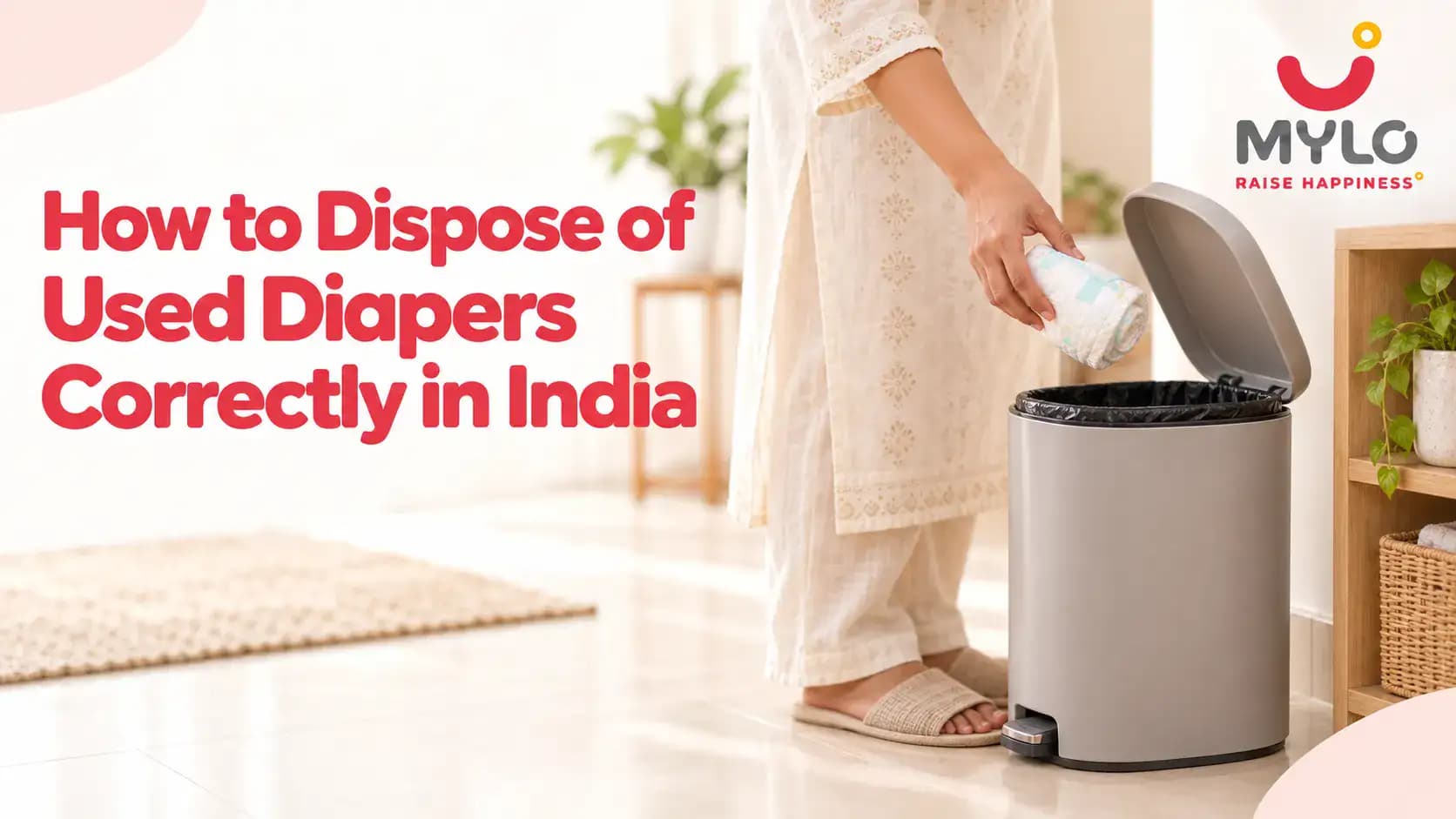
How to Dispose of Used Diapers Correctly in India
 9 Likes|
 19 min
AI-Generated Summary
Quick overview in 30 seconds.webp&w=32&q=75)
- Proper diaper disposal prevents odor, bacteria buildup, contamination, and reduces environmental impact while maintaining a clean, hygienic space for both babies and caregivers.
- Disposal options include diaper pails, disposal bags, diaper disposal machines, lidded trash bins, and cloth diaper wet bags for reusable nappies.
- Follow a step-by-step routine: prepare the area, remove the soiled diaper, dispose solids in toilet, roll, seal, discard, and wash hands.
- Looking for diapers and wipes that make disposal easier? Explore our Adjustable & Reusable Cloth Diaper - Red & Blue - Pack of 2.
Last updated: 10 September 2026
Quick Answer
Empty solid poop into the toilet, roll the diaper inward so the mess is sealed inside, fasten it with its own tabs, then wrap it in a pouch or newspaper. Since 1 April 2026, India's waste rules treat used diapers as sanitary waste, which must be kept separate from your wet and dry bins. Never flush a diaper or a wipe.
Key Takeaways
India's Solid Waste Management Rules, 2026 replaced the 2016 rules on 1 April 2026 and moved households from three bins to four: wet, dry, sanitary and special care waste.
Used diapers are now classified as sanitary waste, so they no longer belong in the dry waste bin where the older rules placed them.
Sanitary waste must be securely wrapped and kept separate, which protects the waste workers who handle your bin by hand.
Never flush a diaper, a liner or a wipe, including wipes labelled flushable. They do not break down and they block drains and sewage systems.
Emptying solid stool into the toilet before wrapping is the single most considerate thing you can do, because it keeps faecal matter out of the waste chain.
Why Does It Matter How You Throw Away a Diaper?
Because in India a used diaper is usually handled by a person, not a machine. Waste is often collected, carried and sorted by hand at some point in its journey, and a diaper that is open, leaking or full of stool exposes that worker directly to faecal bacteria and viruses.
Four things go wrong when disposal is careless:
Worker exposure. Unwrapped sanitary waste is a direct infection risk to collection and sorting staff, who frequently work without gloves.
Contamination of recyclables. A diaper thrown into the dry waste bin can soil an entire bag of paper and plastic, which means recoverable material goes to landfill instead.
Plumbing and sewage damage. Flushed diapers and wipes do not disintegrate. They cause household blockages and, at scale, they clog municipal sewers.
Odour and pests in your own home. Mostly a comfort issue, but flies around a diaper bin are also a hygiene issue in a house with a baby.
What India's Waste Rules Now Require
This is the part that changed recently, and most households have not caught up with it.
The Ministry of Environment, Forest and Climate Change notified the Solid Waste Management Rules, 2026, which came into force on 1 April 2026 and superseded the Solid Waste Management Rules, 2016. The headline change for parents is that segregation at source moved from three streams to four.
Stream | What goes in it | Where it goes |
|---|---|---|
Wet waste | Kitchen waste, vegetable and fruit peel, food scraps, flowers | Composting or bio-methanation |
Dry waste | Plastic, paper, metal, glass, wood, rubber | Material Recovery Facility for sorting and recycling |
Sanitary waste | Used diapers, sanitary napkins, tampons, condoms, incontinence sheets | Kept separate, securely wrapped, collected separately |
Special care waste | Domestic hazardous items such as batteries, paint, expired medicines, sharps | Handed only to authorised agencies or designated collection centres |
What actually changed for diapers. Under the 2016 rules, households were told to wrap used diapers and place them in the bin meant for dry or non-biodegradable waste. Under the 2026 rules, sanitary waste is its own stream, so a used diaper should no longer go into your dry waste bin alongside paper and plastic. It needs wrapping and keeping separate.
The rules also carry environmental compensation for non-compliance on a polluter pays basis, though in practice enforcement for an individual household is far less likely than for a bulk waste generator such as a housing society, hospital or office.
One honest caveat. National rules and local collection are not the same thing. Many municipalities are still operating a two bin or three bin collection, and staff may not yet be collecting a fourth stream. If your area does not collect sanitary waste separately, wrap it securely anyway and ask your collector or resident association which bin they want it in. Wrapping is the part that protects people, and it is within your control regardless of what your city has implemented.
How to Wrap and Bin a Used Diaper, Step by Step
Empty solid stool into the toilet where you can, tipping or scraping it in. This keeps faecal matter out of the waste stream entirely and is the single biggest courtesy you can extend to whoever handles your bin. Do not attempt this with loose newborn stool, which is not practical.
Fold the front of the diaper inward, so the soiled surface faces in on itself rather than out.
Roll it from the front towards the back, tightly, keeping everything contained inside the roll.
Fasten it with its own tabs. Most tape style diapers have side tabs you can wrap around the roll. On a pull up pant, tuck the rolled edge under the waistband.
Put used wipes inside the roll before you close it, rather than loose in the bin.
Wrap the roll in the pouch supplied with the diaper packet if there is one, or in newspaper, an old paper bag, or a small bag you are reusing anyway.
Place it in your sanitary waste container, lidded and lined, kept away from food preparation areas.
Wash your hands with soap and water for at least 20 seconds. Hand sanitiser is a fallback when you have no access to water, not a replacement, because it works poorly on visibly soiled hands.
One thing worth knowing: under the 2016 rules, manufacturers and brand owners of diapers and sanitary napkins were expected to either use recyclable materials or supply a disposal pouch with each packet. If your diaper pack includes such a pouch, use it. If it does not, newspaper works perfectly well.
What Should You Never Flush?
Anything from a diaper change except actual stool and toilet paper.
Item | Flush? | Why |
|---|---|---|
Solid poop, tipped off the diaper | Yes | This is what sewage systems are built for, and it keeps pathogens out of the waste chain |
The diaper itself | Never | The absorbent core swells enormously in water and does not break down. It will block your plumbing |
Baby wipes, including "flushable" ones | Never | Wipes do not disintegrate the way toilet paper does. They are a leading cause of sewer blockages worldwide |
Cloth diaper liners | Check the pack | Some are designed to flush, but not into a septic tank, and not in older or narrow plumbing. When unsure, bin it |
Cotton wool or cotton pads | Never | Cotton holds its structure and clumps in pipes |
Nappy bags or wrapping | Never | Plastic does not break down and will lodge in the trap |
If you are on a septic tank rather than a municipal sewer, be stricter still. Only stool and toilet paper.
Where Do Used Diapers Actually Go After Your Bin?
Understanding the route explains why the wrapping matters more than the bin colour.
In most Indian cities, a wrapped diaper leaves your home in a collection vehicle, and if it has been segregated as sanitary waste it goes to landfill or, in some cities, to incineration at an authorised facility. If it has been mixed into dry waste, it arrives at a Material Recovery Facility where workers sort recyclables by hand, and that is where the real harm happens: a leaking diaper contaminates the paper and plastic around it, so material that could have been recycled is discarded, and a worker handles faecal matter with their bare hands.
Diaper recycling technology exists in a small number of countries but is not available at scale in India. There is currently no household route to recycling a used disposable diaper here, which means the realistic goals are containment, worker safety and keeping recyclables clean, rather than recovery.
How Do You Keep the Smell Down Without Buying a Special Bin?
Diaper pails and sealing bins work, but they are not necessary and they add a recurring cost for refill cartridges. What actually controls odour:
Empty the stool. Odour is overwhelmingly from faecal matter, so removing it removes most of the smell at source.
Roll and wrap every single one. An unwrapped diaper in a lidded bin still smells. A wrapped one in an open bin often does not.
Use a lidded bin with a liner, and empty it daily in summer. In Indian summer heat, a bin emptied every second day will smell regardless of what you put in it.
Keep it out of the bedroom and away from the kitchen. A balcony or bathroom is better, provided pets and other children cannot reach it.
A spoonful of baking soda in the base of the liner absorbs odour cheaply. Avoid strongly fragranced products in a room where a baby sleeps.
Watch for flies in monsoon. A tight lid matters more in the wet months than at any other time.
How Do You Dispose of a Diaper When You Are Out?
The situation nobody plans for, and the one where diapers most often get left behind.
Carry wrapping with you. A few paper bags or a roll of nappy bags in your changing bag solves most of it.
On a train or a flight, wrap the diaper and hand it to crew or place it in the toilet's waste bin. Never put it down the toilet on a train or aircraft, where the plumbing is even less forgiving than at home.
In a car, keep a small lidded container or a sealed bag rather than a loose bag on the floor, especially in summer heat.
Outdoors, on a trek or at a beach, pack it out. There is no version of burying or leaving a diaper that is acceptable, because the plastic and the absorbent core will not break down.
At someone else's home, ask before you use their bin, and take it with you if they do not segregate. It is a small courtesy that is widely appreciated.
Never leave a diaper in a public toilet anywhere other than in a bin. Someone has to pick it up.
What Does Disposal Mean If You Use Cloth Diapers?
There is nothing to throw away, which is the point, but there is still a waste question: what to do with the stool.
Rinse solid stool off the insert into the toilet before the diaper goes into your wash bucket. Breastfed newborn stool is water soluble and rinses away easily. Once solids begin, stool is firmer and needs shaking or rinsing off properly. Then wash as normal.
For the full washing routine, drying, strip washing and how many diapers to keep, see our beginner's guide to using cloth diapers. For how often a cloth diaper needs changing in the first place, see whether it needs changing after every pee.
At the end of their life, worn out cloth diapers are textile waste rather than sanitary waste. The waterproof shell is not recyclable through household streams, but clean, worn out cotton inserts can often be reused as cleaning cloths, which is a better end than the bin.
Are Disposable Diapers as Bad for the Environment as People Say?
They are genuinely a landfill problem, and the comparison with cloth is more balanced than either side usually admits.
Disposable diapers combine plastic, absorbent polymer and cellulose, and they are not biodegradable in any meaningful household timeframe. You will see specific decomposition figures quoted widely, often 200 to 500 years. Those numbers are repeated far more often than they are evidenced, so it is more accurate to say simply that a disposable diaper does not break down within a human lifetime in landfill conditions.
Cloth is not automatically the greener choice either. It shifts the impact from landfill to water, detergent and energy across hundreds of wash and dry cycles, and in parts of India where water is genuinely scarce that trade off is not trivial. Which option comes out better depends on how you wash, how you dry, how many children use the same set, and where you live.
If reducing waste is your priority, the honest options are: use cloth for the hours you can manage it, avoid buying a size too small so you are not throwing away barely used diapers, and stop wrapping every diaper in a fresh plastic bag when newspaper does the same job. Compare options across the reusable cloth diaper range or the full diapering range if you are weighing up a mixed routine.
What is not a real solution: so called biodegradable or compostable disposable diapers. Most require industrial composting conditions that are not available to Indian households, and in a landfill they behave much like an ordinary diaper.
What If Your Area Only Collects Two Types of Waste?
This is the common reality, and it is worth saying plainly rather than pretending the four bin system is universally in place.
Wrap it securely anyway. This is the part that protects the person handling your bin, and it does not depend on your municipality.
Ask your collector directly which bag they want sanitary waste in. They know their own sorting process better than any general guidance can.
If you live in an apartment complex, raise it with your resident welfare association. Housing societies above certain thresholds count as bulk waste generators under the 2026 rules and carry heavier obligations, so they have a genuine reason to act.
Keep it out of the wet waste bin in particular. Wet waste is destined for composting, and a diaper contaminates the whole batch.
Do not double bag out of caution. One wrap contains it. Two adds plastic without adding protection.
Mylo Parents Asked
Diaper ko sahi tareeke se kaise fenkein?
Pehle solid potty toilet mein daal dein. Phir diaper ko andar ki taraf fold karke tight roll karein aur uske apne tapes se band kar dein. Use newspaper ya packet ke saath aane wale pouch mein lapet kar dhakkan wale bin mein daalein. April 2026 se naye niyamon ke hisaab se diaper sanitary waste hai, isliye ise geele aur sookhe kachre se alag rakhein. Uske baad haath sabun se 20 second dhoyein.
Kya wipes ko toilet mein flush kar sakte hain?
Nahi, kabhi nahi. "Flushable" likhe wipes bhi toilet paper ki tarah nahi ghulte. Ye pipe aur sewer block karte hain. Wipes ko diaper ke andar roll karke bin mein daalein.
Do I really have to scrape the poop into the toilet? It seems unnecessary.
It is not compulsory, and it is not always practical with loose newborn stool. But it is the single most useful thing you can do, because in India someone will almost certainly handle that bag by hand. Removing the stool removes most of the infection risk and most of the smell.
Which bin does a used diaper go in now?
Its own. Since 1 April 2026, India's Solid Waste Management Rules treat used diapers as sanitary waste, a separate fourth stream alongside wet, dry and special care waste. Under the older 2016 rules they went in the dry waste bin, so this is a genuine change. If your area has not started separate collection, wrap it and ask your collector where they want it, but keep it out of the wet waste bin.
Do I need to buy a diaper pail or a disposal machine?
No. A lidded bin with a liner, emptied daily, plus rolling and wrapping every diaper, controls odour just as well without the recurring cost of refill cartridges. Emptying the stool does more for the smell than any bin design.
Are biodegradable disposable diapers a better choice?
Usually not in practice. Most need industrial composting conditions that Indian households do not have access to, and in landfill they behave much like a standard diaper. Judge them on fit, absorbency and price rather than on the environmental claim, unless a genuine composting facility is available to you.
Can used diapers be recycled?
Not through any household route in India at present. The technology exists in a few countries but not at scale here. The realistic goals are containing the waste properly and keeping your recyclables uncontaminated.
What do I do with a diaper on a long train journey?
Wrap it and put it in the toilet's waste bin, or carry it in a sealed bag until you can dispose of it. Do not put it down the train toilet, where it will block the system, and do not leave it on the floor of the toilet.
A Note on Hygiene and Health
Faecal matter carries bacteria and viruses that cause diarrhoeal illness, so hand washing after every change is the part not to skip. Soap and water for at least 20 seconds, and wash before handling food or feeding your baby, not just after.
Speak to a doctor if your baby has diarrhoea and is under 3 months old, if diarrhoea lasts more than a day in an older baby, if there is blood in the stool, or if you notice signs of dehydration such as fewer wet diapers, a dry mouth or unusual drowsiness. If anyone else in the household develops diarrhoea or vomiting at the same time, mention that too.
This article is general information and does not replace medical or legal advice. For compliance obligations that apply to a housing society, institution or business, consult your local municipal body.
Bottom Line
Empty the stool, roll the diaper inward, fasten it with its own tabs, wrap it, and keep it separate from your wet and dry waste. Never flush a diaper or a wipe, whatever the packet says. India moved to four stream segregation on 1 April 2026 and used diapers are now sanitary waste rather than dry waste, so if you have been putting them in with the paper and plastic, that is the one habit worth changing today.
References
Ministry of Environment, Forest and Climate Change, Government of India. New Solid Waste Management Rules Notified, To Come into Force from April 1, 2026. Press Information Bureau.
Solid Waste Management Rules, 2026, notified under the Environment (Protection) Act, 1986.
Central Pollution Control Board. Guidelines for Management of Sanitary Waste.
Solid Waste Management Rules, 2016 (superseded). Rules as amended, for the earlier dry waste classification.
Centers for Disease Control and Prevention. When and How to Wash Your Hands.

Article Posted Under
Related Articles

Related Topics
.webp&w=32&q=75)
Medical Disclaimer
This content is for informational purposes only and should not replace professional medical advice. Consult with a physician or other health care professional if you have any concerns or questions about your health. If you rely on the information provided here, you do so solely at your own risk.


AWARDS AND RECOGNITION

Mylo wins Forbes D2C Disruptor award
Mylo wins The Economic Times Promising Brands 2022
AS SEEN IN











- Mylo Care: Effective and science-backed personal care and wellness solutions for a joyful you.
- Mylo Baby: Science-backed, gentle and effective personal care & hygiene range for your little one.
- Mylo Community: Trusted and empathetic community of 10mn+ parents and experts.


Product Categories
Baby Carrier | Baby Soap | Baby Wipes | Stretch Marks Cream | Baby Cream | Baby Shampoo | Baby Massage Oil | Baby Hair Oil | Stretch Marks Oil | Baby Body Wash | Baby Powder | Baby Lotion | Diaper Rash Cream | Newborn Diapers | Teether | Baby Kajal | Baby Diapers Pants | Cloth Diapers | Laundry Detergent | Lactation Granules |