


Orders
.png&w=48&q=75 "login")
Profile


Wallet

How to Change a Diaper : A Step-by-Step Guide for New Parents
 23 Likes|
 12 min
TL;DR
Changing a diaper feels daunting at first, but it quickly becomes routine. Gather everything before you start, because the golden safety rule is that you must never leave your baby unattended on a changing table, not even for a second. Always keep one hand on your baby. Wipe front to back, which lowers the risk of urinary tract infection (NHS). Pat the skin dry rather than rubbing, and use a barrier cream only if your baby is prone to rash or you see redness, not routinely at every change. Before fastening, pull the leg cuffs out, this single step prevents most blowouts. For newborns, fold the diaper below the umbilical cord stump while it heals (AAP). Change every 2 to 3 hours, and change a soiled diaper immediately (AAD).
Quick Answer
To change a diaper: gather your supplies within arm's reach, lay your baby on their back with one hand always on them, unfasten the dirty diaper and use its front to wipe away the bulk of the poop, fold it under, then clean the area front to back with a wipe or warm water and a soft cloth. Pat dry, apply barrier cream only if needed, slide the clean diaper under with the back at the waistline, bring the front up between the legs, pull the leg cuffs out, and fasten snugly (two fingers should fit at the waist). Roll and seal the used diaper, then wash your hands. Never leave your baby alone on a raised surface.
Author: Mylo Editorial Team, Mylo Parenting Desk Medically reviewed by: Mylo Editorial Board, aligned with NHS, AAP and IAP (Indian Academy of Pediatrics) guidance Last updated: 16 July 2026
Medical Disclaimer: This article is for informational purposes only and is not a substitute for professional medical advice. If your baby has a rash that is severe, blistering, bleeding, spreading or not improving in a few days, or if you notice redness, pus or a foul smell around the umbilical cord stump, or fever, please consult your paediatrician.
Key Takeaways
- NEVER leave your baby unattended on a changing table; keep one hand on them at all times
- Gather every supply within arm's reach BEFORE you start
- Wipe front to back, this lowers UTI risk (NHS)
- Pat the skin dry, do not rub
- Use barrier cream only if your baby is prone to rash or shows redness, not every time
- Pull the leg cuffs OUT before fastening, this prevents most blowouts
- For newborns, fold the diaper below the umbilical cord stump (AAP)
- Change every 2 to 3 hours, and a soiled diaper immediately (AAD)
What You Need Before You Start
Set everything out first, so you never have to walk away mid-change:
| Item | Why You Need It |
|---|---|
| Clean diaper (right size) | The main event; check the weight range fits your baby |
| Wipes, or cotton and warm water | For cleaning; warm water and cotton is gentlest for newborns |
| Soft dry cloth | To pat the skin dry |
| Barrier cream (only if needed) | Zinc oxide or petroleum jelly, if prone to rash or redness |
| Changing mat or a clean towel | A safe, wipeable surface |
| Spare clothes | In case of leaks or blowouts |
| A bag or covered bin | For sealing the used diaper |
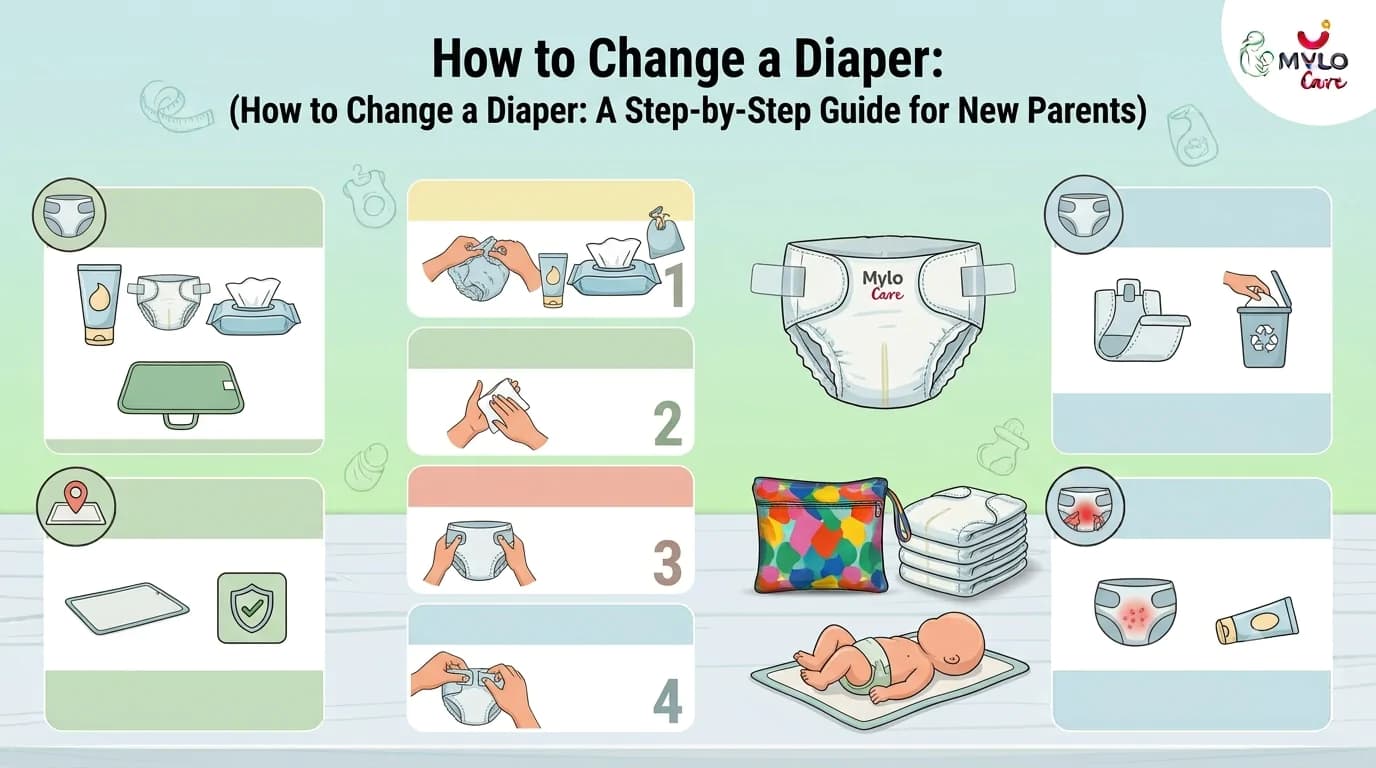
How to Change a Diaper: Step by Step
Step 1: Get everything within reach
You will know it is time when you smell it, the wetness indicator has changed, or the diaper feels heavy and is sagging. Lay out every item above before you pick up your baby.
Step 2: Lay your baby down safely
Place your baby on their back on the changing mat. Remove clothing from the waist down (take the whole outfit off if it is soiled). Keep one hand on your baby at all times, and never step away, even for a second. Babies can roll over sooner than parents expect, and falls from changing tables are a common household injury.
Step 3: Open the dirty diaper and wipe away the bulk
Unfasten the tapes (or tear the sides of a pant-style diaper). Gently lift your baby's legs by the ankles. If there is poop, use the clean front section of the dirty diaper to wipe most of it away in one downward stroke, then fold the dirty diaper under your baby so the clean outer side is facing up. This keeps the mess contained.
Step 4: Slide the clean diaper underneath
Open the clean diaper and slide it under your baby's bottom, with the back at your baby's waistline. Doing this now means you are covered if your baby wees mid-change. Sing or chat to keep your baby happy and still.
Step 5: Clean, front to back
Clean the whole area with a wipe, or cotton and warm water for newborns. Always wipe from front to back, never back to front, which reduces the risk of spreading germs and causing a urinary tract infection (NHS). Clean gently into the skin folds and thighs, where stool hides.
- For girls: wipe front to back only, and clean the outer area. Do not clean inside the labia
- For boys: clean around the area gently, and do NOT pull back the foreskin. Point the penis downwards when you fasten the diaper, so wee does not shoot up the front. A cloth over the area can save you mid-change surprises
- For newborns: early stools (meconium) are dark, sticky and tar-like, which is normal. Warm water and cotton work well
Step 6: Pat dry
With a soft dry cloth, pat the skin dry, do not rub. Skin must be fully dry before you fasten a new diaper, because trapped moisture is the leading cause of diaper rash (Mayo Clinic). If you can, give a minute of nappy-free air time.
Step 7: Apply barrier cream only if needed
If your baby is prone to rash or you can see redness, apply a thin layer of barrier cream (zinc oxide or petroleum jelly) (AAD). Not every baby needs cream at every change, so use it as protection when required, not as routine.
Step 8: Fasten the clean diaper properly
Bring the front of the diaper up between your baby's legs onto the tummy. Then:
- Pull the leg cuffs out, this is the single most missed step and the main cause of blowouts
- Fasten the tapes symmetrically, without stretching them
- Check the fit: you should be able to slip two fingers under the waistband. Snug, not tight
- For newborns: fold the front of the diaper down so it sits below the umbilical cord stump, keeping it dry and open to air while it heals (AAP) (Cleveland Clinic). Many newborn diapers have a cut-out notch for this
Step 9: Dispose and wash your hands
Roll the used disposable diaper inwards, tape it closed, and put it in a covered bin. For cloth, shake solids into the toilet and place the diaper in a dry pail until wash day. Wash your hands with soap, and clean the changing mat.
Signs the Fit Is Wrong
| What You See | What It Means |
|---|---|
| Red marks on the waist or thighs | Too tight or too small, go up a size |
| Tapes meeting in the middle | Too small |
| Gaps around the legs, diaper sagging | Too big |
| Repeated blowouts up the back | Leg cuffs tucked in, or wrong size |
| Diaper fills very fast | Time to move up a size |
How Often Should You Change a Diaper?
Newborns need about 10 to 12 changes a day, roughly every 2 to 3 hours (NHS). Older babies often manage 3 to 4 hours. A soiled diaper should be changed immediately, at any hour, because stool irritates skin very quickly (AAD).
A Practical Note on Diapering Supplies
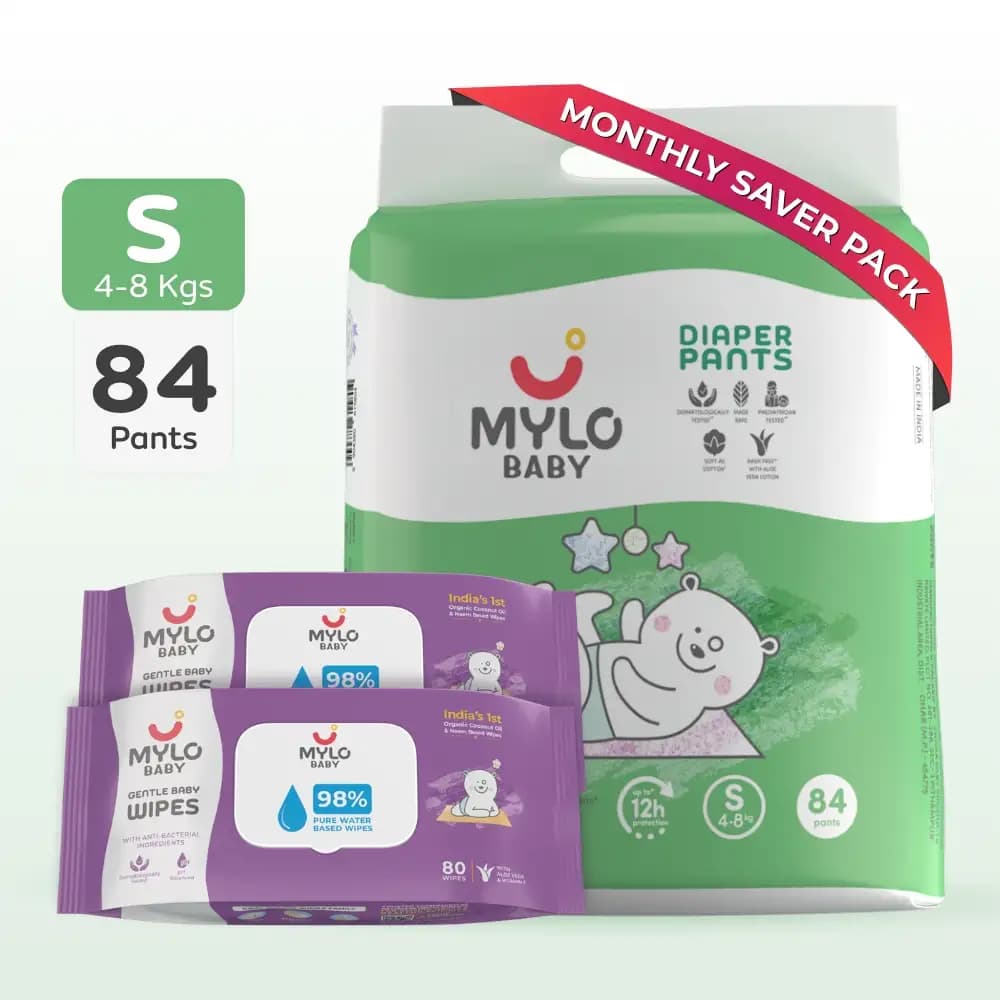
Running out mid-change is every parent's nightmare, so keeping a steady stock of diapers and wipes genuinely helps. Mylo's Diapering Combo bundles baby wet wipes (with organic coconut oil and aloe vera) together with Mylo Care Baby Diaper Pants, which are made for up to 12 hours of leak protection.
One honest clarification: "up to 12 hours of leak protection" describes how long a diaper resists leaking, not how long a baby should stay in one. Even the most absorbent diaper should be changed when wet, and immediately when soiled.
Indian Context
In India's heat and humidity, moisture builds up under a diaper fast, so change promptly and allow some nappy-free air time. Many families prefer cotton and warm water over wipes for newborns, which is gentle and perfectly good; just pat dry properly afterwards. Skip talcum powder in the diaper area. If you use a cloth langot, change it as soon as it is wet. While the umbilical stump is healing, avoid tight binding around the tummy, and keep the stump dry and open to air rather than applying oils or powders.
Myths vs Facts
| Myth | Fact |
|---|---|
| Apply rash cream at every single change | Use it only if your baby is prone to rash or shows redness |
| A "12-hour" diaper can be worn for 12 hours | That describes leak protection, not recommended wear time |
| Wiping direction does not matter | Always wipe front to back; it lowers UTI risk |
| Blowouts just happen randomly | Usually the leg cuffs were tucked in, or the size is wrong |
| You can turn away for just a second | Never; falls from changing tables happen in that second |
Frequently Asked Questions
Diaper badalne ka sahi tareeka kya hai? (Hinglish)
Pehle saara saaman haath ki pahunch mein rakhein. Baby ko peeth ke bal litayein aur ek haath hamesha baby par rakhein, use akela bilkul na chhodein. Ganda diaper kholkar uske aage wale hisse se poop saaf karein, phir saaf diaper neeche sarkayein. Hamesha aage se peeche ki taraf pochein, thapthapa kar sukhayein, zaroorat ho to patli si cream lagayein. Diaper pehnate waqt leg cuffs bahar nikaalein aur kamar par do ungli ki jagah rakhein.
Baby ko diaper rash na ho, iske liye kya karein? (Hinglish)
Sabse zaroori hai jaldi jaldi badalna, newborn ko din mein 10 se 12 baar, aur potty hote hi turant. Skin ko thapthapa kar poora sukhayein, ragdein nahin. Thodi der diaper-free hawa lagne dein. Agar rash ho jaata hai to zinc oxide wali barrier cream patli parat mein lagayein. Talcum powder na lagayein.
Why should I wipe from front to back?
Wiping front to back stops germs from the stool area being carried forward, which lowers the risk of a urinary tract infection. This matters for all babies and is especially important for girls (NHS).
How do I stop blowouts up the back?
The most common cause is leg cuffs tucked inside. Always run your finger around the legs and pull the cuffs out after fastening. Also check the size: repeated blowouts often mean the diaper is too small.
Do I need to use diaper cream every time?
No. Barrier cream is helpful if your baby is prone to rash or you see redness, but most babies do not need it at every change. Frequent changing and drying the skin properly matter far more.
What should I do about the umbilical cord stump?
Fold the front of the diaper down so it sits below the stump, keeping it dry and exposed to air while it heals (AAP). Tell your doctor if you see spreading redness, pus, a foul smell, or fever.
References
- NHS. How to change your baby's nappy. www.nhs.uk
- NHS. Nappy rash. www.nhs.uk
- American Academy of Pediatrics (HealthyChildren.org). Umbilical Cord Care in Newborns. www.healthychildren.org
- American Academy of Pediatrics (HealthyChildren.org). Common Diaper Rashes and Treatments. www.healthychildren.org
- Mayo Clinic. Diaper rash: Symptoms and causes. www.mayoclinic.org
- American Academy of Dermatology (AAD). How to treat diaper rash. www.aad.org
- Cleveland Clinic. Umbilical Cord: Care and Appearance. my.clevelandclinic.org
- StatPearls (NCBI Bookshelf). Diaper Dermatitis. www.ncbi.nlm.nih.gov




Related Articles


Related Topics
.webp&w=32&q=75)
Medical Disclaimer
This content is for informational purposes only and should not replace professional medical advice. Consult with a physician or other health care professional if you have any concerns or questions about your health. If you rely on the information provided here, you do so solely at your own risk.


AWARDS AND RECOGNITION

Mylo wins Forbes D2C Disruptor award

Mylo wins The Economic Times Promising Brands 2022
AS SEEN IN













- Mylo Care: Effective and science-backed personal care and wellness solutions for a joyful you.
- Mylo Baby: Science-backed, gentle and effective personal care & hygiene range for your little one.
- Mylo Community: Trusted and empathetic community of 10mn+ parents and experts.


Product Categories
Baby Carrier | Baby Soap | Baby Wipes | Stretch Marks Cream | Baby Cream | Baby Shampoo | Baby Massage Oil | Baby Hair Oil | Stretch Marks Oil | Baby Body Wash | Baby Powder | Baby Lotion | Diaper Rash Cream | Newborn Diapers | Teether | Baby Kajal | Baby Diapers Pants | Cloth Diapers | Laundry Detergent | Lactation Granules |