


Orders
.png&w=48&q=75 "login")
Profile


Wallet

Do You Need to Change Your Baby's Cloth Diaper After Every Episode of Pee?


MBBS, DGO · 41 years experience

 5 Likes|
 23 min
Key Takeaways
Quick overview in 30 seconds.webp&w=32&q=75)
- Cloth diapers should be changed after every pee episode as free size reusable diapers absorb only one wetting, keeping babies dry prevents rashes, infections and eczema.
- Newborns need diaper changes every 2 hours while toddlers can stretch to 2-4 hours, averaging 7-10 cloth diaper changes daily for proper hygiene.
- Check if the diaper is hanging low, the outer surface feels wet, the cotton fabric feels stiff, or peek from behind to spot wetness.
- Looking for super-absorbent reusable cloth diapers for your baby? Explore our Adjustable & Reusable Cloth Diaper - Red & Blue - Pack of 2.
Published: 10 September 2026 | Last updated: 10 September 2026
Quick Answer
In most cases, yes. A cloth diaper with a single insert usually holds only one good pee, and the wetness stays close to your baby's skin instead of locking away. Change it as soon as you notice it is wet, or at least every 2 to 3 hours during the day. Poop always needs an immediate change, whatever the diaper type.
Key Takeaways
Cloth diapers do not gel urine the way a disposable pant does, so the wet feeling reaches the skin sooner and a change after each pee is the safer default.
Newborns often need 8 to 12 cloth changes a day. Older babies and toddlers pee in larger, less frequent volumes, so 5 to 8 changes a day is more typical.
Adding a booster or second insert buys absorbency, not dryness. It helps with leaks, but it does not remove the need to check and change.
Skin that stays wet, rubs against fabric and then meets urine and stool is the main trigger for diaper rash, which is why timing matters more than the brand.
Many Indian families use cloth by day and a well fitted disposable pant for long stretches such as night sleep, travel and monsoon weeks when drying is slow. That is a practical routine, not a compromise.
Do You Really Need to Change a Cloth Diaper After Every Pee?
Yes, as a working rule. A standard cotton or bamboo insert absorbs roughly one full bladder emptying, and once it is saturated the moisture sits against the skin rather than being pulled away from it. That is the core difference from a disposable pant, which uses a super absorbent polymer core to convert urine into gel and hold it away from the surface.
So the honest answer is not "every pee, always, no exceptions." It is this: with cloth, you should assume the diaper needs changing after each pee unless you have deliberately built extra absorbency into it, and even then you still need to check. With a disposable pant, the diaper can usually stay on through more than one pee because the surface stays drier for longer.
The reason to be strict about this is skin, not hygiene theatre. Irritant diaper dermatitis develops when three things happen together: skin stays damp and over hydrated, it rubs against a wet surface, and it is exposed to urine and stool, which raise the pH and activate enzymes that break down the skin barrier. Frequent changing interrupts all three. General guidance from bodies such as the NHS and the American Academy of Pediatrics is to change a diaper as soon as it is wet or soiled, and cloth simply reaches that point faster.
Why Does Cloth Behave So Differently From a Disposable Diaper Pant?
Because the two products solve the same problem with completely different physics.
What happens after a pee | Cloth diaper with insert | Disposable diaper pant |
|---|---|---|
Where the urine goes | Soaks into fibres and spreads through the insert | Pulled through a top sheet and locked into a gel core |
How the surface feels | Wet to the touch almost immediately | Stays relatively dry to the touch |
Capacity | Roughly one pee per insert, more if boosted | Several pees, depending on size and design |
How you know it is wet | Feel, weight, warmth, sometimes visible damp on the shell | Wetness indicator line changes colour on many pants |
Realistic change interval | After each pee, or every 2 to 3 hours | Every 3 to 4 hours by day, once at night for many babies |
Main risk if left too long | Skin stays damp, rash risk rises | Leaks and heaviness once the core is full |
Neither is automatically better. Cloth wins on running cost, waste and breathability when it is changed promptly. Disposables win on dry surface time and on nights, travel and days when you simply cannot keep up with washing.
How Often Should You Change a Cloth Diaper, by Age?
Change frequency drops as your baby gets older, because bladder capacity grows and pees become bigger and less frequent. Use this as a starting point and adjust to your own baby.
Age | Typical cloth changes per day | What is going on | Practical note |
|---|---|---|---|
0 to 6 weeks | 8 to 12 | Very frequent small pees, frequent stools | Many parents find newborn cloth fit bulky at this stage. Check that the umbilical stump area stays dry. |
6 weeks to 3 months | 7 to 10 | Feeds settle, pees still frequent | Cloth diapers sized from 3 months usually start fitting properly around now. |
3 to 6 months | 6 to 8 | Larger volume per pee | A single insert may now flood in one go. Consider a booster for outings. |
6 to 12 months | 5 to 8 | Solids begin, stools change in smell and texture | Rinse stool off before the wash bucket once solids start. |
1 to 2 years | 5 to 7 | Fewer, much bigger pees | Leaks here are usually a capacity problem, not a fit problem. |
2 to 3 years | 4 to 6 | Some bladder control developing | Cloth is useful during potty learning because your child can feel the wetness. |
These are ranges, not targets. A baby who is peeing far less than expected, or whose urine is dark and strong smelling, needs a doctor's assessment rather than a schedule change.
How Do You Know a Cloth Diaper Is Wet Without Opening It Every Time?
You use touch and weight, because cloth has no colour indicator. Slide a clean finger inside the leg opening, or lift the baby and feel the weight of the diaper against your palm. With practice this takes two seconds.
What you notice | Likely reason | What to do |
|---|---|---|
Insert feels cool and damp | Recent pee, absorbed | Change now |
Diaper feels heavy or sags | Insert saturated | Change now, consider a booster next time |
Outer shell feels damp on the outside | Insert has flooded past capacity, or the waterproof layer is worn | Change, and check whether the shell needs replacing |
Wet marks on clothes at the thigh or back | Fit gap, or insert not centred | Re snap the rise and waist, centre the insert |
Baby suddenly fussy, squirming or waking | Discomfort from wetness | Check and change before assuming hunger |
Strong ammonia smell | Detergent residue or urine build up in the fabric | Change, then strip wash the inserts |
Red, shiny or raw skin at the diaper edges | Prolonged wetness plus friction | Increase change frequency, allow nappy free air time, use a barrier cream |
Can You Just Add a Booster Instead of Changing After Every Pee?
A booster increases how much the diaper can hold, but it does not keep your baby's skin dry. Adding a second insert stops leaks. It does not change the fact that cotton and bamboo hold moisture against the skin once they are wet.
Boosting is genuinely useful for:
Car journeys and long outings where you cannot change immediately
Heavy wetters who flood a single insert in one pee
Naps of an hour or two
Boosting is not the right tool for:
Stretching one diaper across a full night
Reducing rash risk
Compensating for a poor fit, since extra bulk usually makes gaps worse
One more caution: a heavily boosted cloth diaper gets thick between the legs. Keep the fit snug at the waist and thighs without forcing the legs apart, and re check the fit whenever you add bulk.
What About Night-Time? Should You Use Cloth All Night?
You can, but only if you are prepared to either change during the night or accept that the insert will be wet against the skin for several hours. That second option is exactly the situation that causes rash in babies with sensitive skin.
Here is a simple way to decide.
Baby wakes for a feed anyway: cloth at night works well. Change at the feed.
Baby sleeps a long stretch and has no rash history: a boosted cloth diaper is reasonable. Check the skin every morning and stop if you see redness.
Baby sleeps a long stretch and has had rash before, or has eczema prone skin: use a well fitted disposable pant at night and cloth by day.
You are in monsoon or peak humidity and inserts are not drying: use disposables at night to protect your rotation.
Combining cloth and disposables is one of the most common real world routines among Indian parents, and there is nothing wrong with it. Choose by situation rather than by ideology.
Does the Indian Climate Change the Answer?
It changes the practical side more than the medical side. The change frequency stays the same. What changes is your laundry and your rash risk.
Summer heat, 35 degrees and above: sweat plus urine keeps the skin damp for longer. Change promptly and give 10 to 15 minutes of nappy free time twice a day where the room allows it.
Monsoon: this is the real constraint. Cotton and bamboo inserts can take a day or longer to dry indoors in high humidity, and inserts that are put away slightly damp develop smell and can grow mould. Plan for a bigger rotation, dry indoors with a fan, and keep a disposable pant backup.
North Indian winter: parents often layer heavily and check less often. Cold skin still gets diaper rash. Keep the change interval, just change in a warm room.
Hard water: common across large parts of India, and it leaves mineral and detergent residue in inserts, which reduces absorbency and causes an ammonia smell. If your inserts start repelling water, that is usually a wash problem rather than an ageing problem.
Shared caregiving: if a grandparent or helper handles some changes, write the change routine down. Cloth needs a shared rule because there is no indicator line to prompt anyone.
How Many Cloth Diapers and Inserts Do You Actually Need?
Work backwards from your drying time, not from a number on a packet. The formula that matters is:
Inserts needed = changes per day x number of days until a load is washed, dried and back in the drawer
Situation | Changes per day | Drying reality | Inserts to keep |
|---|---|---|---|
Newborn, dry weather, daily wash | 10 | Same day drying | About 20 |
Newborn, monsoon, indoor drying | 10 | 2 days to dry | About 30, or use disposables for part of the day |
6 month old, dry weather | 7 | Same day drying | About 14 |
6 month old, monsoon | 7 | 2 days to dry | About 21 |
Toddler, cloth by day and disposable at night | 5 | Same day drying | About 10 to 12 |
You need fewer shells than inserts, because a shell can often be reused across a couple of pee only changes if it is completely dry and unsoiled. Never reuse a shell after a poop, or if it feels damp.
How to Change and Care for a Cloth Diaper Properly
Lay your baby down on a clean surface and keep one hand on them at all times.
Unsnap the diaper and remove the insert. Do not slide a wet insert across the skin.
Clean front to back with plain water and cotton, or with a fragrance free wipe. Pay attention to the skin folds at the thighs and groin.
Pat the skin dry. Do not put a fresh diaper on damp skin.
Apply a thin layer of barrier cream if the skin is pink or if your baby is prone to rash. Skip it on broken skin unless a doctor has advised it.
Place a dry insert in the centre of the shell and re snap. Two fingers should slide in at the waist, and the leg elastic should sit in the thigh crease without leaving a deep mark.
Rinse a soiled insert immediately. Store used inserts in a dry, ventilated bucket rather than sealed in a bag.
Wash with a mild, fragrance free detergent. Avoid fabric softener, which coats fibres and reduces absorbency.
Dry fully before storing. Sunlight helps with stains and odour. In monsoon, rely on airflow and a fan rather than a closed room.
Myths and Facts About Cloth Diaper Changing
What people say | What is actually true |
|---|---|
Cloth diapers cause more rash than disposables | Cloth left on too long causes rash. Cloth changed promptly is gentle on skin. The variable is timing, not the fabric. |
You can leave a cloth diaper on as long as a disposable | No. The absorbency mechanism is different, and the surface goes wet much sooner. |
Talcum powder keeps the area dry | Powder is not recommended in the diaper area. Loose particles can be inhaled and it can clump in skin folds. |
A thicker insert means fewer changes | It means fewer leaks. The wetness in contact with skin is unchanged. |
Antiseptic liquid in the wash keeps the diaper hygienic | Harsh additives can irritate skin and damage fabric. A proper hot rinse with mild detergent, followed by full drying, is the safer approach. |
Newborns can wear one size fits all cloth diapers from day one | Most one size cloth diapers are designed from around 3 months. For the first weeks, a correctly sized newborn diaper usually fits better. |
Where Do Cloth and Disposable Diapers Each Fit in a Real Routine?
Start with the problem rather than the product. If your issue is running cost and waste, cloth solves it, provided you can change often and dry reliably. If your issue is long stretches without a change, such as nights, a hospital visit, a train journey or a monsoon week with wet laundry, a disposable pant solves it better.
What to look for when you choose either option:
Correct size for current weight, not the size you bought last month. Most leaks are sizing problems.
A breathable outer layer and soft leg elastic that does not leave deep marks.
Fragrance free materials, especially if your baby has had rash or there is a family history of eczema.
For cloth: adjustable snaps so the diaper grows with your baby, a removable insert, and a shell that dries quickly.
For disposables: a wetness indicator is genuinely useful, because it removes the guesswork that cloth requires.
Limitations worth knowing: no diaper prevents diaper rash on its own, and no diaper removes the need to check your baby. Absorbency claims describe capacity under test conditions, not a promise for every baby on every night.
Mylo options that fit these situations
For day time cloth use: the Adjustable Washable and Reusable Cloth Diaper with absorbent insert pad (3M to 3Y) uses snap rows at the waist and rise, so one diaper adapts as your baby grows. You can compare colours and packs in the reusable cloth diaper range. It still needs changing after each pee, and the insert needs full drying before reuse.
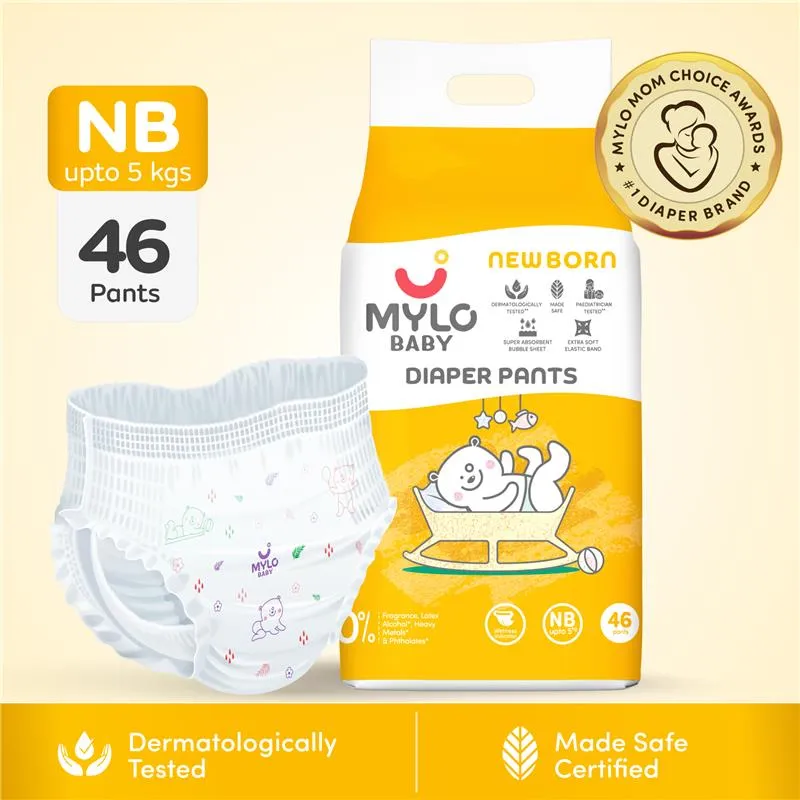
For the newborn weeks, when cloth often does not fit yet: Mylo Baby Diaper Pants come in a New Born size for babies up to 5 kg, in 46 count and 92 count packs, both with a wetness indicator. If the umbilical stump is still healing, a New Born tape style diaper is easier to fold below the navel.
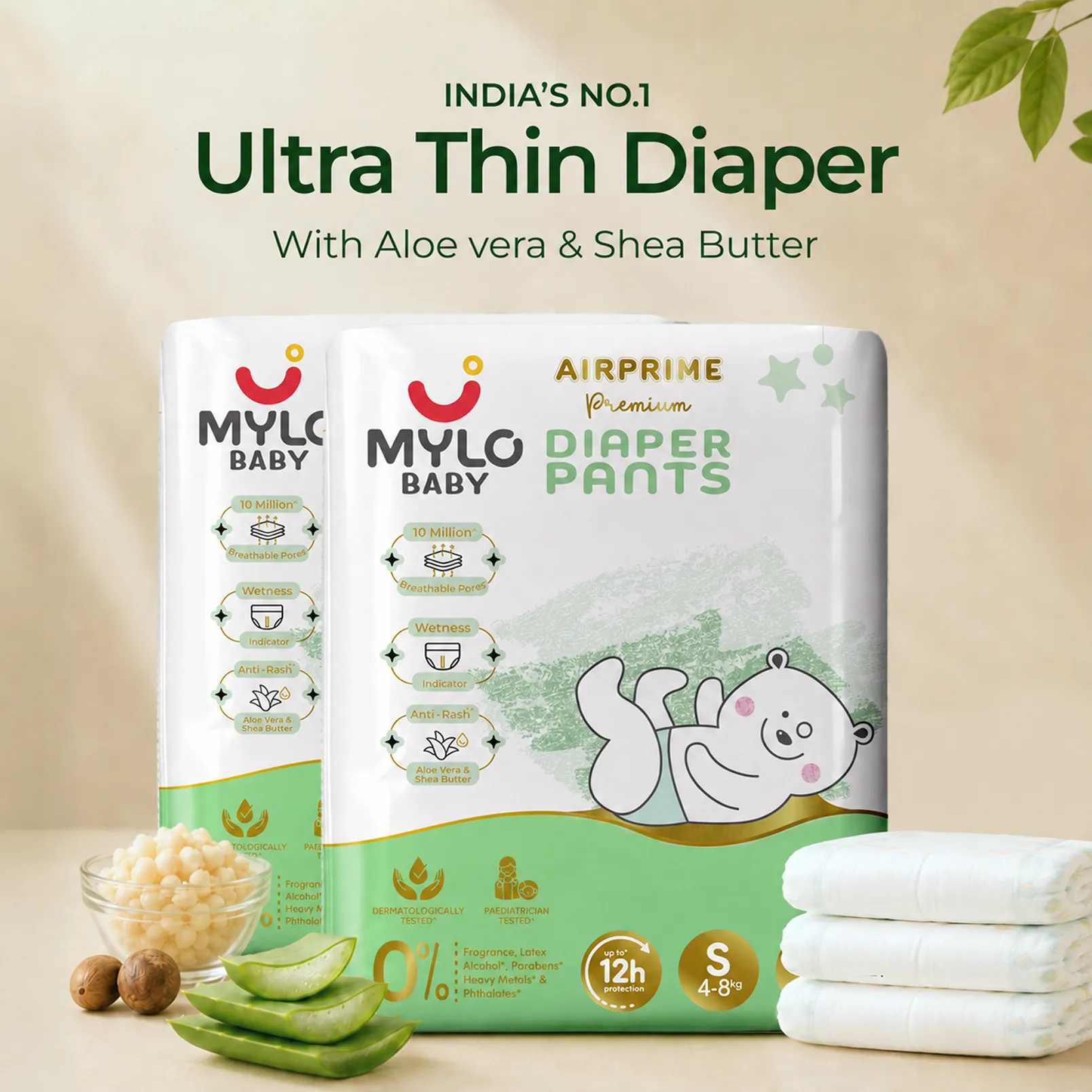
For older babies and heavier toddlers who need a longer stretch: the Mylo Airprime Premium Diaper Pants range extends into the larger sizes, so a big toddler is not stuck in a pant that is too small. XL covers 12 to 17 kg in 24 count, 48 count and 96 count. XXL covers 15 to 25 kg in 24 count, 48 count and 96 count. The colour changing wetness indicator is the relevant feature here, since it tells you when to change without opening the pant.
If you want to set up a cloth by day and disposable by night routine, compare options across the full Mylo diapering range.
One honest caveat: a wetness indicator tells you the diaper is wet. It does not tell you the diaper is still comfortable, and it is not a substitute for looking at your baby's skin.
Mylo Parents Asked
My baby peed twice in 20 minutes and the insert still feels only slightly damp. Do I still change it?
Yes. Slightly damp is enough to matter. Small volumes spread thinly across the insert and still keep the skin in contact with moisture. If this keeps happening, the insert may be losing absorbency and could need a strip wash.
Can I remove just the wet insert and put a dry one in the same shell?
Yes, if the shell is completely dry inside and there was no poop. Feel the inner surface of the shell first. If there is any dampness at all, change the whole thing.
My 8 month old sleeps 6 hours straight. Should I wake her to change a cloth diaper?
Sleep matters, so most paediatricians would not have you wake a baby purely to change a wet diaper. The better fix is to not use a plain cloth diaper for that stretch. Use a boosted cloth diaper if her skin has always been fine, or a well fitted disposable pant if she has had rash before. Change at the first wake.
My cloth diapers smell of ammonia even after washing. Is that unhygienic for my baby?
It usually means detergent or mineral residue plus urine build up in the fibres, which is common with hard water. Do a strip wash, use enough detergent rather than too little, add an extra rinse and dry fully. Do not put a diaper that smells of ammonia back on your baby, since it can irritate the skin.
My baby is 13 kg and the L pant leaks every night. Should I move to XL?
Very likely yes. Leaks at the upper end of a weight range are almost always a capacity and fit issue. Move up one size and check that the elastic sits in the thigh crease. If leaks continue in the correct size, look at how the diaper sits at the back, because night time leaks often escape upwards rather than at the legs.
Is cloth better than disposable for preventing rash?
Neither prevents rash by itself. Cloth changed every time it is wet is very gentle on skin. Cloth left on for hours is the worst of both options. Choose based on how often you can realistically change.
Can I use cloth diapers for my newborn from day one?
Only if you have a genuine newborn sized cloth diaper. Most adjustable cloth diapers are designed from about 3 months and will gap at the legs on a small newborn, which causes leaks. Many parents start with a New Born size diaper and move to cloth once their baby fills it out.
During monsoon my inserts never dry. What should I do?
Do not store or reuse a damp insert. Increase your rotation, dry indoors with a fan and good airflow rather than in a closed bathroom, and use disposable pants for part of the day until the weather turns. Damp storage causes smell and mould, both of which are worse for skin than a disposable diaper.
When Should You Speak to a Doctor?
Contact your paediatrician if you notice any of the following:
A rash that does not improve within 2 to 3 days of frequent changing and barrier cream
Blisters, open sores, pus, yellow crusting or bleeding in the diaper area
A bright red rash with a clear border and small spots spreading beyond it, which can indicate a fungal infection needing prescribed treatment
Fever along with a rash in the diaper area
Far fewer wet diapers than usual, dark or strong smelling urine, or a baby who seems unusually drowsy or hard to rouse, which can indicate dehydration and needs same day attention
Pain, swelling or crying on passing urine
Blood in the urine or stool
This article is general information and does not replace an examination. Any diagnosis or medicine for your baby's skin should come from your own doctor.
References section (added to the article)
Place this above the "Medically reviewed by" byline.
National Health Service (NHS), UK. Nappy rash.
American Academy of Pediatrics, HealthyChildren.org. Common Diaper Rashes and Treatments.
American Academy of Pediatrics, HealthyChildren.org. Make Baby's Room Safe: Parent Checklist. (Advice against talcum and baby powder use on infants.)
Stamatas GN, Tierney NK. Diaper dermatitis: etiology, manifestations, prevention, and management. Pediatric Dermatology. 2014;31(1):1-7.
Baer EL, Davies MW, Easterbrook KJ. Disposable nappies for preventing napkin dermatitis in infants. Cochrane Database of Systematic Reviews.
Indian Academy of Pediatrics. Indian Academy of Pediatrics Guidelines for Pediatric Skin Care. Indian Pediatrics. 2021.
Indian Academy of Pediatrics. Care of Newborn Skin. Parent resource.
StatPearls, NCBI Bookshelf. Diaper Dermatitis.
Bottom Line
With a cloth diaper, treat every pee as a change. The fabric holds moisture against the skin, so a single insert genuinely does not stretch across two wettings the way a gel core disposable can. Change promptly, keep the fit snug without being tight, dry inserts completely, and switch to a well fitted disposable pant for nights, travel and monsoon weeks rather than leaving your baby in something wet.

Article Posted Under
Related Articles
How can reusable cloth diapers help in preventing diaper rashes in your baby?
 39·3 min
 The Ultimate Guide to Baby Cloth Diapers: Countless Benefits of Eco-Friendly Diapering
 11·7 min
 Can Rashes Be Prevented While Using Disposable Diapers for Your Baby?
 8·5 min
 Can disposable diapers keep your baby dry through the night?
 8·4 min
Related Topics
.webp&w=32&q=75)
Medical Disclaimer
This content is for informational purposes only and should not replace professional medical advice. Consult with a physician or other health care professional if you have any concerns or questions about your health. If you rely on the information provided here, you do so solely at your own risk.


AWARDS AND RECOGNITION

Mylo wins Forbes D2C Disruptor award

Mylo wins The Economic Times Promising Brands 2022
AS SEEN IN













- Mylo Care: Effective and science-backed personal care and wellness solutions for a joyful you.
- Mylo Baby: Science-backed, gentle and effective personal care & hygiene range for your little one.
- Mylo Community: Trusted and empathetic community of 10mn+ parents and experts.


Product Categories
Baby Carrier | Baby Soap | Baby Wipes | Stretch Marks Cream | Baby Cream | Baby Shampoo | Baby Massage Oil | Baby Hair Oil | Stretch Marks Oil | Baby Body Wash | Baby Powder | Baby Lotion | Diaper Rash Cream | Newborn Diapers | Teether | Baby Kajal | Baby Diapers Pants | Cloth Diapers | Laundry Detergent | Lactation Granules |