


Orders
.png&w=48&q=75 "login")
Profile


Wallet

Incompetent Cervix (Cervical Insufficiency): Causes, Symptoms, Treatment and Recovery Guide (2026)


BDS (Gold Medalist), Certified Lactation Consultant – BPNI Delhi, Maternal & Infant Nutrition Expert · 15 years experience
 2 Likes|
 14 min
AI-Generated Summary
Quick overview in 30 seconds.webp&w=32&q=75)
- An incompetent cervix, or cervical insufficiency, occurs when the cervix opens too early during pregnancy, increasing the risk of premature birth or miscarriage in the second trimester.
- Causes include cervical birth defects, prior cervix injuries, treatments like D&C or LEEP, exposure to DES medication, and a history of repeated second-trimester miscarriages.
- Symptoms appear between weeks 14-20 and include mild spotting, pelvic pressure, uterine cramps, back pain, and vaginal discharge changing from white to pink.
- What can offer comfort during a sensitive pregnancy? Explore our Pregnancy Wellness Super Saver Combo - Stretch Marks Cream for Women 100g + Long Grain Pure Saffron for Pregnant Women (Kesar) - 2g.

 4.6
4.6TL;DR
Incompetent cervix (also called cervical insufficiency) is a pregnancy condition where the cervix begins to open painlessly and prematurely in the second trimester (typically weeks 14 to 24), increasing the risk of late miscarriage or preterm birth (ACOG) (Cleveland Clinic). It affects about 1 in 100 pregnancies (Mayo Clinic). Treatment includes cervical cerclage (a stitch), progesterone supplementation, pessary placement and frequent transvaginal ultrasound monitoring. With early diagnosis and timely treatment, most women carry their pregnancies to term.
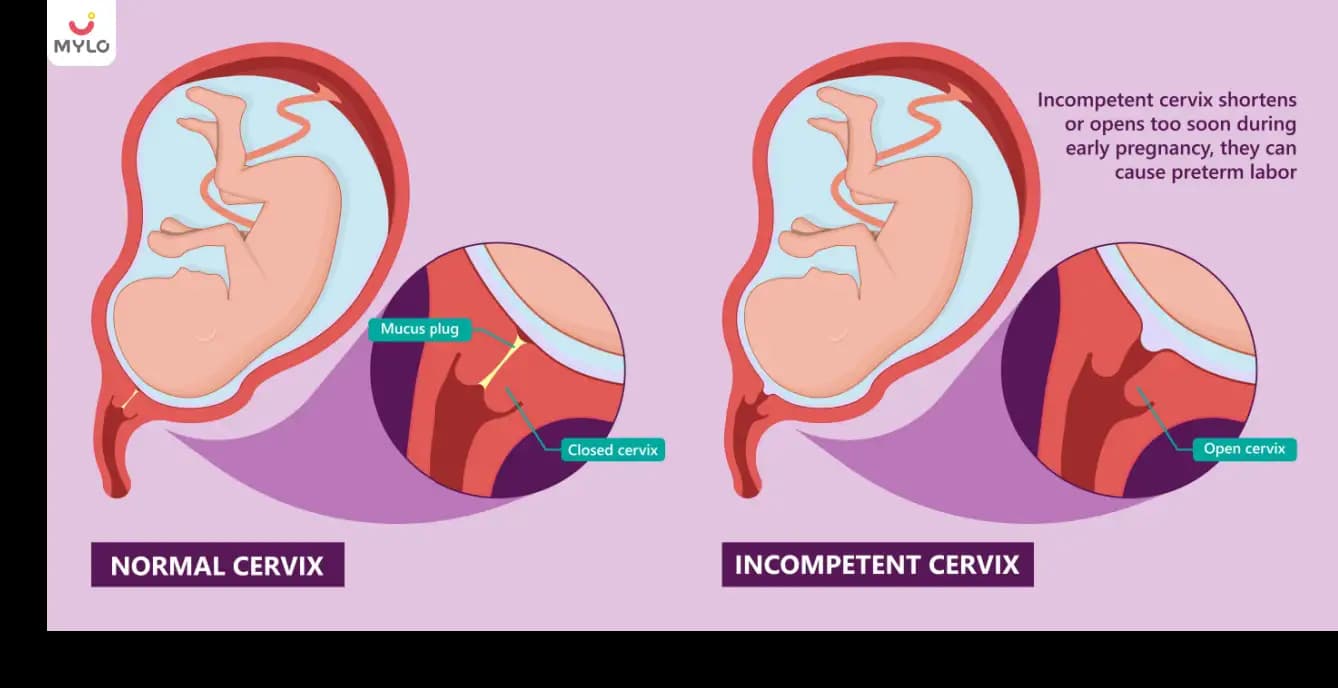
Biomechanical Reality: Cervical insufficiency is fundamentally a structural failure of the cervical connective tissue. Normally, a rich collagen matrix keeps the cervix rigid and closed. If this collagen framework is altered or damaged, the cervix loses its tensile strength and cannot withstand the increasing hydrostatic pressure exerted by the growing amniotic sac, causing it to open silently under the weight of the pregnancy
Quick Answer
Incompetent cervix is when the cervix opens too early during pregnancy, usually in the second trimester, without contractions or pain. It can cause late miscarriage or premature birth. Standard treatment includes cervical cerclage (stitch), progesterone supplementation and pessary. Early diagnosis through transvaginal ultrasound and timely intervention helps most women carry their pregnancy to term.
Author: Khushboo Jain, Senior Pregnancy Content Editor, Mylo Parenting Desk Medically reviewed by: Mylo Editorial Board, aligned with FOGSI (Federation of Obstetric and Gynaecological Societies of India) and ACOG Clinical Practice Bulletin guidelines Last updated: 11 June 2026
Medical Disclaimer: This article provides general information only and is not a substitute for professional medical advice. If you have a history of late miscarriage, preterm birth or have been told you may have a short cervix, please consult your obstetrician immediately for personalised assessment and treatment.
Key Takeaways
Incompetent cervix affects approximately 1% of pregnancies (Mayo Clinic)
It causes painless cervical dilation in the second trimester (weeks 14 to 24)
It is responsible for about 15% of second-trimester miscarriages (NCBI/StatPearls)
Cervical cerclage has a success rate of approximately 85 to 90% (ACOG Practice Bulletin)
Transvaginal ultrasound is the gold standard for diagnosis (Cleveland Clinic)
Risk factors include prior cervical surgery, congenital cervix issues and history of second-trimester loss
Most women with treatment carry to term
What Is an Incompetent Cervix?
An incompetent cervix, medically known as cervical insufficiency, is a condition in which the cervix (the narrow, lower end of the uterus that opens into the vagina) weakens and opens prematurely during pregnancy, usually in the second trimester, without contractions or pain (ACOG).
In a healthy pregnancy, the cervix stays firm and closed until labour begins around week 37 or later. In cervical insufficiency, the cervix shortens, softens and dilates too early, which can lead to:
Late miscarriage (between weeks 14 and 24)
Preterm birth (before week 37)
Premature rupture of membranes (PROM)
According to Cleveland Clinic, this condition affects about 1 in every 100 pregnant women and accounts for nearly 15% of second-trimester miscarriages.
What Causes an Incompetent Cervix?
The exact cause is not always clear, but several factors weaken cervical tissue (ACOG) (Mayo Clinic):
Cause | Description | Source |
|---|---|---|
Congenital cervical defects | Born with a shorter or weaker cervix; abnormal uterine shape | |
Cervical surgeries | LEEP, cone biopsy, D&C may weaken cervical tissue | |
Past trauma during childbirth | Tears or injury from prior delivery | |
DES exposure | Mother took diethylstilbestrol during her pregnancy | |
Repeated second-trimester pregnancy losses | History of late miscarriages | |
Ehlers-Danlos syndrome | Connective tissue disorder weakening cervix | |
Multiple pregnancies (twins or triplets) | Greater pressure on cervix |
What Are the Symptoms of Incompetent Cervix?
The condition is often silent and painless, which is why regular monitoring matters. However, watch for these warning signs between weeks 14 to 24 (Cleveland Clinic):
Mild vaginal spotting or bleeding
Pelvic pressure or a "heavy" feeling in the lower abdomen
New backache that was not present before
Mild abdominal cramping (often mistaken for normal pregnancy discomfort)
Change in vaginal discharge (from white to pink, brown or watery)
Sensation of something coming down in the vagina
When in doubt, call your doctor. Many women with cervical insufficiency have NO symptoms at all, which makes screening through ultrasound critical for high-risk patients (ACOG).
How Is Incompetent Cervix Diagnosed?
Diagnosis is made using a combination of medical history and imaging (Cleveland Clinic):
1. Transvaginal Ultrasound (Primary Tool)
The gold standard. Cervical length is measured between weeks 16 and 24.
Cervical Length | Interpretation |
|---|---|
Greater than 3.0 cm | Normal |
2.5 cm to 3.0 cm | Borderline, monitor closely |
Less than 2.5 cm | Short cervix, possible insufficiency |
Less than 1.5 cm | High risk, immediate intervention often needed |
2. Pelvic Examination
The doctor checks if the cervix has dilated or if membranes are visible.
3. Amniocentesis (If Infection Suspected)
A small amount of amniotic fluid is tested to rule out intra-amniotic infection (NCBI/StatPearls).
4. Medical History Review
Doctors evaluate prior pregnancy losses, cervical surgeries and any DES exposure.
Who Is at Risk of Incompetent Cervix?
You may be at higher risk if you have any of the following (Mayo Clinic) (ACOG):
Previous second-trimester miscarriage
Previous preterm birth before 32 weeks
History of cervical surgery (LEEP, cone biopsy, D&C)
Known short cervix on ultrasound
Congenital uterine or cervical abnormalities
Multiple pregnancy (twins, triplets)
Connective tissue disorders (Ehlers-Danlos, Marfan syndrome)
Mother exposed to DES during pregnancy
What Are the Treatment Options for Incompetent Cervix?
Treatment depends on how early the diagnosis is made and the patient's medical history.
1. Cervical Cerclage (Cervical Stitch)
A surgical procedure where the doctor stitches the cervix closed using strong sutures (ACOG Practice Bulletin).
Type | When It Is Done | Purpose |
|---|---|---|
History-indicated cerclage | Weeks 12 to 14 | For women with 3 or more prior second-trimester losses |
Ultrasound-indicated cerclage | Weeks 16 to 23 | When cervix shortens below 2.5 cm on ultrasound |
Physical exam-indicated (rescue) cerclage | Up to week 24 | When cervix is already dilated but no labour |
Success rate: Approximately 85 to 90% (ACOG). The stitch is removed at around week 36 to 37, before labour begins.
2. Progesterone Supplementation
Vaginal progesterone (gel, suppository or capsule) is used in women with a short cervix (NCBI)
17-hydroxyprogesterone caproate injections weekly during second and third trimesters
3. Pessary
A small silicone device inserted into the vagina to support the cervix and reduce pressure. May be used when cerclage is not appropriate (NIH).
4. Bed Rest and Activity Modification
While strict bed rest is no longer routinely recommended (ACOG), reduced physical activity, pelvic rest and avoiding heavy lifting may be advised.
5. Frequent Ultrasound Monitoring
Cervical length is checked every 1 to 2 weeks from week 16 to week 24.
Can You Prevent an Incompetent Cervix?
You cannot fully prevent it, but you can reduce risk and catch it early (Cleveland Clinic):
Disclose full obstetric history to your doctor in the first prenatal visit
Request cervical length screening if you have any risk factors
Avoid unnecessary cervical procedures before pregnancy
Treat vaginal and urinary infections promptly
Maintain healthy weight gain during pregnancy
Quit smoking and avoid alcohol (WHO)
Get early prenatal care (preferably by week 8)
What Is Recovery Like After Cervical Cerclage?
Recovery is generally smooth (NHS):
First 24 to 48 hours:
Mild cramping or spotting (normal)
Hospital observation may be required
Pelvic rest for 1 to 2 weeks
Throughout pregnancy:
Avoid intercourse, tampons and douching
Avoid heavy lifting and strenuous exercise
Attend all follow-up scans
Stitch removal:
Done at approximately weeks 36 to 37
Outpatient procedure, no anaesthesia usually needed
Labour typically begins naturally within days to weeks
When Should You Call Your Doctor Immediately?
Call your doctor or visit the emergency room if you experience (Mayo Clinic) (Cleveland Clinic):
Vaginal bleeding (any amount)
Watery discharge (possible amniotic fluid leak)
Severe pelvic pressure or pain
Regular contractions before week 37
Sudden change in vaginal discharge (pink, brown or blood-stained)
Fever with abdominal pain (possible infection)
Sensation of "something falling out" of the vagina
Indian Context: What Should You Know?
In India, incompetent cervix is often underdiagnosed because routine cervical length screening is not yet standard practice in all hospitals. Here is what Indian mothers should know:
FOGSI recommendation: Women with prior second-trimester loss should get cervical length monitoring (FOGSI)
Insurance coverage: Cervical cerclage is covered under most Indian health insurance maternity plans
Cost in India: Cerclage procedure typically costs INR 25,000 to INR 80,000 (varies by city and hospital)
Government hospitals: AIIMS and other public institutions perform cerclage; ask your gynaecologist for a referral
Tier-2/Tier-3 city challenge: If transvaginal ultrasound is unavailable, request transabdominal cervix length measurement as a screening alternative
Myths vs Facts About Incompetent Cervix
Myth | Fact | Source |
|---|---|---|
"Bed rest alone can prevent miscarriage" | Strict bed rest is NOT proven to help | |
"Once you have it, you cannot have a healthy baby" | False. Most women with treatment carry to term | |
"Cerclage causes infection in all cases" | False. Infection risk is low when done correctly | |
"Stress causes incompetent cervix" | False. It is a structural issue, not emotional | |
"It only affects older mothers" | False. It can affect any pregnant woman | |
"Surgery is always required" | False. Some cases are managed with progesterone or pessary |
FAQs: Incompetent Cervix
What is the difference between incompetent cervix and short cervix?
A short cervix is a measurement (less than 2.5 cm on ultrasound), while incompetent cervix is a clinical diagnosis based on premature painless dilation, often (but not always) preceded by a short cervix (ACOG). All women with cervical insufficiency typically have a short cervix, but not all women with a short cervix have cervical insufficiency.
Incompetent cervix kya hota hai? (Hinglish)
Incompetent cervix ek pregnancy condition hai jismein cervix (uterus ka neeche ka mooh) bina kisi pain ya contraction ke pregnancy ke second trimester (14 to 24 weeks) mein jaldi khulne lagta hai. Isse late miscarriage ya premature delivery ho sakti hai. Iska treatment cervical cerclage (stitch), progesterone ya pessary se hota hai.
Can incompetent cervix be diagnosed before pregnancy?
Not directly. There is no reliable test to diagnose cervical insufficiency before pregnancy. However, doctors look at your medical history (prior second-trimester losses, cervical surgeries) to identify women at higher risk (Mayo Clinic).
Is cervical cerclage painful?
The procedure is done under spinal or general anaesthesia, so it is not painful during the surgery. Mild cramping and spotting for 1 to 2 days afterward is common (NHS). Recovery is usually smooth with rest.
Can I have a normal vaginal delivery after cerclage?
Yes. The stitch is removed at around weeks 36 to 37, and most women can have a normal vaginal delivery. Some women may need a C-section depending on other obstetric factors (ACOG).
Will I have incompetent cervix in my next pregnancy?
If you had cervical insufficiency in one pregnancy, the risk of recurrence is higher in subsequent pregnancies. Doctors usually recommend a history-indicated cerclage at weeks 12 to 14 in future pregnancies for prevention (Cleveland Clinic).
Cerclage ke baad rest kitne din karna chahiye? (Hinglish)
Cerclage ke baad doctor aap ko 1 to 2 hafte tak pelvic rest karne ko kahenge. Iska matlab hai sex avoid karein, heavy lifting na karein, aur strenuous exercise na karein. Aap normal walking aur halki activities kar sakte hain. Doctor ki specific advice follow karein.
Can sex cause incompetent cervix?
No. Normal sexual intercourse does not cause cervical insufficiency. However, after diagnosis, your doctor will usually advise pelvic rest (avoiding intercourse) for the rest of the pregnancy to reduce pressure on the cervix (Mayo Clinic).
Is progesterone safe during pregnancy?
Yes, vaginal progesterone is widely used and considered safe for both mother and baby (NCBI Meta-analysis). It is one of the first-line treatments for short cervix and prevention of preterm birth.
What happens if incompetent cervix is not treated?
Without treatment, the cervix continues to open, eventually leading to late miscarriage (between weeks 14 and 24) or extreme preterm birth. Early diagnosis and treatment dramatically improve outcomes (ACOG).
Can incompetent cervix happen in first pregnancy?
Yes, although it is less common in first-time mothers. It can occur in first pregnancy due to congenital cervix abnormalities, prior cervical surgery or connective tissue disorders. This is why cervical length screening is often advised even for first-time mothers with risk factors (NCBI).
References
American College of Obstetricians and Gynecologists (ACOG). "Cervical Insufficiency." https://www.acog.org/womens-health/faqs/cervical-insufficiency
ACOG Practice Bulletin No. 142. "Cerclage for the Management of Cervical Insufficiency." https://www.acog.org/clinical/clinical-guidance/practice-bulletin/articles/2014/02/cerclage-for-the-management-of-cervical-insufficiency
Cleveland Clinic. "Cervical Insufficiency (Incompetent Cervix)." https://my.clevelandclinic.org/health/diseases/17912-cervical-insufficiency-incompetent-cervix
Mayo Clinic. "Incompetent Cervix." https://www.mayoclinic.org/diseases-conditions/incompetent-cervix/symptoms-causes/syc-20373109
National Health Service (NHS) UK. "Premature labour and birth." https://www.nhs.uk/pregnancy/labour-and-birth/signs-of-labour/premature-labour-and-birth/
NCBI / StatPearls. "Cervical Insufficiency." https://www.ncbi.nlm.nih.gov/books/NBK525954/
National Institute of Child Health and Human Development (NICHD). "Pregnancy." https://www.nichd.nih.gov/health/topics/pregnancy
National Cancer Institute. "Diethylstilbestrol (DES) Fact Sheet." https://www.cancer.gov/about-cancer/causes-prevention/risk/hormones/des-fact-sheet
NIH/NINDS. "Ehlers-Danlos Syndrome." https://www.ninds.nih.gov/health-information/disorders/ehlers-danlos-syndrome
PubMed / NCBI Meta-analysis. "Vaginal Progesterone for Preventing Preterm Birth." https://pubmed.ncbi.nlm.nih.gov/29422205/
FOGSI (Federation of Obstetric and Gynaecological Societies of India). https://www.fogsi.org/
World Health Organization (WHO). "Tobacco." https://www.who.int/news-room/fact-sheets/detail/tobacco
Trusted by mamas navigating delicate pregnancies
Gentle, doctor-approved essentials to support your body and ease worries while you focus on resting and protecting your little one.

Article Posted Under
Related Articles




Related Topics
.webp&w=32&q=75)
Medical Disclaimer
This content is for informational purposes only and should not replace professional medical advice. Consult with a physician or other health care professional if you have any concerns or questions about your health. If you rely on the information provided here, you do so solely at your own risk.


AWARDS AND RECOGNITION

Mylo wins Forbes D2C Disruptor award

Mylo wins The Economic Times Promising Brands 2022
AS SEEN IN













- Mylo Care: Effective and science-backed personal care and wellness solutions for a joyful you.
- Mylo Baby: Science-backed, gentle and effective personal care & hygiene range for your little one.
- Mylo Community: Trusted and empathetic community of 10mn+ parents and experts.


Product Categories
Baby Carrier | Baby Soap | Baby Wipes | Stretch Marks Cream | Baby Cream | Baby Shampoo | Baby Massage Oil | Baby Hair Oil | Stretch Marks Oil | Baby Body Wash | Baby Powder | Baby Lotion | Diaper Rash Cream | Newborn Diapers | Teether | Baby Kajal | Baby Diapers Pants | Cloth Diapers | Laundry Detergent | Lactation Granules |