


Orders
.png&w=48&q=75 "login")
Profile


Wallet

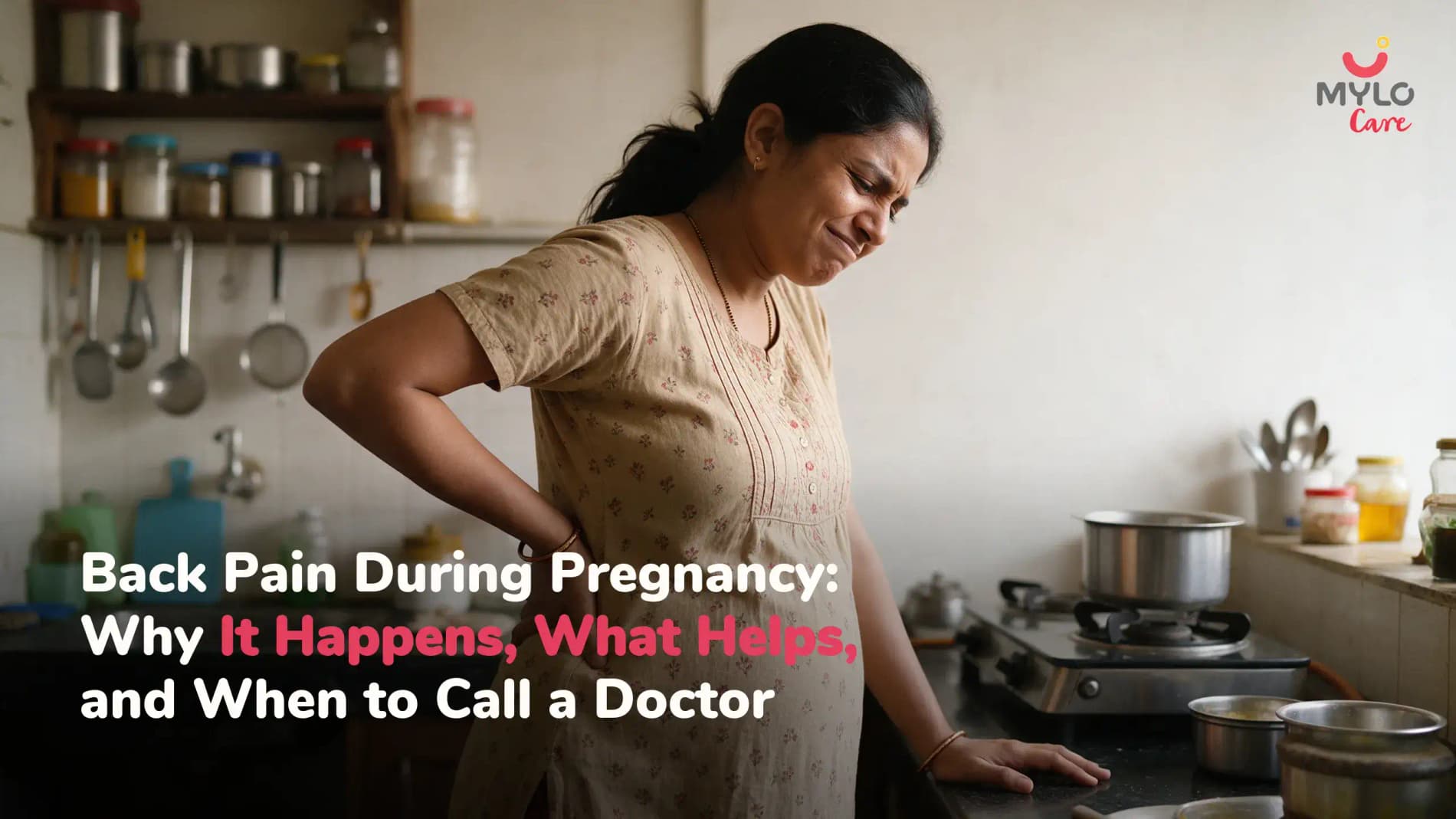
Back Pain During Pregnancy: Why It Happens, What Helps, and When to Call a Doctor

MBBS, DGO · 38 years experience
 1 Likes|
 22 min
Quick answer
Back pain in pregnancy is very common and usually not dangerous. It's caused by shifting posture, added weight and changing joint load — not by damage. The most effective relief is gentle, regular movement and physiotherapy, not bed rest. Paracetamol is the usual first-line painkiller; avoid NSAIDs like ibuprofen from 20 weeks. Sudden, rhythmic or fever-linked back pain needs urgent review.
Key takeaways
Two different problems get called "back pain." Lower back (lumbar) pain and pelvic girdle pain need different management — and telling them apart changes what you should do.
Movement beats rest. Supervised exercise and physiotherapy consistently outperform bed rest, which tends to make stiffness and pain worse.
Paracetamol is the usual first choice. Avoid ibuprofen and other NSAIDs from 20 weeks onward unless your doctor specifically directs otherwise.
Belts and pillows help some women, but they're support tools, not treatments — useful alongside exercise, not instead of it.
Some back pain is an emergency. Rhythmic pain that comes and goes, fever with back pain, bleeding, leaking fluid, numbness with bladder or bowel changes, or a swollen painful calf all need same-day medical attention.
Is back pain during pregnancy normal?
Yes. It's one of the most common complaints in pregnancy — published reviews suggest roughly two in three women experience back or pelvic pain at some stage, and a significant minority describe pain severe enough to limit daily activity.
But "common" isn't the same as "something you have to put up with." Pain that disturbs your sleep, stops you walking comfortably or makes housework difficult is treatable. In Indian households, where women often carry full domestic responsibility well into the third trimester, this kind of pain tends to be under-reported rather than untreatable.
What's typical: a dull, aching, activity-related pain that builds through the day, eases when you change position or rest, and comes with no other symptoms.
What isn't: pain that arrives in waves at regular intervals, pain with fever, pain with bleeding or fluid leakage, pain with numbness or bladder changes, or pain after a fall. If any of those apply right now, skip ahead to the warning signs section.
What causes back pain during pregnancy?
Four mechanical changes stack up at the same time: your centre of gravity moves forward, your abdominal muscles stretch and lose their stabilising role, your lower spine curves more to compensate, and you're carrying meaningfully more weight than your back is conditioned for. Together these change how load travels through your lower back and pelvis — which is why the pain is usually activity-related rather than constant.
Contributor | What it does | Why it matters |
|---|---|---|
Forward shift in centre of gravity | Pelvis tilts, lower back curve deepens | Standing and walking load the lower back more |
Abdominal muscles stretching | The body's natural "corset" weakens | Back muscles take over work they weren't doing before |
Increased body weight | More load through spine and pelvic joints | Explains why pain often begins in the second trimester |
Hormonal changes in ligaments | Pelvic joints become more mobile | Real, but frequently overstated — see below |
Posture, fatigue and daily habits | Prolonged standing, awkward lifting, poor sleep | The most modifiable factor, and the most ignored |
A note on relaxin
You'll often read that the hormone relaxin "loosens your ligaments" and causes back pain. The evidence for that is weaker than the confidence with which it's repeated — studies looking for a relationship between relaxin levels and pelvic pain have produced inconsistent results.
This matters practically. If you believe a hormone has destabilised your joints, the instinct is to protect them and move less. If you understand the pain as mostly load- and control-related, the logical response is to move better and build strength — which is what the evidence actually supports.
Is it lower back pain or pelvic girdle pain?
This is the most useful question on this page, and most women are never asked it. The two conditions feel similar, usually get the same generic advice, and respond to genuinely different management.
Lumbar (lower back) pain | Pelvic girdle pain (PGP) | |
|---|---|---|
Where it hurts | Across the lower back above the waistline; may travel down the leg | Over the pubic bone, in the buttocks, back of the pelvis or groin; may travel to the back of the thigh |
Typical triggers | Prolonged standing or sitting, bending forward, lifting | Walking, stairs, turning in bed, standing on one leg, getting out of a car |
How it feels | Dull, muscular ache; stiffness | Sharp, catching, sometimes clicking or grinding |
Tell-tale sign | Worse after a long day on your feet | Pain putting on clothes standing up, or turning over at night |
First-line approach | Core and postural strengthening, movement variety, heat | Position control, avoiding one-sided loading, pelvic support, targeted physiotherapy |
Best clinician | Physiotherapist or OB-GYN | Women's health physiotherapist specifically |
A 30-second self-check
Does it hurt to turn over in bed?
Does it hurt to stand on one leg — putting on a salwar or trousers, climbing stairs?
Is the pain over the pubic bone or deep in the buttock?
Is it a broad ache across the lower back that builds through the day?
Two or more "yes" answers to questions 1–3 suggest you should ask your doctor for a pelvic girdle pain assessment by name, rather than general back pain advice. Many women are told to rest and take paracetamol for months when targeted physiotherapy would have helped much sooner.
This is a self-orientation tool, not a diagnosis. Only a clinician can confirm which you have, and the two can occur together.
What actually relieves back pain during pregnancy?
Movement is first-line. Everything else is support.
Approach | Evidence strength | What to expect | Practical note |
|---|---|---|---|
Regular exercise / structured programme | Strongest | Meaningful reduction in pain and disability | Prioritise this if you do only one thing |
Physiotherapy (women's health trained) | Strong | Especially valuable for pelvic girdle pain | Ask for a pelvic-specific assessment |
Combined care (exercise + education + manual therapy) | Strong | Often better than any single method | Typical physiotherapy programme structure |
Posture and activity modification | Moderate, high practical value | Fewer daily flare-ups | Free, immediate, within your control |
Heat application | Moderate | Short-term comfort | Warm, not hot. Never on the abdomen |
Pelvic support belt | Limited / mixed | Helps some women, mainly with PGP | Support, not treatment. Fit is everything |
Prenatal massage | Limited | Short-term relief | Prenatally trained therapist only |
Acupuncture | Mixed | Some studies positive | Only with a practitioner experienced in pregnancy |
Bed rest | Evidence against | Stiffness, deconditioning, often worse pain | Not recommended |
Which exercises are safe for back pain in pregnancy?
In an uncomplicated pregnancy, regular moderate activity is recommended rather than merely permitted — around 150 minutes spread across the week, and walking counts.
Generally suitable starting points:
Pelvic tilts — the foundational movement for lumbar pain
Cat-cow on hands and knees — mobility without loading the spine
Side-lying leg lifts — glute strength, which directly supports the pelvis
Walking — start short and frequent rather than long and occasional
Swimming or water exercise — removes load entirely; excellent for pelvic pain
Prenatal yoga with a trained instructor — tell them about your back or pelvic pain before you begin
Check with your doctor first if you have pelvic girdle pain, any bleeding, a cervical stitch, placenta praevia, high blood pressure or pre-eclampsia, or any complication your doctor has flagged.
Stop immediately and call your doctor if exercise brings on bleeding, fluid leakage, regular painful contractions, dizziness, chest pain, or calf pain and swelling.
One caution most articles miss: movements that take your legs wide apart — deep squats, long lunges, breaststroke kick — can aggravate pelvic girdle pain even though they appear on every "safe pregnancy exercise" list. If a movement causes a sharp catching pain near the pubic bone, that's a signal to stop, not to push through.
What pain relief is safe for back pain in pregnancy?
Paracetamol is the usual first-line option, at the lowest effective dose for the shortest necessary time.
Avoid NSAIDs — ibuprofen, diclofenac, naproxen — from 20 weeks onward. Regulatory guidance advises against them at this stage because of potential effects on fetal kidney function and amniotic fluid levels.
This is worth reading labels for. Many of these medicines are available without prescription in India, and a large number of pain balms, gels and sprays contain diclofenac. Check what you're applying, not just what you swallow.
Medication | Position in pregnancy |
|---|---|
Paracetamol | Usual first-line; lowest dose, shortest duration |
Ibuprofen, diclofenac, naproxen (oral) | Avoid from 20 weeks; discuss with your doctor at any stage |
Pain balms, gels and sprays | Read the label — many contain NSAIDs. Ask your doctor before use |
Codeine or opioid combinations | Only if prescribed for your pregnancy specifically |
Muscle relaxants | Prescription decision only |
Ayurvedic or herbal pain preparations | Show the pack to your doctor — ingredients and dosing are often unverified |
Never start, stop or combine medication in pregnancy based on advice from family, a pharmacist counter or the internet, including this page.
How should you sleep to reduce back pain?
Sleep on your side, and support the gaps. From around 28 weeks, side-sleeping is advised in pregnancy — and it also happens to be the most back-friendly position.
The three-support setup:
A pillow between your knees — keeps your hips stacked and stops your top leg pulling your pelvis into rotation. This single change helps more women than any other sleep adjustment.
A pillow or folded towel under your bump — takes the drag off your lower back.
A pillow behind your back — stops you rolling flat in your sleep.
A full-length C- or U-shaped pregnancy pillow does all three at once. Three ordinary pillows do the same job at no cost — try that first, and consider a dedicated pillow if it works but the pillows keep sliding out of place.
If you have pelvic girdle pain, turning over is often the worst moment of the night. Squeeze your knees together as you roll, move as one unit rather than twisting, and get up by rolling onto your side first and pushing up with your arms rather than curling straight upward.
Do pregnancy support belts work?
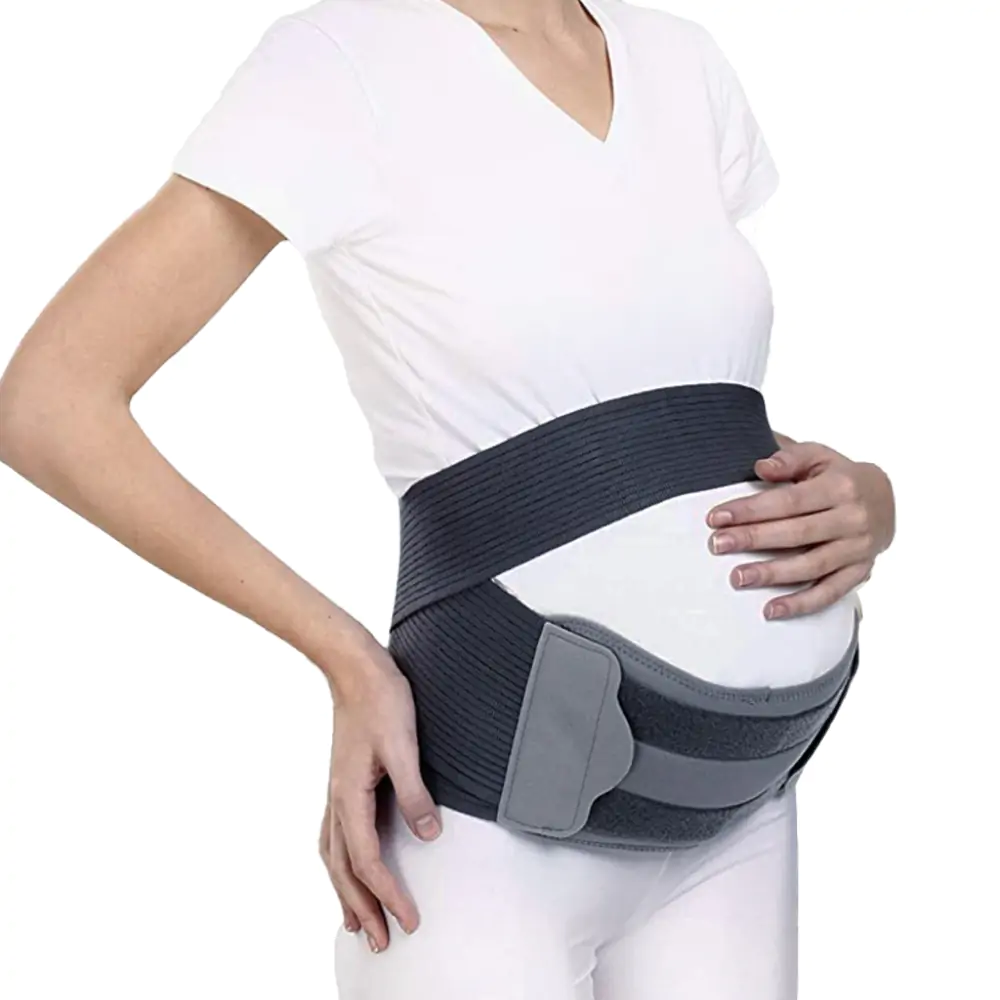
They help some women, particularly with pelvic girdle pain, but the evidence is limited and fit determines whether you get any benefit at all. A belt reduces symptoms while you move; it doesn't change the underlying cause, and it works best alongside exercise rather than in place of it.
If you use one:
Position it low — around the hips, under the bump, across the top of the pubic bone. Most women wear it too high, which achieves nothing.
Firm, not tight. You should be able to slide two fingers underneath. Compressing the abdomen is not the goal.
Wear it for activity, not all day. Standing, walking, housework, commuting — then take it off when you sit or lie down.
Judge it in one session. If it doesn't reduce pain while you walk, the size or position is wrong. Don't persist for weeks hoping it will start working.
Remove it if it causes numbness, tingling or breathlessness.
Is massage safe for back pain during pregnancy?
Generally yes, with a prenatally trained therapist and some specific exclusions. Massage can give real short-term relief from muscular lower back pain.
Non-negotiables:
The therapist must be trained in prenatal massage — this is not a preference
Side-lying or supported positions, not flat on the stomach, and not flat on the back in later pregnancy
No deep pressure on the calves or inner thighs, because of clot risk
No massage at all if you have unexplained calf pain or swelling, bleeding, high blood pressure or any pregnancy complication — check with your doctor first
Traditional malish by a family member or a maalishwali is common and can be genuinely comforting, but the same cautions apply: no firm pressure on the calves, inner thighs or abdomen. Say this out loud to whoever is doing the massage — they usually haven't been told.
What in a typical Indian home makes back pain worse?
This is where generic advice stops being useful. These are the load patterns that actually drive flare-ups in Indian households, and what to do about each.
Daily activity | Why it hurts | What to change |
|---|---|---|
Floor mopping (pochha) bent at the waist | Sustained forward bending under load — one of the worst positions for a pregnant lower back | Switch to a long-handled mop. Treat this as essential from the second trimester |
Indian-style (squat) toilet | Deep squat plus standing up on one leg loads the pelvis hard | Use a Western toilet where possible; a commode seat converter is inexpensive and effective. Hold a support while standing |
Sitting cross-legged on the floor for meals | One-sided pelvic load, and hard to get up from | Sit with your back against a wall and a cushion under your hips, or move to a chair. Get up by turning to one side first |
Two-wheeler commuting | Repeated jolting through the pelvis on uneven roads; the pillion position loads the lower back continuously | One of the most under-recognised aggravators. Reduce distance and frequency, avoid rough routes, and raise your commute with your doctor after 28 weeks |
Cooking or grinding at a low counter | Prolonged forward bend | Sit on a stool, or raise the working surface |
Carrying an older child on one hip | Asymmetric load — a classic pelvic pain trigger | Carry in front with both arms, sit down for lifts, and ask the child to climb up rather than lifting from the floor |
Lifting water buckets or gas cylinders | Heavy one-sided lifting | Hand this over entirely. Split loads into smaller ones if unavoidable |
Thin mattress or floor sleeping | Poor side-lying support | Add a mattress topper and use the three-pillow setup above |
Low vitamin D | Common among Indian adults and linked to musculoskeletal pain | Ask your doctor whether testing is appropriate at a routine visit |
One note on family, not posture: in many joint-family homes, stepping back from household work during pregnancy needs a conversation rather than just a decision. It often helps to have it framed as a medical instruction — asking your doctor to say so explicitly at a visit is a reasonable, and frequently effective, thing to do.
Is this back pain or labour?
Regularity is the distinguishing feature. Musculoskeletal back pain is constant or activity-related. Labour pain comes and goes in a rhythm, and that rhythm tightens over time.
Back pain | Possible labour | |
|---|---|---|
Pattern | Constant or linked to activity | Comes in waves at intervals |
Over time | Eases with rest or position change | Intervals shorten, intensity increases |
Position change | Usually helps | Doesn't help |
Other signs | None | Tightening abdomen, fluid leak, bloody show, pelvic pressure |
Before 37 weeks, rhythmic back pain that comes and goes should be treated as an emergency until proven otherwise. Back-dominant preterm labour is easy to dismiss as "just my back." Call your hospital rather than waiting to see whether it settles.
Will back pain go away after delivery?
For most women, yes — substantially, within the first few months, as weight redistributes and the abdominal muscles recover.
A meaningful minority, though, have pain that persists, particularly with pelvic girdle pain. Ongoing back or pelvic pain after birth is not something to accept as part of having a baby. It responds to physiotherapy, and earlier assessment gives better results. If you're still in significant pain at three months postpartum, ask for a referral.
Who should you see — and what if there's no physiotherapist nearby?
Start with your OB-GYN at your next routine visit. Be specific: how long it's been, what makes it worse, whether it affects your sleep and walking, and whether it hurts to turn in bed or stand on one leg. That last detail is what prompts a pelvic girdle pain assessment.
The ideal referral is a women's health physiotherapist (MPT). These are concentrated in metros and large private hospitals and are genuinely hard to access in smaller cities and towns.
If there's no physiotherapist locally:
Ask about teleconsultation. Assessment and exercise prescription for pregnancy back pain work reasonably well over video, and several Indian women's-health physiotherapy practices now offer it.
Ask your hospital about antenatal classes — many include a physiotherapist-led movement session.
See a general physiotherapist, but say explicitly if you suspect pelvic girdle pain so it isn't treated as ordinary lower back pain.
Avoid forceful manipulation or untrained "bone-setters" during pregnancy.
Five things to change this week
Switch to a long-handled mop
Put a pillow between your knees tonight
Hand over the heaviest lift in your day
Walk 10 minutes twice daily instead of one long walk
Write down your back pain question for your next visit — including whether turning in bed hurts
When to call a doctor
Seek medical care immediately if back pain comes with:
Rhythmic pain that comes and goes, especially before 37 weeks — possible preterm labour
Fever, chills, burning urination or pain in your side — possible kidney infection
Vaginal bleeding or fluid leakage
Numbness in the groin or inner thighs, or any change in bladder or bowel control — a neurological emergency
Severe pain under the ribs or in the upper abdomen, especially with headache, visual changes or swelling — possible pre-eclampsia
Pain, swelling, warmth or redness in one calf — possible blood clot
Any back pain after a fall or accident, however mild it feels
Sudden, severe back pain unlike anything you've had before
Book a routine appointment if you have:
Pain that disturbs your sleep
Pain that limits walking or daily activity
Pain over the pubic bone, or pain when standing on one leg
Pain that is steadily worsening week on week
Back pain still present three months after delivery
Frequently asked questions
When does back pain usually start in pregnancy?
Most often between the fifth and seventh months, as weight increases and posture shifts — though pelvic girdle pain can begin earlier, sometimes in the first trimester.
Is back pain an early sign of pregnancy?
Mild backache can occur early, but it isn't a reliable sign on its own. A pregnancy test is the only way to confirm.
Can I take ibuprofen for back pain while pregnant?
Avoid it from 20 weeks onward, and check with your doctor before taking it at any stage. Paracetamol is usually the preferred option. This applies to pain balms and gels too — many contain NSAIDs.
Is it safe to use a heating pad on my back during pregnancy?
Warm — not hot — heat applied to the lower back is generally considered acceptable for short periods. Avoid applying heat to the abdomen, and don't use hot water bottles or heating pads while sleeping.
Should I rest completely if my back hurts?
No. Complete rest is the one approach the evidence argues against, and it tends to make stiffness and pain worse. Reduce heavy work, not movement.
Does a pregnancy belt actually help?
It helps some women, particularly those with pelvic girdle pain, and only when worn low across the hips rather than over the bump. It supports you during activity; it doesn't treat the cause.
Can back pain harm my baby?
Ordinary musculoskeletal back pain doesn't harm your baby. The concern is the small number of conditions that can present as back pain — preterm labour, kidney infection, pre-eclampsia — which is why the warning signs above matter.
Does back pain in pregnancy mean I'll have back pain forever?
No. For most women it improves substantially within a few months of delivery. Persistent pain isn't inevitable and responds well to physiotherapy.
The bottom line
Back pain in pregnancy is common, mechanically driven and — importantly — usually improvable. The most useful single step is working out whether you have lumbar pain or pelvic girdle pain, because the two need different management and most women are never asked. Movement, not rest, is the evidence-backed foundation; belts, pillows and heat are useful supports around it. And it's worth knowing the short list of warning signs, because a handful of serious conditions announce themselves as "just a bad back."
Sources
American College of Obstetricians and Gynecologists (ACOG) — physical activity and exercise during pregnancy
Royal College of Obstetricians and Gynaecologists (RCOG) and the Pelvic, Obstetric and Gynaecological Physiotherapy (POGP) network — pelvic girdle pain in pregnancy
NHS — back pain and pelvic pain in pregnancy
US Food and Drug Administration — advisory on NSAID use at 20 weeks of pregnancy and later
Centers for Disease Control and Prevention — urgent maternal warning signs
Cochrane Database of Systematic Reviews — interventions for preventing and treating low back and pelvic pain in pregnancy
World Health Organization — recommendations on antenatal care for a positive pregnancy experience
This article is for general information and is not a substitute for medical advice. Always discuss your symptoms and any medication with your doctor.

Shop Now
Extra support when walking hurts




Article Posted Under
Related Articles


Related Topics
.webp&w=32&q=75)
Medical Disclaimer
This content is for informational purposes only and should not replace professional medical advice. Consult with a physician or other health care professional if you have any concerns or questions about your health. If you rely on the information provided here, you do so solely at your own risk.


AWARDS AND RECOGNITION

Mylo wins Forbes D2C Disruptor award

Mylo wins The Economic Times Promising Brands 2022
AS SEEN IN













- Mylo Care: Effective and science-backed personal care and wellness solutions for a joyful you.
- Mylo Baby: Science-backed, gentle and effective personal care & hygiene range for your little one.
- Mylo Community: Trusted and empathetic community of 10mn+ parents and experts.


Product Categories
Baby Carrier | Baby Soap | Baby Wipes | Stretch Marks Cream | Baby Cream | Baby Shampoo | Baby Massage Oil | Baby Hair Oil | Stretch Marks Oil | Baby Body Wash | Baby Powder | Baby Lotion | Diaper Rash Cream | Newborn Diapers | Teether | Baby Kajal | Baby Diapers Pants | Cloth Diapers | Laundry Detergent | Lactation Granules |