


Orders
.png&w=48&q=75 "login")
Profile


Wallet

What Are the Social and Emotional Milestones From 1 to 3 Years? A Toddler Guide for Indian Parents (2026)
 23 min
Quick Answer
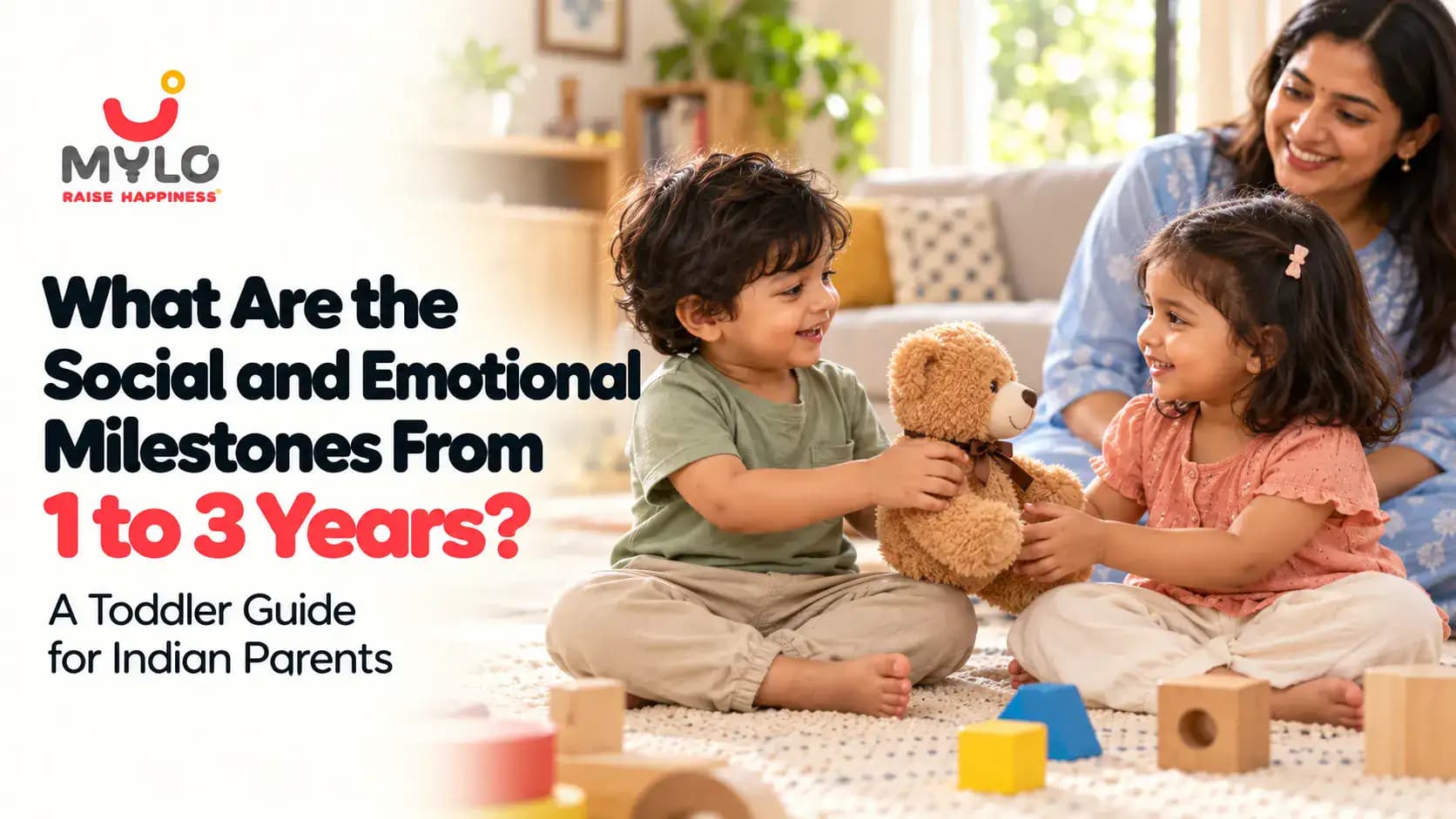
Between 1 and 3 years, toddlers go from clinging to you to making their first friends. Most show affection and copy others by 15 months, notice when someone is upset by 2 years, and join other children to play by 3. Tantrums and trouble sharing are normal. See a doctor if your child shows little interest in people.
Social and Emotional Milestones 1 to 3 Years at a Glance
Age | Key Social and Emotional Milestones | Talk to a Doctor If |
|---|---|---|
12 months | Plays games like pat-a-cake, prefers familiar people, shy with strangers, cries when a parent leaves | No interest in people, no response to name or smiles |
15 months | Copies other children, shows you toys, claps when excited, hugs a doll, shows affection | Doesn't show or share things |
18 months | Explores but checks you're close, points to show you things, helps with dressing | Doesn't point to share interest, doesn't notice when you leave |
2 years | Notices when others are hurt or upset, looks at your face in new situations, wants independence | Doesn't copy others, no interest in other children |
30 months | Plays next to and sometimes with other children, says "Look at me!", follows simple routines | No pretend play, very little interaction |
3 years | Calms within 10 minutes after a parent leaves, joins other children to play, shows empathy | Extreme distress at every separation, no interest in playing with others |
Based on official AAP and CDC milestone checklists (CDC) and ZERO TO THREE.
Key Facts Every Parent Should Know
Parallel play is normal: Young toddlers usually play next to, not with, other children (ZERO TO THREE)
Empathy starts early: 2-year-olds may comfort a hurt friend or cry when another child cries (ZERO TO THREE)
Self-control is still developing: Toddlers struggle with waiting, stopping themselves and sharing. This improves with brain maturity and practice.
Separation anxiety often peaks between 8 and 18 months and can return when starting playschool
10 minutes: By 3 years, most children calm down within 10 minutes after a parent leaves
Executive function (early self-control) at 14 months helps predict emotion regulation at 24 months (ScienceDirect)
What Are Social and Emotional Skills?
Short answer: Social skills are how children connect and interact with others, like sharing, taking turns and playing. Emotional skills are how children understand, express and manage their feelings, like calming down after being upset. The two grow together and are often called social-emotional development.
Social Skills | Emotional Skills |
|---|---|
Making eye contact and smiling | Showing a range of feelings like happy, sad, angry and scared |
Copying others | Beginning to name feelings |
Playing near and with other children | Calming down with help, then gradually alone |
Sharing and taking turns | Handling frustration and disappointment |
Showing affection | Feeling proud of their achievements |
Noticing others' feelings (empathy) | Coping with separation from parents |
Why it matters: Strong social-emotional skills help toddlers make friends, cope with change, settle into playschool and, later, learn well at school.
What Are the Social and Emotional Milestones at 12 to 18 Months?
Short answer: At 12 to 18 months, toddlers are strongly attached to their parents, may be shy or anxious with strangers, start copying other children, show and share things they like and explore while checking you're close by.
Skill | 12 Months | 15 Months | 18 Months |
|---|---|---|---|
Attachment | Prefers familiar people, cries when a parent leaves | Shows affection with hugs and kisses | Moves away to explore but looks back to check you're near |
Sharing interest | Hands you toys | Shows you objects they like | Points to show you something interesting |
Copying | Copies simple gestures | Copies other children while playing | Copies adults doing chores |
Emotions | Shy with strangers | Claps when excited | Shows frustration when they can't do something |
Pretend | Not yet | Hugs a stuffed toy or doll | Begins simple pretend, like feeding a doll |
Cooperation | Enjoys pat-a-cake and peekaboo | Enjoys simple games | Helps with dressing, holds hands out to be washed |
What Are the Social and Emotional Milestones at 18 Months to 2 Years?
Short answer: Between 18 months and 2 years, toddlers become more independent ("Me do it!"), begin to show empathy, look at your face to know how to react in new situations, and may have more tantrums as they want control but can't yet express themselves well.
Skill | By 2 Years |
|---|---|
Empathy | Notices when others are hurt or upset, like pausing or looking sad when someone cries |
Social referencing | Looks at your face to see how to react in a new situation |
Independence | Wants to do things alone; says "no" and "mine" often |
Play | Plays next to other children (parallel play), watches and copies them |
Emotions | Shows pride, shyness, frustration and jealousy |
Self-control | Still very limited; tantrums are common |
What Are the Social and Emotional Milestones at 2 to 3 Years?
Short answer: Between 2 and 3 years, children start playing with other children, follow simple routines, show off new skills ("Look at me!"), comfort others and learn to calm down after separation. By 3, most children calm down within 10 minutes after a parent leaves.
Skill | 30 Months | 3 Years |
|---|---|---|
Play | Plays next to and sometimes with other children | Notices other children and joins them to play |
Showing off | Says "Look at me!" | Proud of achievements |
Routines | Follows simple routines, like clean-up time | Follows routines at home and playschool |
Separation | Still may cry at drop-off | Calms within 10 minutes after a parent leaves |
Empathy | Notices others' feelings | Comforts a crying friend |
Sharing | Beginning to take turns with help | Takes turns in simple games, with reminders |
Emotions | Big feelings; tantrums still common | Starts to use words for feelings, like "I'm sad" |
What Types of Play Do Toddlers Show?
Short answer: Toddlers move through stages of play. Watching others and parallel play (playing side by side) are normal for young toddlers. Associative and cooperative play (playing together) develops gradually from about 2.5 to 3 years and beyond.
Type of Play | What It Looks Like | Typical Age |
|---|---|---|
Solitary play | Plays alone with toys | 1 to 2 years (continues throughout childhood) |
Onlooker play | Watches other children play | 1.5 to 2.5 years |
Parallel play | Plays next to another child with similar toys, without interacting much | 2 to 3 years |
Associative play | Plays with others, sharing toys, but without a shared goal | 3 to 4 years |
Cooperative play | Plays together with shared rules or goals, like "house" or a game | 4 years and older |
Tip: Don't worry if your 2-year-old doesn't "play together" with others. Parallel play is an important step.
Are Tantrums Normal in Toddlers?
Short answer: Yes. Tantrums are a normal part of toddler development, usually starting around 15 to 18 months and peaking between 2 and 3 years. They happen because toddlers have big feelings but limited words and self-control. Most improve as language and emotional skills grow.
Common Triggers | What Helps |
|---|---|
Tiredness or hunger | Keep regular meal and nap routines |
Can't express what they want | Teach words like "help", "more" and "all done" |
Being told "no" | Offer 2 choices instead |
Changes and transitions | Give a warning: "Two more minutes, then bath." |
Wanting independence | Let them try before you help |
During a tantrum: Stay calm, keep them safe, name the feeling ("You're angry because we have to leave") and wait. Offer a hug once they're ready. Don't give in to demands made during a tantrum.
Read more in our guides on why toddlers throw tantrums, the terrible twos and hitting, biting and bad language.
What Is Separation Anxiety and When Does It Happen?
Short answer: Separation anxiety is a toddler's distress when a parent or main caregiver leaves. It's a normal sign of a healthy bond, often peaking between 8 and 18 months and returning at times like starting playschool, a new sibling or illness. By 3 years, most children calm down within 10 minutes after a parent leaves (AAP).
Normal Separation Anxiety | Talk to a Doctor If |
|---|---|
Cries at drop-off but calms within minutes | Extreme distress that lasts for hours every day |
Improves over 2 to 4 weeks at a new playschool | Doesn't improve after 4 weeks |
Clingy during changes like a new sibling | Refuses to eat, sleep or play because of worry |
Happy to see you at pick-up | Constant fear that something bad will happen to you |
What helps: A short, loving goodbye ritual, never sneaking away, and always coming back when you said you would. Read our guide on preparing your child for preschool.
Why Don't Toddlers Share?
Short answer: Sharing is hard for toddlers because they're still learning that others have feelings and that things given away can come back. Most toddlers aren't developmentally ready to share willingly until around 3 years, and even then need help (ZERO TO THREE).
Instead of This | Try This |
|---|---|
Forcing your child to share | Teach turn-taking: "Your turn, then Riya's turn" |
Scolding for grabbing | Name the feeling: "You really want the car" |
Taking toys away | Use a timer for turns |
Expecting sharing at 18 months | Praise any small moment of sharing |
Let each child keep a few special toys they don't have to share. For siblings, see sibling rivalry: causes and how to handle them.
How Can I Help My Toddler Manage Big Feelings?
Short answer: Stay calm, name the feeling, offer comfort, keep routines predictable and model how you handle your own feelings. Over time, toddlers learn to calm down first with your help, then on their own.
Strategy | Example |
|---|---|
Name the feeling | "You're sad that Nani left." |
Validate | "It's okay to feel angry." |
Offer comfort | A hug, a cuddle or sitting close |
Teach calming tools | "Let's take a big breath like blowing a candle." |
Use a calm-down corner | Cushions, a soft toy and books |
Read books about feelings | Talk about how characters feel |
Model calm | "I'm feeling frustrated. I'm going to take a deep breath." |
Keep routines | Predictable days reduce meltdowns |
The Harvard Center on the Developing Child suggests simple games like pretend play, action songs and "stop and go" games to build early self-control in 18 to 36 month olds.
For more, read our guide on positive parenting and why kids copy what you do.
What Activities Build Social and Emotional Skills?
Short answer: Everyday play, reading, playdates, pretend play and warm routines build social-emotional skills best. Toddlers learn most through close relationships with the people who love them.
Age | Best Activities | Household Items to Use |
|---|---|---|
12 to 18 months | Peekaboo, pat-a-cake, mirror play, hugging soft toys, rolling a ball back and forth | A mirror, soft toys, a ball |
18 to 24 months | Pretend feeding a doll, feelings faces in books, short playdates, "helping" with chores | Dolls, board books, a small cloth |
2 to 2.5 years | Turn-taking games, pretend kitchen, music and dance with others | Steel utensils, a timer, music |
2.5 to 3 years | Pretend shop or doctor, simple board games, playdates, naming feelings in stories | Toy money, a toy stethoscope, picture books |
Fun Indian Family Activities
Festivals together: Diwali, Eid, Raksha Bandhan and Pongal visits teach greetings, sharing and belonging
Grandparent stories: Panchatantra stories help children understand kindness and feelings
Joint family play: Cousins and neighbours give daily practice in playing together
Helping in the kitchen: Builds pride and cooperation
Video calls with family: Keep bonds strong with relatives who live far away
For daily bonding ideas, see 15-minute connection rituals for working parents. For shy toddlers, read how to help your toddler overcome shyness.
What Helps and What Hurts Social-Emotional Development?
Short answer: Warm, responsive care, predictable routines, play and time with other children help. Harsh punishment, constant screens, frequent shouting and chaotic routines can make emotional development harder.
Helps | Can Hold It Back |
|---|---|
Warm, loving responses | Harsh punishment or frequent shouting |
Naming and accepting feelings | "Stop crying!" or "Big boys don't cry" |
Predictable routines | Chaotic, unpredictable days |
Play with other children | Very little social contact |
Parents who put their phones away | Constant screen use by parents or child |
Modelling calm behaviour | Adults fighting in front of children |
Enough sleep | Overtired, irregular sleep |
When Should I Worry About My Toddler's Social and Emotional Development?
Short answer: Talk to your doctor if your toddler shows little interest in people, doesn't point to share interest, rarely makes eye contact, doesn't respond to their name, doesn't copy others, has extreme, long-lasting distress at separations, or loses skills they had. These can be early signs of autism or other concerns, and early support helps a lot.
Age | Red Flag |
|---|---|
Any age | Loses social skills they once had (see a doctor right away) |
Any age | Rarely makes eye contact or smiles back |
12 months | No interest in people, doesn't respond to name, doesn't play simple games |
15 to 18 months | Doesn't point to show things, doesn't copy others, doesn't notice when you leave or return |
2 years | Doesn't notice others' feelings, no interest in other children |
30 months | No pretend play, very little interaction with others |
3 years | Doesn't play with other children, extreme distress at every separation, very frequent and intense tantrums |
The AAP recommends autism screening at 18 and 24 months (AAP). You can ask for a check anytime if you're worried.
Who Can Help?
Professional | How They Help |
|---|---|
Pediatrician | First check-up, screening and referrals |
Child psychologist | Assesses emotions, behaviour and social skills |
Developmental pediatrician | Full developmental assessment |
Occupational therapist | Helps with sensory issues and self-regulation |
Speech therapist | Supports social communication |
Free Government Support in India
Service | What It Offers |
|---|---|
Rashtriya Bal Swasthya Karyakram (RBSK) | Free screening for developmental delays |
District Early Intervention Centres (DEIC) | Free assessment and therapy |
Tele-MANAS (14416) | Free mental health support for parents |
Read our guide on identifying developmental disorders in toddlers.
What Should Indian Parents Keep in Mind?
Short answer: Accept all feelings, avoid shaming, teach turn-taking instead of forced sharing, keep screens and harsh punishment away, and use your family and community as a rich source of social learning.
Common Practice | Better Approach |
|---|---|
"Stop crying, big boys don't cry" | "It's okay to be sad. I'm here." |
Forcing a child to hug relatives | Offer choices like namaste, a wave or a high five |
Forcing sharing with cousins | Teach turn-taking |
Comparing: "Look how nicely your cousin plays!" | Praise your child's own efforts |
"Ek thappad" for tantrums | Calm, firm limits and naming feelings |
Phone to calm every meltdown | Comfort, cuddles and a calm-down corner |
Sneaking away at drop-off | A short, loving goodbye ritual |
Myths vs Facts About Toddler Social and Emotional Development
Myth | Fact |
|---|---|
"Tantrums mean bad parenting" | Tantrums are a normal part of toddler development |
"A 2-year-old should share nicely" | Most toddlers aren't ready to share willingly until around 3 (ZERO TO THREE) |
"My toddler doesn't play with others, so something is wrong" | Parallel play is normal and important at 2 years |
"Separation anxiety means my child is spoilt" | It's a sign of a healthy, secure bond (AAP) |
"Boys shouldn't cry" | All children need to express feelings to learn to manage them |
"Ignoring feelings makes children strong" | Naming and accepting feelings builds emotional strength |
Frequently Asked Questions About Social and Emotional Milestones
What are social and emotional milestones in toddlers?
Skills like showing affection, copying others, pointing to share interest, noticing others' feelings, playing with other children, following routines and calming down after separation.
Social emotional development kya hota hai? (Hinglish)
Social emotional development ka matlab hai bachche ka doosron se judna, khelna, apni bhavnaon ko samajhna aur sambhalna. Jaise pyaar dikhana, doosre bachchon ki nakal karna, kisi ko rota dekhkar dukhi hona, baari-baari khelna aur maa-baap ke jaane ke baad shaant hona.
At what age do toddlers start playing with other children?
Young toddlers usually play next to others (parallel play). Most start joining other children in play around 2.5 to 3 years.
When do toddlers show empathy?
Many 2-year-olds notice when others are upset and may try to comfort them.
Are tantrums normal at 2 years?
Yes. Tantrums often peak between 2 and 3 years and improve as language and self-control grow.
When does separation anxiety stop?
It often peaks between 8 and 18 months. By 3 years, most children calm down within 10 minutes after a parent leaves.
Why won't my toddler share?
Sharing is hard for toddlers. Most aren't ready to share willingly until around 3 years. Teach turn-taking instead.
Bachcha baat-baat par gussa karta hai, kya karein? (Hinglish)
Toddlers mein gussa aur tantrum normal hai kyunki unke paas bhavnayein badi hoti hain par shabd kam. Shaant rahein, unki feeling ka naam lein ("tumhe gussa aa raha hai"), unhe surakshit rakhein aur baad mein gale lagayein. Zid mein aakar unki maang puri na karein, aur maarna ya chillana bilkul na karein.
How can I help my toddler manage emotions?
Name their feelings, stay calm, offer comfort, teach simple calming tools like deep breaths, keep routines predictable and model calm behaviour.
Does screen time affect social skills?
Too much screen time can mean fewer chances for real interaction, eye contact and play. Limit screens and play together.
When should I worry about my toddler's social development?
If your child shows little interest in people, doesn't point to share interest, rarely makes eye contact, doesn't respond to their name, has extreme distress at separations or loses skills, speak to your pediatrician.
Related Reads on Mylo
References
ZERO TO THREE. "12 to 24 Months: Social-Emotional Development." https://www.zerotothree.org/resource/12-24-months-social-emotional-development/
ZERO TO THREE. "24 to 36 Months: Social-Emotional Development." https://www.zerotothree.org/resource/24-36-months-social-emotional-development/
ZERO TO THREE. "Tips for Promoting Social-Emotional Development in Infants and Toddlers." https://www.zerotothree.org/resource/tips-for-promoting-social-emotional-development/
American Academy of Pediatrics (AAP). "How to Ease Your Child's Separation Anxiety." HealthyChildren.org. https://www.healthychildren.org/English/ages-stages/toddler/Pages/Soothing-Your-Childs-Separation-Anxiety.aspx
American Academy of Pediatrics (AAP). "How Pediatricians Screen for Autism." HealthyChildren.org. https://www.healthychildren.org/English/health-issues/conditions/Autism/Pages/How-Doctors-Screen-for-Autism.aspx
Center on the Developing Child, Harvard University. "Executive Function Activities for 18 to 36-Month-Olds." https://developingchild.harvard.edu/wp-content/uploads/2024/10/Executive-Function-Activities-for-18-to-36-month-olds.pdf
"Developmental Links Between Executive Function and Emotion Regulation in Early Toddlerhood." ScienceDirect. https://www.sciencedirect.com/science/article/pii/S0163638322000960
New York State Department of Health. "Social-Emotional Development: 24 to 36 Months." https://www.health.ny.gov/community/infants_children/early_intervention/social-emotional_development/docs/handout_for_parents_24-36mo
Centers for Disease Control and Prevention (CDC). "CDC's Developmental Milestones." https://www.cdc.gov/act-early/milestones/index.html
Medical Disclaimer
This article is for information only and does not replace professional medical or psychological advice. Every child develops at their own pace. If you have concerns about your child's emotions, behaviour or social development, please consult your pediatrician or a child psychologist.


Shop Now
Baby Essentials





Article Posted Under
Related Articles

Related Topics
.webp&w=32&q=75)
Medical Disclaimer
This content is for informational purposes only and should not replace professional medical advice. Consult with a physician or other health care professional if you have any concerns or questions about your health. If you rely on the information provided here, you do so solely at your own risk.


AWARDS AND RECOGNITION

Mylo wins Forbes D2C Disruptor award

Mylo wins The Economic Times Promising Brands 2022
AS SEEN IN













- Mylo Care: Effective and science-backed personal care and wellness solutions for a joyful you.
- Mylo Baby: Science-backed, gentle and effective personal care & hygiene range for your little one.
- Mylo Community: Trusted and empathetic community of 10mn+ parents and experts.


Product Categories
Baby Carrier | Baby Soap | Baby Wipes | Stretch Marks Cream | Baby Cream | Baby Shampoo | Baby Massage Oil | Baby Hair Oil | Stretch Marks Oil | Baby Body Wash | Baby Powder | Baby Lotion | Diaper Rash Cream | Newborn Diapers | Teether | Baby Kajal | Baby Diapers Pants | Cloth Diapers | Laundry Detergent | Lactation Granules |