


Orders
.png&w=48&q=75 "login")
Profile


Wallet

How to Help Your Toddler Overcome Their Shyness
 31 Likes|
 20 min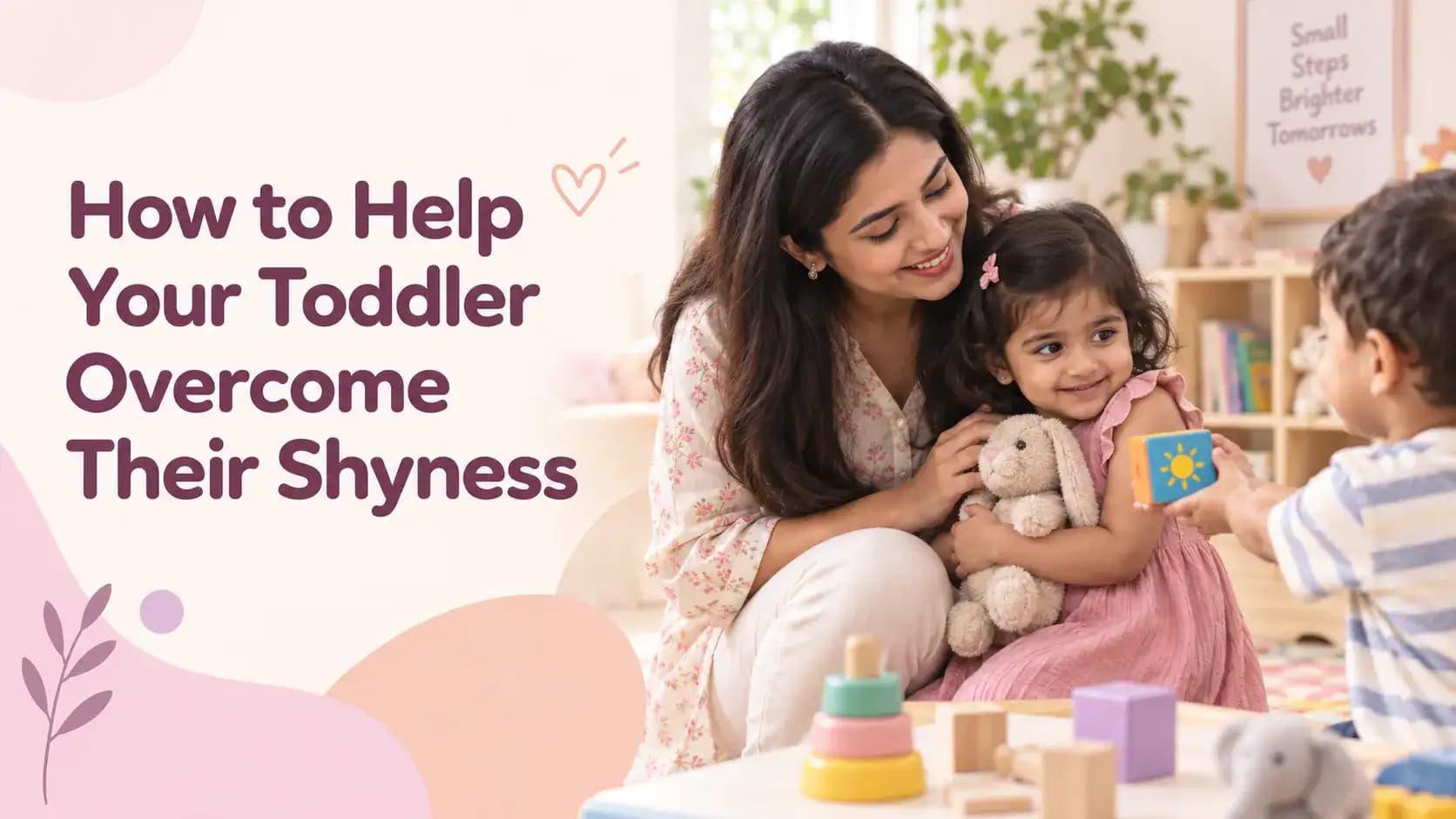
At home your toddler sings, dances and chats non stop. Then the doorbell rings, the neighbour walks in, and the same child is suddenly clamped to your leg, face buried in your dupatta, refusing to say hello.
Sound familiar?
Some children are shy only now and then. Others are quieter and more watchful in most new social situations. Either way, the goal is not to turn your toddler into a performer. It is to help them feel comfortable and confident being themselves.
The short version. Shyness at this age is normal and usually temporary. What helps is preparation, arriving early, staying close, teaching the actual social skills, and praising small steps. What makes it worse is pushing, labelling them "shy", apologising for them, and forcing hugs or performances. Most children grow out of it.
Is it normal for my toddler to be shy?
Yes, very. Holding back around new people is a normal part of toddler development, and there are usually one of three things behind it.
1. A slow to warm up temperament
Has your toddler always been quiet, watchful and hesitant around strangers or group activities? Then they are probably just cautious by nature.
Child development experts prefer the phrase slow to warm up over "shy", and that wording matters. It is not a flaw to be fixed. It describes a child who needs extra time to size up an unfamiliar situation before joining in. Given that time, most of these children do warm up, and they often end up playing happily by the end of the party you nearly gave up on.
2. Separation anxiety
If your toddler used to be outgoing and has recently turned clingy, this may be separation anxiety rather than shyness. They will seem more attached than usual to you and their main carer, and more reserved with everybody else.
Separation anxiety typically starts around 6 to 7 months, peaks between 14 and 18 months, and then eases gradually through early childhood. It is a sign of healthy attachment, not a problem you have caused, and it comes and goes with big changes such as starting playschool, a new carer, travel or a new baby.
3. It is simply how toddlers play
This one gets missed. Toddlers are not built for group socialising yet. At around two, most children do parallel play, which means playing happily beside another child rather than with them. Genuine cooperative play, taking turns and sharing a game, mostly arrives between three and four.
So a two year old who watches the other children from the edge and then plays quietly next to them is not being shy. They are being two.
You may also like: Amazing Ways to Help Your Toddler Talk
Shy, slow to warm up, or introvert?
These get used interchangeably and they are not the same thing. Knowing which one you are looking at changes how you respond.
What it looks like | What they need | |
|---|---|---|
Slow to warm up | Hesitates at the start, watches, then joins in once comfortable | Time and a warm up window, not encouragement to hurry |
Introverted | Enjoys company but tires of crowds, prefers one or two friends, needs quiet to recharge | Smaller settings and downtime afterwards, not more exposure |
Shy | Wants to join in but worries about how they will be seen | Skills, practice and reassurance |
Socially anxious | Real distress, avoids consistently, does not warm up even in familiar company | Assessment and support from a professional |
Most toddlers described as shy are actually in the first two rows, and they need patience rather than intervention.
What is normal at each age?
Age | What you can reasonably expect |
|---|---|
12 to 18 months | Wariness of strangers is at its peak. Clings, hides, cries when handed to someone new. Wants you within sight |
18 to 24 months | Watches other children with interest but plays alongside rather than with them. Warms up to familiar visitors within a few minutes |
2 to 3 years | Starts brief cooperative play. May greet familiar people with prompting. Still needs a settling in period in new places |
If your toddler is broadly following this pattern, even slowly, there is nothing to fix.
The golden rule: let them set the pace
Whatever the reason for the shyness, the core advice is the same. Help them feel comfortable in social situations by letting them approach at their own speed.
In practice that means:
Ask visiting friends and relatives, in advance, to approach your child slowly and let your child come to them, rather than the other way round.
In a group activity, do not worry if they hover at the edge instead of jumping into the game. Watching is participating.
Let them sit on your lap while other children play nearby, instead of setting them down in the middle of the group. They will get far more out of joining on their own terms than out of being coaxed in.
A child who is allowed to watch from safety usually joins in. A child who is pushed in usually retreats further.
Nine things that actually help
1. Stay close and be sympathetic
You are their safe base. When your toddler signals that they do not want to mingle, pick them up if that is what they want, and talk quietly about where you are and who is here. Try something like: "The children are having fun, aren't they? They are all here for Manya's birthday. Shall we go and look at her cake?"
Exploring the room together, hand in hand, works far better than a nudge from behind. If they are frightened of something, acknowledge it rather than dismissing it. Being taken seriously is what lets them trust you when a situation feels uncertain.
2. Arrive early and use the warm up window
This is the highest impact tip on the list. Get to the park, the play area or the birthday party before the crowd. Your toddler gets to claim the space while it is calm, and then watch other children arrive into their territory.
Compare that with walking in last, into a room already full of noise and running children. Same child, completely different experience.
If you cannot arrive early, find a quiet corner and sit there together for a few minutes before doing anything else.
3. Prepare them before you go
Talk about it beforehand: where you are going, who will be there, what will happen, how long you will stay. Predictability does a lot of the work for a cautious child.
Give them permission in advance too: "Dadi will want to talk to you. She will not mind at all if you just smile or wave instead of talking." That single sentence removes most of the pressure.
Looking at photos of the people you are about to meet helps. So do picture books about meeting new people or going to a party.
4. Teach the skills, because they are not instinctive
Shyness is often just not knowing what to do. Practise the mechanics at home, with toys or through role play, and keep the scripts very short:
How to say "hello", or a wave if words are too much
How to say their own name and age
How to answer the standard adult questions ("What is your name?", "Which school do you go to?")
How to ask another child to play: "Can I play?"
How to offer a toy to a visitor
How to say goodbye
Rehearse with soft toys first, then with you playing the visiting uncle. It sounds silly and it works.
5. Never call them shy
Even if your child is not particularly shy, describing them as "shy" repeatedly can convince them that they are. And if they genuinely are shy, the label turns a personality trait into something they feel ashamed of. Labels stick, and toddlers believe what they hear about themselves.
Ask family members, carers and teachers not to call them shy or timid in front of them. When someone comments on the behaviour, describe it in a way that does not dent their confidence.
If you are naturally outgoing, resist the urge to make your toddler more "sociable". Think back to the few times you have felt out of place in a room, and how little a shove would have helped.
6. Praise the effort, not the outcome
Notice and name the small steps. "You waved at Meera Aunty today" or "You went and stood near the other children" tells your toddler exactly what they did well. "Good girl for finally talking" tells them they were failing until then.
Focus positively on the moments they manage. Say nothing about the moments they do not.
7. Choose easier social settings
Rather than avoiding socialising, make it smaller and calmer.
One to one playdates instead of large groups
Your own home, where they feel confident, rather than someone else's
A familiar, structured activity such as a story session at the local library or club, where the routine is predictable
Inviting one friend along to something they already enjoy
Structured activities suit cautious children particularly well, because there is a clear thing to do and side by side play is built in.
8. Do not avoid social situations altogether
Keeping your child away from gatherings does not make life easier for them, it makes the next gathering harder. They may take longer to join the table at a birthday party, but the more often they are in these situations, the more ordinary they become. Aim to reduce the stress of the situation rather than remove the situation.
9. Listen properly afterwards
Encourage your toddler to talk about how an outing felt, and when they do open up, give them your whole attention. If they come to you mid conversation, excuse yourself for a minute and listen without making them feel like an interruption.
Later, ask what they liked and did not like, and what they might do next time. If they tell you they did not like someone squeezing them or pulling their cheeks, take that seriously instead of laughing it off.
What to say instead
Most of what slips out in the moment makes things worse. These swaps are the single most useful thing to practise.
Instead of | Try |
|---|---|
"Say hello to Uncle!" | "You can wave, or say hello when you are ready." |
"Don't be shy!" | "It takes a little time to feel comfortable. I am right here." |
"She's very shy, sorry." | "She likes to take her time before she joins in." |
"Why are you being like this?" | "It is loud in here, isn't it? Shall we sit here for a bit?" |
"Look, everyone else is playing." | "Do you want to watch for a while first?" |
"Go on, sing the rhyme for Nani." | "She will sing it later if she feels like it." |
"Good girl, finally you talked!" | "You said hello to Nani. That was kind." |
"There's nothing to be scared of." | "You are not sure about this yet. That is okay." |
Handling relatives and family gatherings
For most Indian families this is the real battleground, not the park. A shy toddler at a wedding, a festival or a full house of relatives is dealing with a lot: volume, crowds, unfamiliar faces and a great deal of physical affection they did not ask for.
Brief people in advance. A quick message before a visit works well: "She takes a few minutes to warm up. Please don't ask her for a hello straight away, she will come to you once she is comfortable."
Decline the performance. You may be tempted to show off your toddler to relatives, but do not make them sing a rhyme or recite the alphabet when they are clearly not comfortable. A simple "she'll do it later when she's warmed up" ends it without anyone losing face.
Protect them from unwanted handling. Cheek pulling, being lifted by someone they do not know, being passed around the room. You are allowed to intervene, and you should. "She doesn't like being picked up, but she'll give you a high five." This is also the earliest and simplest way to teach your child that their body is theirs, which is a lesson worth far more than one polite hug.
Give them an exit. Point out a quiet room they can retreat to, and check on them there instead of marching them back into the crowd. Leaving a gathering slightly early with a calm child beats staying to the end with an overwhelmed one.
Handle the commentary. Someone will say "arre, itni sharmili hai". A light, firm reply protects your child: "She is just taking her time." Then change the subject.
Playschool and daycare drop off
Shyness peaks at handover, so build a routine and keep it identical every day.
Visit the classroom together once or twice before the first day if the school allows it
Keep goodbyes short, warm and predictable. A hug, one line, and go. Drawing it out or sneaking away both make the next day harder
Use the same goodbye phrase every single time, so it becomes a signal rather than a negotiation
Send a comfort object if the school permits one
Tell them clearly when you will be back, tied to an event: "I will come after snack time"
Ask the teacher to give them a job on arrival, such as handing out crayons. Having a task is easier than having to socialise
Ask how long the crying actually lasted. Most children settle within a few minutes of the parent leaving, which is useful to know when you are sitting in the car feeling terrible
Five mistakes to avoid
Apologising for your child in front of them. It teaches them that how they are is something to be sorry for.
Answering for them, every time. Leave a pause first. Older siblings do this constantly, so mention it to them.
Bribing or bargaining for social behaviour. "Say hello and you can have a chocolate" turns an ordinary interaction into a transaction with a price on it.
Comparing them, especially with a sibling or a cousin. "See how nicely Aarav talks to everyone" teaches shame, not confidence.
Forcing physical affection. No child should have to hug or kiss someone to be considered polite. A wave, a high five or a namaste is a perfectly good alternative.
Remember that the more a child is pushed, the further they retreat into the shell where they feel safe. It is worth having a quiet word with family and friends who can help rather than hinder.
The upside of a cautious child
Slow to warm up children tend to share a set of real strengths, and it helps to keep them in view on a difficult evening.
They observe carefully before acting, so they read a room well
They are often more careful and take fewer reckless risks
They tend to be good listeners, which makes them well liked once they do connect
They frequently form deep, loyal friendships rather than many shallow ones
Many are noticeably empathetic, because they pay attention to how other people are feeling
Your job is not to remove the caution. It is to make sure the caution does not stop them from doing things they actually want to do.
When shyness may be something more
Most shyness needs nothing but time. Talk to your paediatrician if you notice any of the following.
The shyness is getting worse rather than slowly better over several months
They never warm up, even with people they see regularly, and even after a long settling in period
Distress is intense and physical: panic, freezing, trembling, vomiting or inconsolable crying at the thought of going somewhere
It is stopping them living normally, so you cannot take them to playschool, the park or a family event at all
They speak freely and normally at home but not at all outside it, for more than a month or two. Consistently not speaking outside the home for longer than three months should be assessed, as it may be selective mutism, an anxiety condition rather than shyness or stubbornness. It is most often first noticed between three and six years, when a child starts preschool
There are wider developmental concerns: little eye contact, not responding to their name, limited pointing or gesturing, few words, no pretend play, strong resistance to change or repetitive movements. These need a developmental assessment, since social withdrawal can look like shyness
Hearing. A child who cannot hear well in a noisy room may simply go quiet in company. A hearing check is quick and worth ruling out
The withdrawal began suddenly, or after a specific frightening event, a change of carer, or a change in the household
None of these mean something is wrong. They mean it is worth a conversation, and early support is easier than late support.
Frequently asked questions
Will my toddler grow out of being shy?
Most do, or at least grow comfortable enough that it stops limiting them. Plenty of quiet toddlers become confident adults, and plenty stay reserved and are perfectly happy. What predicts a good outcome is not how outgoing they become, but whether they feel accepted as they are.
Is shyness genetic?
Temperament has a strong inherited component, so if you or your partner were slow to warm up as children, your toddler may be too. What you do still matters a great deal. Gentle, consistent exposure helps cautious children become more confident over time.
Is my child shy or introverted?
Roughly speaking, a shy child wants to join in but feels anxious about it. An introverted child can join in comfortably and simply finds crowds tiring and prefers small groups. Introversion needs no fixing at all.
Should I put my shy toddler in playschool to bring them out of their shell?
Playschool can help a lot, but not as a shock treatment. Choose a small group, visit beforehand, and expect two to four weeks of settling. If they are still deeply distressed after a month, talk to the teacher and your paediatrician rather than pushing through.
My toddler talks non stop at home but goes silent outside. Why?
This is extremely common and usually just a warm up issue. Home is safe and predictable. Watch the pattern over a few months. Total silence outside the home for more than three months is worth having assessed.
What if relatives keep insisting my child hug or greet them?
Answer for your child, warmly and without apology: "She'll say hello when she's ready, she just needs a minute." Offer a substitute such as a wave or a high five. You are not being rude, you are modelling for your child that their comfort counts.
Is it my fault for not socialising them enough?
Almost certainly not. Temperament is largely something children are born with. Being at home more during the early years may mean less practice, which practice can fix, but it does not create a cautious nature.
Final thoughts
There is no way to know whether your child will stay shy, and countless people have quietly outgrown childhood bashfulness. So try not to worry about the future. Focus instead on the acceptance and support that will help them face the world.
Help them feel comfortable with themselves and their surroundings, and the confidence you build will carry into whatever they take on. Shyness is nothing to be ashamed of, and a great many shy people lead happy, full and successful lives.
References
Raising Children Network. Shyness in children: how to help a shy child. https://raisingchildren.net.au/toddlers/behaviour/common-concerns/shyness
Zero to Three. Children with Shy or Slow to Warm Up Temperaments. https://www.zerotothree.org/resource/children-with-shy-or-slow-to-warm-up-temperaments/
Zero to Three. Parenting Strategies to Help Children Meet New People. https://www.zerotothree.org/resource/parenting-strategies-to-help-children-meet-new-people/
American Academy of Pediatrics, HealthyChildren.org. Shyness in Children. https://www.healthychildren.org/English/ages-stages/gradeschool/Pages/Shyness-in-Children.aspx
Raising Children Network. Separation anxiety in babies and children. https://raisingchildren.net.au/babies/behaviour/common-concerns/separation-anxiety
NHS. Separation anxiety. https://www.nhs.uk/baby/babys-development/behaviour/separation-anxiety/
Raising Children Network. Social anxiety in children. https://raisingchildren.net.au/toddlers/health-daily-care/mental-health/social-anxiety
NHS. Selective mutism. https://www.nhs.uk/mental-health/conditions/selective-mutism/


Related Articles
Autism Spectrum in Children: Signs, Causes and Support
 5·6 min
 5 Dangerous Mistakes Every Parent Should Avoid While Carrying a Baby in a Baby Carrier
 47·4 min
 Never Miss These Crucial Warning Signs of Emotional Development Problems in Your Baby
 979·4 min
 5 Ways to Make Baby Bath Time Fun & Enjoyable for Your Little One
 5·5 min
Medical Disclaimer
This content is for informational purposes only and should not replace professional medical advice. Consult with a physician or other health care professional if you have any concerns or questions about your health. If you rely on the information provided here, you do so solely at your own risk.


AWARDS AND RECOGNITION

Mylo wins Forbes D2C Disruptor award

Mylo wins The Economic Times Promising Brands 2022
AS SEEN IN













- Mylo Care: Effective and science-backed personal care and wellness solutions for a joyful you.
- Mylo Baby: Science-backed, gentle and effective personal care & hygiene range for your little one.
- Mylo Community: Trusted and empathetic community of 10mn+ parents and experts.


Product Categories
Baby Carrier | Baby Soap | Baby Wipes | Stretch Marks Cream | Baby Cream | Baby Shampoo | Baby Massage Oil | Baby Hair Oil | Stretch Marks Oil | Baby Body Wash | Baby Powder | Baby Lotion | Diaper Rash Cream | Newborn Diapers | Teether | Baby Kajal | Baby Diapers Pants | Cloth Diapers | Laundry Detergent | Lactation Granules |