


Orders
.png&w=48&q=75 "login")
Profile


Wallet

What Should a 21-Month-Old Toddler Be Able to Do? The Complete 21 Month Milestones Checklist (2026)
 24 min
Quick Answer
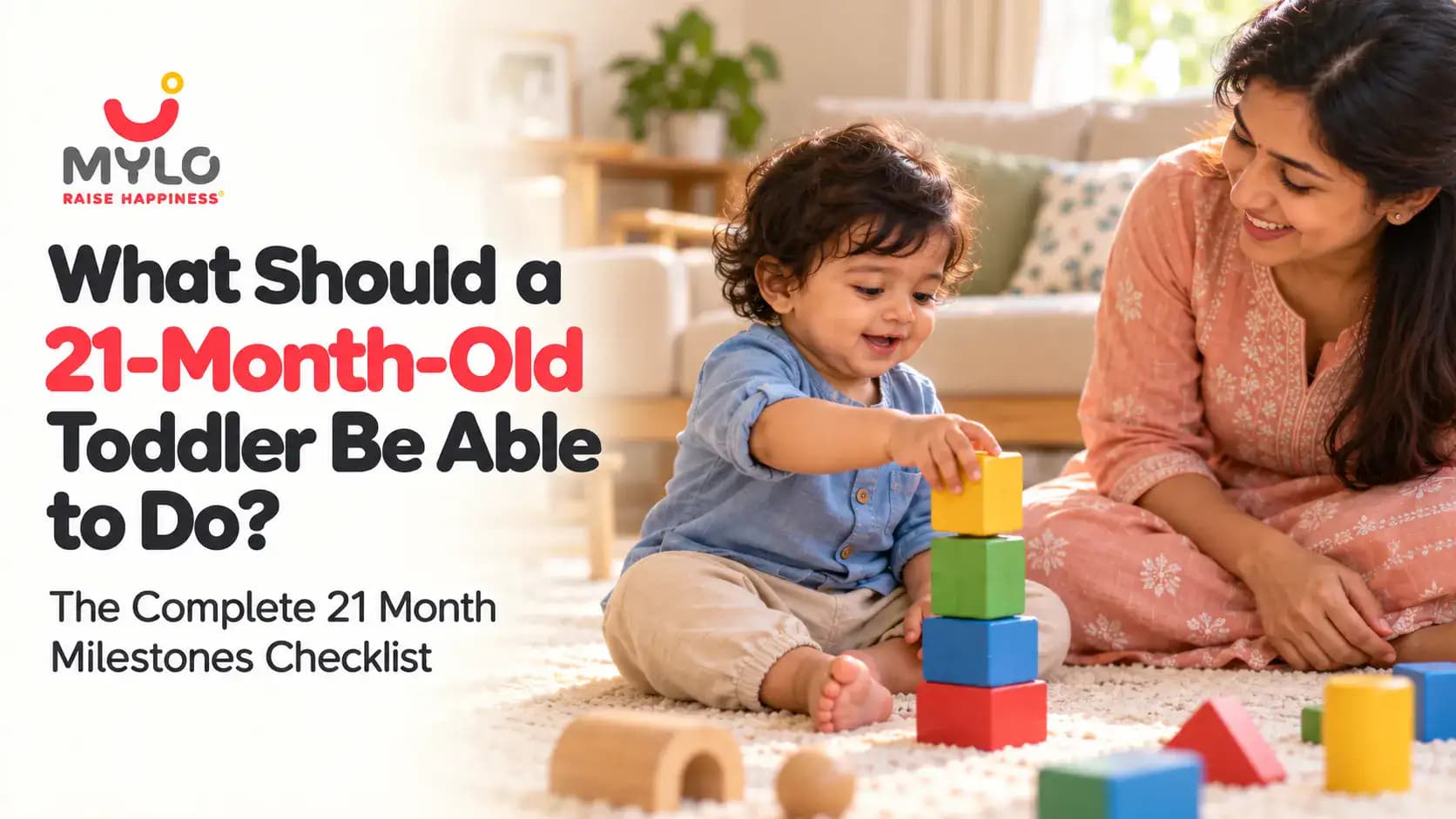
By 21 months, most toddlers walk steadily, are starting to run, climb stairs with help, kick or throw a ball, use a spoon, say many single words and may start joining two words like "more milk", follow simple directions, point to body parts and pictures, and enjoy pretend play. There's no official 21-month checklist. It's a bridge between the 18-month milestones (which your toddler should already be doing) and the 2-year milestones (which they're working towards). See your pediatrician if your toddler isn't walking, doesn't point, has fewer than 3 words, isn't gaining new words or loses skills.
21 Month Milestones at a Glance
Area | Typical at 21 Months | Working Towards (by 24 Months) | Talk to a Doctor If |
|---|---|---|---|
Movement | Walks steadily, starts running, squats to play | Runs, kicks a ball, walks up stairs | Not walking, or walks only on tiptoes |
Language | Many single words, may try 2-word phrases | Says 2 words together, like "more milk" | Fewer than 3 words, no new words |
Understanding | Follows simple one-step directions | Points to pictures in a book when asked | Doesn't follow simple directions |
Social | Pretend play, copies adults, may be clingy | Notices when others are hurt or upset | Doesn't point, share interest or copy |
Thinking | Knows what everyday objects are for | Plays with 2 toys together, uses buttons and knobs | Doesn't play purposefully |
Self-care | Uses a spoon, drinks from an open cup | Eats with a spoon well | Only eats purees |
Sleep | 11 to 14 hours a day, 1 nap | Same | Very poor sleep with other concerns |
Sources: Pathways.org, University of Kentucky Parent Express, AAP.
Key Facts Every Parent Should Know
No official 21-month checklist: The official AAP and CDC checklists cover 18 months and 2 years, and 21 months sits in between
18 to 21 months: When 2-word phrases often begin to appear, becoming more frequent by 24 months (Pathways.org)
17.6 months: The upper end of the normal window for walking alone (WHO), so by 21 months almost all healthy toddlers walk
24 months: The next routine autism screening, recommended by the AAP
11 to 14 hours: Recommended daily sleep for 1 to 2 year olds (AAP)
Zero: Added sugar recommended before age 2 (ICMR-NIN)
Is There an Official 21 Month Milestones Checklist?
Short answer: No. The official AAP and CDC checklists cover 18 months and 2 years, and most pediatricians don't have a routine visit at 21 months. The best way to check your 21-month-old is to confirm they're doing the 18-month milestones and making progress towards the 2-year milestones.
Should Already Be Doing (18-Month Milestones) | Working Towards (2-Year Milestones) |
|---|---|
Walks without holding on | Runs and kicks a ball |
Says 3 or more words besides "mama" or "dada" | Says 2 words together, like "more milk" |
Follows one-step directions without gestures | Points to things in a book when asked |
Points to show you something interesting | Points to at least 2 body parts |
Copies chores like sweeping | Plays with more than one toy together, like toy food on a plate |
Scribbles | Holds something in one hand while using the other |
Tries to use a spoon | Eats with a spoon |
Climbs on and off a sofa | Walks up a few stairs, with or without help |
Explores but checks you're nearby | Notices when others are hurt or upset |
Based on the official 2-year milestones and the 18-month milestones.
What Does a Complete 21 Month Milestones Checklist Look Like?
Short answer: Most 21-month-olds are walking confidently, starting to run, adding new words quickly, enjoying pretend play and wanting to do things themselves. Tick what your toddler can do.
😊 Social and Emotional Checklist
☐ Enjoys simple pretend play, like feeding a doll or talking on a toy phone
☐ Copies what adults do, like sweeping or cooking
☐ Shows affection with hugs and kisses
☐ Wants to do things "by myself"
☐ Has tantrums when frustrated
☐ May be clingy or shy in new places
☐ Plays next to other children (parallel play)
🗣️ Language and Communication Checklist
☐ Says many single words and adds new ones often
☐ May start joining 2 words, like "more milk" or "daddy go"
☐ Points to body parts when asked
☐ Points to pictures in a book when you name them
☐ Follows simple directions, like "Bring your shoes"
☐ Says "no" and "mine"
☐ Copies words and sounds they hear
🧠 Cognitive Checklist
☐ Knows what everyday objects are for, like a comb or cup
☐ Completes simple shape sorters and puzzles
☐ Stacks 4 or more blocks
☐ Starts matching simple things, like shoes or socks
☐ Finds hidden objects easily
☐ Tries to use buttons, switches and knobs on toys
🚶 Movement Checklist
☐ Walks steadily without falling often
☐ Starts to run, though sometimes stiffly
☐ Squats to pick up toys and stands back up
☐ Climbs stairs with help, holding a hand or rail
☐ Kicks or throws a ball
☐ Uses a spoon with fewer spills
☐ Drinks from an open cup
☐ Scribbles and makes marks on paper
How Many Words Should a 21-Month-Old Say?
Short answer: Most 21-month-olds say many single words and are adding new ones quickly. Many are starting to join 2 words together, like "more milk" or "mama go". According to Pathways.org, 2-word phrases often begin between 18 and 21 months and become more common by 24 months.
Communication Skill | By 18 Months | By 21 Months | By 24 Months |
|---|---|---|---|
Spoken words | 3 or more words | Many words, growing quickly | Often 50 or more words |
Joining words | Not yet | 2-word phrases may begin | Says 2 words together |
Directions | One-step, without gestures | One-step, easily | Starts 2-step directions |
Pointing | To show things | To body parts and pictures | Points to 2 or more body parts |
Gestures | Waving, pointing | Nodding, blowing kisses | Uses more gestures than waving and pointing |
Is My 21-Month-Old a Late Talker?
Probably Fine | Talk to Your Doctor |
|---|---|
Says several words and learns new ones | Fewer than 3 words, or no new words for months |
Understands a lot and follows directions | Doesn't follow simple directions |
Points, nods and uses gestures | Doesn't point or use gestures |
Copies words and sounds | Rarely copies sounds or words |
Responds to their name | Doesn't respond to their name, or you worry about hearing |
Don't wait and watch. If you're worried about speech at 21 months, talk to your pediatrician now rather than waiting until the 2-year visit. Early speech therapy works well.
How Can I Help My Toddler Start 2-Word Phrases?
Tip | Example |
|---|---|
Add one word to what they say | Toddler: "Ball." You: "Big ball!" or "Throw ball!" |
Model 2-word phrases in daily life | "Shoes on." "Bath time." "More roti?" |
Give choices | "Milk or water?" |
Pause and wait | Give them time to answer before you speak |
Read and point | "Where's the dog? There's the dog!" |
Sing rhymes and pause | "Johnny Johnny, yes..." and let them finish |
Limit screens | Real conversation builds language faster than videos |
What Movement Skills Should a 21-Month-Old Have?
Short answer: By 21 months, most toddlers walk steadily and are starting to run, squat, climb stairs with help and kick or throw a ball. Almost all healthy toddlers walk alone by this age. The WHO upper limit for walking alone is about 17.6 months.
Movement Skill | Typical at 21 Months? | Talk to a Doctor If |
|---|---|---|
Walks steadily | Yes | Not walking at all |
Starts running | Many toddlers | Walks only on tiptoes all the time |
Squats and stands up | Yes | Can't get up from the floor without help |
Climbs stairs with help | Many toddlers | Not trying by 2 years |
Kicks or throws a ball | Many toddlers | Uses one side of the body much more |
Jumps | Some toddlers (Mylo) | Not a concern yet at 21 months |
Read more in our guides on running and jumping milestones and reasons for late walking.
Why Is My 21-Month-Old So Clingy and Having Tantrums?
Short answer: At 21 months, toddlers want independence but still need to know you're close. This mix often shows up as clinginess, "no!", "mine!" and tantrums. It's a normal and healthy stage of development.
Behaviour | Why It Happens | What Helps |
|---|---|---|
Tantrums | Big feelings, few words | Stay calm, name the feeling, keep them safe |
Saying "no" to everything | Testing independence | Offer 2 choices instead of yes or no questions |
"Mine!" and not sharing | Sharing is still hard at this age | Teach turn-taking with a timer |
Clinginess and separation anxiety | Still learning that you'll come back | Short goodbye ritual, always say bye |
Hitting or biting | Frustration without words | "I won't let you hit." Teach gentle hands. |
For more help, see our guides on hitting, biting and bad language in toddlers and sibling rivalry, since many families have a new baby around this age.
Is My 21-Month-Old Ready for Potty Training?
Short answer: Some toddlers show readiness signs between 18 and 24 months, but most complete potty training between 2 and 3 years. At 21 months, you can introduce the potty and watch for signs without pressure.
Readiness Sign | What It Looks Like |
|---|---|
Stays dry for 2 hours | Dry nappy after naps |
Notices a wet or dirty nappy | Tells you or pulls at it |
Interested in the toilet | Follows you to the bathroom |
Can pull pants down and up | With a little help |
Has regular bowel movements | Around the same time daily |
Can follow simple directions | "Sit on the potty, please" |
If you see several signs, let your toddler sit on the potty as part of the daily routine, starting with clothes on.
What Activities Help a 21-Month-Old's Development?
Short answer: Pretend play, reading, simple puzzles, ball games, dancing, outdoor play and helping with chores all build skills. Toddlers at this age love copying adults and doing things themselves.
Skill Area | Best Activities | Household Items to Use |
|---|---|---|
Social | Pretend kitchen, doctor play, tea party | Steel katoris, spoons, soft toys |
Language | Reading, naming body parts, rhymes, "What's this?" games | Board books, family photos |
Cognitive | Simple puzzles, matching socks, sorting by colour | Socks, spoons, coloured cups |
Fine motor | Scribbling, play dough, putting lids on containers | Chunky crayons, atta dough, dabbas |
Gross motor | Running, kicking a ball, climbing, dancing | A soft ball, sofa cushions |
Chores | Putting toys away, wiping spills, carrying light things | Small cloth, toy basket |
What Should a 21-Month-Old Eat and Drink?
Short answer: At 21 months, toddlers eat family foods in small, soft pieces, with 3 meals and 2 snacks a day. Offer water and plain milk (about 300 to 500 ml a day), iron-rich foods and no added sugar, and let them feed themselves with a spoon.
Food or Drink | At 21 Months | Tip |
|---|---|---|
Meals | 3 meals and 2 snacks | Eat together as a family |
Milk | About 300 to 500 ml a day | Too much milk lowers appetite and iron |
Iron-rich foods | Daily | Dal, ragi, eggs, spinach, chicken, rajma |
Bottle | Should be finished | The AAP advises weaning by 12 to 18 months |
Breastfeeding | Can continue | The WHO recommends up to 2 years and beyond |
Sugar and honey | None | ICMR-NIN advises no added sugar under 2 |
Which Foods Are Still Choking Hazards?
Avoid | Safer Option |
|---|---|
Whole nuts and peanuts | Finely ground nuts in food |
Whole grapes and cherry tomatoes | Cut into quarters |
Popcorn, hard sweets and toffees | Soft fruit pieces |
Hard raw carrot or apple | Steamed or grated |
Picky eating at this age? It's very common. Read our guide on picky eating and food refusal in toddlers.
How Much Should a 21-Month-Old Sleep?
Short answer: Toddlers aged 1 to 2 years need 11 to 14 hours of sleep in 24 hours (AAP), usually with 1 afternoon nap.
Sleep Detail | Typical at 21 Months |
|---|---|
Total sleep | 11 to 14 hours a day |
Night sleep | About 10 to 12 hours |
Naps | 1 nap of 1.5 to 3 hours |
Common problems | Bedtime resistance, early waking, night waking from teething (canines and second molars) |
Tip: A predictable routine (bath, pyjamas, brushing, books, song, lights off) and offering small choices ("Which pyjamas?") can reduce bedtime battles.
How Much Should a 21-Month-Old Weigh?
Short answer: Many 21-month-olds weigh around 10.5 to 12.5 kg and measure around 82 to 87 cm, but healthy toddlers vary a lot. Steady growth along your toddler's own curve is what matters most.
Measurement | Typical at 21 Months |
|---|---|
Weight | Often 10.5 to 12.5 kg |
Height | Often 82 to 87 cm |
Teeth | Often 14 to 16, with canines and second molars coming in |
See our height and weight chart for boys and girls in India, or read what to do if your toddler is underweight.
Are Any Vaccines Due Around 21 Months in India?
Short answer: There usually isn't a routine visit at 21 months. However, some vaccines fall in the 16 to 24 month window under the IAP schedule and India's government schedule. If your toddler missed any 15 to 18 month doses, now is a good time to catch up.
Vaccine | Typical Timing |
|---|---|
DTP, Hib and IPV boosters (if not yet given) | 16 to 18 months (IAP) |
Hepatitis A 2nd dose (if inactivated vaccine) | 6 months after the 1st dose |
DPT booster, MR 2nd dose, OPV booster | 16 to 24 months (government schedule) |
Vitamin A | Every 6 months from 9 months to 5 years (government schedule) |
Influenza | Yearly, if advised by your doctor |
Always follow your pediatrician's schedule.
How Can I Keep My 21-Month-Old Safe?
Short answer: At 21 months, toddlers run, climb, open doors and drawers, and move fast. Use stair gates and window guards, anchor furniture, lock away medicines, and never leave your toddler alone near water.
Risk | How to Prevent It |
|---|---|
Falls from climbing | Window and balcony guards, stair gates, move furniture away from windows |
Opening doors and drawers | Child locks on cabinets, doors and fridges |
Drowning | Empty buckets and tubs, keep bathroom doors closed |
Poisoning | Lock medicines, cleaners, mosquito repellents and pesticides away |
Choking | Keep coins, button batteries, magnets and small toys away |
Burns | Keep hot drinks, stoves, irons and matches out of reach |
Road safety | Car seat for every ride; hold hands near roads and in parking areas |
Emergency number: Dial 108 for ambulance services in most states, or 112 for emergencies.
How Much Screen Time Is Okay at 21 Months?
Short answer: Between 18 and 24 months, a small amount of good-quality content watched together with a parent is okay. Talking, reading and playing remain far more important for language and social skills.
Instead of Solo Screen Time | Try This |
|---|---|
Videos to keep them busy | Pretend play, puzzles or books |
Cartoons during meals | Family conversation |
Phone to stop tantrums | Name the feeling and offer comfort |
Solo tablet time | A short, slow-paced show watched together, and talk about it |
When Should I Worry About My 21-Month-Old's Development?
Short answer: Talk to your doctor if your toddler isn't walking, doesn't point, has fewer than 3 words or isn't learning new words, doesn't follow simple directions, doesn't copy others, or loses skills they had. Don't wait for the 2-year visit if you're worried.
Red Flag at 21 Months | What It May Relate To |
|---|---|
Loses skills they once had | See a doctor right away |
Not walking | Movement or muscle development |
Doesn't point to show things | Social communication |
Fewer than 3 words, or no new words | Speech, language or hearing |
Doesn't follow simple directions | Understanding or hearing |
Doesn't copy actions or words | Social learning |
Little eye contact, or doesn't respond to name | Social communication, hearing |
Walks only on tiptoes, or is very floppy or stiff | Muscle tone or nervous system |
The AAP recommends autism screening at 18 and 24 months. If your toddler missed the 18-month screening, or you have concerns, ask for one now.
Where Can I Get Free Developmental Screening in India?
Service | What It Offers |
|---|---|
Rashtriya Bal Swasthya Karyakram (RBSK) | Free screening for developmental delays |
District Early Intervention Centres (DEIC) | Free assessment, speech and occupational therapy |
Anganwadi centres | Growth monitoring, vaccines and referrals |
Read our guide on identifying developmental disorders in toddlers.
What Should Indian Parents Keep in Mind at 21 Months?
Short answer: Don't wait and watch if you're worried about speech, avoid using the phone as a babysitter, let your toddler try things themselves, and help grandparents encourage words and independence.
Common Practice | Better Approach |
|---|---|
"He'll talk when he goes to school" | Check early if words are few; early help works best |
Speaking to the toddler only in "baby talk" | Use simple, clear words and short phrases |
Mobile phone to feed or calm | Talk, sing and eat together |
Doing everything for the toddler | Let them try, then help |
Comparing with cousins | Every toddler has their own pace |
Sugar or "health drink" in milk | No added sugar under 2 years |
Myths vs Facts About 21 Month Milestones
Myth | Fact |
|---|---|
"There's a strict 21-month checklist" | Official checklists cover 18 months and 2 years; 21 months is a bridge |
"Toddlers must speak in sentences by 21 months" | 2-word phrases often just begin at 18 to 21 months (Pathways.org) |
"Late talking always runs in families" | Family history doesn't replace a check-up |
"Toddlers should share nicely by now" | Sharing is still hard; turn-taking comes gradually |
"Screens help toddlers learn to talk" | Real conversation builds language best |
"Tantrums mean bad parenting" | Tantrums are a normal toddler stage |
Frequently Asked Questions About 21 Month Milestones
What should a 21-month-old be able to do?
Most walk steadily, are starting to run, use a spoon, say many words and may start 2-word phrases, follow simple directions, point to body parts and enjoy pretend play.
21 mahine ka bachcha kya-kya kar sakta hai? (Hinglish)
Zyada tar bachche 21 mahine tak aaram se chalte hain, daudna shuru karte hain, chammach se khaate hain, kai shabd bolte hain aur kabhi-kabhi 2 shabd jod kar bolte hain jaise "aur doodh", sharir ke hisson ki taraf ishaara karte hain aur khel-khel mein nakal karte hain.
How many words should a 21-month-old say?
Many single words, with new ones added often. Some toddlers start joining 2 words together by 21 months.
Mera 21 mahine ka bachcha kam bolta hai, kya karein? (Hinglish)
Agar bachcha 3 se kam shabd bolta hai, naye shabd nahi seekh raha, ishaara nahi karta ya naam pukarne par nahi dekhta, toh 2 saal ka intezaar mat karein. Doctor se milein aur hearing check karwayein. Ghar par roz baat karein, kitaab padhein aur mobile kam karein.
Is there a doctor visit at 21 months?
Usually not. Most routine visits are at 18 and 24 months. If you have concerns, you can book a visit anytime.
Should my 21-month-old be running?
Many toddlers start running around this age, sometimes stiffly. Most run well by 2 years.
Is my 21-month-old ready for potty training?
Some show signs between 18 and 24 months, but most are ready between 2 and 3 years. Introduce the potty without pressure.
Why is my 21-month-old so clingy?
Toddlers want independence but still need reassurance. Clinginess and separation anxiety are normal at this age.
How much should a 21-month-old sleep?
11 to 14 hours in 24 hours, usually with 1 afternoon nap.
What should a 21-month-old eat?
Family foods in small pieces, 3 meals and 2 snacks, about 300 to 500 ml of milk a day, iron-rich foods and no added sugar.
When should I worry about my 21-month-old?
If your toddler isn't walking, doesn't point, has fewer than 3 words, doesn't follow simple directions or loses skills, speak to your pediatrician.
Related Reads on Mylo
References
Pathways.org. "Two-Word Phrases: What Are They and When Will Baby Use Them?" https://pathways.org/two-word-phrases
University of Kentucky Cooperative Extension. "Parent Express: A Guide for You and Your Child, 21 and 22 Months." https://fcs.mgcafe.uky.edu/publications/parent-express-guide-you-and-your-child-21-and-22months
World Health Organization (WHO). "WHO Motor Development Study: Windows of Achievement for Six Gross Motor Development Milestones." cdn.who.int/media/docs/default-source/child-growth/…/who-motor-development-s…elopment-milestones.pdf?…
American Academy of Pediatrics (AAP). "How Pediatricians Screen for Autism." HealthyChildren.org. https://www.healthychildren.org/English/health-issues/conditions/Autism/Pages/How-Doctors-Screen-for-Autism.aspx
American Academy of Pediatrics (AAP). "AAP Endorses New Recommendations on Sleep Times." https://publications.aap.org/aapnews/news/6630/AAP-endorses-new-recommendations-on-sleep-times
American Academy of Pediatrics (AAP). "From Bottle to Cup." HealthyChildren.org. https://www.healthychildren.org/English/ages-stages/baby/feeding-nutrition/Pages/Discontinuing-the-Bottle.aspx
Indian Academy of Pediatrics (IAP) ACVIP. "Recommended Immunization Schedule (2023)." Indian Pediatrics. https://link.springer.com/article/10.1007/s13312-024-3104-5
World Health Organization (WHO). "Infant and Young Child Feeding." https://www.who.int/news-room/fact-sheets/detail/infant-and-young-child-feeding
Centers for Disease Control and Prevention (CDC). "Milestones by 2 Years." https://www.cdc.gov/act-early/milestones/2-years.html
Medical Disclaimer
This article is for information only and does not replace professional medical advice. Every toddler develops at their own pace. If you have concerns about your toddler's growth, development, speech, hearing or behaviour, please consult your pediatrician.

Shop Now
Baby Essentials
Article Posted Under
Related Articles

Related Topics
.webp&w=32&q=75)
Medical Disclaimer
This content is for informational purposes only and should not replace professional medical advice. Consult with a physician or other health care professional if you have any concerns or questions about your health. If you rely on the information provided here, you do so solely at your own risk.


AWARDS AND RECOGNITION

Mylo wins Forbes D2C Disruptor award

Mylo wins The Economic Times Promising Brands 2022
AS SEEN IN












- Mylo Care: Effective and science-backed personal care and wellness solutions for a joyful you.
- Mylo Baby: Science-backed, gentle and effective personal care & hygiene range for your little one.
- Mylo Community: Trusted and empathetic community of 10mn+ parents and experts.


Product Categories
Baby Carrier | Baby Soap | Baby Wipes | Stretch Marks Cream | Baby Cream | Baby Shampoo | Baby Massage Oil | Baby Hair Oil | Stretch Marks Oil | Baby Body Wash | Baby Powder | Baby Lotion | Diaper Rash Cream | Newborn Diapers | Teether | Baby Kajal | Baby Diapers Pants | Cloth Diapers | Laundry Detergent | Lactation Granules |