


Orders
.png&w=48&q=75 "login")
Profile


Wallet

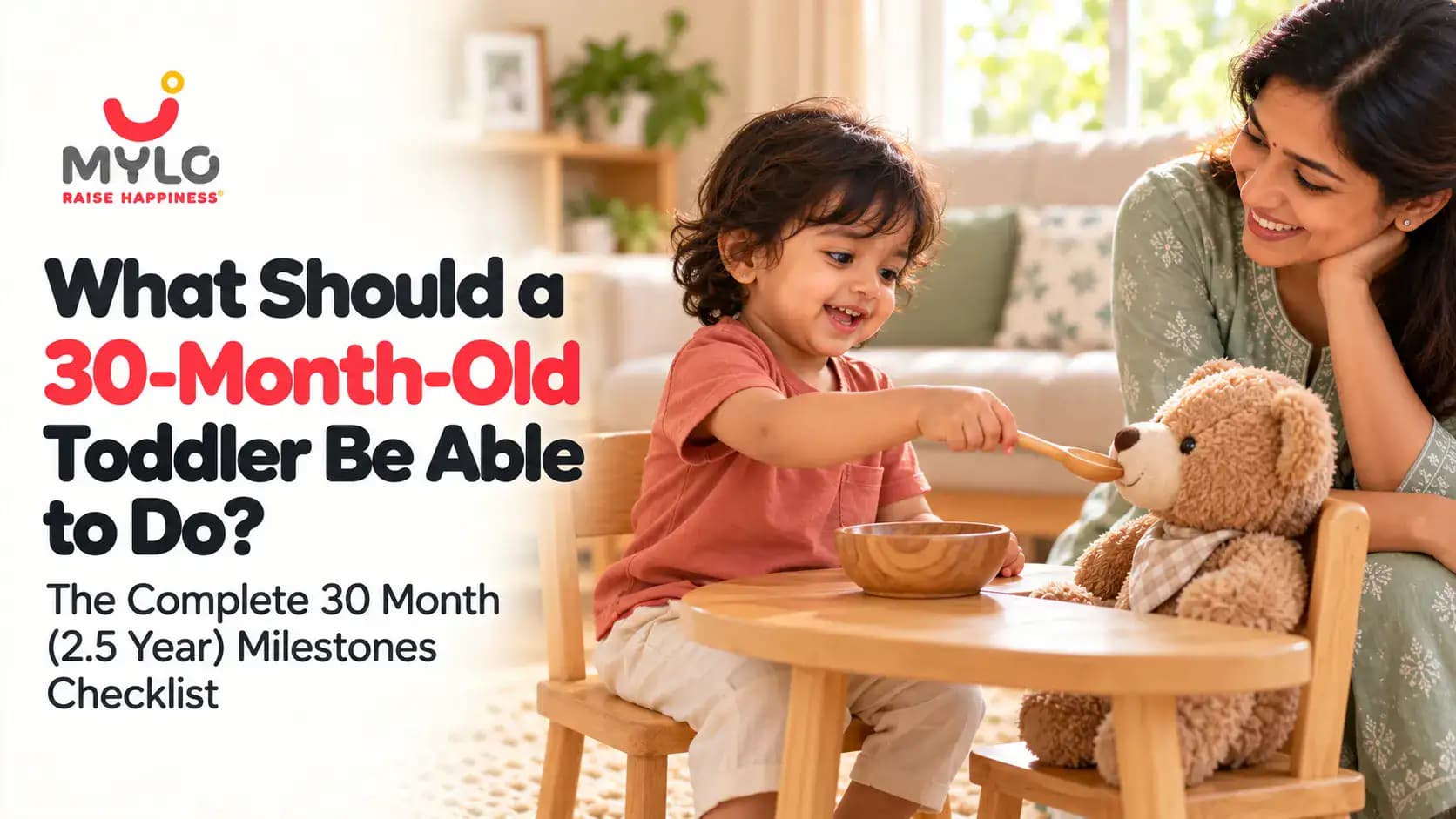
What Should a 30-Month-Old Toddler Be Able to Do? The Complete 30 Month (2.5 Year) Milestones Checklist (2026)
 24 min
Quick Answer
By 30 months (2.5 years), most toddlers say about 50 words, join 2 or more words with an action word like "doggie run", use "I", "me" or "we", name things in a book, follow 2-step instructions, know at least one colour, pretend play, jump with both feet, twist doorknobs and lids, take off loose clothes and turn book pages one at a time. These are the official 30-month milestones from the AAP and CDC. See your pediatrician if your child has far fewer words, doesn't join words, doesn't follow simple instructions, doesn't pretend play or loses skills.
30 Month Milestones at a Glance
Area | Key Milestones by 30 Months | Coming Next (by 3 Years) | Talk to a Doctor If |
|---|---|---|---|
Language | About 50 words, 2 or more words with an action word, uses "I", "me" and "we" | Short sentences, talks in conversations | Far fewer words, no word combinations |
Understanding | Follows 2-step instructions, names pictures | Answers simple "what" and "where" questions | Doesn't follow simple instructions |
Social | Plays next to and sometimes with others, says "Look at me!" | Joins other children in play | No interest in other children |
Thinking | Pretend play, simple problem-solving, knows 1 colour | Draws a circle when shown | No pretend play |
Movement | Jumps with both feet, twists lids and doorknobs | Climbs well, pedals a tricycle | Falls a lot, can't jump or climb |
Self-care | Takes off loose clothes, eats with a spoon | Puts on some clothes, uses the toilet | Loses self-care skills |
Sleep | 11 to 14 hours a day, often 1 nap | 10 to 13 hours from age 3 | Very poor sleep with other concerns |
Sources: Nemours KidsHealth, University of Michigan Health, AAP.
Key Facts Every Parent Should Know
About 50 words: The official language milestone at 30 months (Nemours KidsHealth)
2-step instructions: Most children can follow instructions like "Put the toy down and close the door"
Both feet: Most 30-month-olds can jump off the ground with both feet
All 20 milk teeth: Usually in by about 2.5 years (Mylo)
Almost half their adult height: Many children reach this by 2.5 years (Mylo)
11 to 14 hours: Recommended daily sleep until the third birthday (AAP)
About 1 hour a day: The AAP's screen time limit for ages 2 to 5, watched together
What Are the Official Milestones for a 30-Month-Old?
Short answer: The official AAP and CDC checklist lists 15 key milestones by 30 months across four areas. These show what most (75%) children can do by 2.5 years.
Area | Milestone by 30 Months |
|---|---|
Social and Emotional | Plays next to other children and sometimes plays with them |
Shows you what they can do by saying "Look at me!" | |
Follows simple routines when told, like helping pick up toys at clean-up time | |
Language and Communication | Says about 50 words |
Says 2 or more words together with one action word, like "Doggie run" | |
Names things in a book when you point and ask "What is this?" | |
Says words like "I", "me" or "we" | |
Cognitive | Uses things to pretend, like feeding a block to a doll as if it were food |
Shows simple problem-solving, like standing on a stool to reach something | |
Follows 2-step instructions, like "Put the toy down and close the door" | |
Shows they know at least 1 colour, like pointing to a red crayon when asked | |
Movement and Physical | Uses hands to twist things, like turning doorknobs or unscrewing lids |
Takes some clothes off alone, like loose pants or an open jacket | |
Jumps off the ground with both feet | |
Turns book pages one at a time when you read together |
What Does a Complete 30 Month Milestones Checklist Look Like?
Short answer: Along with the official milestones, many 2.5-year-olds also start short sentences, ask simple questions, show new fears, want strong routines and begin potty training. Tick what your child can do. Milestones marked ⭐ are official ones.
😊 Social and Emotional Checklist
☐ Plays next to and sometimes with other children ⭐
☐ Says "Look at me!" to show you things ⭐
☐ Follows simple routines, like clean-up time ⭐
☐ Shows a wide range of emotions: proud, shy, jealous, frustrated
☐ May have new fears, like of the dark or loud noises
☐ Likes routines and gets upset when they change
☐ Starts to take turns with help
🗣️ Language and Communication Checklist
☐ Says about 50 words ⭐
☐ Joins 2 or more words with an action word, like "Mama sit" ⭐
☐ Names things in a book when asked ⭐
☐ Uses "I", "me" or "we" ⭐
☐ Asks simple questions, like "What's that?"
☐ Starts using 3-word sentences, like "I want juice"
☐ Can be partly understood by people outside the family
🧠 Cognitive Checklist
☐ Uses objects to pretend ⭐
☐ Shows simple problem-solving ⭐
☐ Follows 2-step instructions ⭐
☐ Knows at least 1 colour ⭐
☐ Completes simple 3 to 4 piece puzzles
☐ Sorts objects by shape or colour
☐ Understands "one" and "more"
🚶 Movement Checklist
☐ Twists doorknobs and lids ⭐
☐ Takes off loose clothes ⭐
☐ Jumps with both feet ⭐
☐ Turns book pages one at a time ⭐
☐ Runs well and climbs playground equipment
☐ Walks up stairs, sometimes one foot per step
☐ Kicks and throws a ball
☐ Copies a vertical line when drawing
How Many Words Should a 30-Month-Old Say?
Short answer: By 30 months, most children say about 50 words and join 2 or more words with an action word, like "Doggie run" or "Baby sleep" (Nemours KidsHealth). Many are starting 3-word sentences and using "I", "me" and "we".
Communication Skill | By 2 Years | By 30 Months | By 3 Years |
|---|---|---|---|
Spoken words | 2 words together | About 50 words | Many more words; talks in conversations |
Sentences | "More milk" | 2 or more words with an action word ("Doggie run") | Short sentences of 3 or more words |
Pronouns | Not yet | Uses "I", "me", "we" | Uses more pronouns |
Books | Points to pictures when asked | Names things in a book | Talks about the story |
Instructions | One-step | 2-step instructions | Follows more complex directions |
Questions | Few | Asks "What's that?" | Asks "why?" often |
Is My 30-Month-Old a Late Talker?
Probably Fine | Talk to Your Doctor |
|---|---|
Uses many words and joins 2 or 3 together | Far fewer than 50 words, or no word combinations |
Learning new words every week | Isn't learning new words |
Follows 2-step instructions | Doesn't follow simple instructions |
Some repetition of sounds, like "I-I-I want" | Stuttering with tension, or lasting more than 6 months |
Family understands most words | Even the family understands very little |
Is stuttering normal at 2.5 years? Many children repeat words or sounds between 2 and 5 years as language grows quickly. This is often normal. See a doctor or speech therapist if it continues more than 6 months, comes with visible tension or struggle, or your child seems upset by it.
How Can I Help My 30-Month-Old Talk More?
Tip | Example |
|---|---|
Expand their sentences | Child: "Doggie run." You: "Yes, the doggie is running fast!" |
Ask open questions | "What is the cat doing?" |
Talk about feelings | "You look happy!" "Are you sad?" |
Read and ask questions | "Where is the elephant going?" |
Play pretend together | Kitchen play: "What are you cooking?" |
Use your home language | Every language helps |
Limit screens | Real conversation builds language best |
What Movement Skills Should a 30-Month-Old Have?
Short answer: By 30 months, most children jump off the ground with both feet, run well, climb playground equipment, twist doorknobs and lids, and turn pages one at a time. Many start walking up stairs with one foot on each step.
Movement Skill | Typical at 30 Months? | Talk to a Doctor If |
|---|---|---|
Jumps with both feet | Yes | Can't jump at all |
Runs and climbs | Yes | Falls very often, or seems weak or clumsy |
Twists lids and doorknobs | Yes | Can't use hands to twist or turn |
Turns pages one at a time | Yes | Very poor hand control |
Walks up stairs | Yes, often with support | Can't manage stairs even with help |
Pedals a tricycle | Some children | Not a concern until about 3 years |
Draws a line | Many children | Can't hold a crayon at all |
Read more in running and jumping milestones and when your toddler will learn to scribble or draw.
Why Is My 2.5-Year-Old So Emotional?
Short answer: At 30 months, children feel big emotions like pride, frustration, jealousy and fear, but can't fully control them yet. Tantrums, new fears and wanting strict routines are all normal at this age.
Behaviour | Why It Happens | What Helps |
|---|---|---|
Tantrums | Big feelings and growing independence | Stay calm, name the feeling, offer choices |
New fears (dark, dogs, loud sounds) | Imagination is growing | Reassure, use a night light, avoid forcing |
Wanting the same routine | Routines feel safe | Keep daily routines predictable |
"Look at me!" | Wants to share achievements | Give attention and specific praise |
Not sharing | Still learning turn-taking | Use a timer, praise sharing |
Jealousy of a sibling | Needs extra attention | Daily one-on-one time |
For more help, read our guides on the terrible twos, sibling rivalry and hitting, biting and bad language.
Is My 30-Month-Old Ready for Potty Training?
Short answer: 30 months is a very common age to start or be in the middle of potty training. Most children complete it between 2 and 3 years, and night dryness often comes later. Stay positive, praise effort and don't force (Nemours KidsHealth).
Readiness Sign | What It Looks Like |
|---|---|
Stays dry for 2 hours or more | Dry nappy after naps |
Tells you before or after going | Uses words like "susu" or "potty" |
Can pull pants down and up | With little help |
Follows 2-step instructions | "Pull pants down and sit on the potty" |
Wants to be independent | "I do it!" |
Shows interest in the toilet | Copies family members |
Potty Training Tips | Avoid |
|---|---|
Use a potty or child seat with a footstool | Forcing or long sitting |
Take them after meals and waking up | Punishing accidents |
Praise every try | Starting during big changes, like a new sibling or a move |
Use easy-to-pull-down clothes | Comparing with other children |
Is My 30-Month-Old Ready for Playschool?
Short answer: Many 2.5-year-olds do well in playschool if they can spend time away from you, communicate basic needs, follow simple routines and play near other children.
Readiness Sign | Typical at 30 Months? |
|---|---|
Can spend a few hours away from parents | Many children, with settling-in time |
Says basic needs like "water", "toilet" and "help" | Yes |
Follows simple routines | Yes (official milestone) |
Plays near other children | Yes (official milestone) |
Eats from a tiffin on their own | Many children, with practice |
Read our guide on how to prepare your child for preschool for tips on separation anxiety and crying at drop-off.
What Activities Help a 30-Month-Old's Development?
Short answer: Pretend play, reading, puzzles, colour games, outdoor play, dancing, drawing and helping with chores all build skills. 2.5-year-olds love "doing it myself" and pretending.
Skill Area | Best Activities | Household Items to Use |
|---|---|---|
Social | Pretend shop or kitchen, playdates, simple turn-taking games | Steel utensils, empty boxes |
Language | Reading with questions, rhymes, talking about the day | Picture books, family photos |
Cognitive | 3 to 4 piece puzzles, sorting by colour, "find the red one" | Coloured cups, spoons, socks |
Fine motor | Opening lids, play dough, drawing lines, stickers | Dabbas with lids, atta dough, crayons |
Gross motor | Jumping, climbing, running games, dancing | Cushions, a soft ball |
Self-care | Taking off clothes, washing hands, putting toys away | Step stool, toy basket |
See our guide on toddler self-care: dressing, handwashing and eating.
What Should a 30-Month-Old Eat and Drink?
Short answer: At 30 months, children eat family foods with 3 meals and 2 snacks a day. Offer about 400 to 500 ml of dairy, iron-rich foods, fruit and vegetables, plenty of water, and keep added sugar, salt and junk food low.
Food or Drink | At 30 Months | Tip |
|---|---|---|
Meals | 3 meals and 2 snacks | Eat together as a family |
Milk and dairy | About 400 to 500 ml a day | Your doctor may suggest toned (lower-fat) milk (Nemours KidsHealth) |
Iron-rich foods | Daily | Dal, ragi, eggs, spinach, chicken, rajma |
Fruit and vegetables | At every meal | Offer a variety of colours |
Juice | Not needed | Offer whole fruit |
Added sugar | Keep very low | Under 5% of daily calories (ICMR-NIN) |
Junk food | Occasional only | Limit chips, biscuits, soft drinks and instant noodles |
Picky eater? Very common at this age. Read our guide on picky eating and food refusal in toddlers.
How Much Should a 30-Month-Old Sleep?
Short answer: Children need 11 to 14 hours of sleep in 24 hours until their third birthday (AAP). Most 30-month-olds still take 1 afternoon nap.
Sleep Detail | Typical at 30 Months |
|---|---|
Total sleep | 11 to 14 hours a day |
Night sleep | About 10 to 12 hours |
Naps | 1 nap of 1 to 2 hours; some start dropping it |
Common problems | Bedtime stalling, night fears, nightmares, climbing out of the cot |
From age 3 | 10 to 13 hours a day recommended |
Tip: A calm routine (bath, brushing, 2 books, a song, lights off), a night light for fears and a "one more hug" ritual can help with bedtime battles.
How Much Should a 30-Month-Old Weigh?
Short answer: Many 30-month-olds weigh around 12 to 14 kg and measure around 88 to 95 cm, but healthy children vary. Growth slows after age 2, so small gains are normal. Steady growth along your child's own curve matters most.
Measurement | Typical at 30 Months |
|---|---|
Weight | Often 12 to 14 kg |
Height | Often 88 to 95 cm; almost half their adult height |
Teeth | All 20 milk teeth usually in |
See our girls' growth chart for 24 to 36 months and height and weight chart for boys and girls in India.
What Happens at the 30-Month Doctor Visit?
Short answer: At the 30-month check-up, your pediatrician checks growth, development, speech, teeth and behaviour, and often does a developmental screening questionnaire. Many parents skip this visit because no vaccines are due, but it's an important check before age 3.
What the Doctor Checks | Questions You Can Ask |
|---|---|
Weight, height and BMI | Is my child growing well? |
Speech and understanding | Is my child's talking on track? |
Development (screening questionnaire) | Are there any concerns? |
Teeth | Are there any cavities? |
Behaviour and sleep | How do I handle tantrums and bedtime battles? |
Potty training | Is my child ready? |
Vaccines and Preventive Care Around 30 Months in India
There are usually no routine vaccines due at 30 months under the IAP schedule. Ask your doctor to check for any missed doses.
Influenza vaccine may be advised every year.
Vitamin A is given every 6 months until age 5 under the government programme.
Deworming every 6 months is recommended for children over 1 year. See our guide to worms and deworming.
Dental Care at 30 Months
Brush twice a day with a rice-grain smear of fluoride toothpaste until age 3 (AAP)
Visit the dentist every 6 months
Avoid sticky sweets, sweet drinks and night-time milk without brushing
How Much Screen Time Is Okay for a 30-Month-Old?
Short answer: No more than about 1 hour a day of good-quality content, watched together, according to AAP guidance for ages 2 to 5 (Nemours KidsHealth). Keep screens away from meals and bedtime.
Instead of Solo Screen Time | Try This |
|---|---|
Videos to keep them busy | Puzzles, blocks or drawing |
Cartoons during meals | Family conversation |
Phone to stop tantrums | Name the feeling and offer comfort |
Screens before bed | Books and a bedtime song |
How Can I Keep My 30-Month-Old Safe?
Short answer: At 2.5 years, children can open doors, unscrew lids and climb high, so safety needs extra care. Lock away medicines and chemicals, use window and balcony guards, supervise near water and roads, and use a car seat on every ride.
Risk | How to Prevent It |
|---|---|
Opening medicine or chemical bottles | Lock them away; children can now unscrew lids |
Falls from windows and balconies | Grills and guards; move furniture away |
Drowning | Supervise near buckets, tanks and pools |
Choking | Avoid whole nuts, whole grapes and hard sweets; keep button batteries away |
Burns | Keep hot drinks, stoves, irons and matches out of reach |
Road safety | Car seat for every ride, hold hands near roads, helmet on a tricycle |
Emergency number: Dial 108 for ambulance services in most states, or 112 for emergencies.
When Should I Worry About My 30-Month-Old's Development?
Short answer: Talk to your doctor if your child has far fewer than 50 words, doesn't join words, doesn't follow simple instructions, doesn't pretend play, shows little interest in other children, falls often or loses skills. Don't wait until age 3 if you're worried.
Red Flag at 30 Months | What It May Relate To |
|---|---|
Loses skills they once had | See a doctor right away |
Far fewer than 50 words, or no word combinations | Speech or language delay |
Doesn't follow simple instructions | Understanding or hearing |
Doesn't pretend play | Cognitive or social development |
No interest in other children | Social development |
Speech very hard to understand, even for family | Speech sound or hearing concerns |
Falls often or can't jump or climb | Movement or muscle development |
Little eye contact, or doesn't respond to name | Social communication or hearing |
Where Can I Get Free Developmental Screening in India?
Service | What It Offers |
|---|---|
Rashtriya Bal Swasthya Karyakram (RBSK) | Free screening for developmental delays |
District Early Intervention Centres (DEIC) | Free assessment, speech and occupational therapy |
Anganwadi centres | Growth monitoring, vitamin A, deworming and referrals |
Read our guide on identifying developmental disorders in toddlers.
What Should Indian Parents Keep in Mind at 30 Months?
Short answer: Don't wait and watch on speech, keep screens limited, encourage independence, and make sure no vaccine or deworming dose is missed.
Common Practice | Better Approach |
|---|---|
"She'll talk properly after she starts school" | Check early if speech is behind |
Skipping the 30-month visit because no vaccine is due | Go anyway for a development and dental check |
Spoon-feeding and dressing the child fully | Let them try on their own |
Phone during meals and tantrums | Talk, read and play together |
Forcing potty training | Stay positive and patient |
Daily biscuits and sweet drinks | Fruit, curd, roasted chana or makhana |
Myths vs Facts About 30 Month Milestones
Myth | Fact |
|---|---|
"Stuttering at 2.5 years always means a problem" | Repeating sounds is often normal between 2 and 5 years; check if it lasts more than 6 months or comes with struggle |
"Two languages at home delay speech" | Children can learn two or more languages well |
"Children must be fully potty trained by 2.5" | Most complete it between 2 and 3 years, and night dryness often comes later |
"No vaccines are due, so there's no need to see a doctor" | The 30-month visit checks development, speech and teeth |
"Fears of the dark mean my child is weak" | New fears are a normal sign of a growing imagination |
"Educational videos teach colours and words" | Real play and conversation teach best |
Frequently Asked Questions About 30 Month Milestones
What should a 30-month-old be able to do?
Most say about 50 words, join 2 or more words with an action word, use "I" and "me", follow 2-step instructions, pretend play, know 1 colour, jump with both feet and take off loose clothes.
2.5 saal ka bachcha kya-kya kar sakta hai? (Hinglish)
Zyada tar bachche 2.5 saal tak lagbhag 50 shabd bolte hain, "doggy bhaaga" jaise 2-3 shabd jod kar bolte hain, "main" aur "mujhe" bolte hain, 2 kaam wali baat samajhte hain, khel-khel mein nakal karte hain, ek rang pehchante hain, dono pairon se koodte hain aur dhile kapde khud utaar lete hain.
How many words should a 30-month-old say?
About 50 words, and they should be joining 2 or more words together with an action word.
Mera 2.5 saal ka bachcha kam bolta hai, kya karein? (Hinglish)
Agar bachcha 50 se bahut kam shabd bolta hai, shabd jod kar nahi bolta, ya simple baat nahi samajhta, toh doctor se milein aur speech aur hearing check karwayein. 3 saal ka intezaar mat karein. Roz baat karein, kahani padhein aur mobile kam karein.
Is stuttering normal at 2.5 years?
Often, yes. Many children repeat sounds or words as language grows. See a doctor if it lasts more than 6 months or comes with tension or distress.
Should my 30-month-old be potty trained?
Many are in the process. Most complete potty training between 2 and 3 years. Stay positive and don't force it.
Can my 30-month-old start playschool?
Many can, if they can spend time away from you, communicate basic needs and follow simple routines.
How much should a 30-month-old sleep?
11 to 14 hours in 24 hours, usually with 1 afternoon nap.
Are any vaccines due at 30 months?
Usually none, but it's a good time to check for missed doses, the yearly flu vaccine, vitamin A and deworming.
How much screen time is okay at 30 months?
No more than about 1 hour a day of good-quality content, watched together.
When should I worry about my 30-month-old?
If your child has far fewer than 50 words, doesn't join words, doesn't follow simple instructions, doesn't pretend play or loses skills, speak to your pediatrician.
Related Reads on Mylo
References
Nemours KidsHealth. "30-Month Well-Child Checkup." https://kidshealth.org/en/parents/checkup-30mos.html
University of Michigan Health. "30 Month Developmental Milestones." https://www.med.umich.edu/1libr/Pediatrics/30MonthDevelopmentalMilestones.pdf
American Academy of Pediatrics (AAP). "AAP Endorses New Recommendations on Sleep Times." https://publications.aap.org/aapnews/news/6630/AAP-endorses-new-recommendations-on-sleep-times
American Academy of Pediatrics (AAP). "Good Oral Health Starts Early." HealthyChildren.org. https://www.healthychildren.org/English/healthy-living/oral-health/Pages/Brushing-Up-on-Oral-Health-Never-Too-Early-to-Start.aspx
Indian Academy of Pediatrics (IAP) ACVIP. "Recommended Immunization Schedule (2023)." Indian Pediatrics. https://link.springer.com/article/10.1007/s13312-024-3104-5
Centers for Disease Control and Prevention (CDC). "Milestones by 30 Months." https://www.cdc.gov/act-early/milestones/30-months.html
Medical Disclaimer
This article is for information only and does not replace professional medical advice. Every child develops at their own pace. If you have concerns about your child's growth, development, speech, hearing or behaviour, please consult your pediatrician.


Shop Now
Baby Essentials





Article Posted Under
Related Articles


Related Topics
.webp&w=32&q=75)
Medical Disclaimer
This content is for informational purposes only and should not replace professional medical advice. Consult with a physician or other health care professional if you have any concerns or questions about your health. If you rely on the information provided here, you do so solely at your own risk.


AWARDS AND RECOGNITION

Mylo wins Forbes D2C Disruptor award

Mylo wins The Economic Times Promising Brands 2022
AS SEEN IN












- Mylo Care: Effective and science-backed personal care and wellness solutions for a joyful you.
- Mylo Baby: Science-backed, gentle and effective personal care & hygiene range for your little one.
- Mylo Community: Trusted and empathetic community of 10mn+ parents and experts.


Product Categories
Baby Carrier | Baby Soap | Baby Wipes | Stretch Marks Cream | Baby Cream | Baby Shampoo | Baby Massage Oil | Baby Hair Oil | Stretch Marks Oil | Baby Body Wash | Baby Powder | Baby Lotion | Diaper Rash Cream | Newborn Diapers | Teether | Baby Kajal | Baby Diapers Pants | Cloth Diapers | Laundry Detergent | Lactation Granules |