


Orders
.png&w=48&q=75 "login")
Profile


Wallet

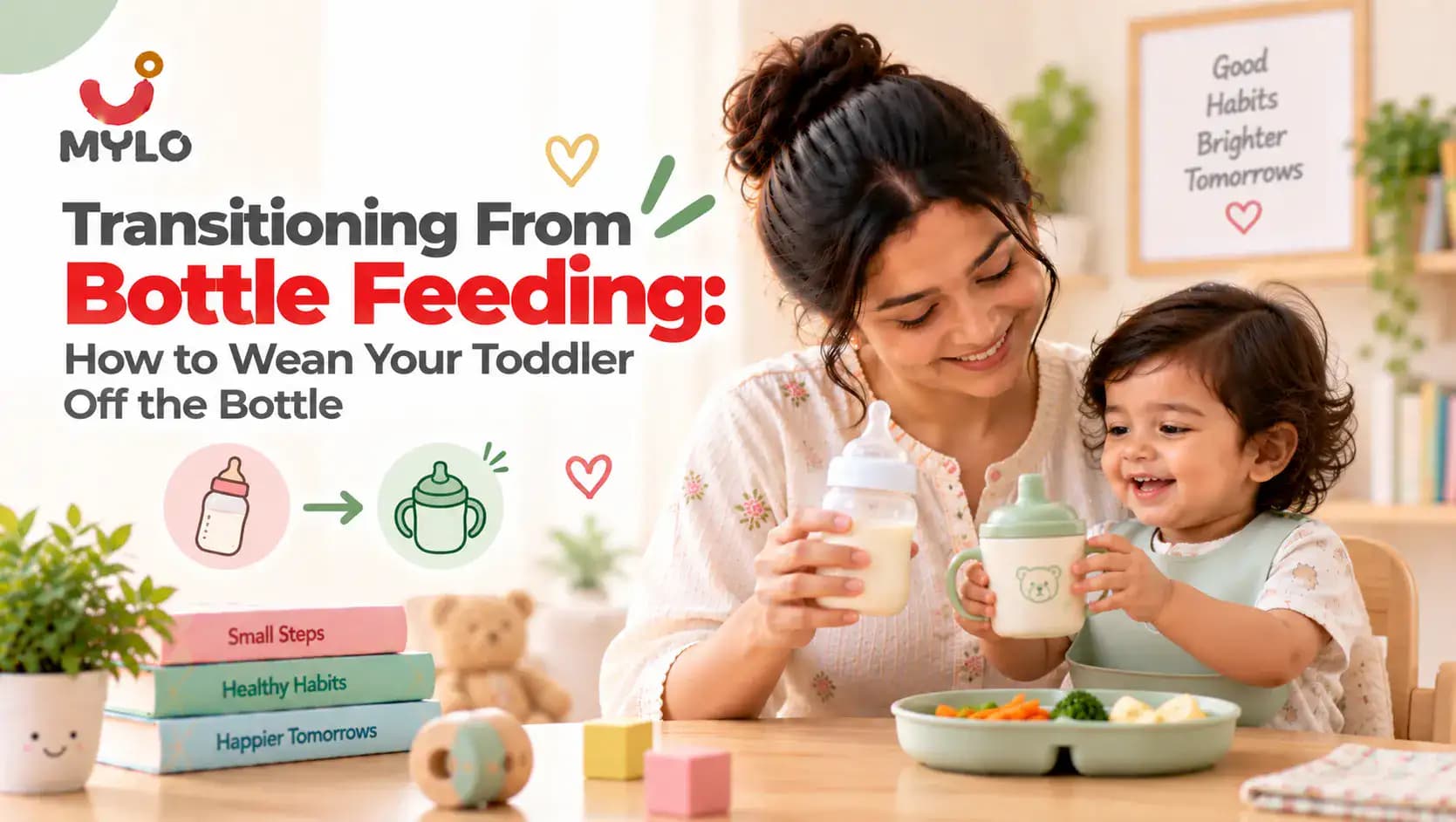
Transitioning From Bottle Feeding: How to Wean Your Toddler Off the Bottle (2026 Guide for Indian Parents)


RMNCH+A, MCH & Midwifery, Program Management & National Trainer (ToT/ToN), WHO, MoHFW, ECHO Model · 11 years experience
 1 Likes|
 18 min
TL;DR
The bottle is a big comfort for babies, but it isn't meant to last forever. The American Academy of Pediatrics recommends introducing a cup around 6 months and finishing bottle weaning by 12 to 18 months. Staying on the bottle too long is linked to tooth decay, drinking too much milk, iron deficiency and a higher risk of obesity. The easiest method is gradual: replace one bottle a week with a cup, starting with the midday bottle and ending with bedtime. Try an open cup or straw cup, and make it fun. Offer lots of cuddles and a new bedtime routine. Most toddlers make the switch in 2 to 4 weeks.
Key Takeaways
Introduce a cup at 6 months, start weaning at 12 months and aim to finish by 18 months
Children still on a bottle at 2 years were about 30% more likely to be obese by 5.5 years
Bedtime bottles are the biggest cause of baby bottle tooth decay
Open cups and straw cups are better for teeth and speech than long-term sippy cups
Gradual weaning (one bottle at a time) is easiest for most families
Always drop the bedtime bottle last
After 12 months, toddlers need only about 300 to 500 ml of milk a day
Replace the comfort of the bottle with cuddles, stories and a soft toy
Expect a few tough days. Consistency wins.
Why Everyone Is Talking About Bottle Weaning
Bottle weaning has become a hot topic for Indian parents:
Pediatric dentists are raising the alarm about early tooth decay from night-time bottles
"Bottle to cup" reels and "bottle goodbye party" videos are going viral on Instagram
Many Indian toddlers still use a bottle at 3 or 4 years, often for night milk
Research links long-term bottle use with obesity, drinking too much milk and picky eating
Parents are rediscovering traditional options like the steel glass, katori-spoon and paladai
If your toddler is still attached to the bottle, you're not alone, and it's never too late to make the switch.
Why Should You Wean Your Toddler Off the Bottle?
Reason | What Happens With Long-Term Bottle Use |
|---|---|
Tooth decay | Milk sitting on teeth, especially at night, causes cavities ("baby bottle tooth decay") |
Too much milk | Toddlers drink more from a bottle, leaving less room for food |
Iron deficiency | Too much milk lowers iron intake and absorption |
Picky eating | A tummy full of milk means less interest in meals |
Obesity risk | Children using a bottle at 24 months had a higher risk of obesity at 5.5 years (study) |
Ear infections | Drinking lying down can let milk flow towards the ears |
Speech and teeth alignment | Long-term sucking may affect how teeth and mouth muscles develop |
Harder to stop later | The older the child, the stronger the habit and attachment |
When Should You Stop Bottle Feeding?
Age | What to Do |
|---|---|
6 months | Introduce a small open cup or straw cup with water during meals |
9 to 12 months | Offer more drinks in a cup; start reducing daytime bottles |
12 months | Begin weaning. Switch from formula to whole cow's milk (if advised by your doctor) and offer it in a cup. |
12 to 18 months | Complete bottle weaning (AAP) |
By 2 years | Your child should drink comfortably from an open cup |
Already past 18 months? Don't worry. Start now using the gradual plan below.
Note on breastfeeding: This guide is about bottles. The WHO recommends continued breastfeeding up to 2 years and beyond, alongside solid foods.
Signs Your Child Is Ready to Say Bye-Bye Bottle
Eating 3 meals and 2 snacks of solid food a day
Able to sit up and hold objects well
Showing interest in your cup or glass
Using the bottle more for comfort than hunger
Around 12 months or older
Choosing the Right Cup
Cup Type | Pros | Cons | Best For |
|---|---|---|---|
Open cup (small steel glass or tumbler) | Best for mouth development, teeth and speech; teaches sipping | Spills while learning | From 6 months, with help |
Straw cup | Easy to learn, fewer spills, good for mouth muscles | Needs cleaning well | From 6 to 9 months |
360 cup (spoutless) | Spill-proof, teaches sipping from the rim | Some toddlers find it hard at first | From 9 to 12 months |
Sippy cup (spout) | Spill-proof and familiar | Similar to a bottle when used all day; not ideal long term | Short-term bridge only |
Paladai or katori-spoon | Traditional Indian option, no teat | Slower, needs adult help | Younger babies |
Pediatric dentists recommend straw cups and open cups over long-term sippy cup use.
Tips for Teaching Cup Drinking
Start with a tiny amount of water so spills don't matter
Hold the cup with your child at first
Sip from your own cup to show them how
Let them choose a cup in their favourite colour or character
Practise at every meal and snack
Praise every sip: "You drank from a big-kid cup!"
3 Ways to Wean Your Toddler Off the Bottle
Method 1: The Gradual Method (Most Recommended)
Replace one bottle at a time with a cup. Start with the least emotional feeding, usually midday, and end with bedtime.
4-Week Bottle Weaning Plan
Week | What to Do |
|---|---|
Week 1 | Replace the midday bottle with milk or water in a cup at lunch |
Week 2 | Replace the afternoon or evening bottle with a cup at snack time |
Week 3 | Replace the morning bottle with milk in a cup at breakfast |
Week 4 | Replace the bedtime bottle (see the bedtime section below) |
Tip: If your child is struggling, stay on the current step for an extra week. Going slow is fine. Going backwards is what makes it harder.
Method 2: Cold Turkey
Some families remove all bottles at once. This works best for:
Toddlers who aren't very attached to the bottle
Families who want a quick, clear change
Older toddlers (2 years and up) who understand explanations
How to do it: Pick a start day, remove all bottles from the house, and offer milk only in a cup. Expect 3 to 7 hard days. Stay calm and consistent, and don't bring the bottle back.
Method 3: The "Bottle Goodbye" Ritual (Great for 2 Years and Up)
Older toddlers love a story and a ceremony:
Bottle Fairy: Your child leaves their bottles out at night, and the "Bottle Fairy" takes them to new babies and leaves a small gift, like a new cup, book or soft toy
Bottle Goodbye Party: Say bye-bye to the bottles together, decorate the new cup and celebrate being a "big kid"
Give them to a baby: Your child "gifts" their bottles to a new baby in the family (or pretends to)
Read a story about giving up the bottle a few days before
Once the bottles are gone, they stay gone.
How to Drop the Bedtime Bottle
The bedtime bottle is usually the hardest to give up because it's linked to comfort and sleep.
Step-by-Step
Move milk earlier: Offer milk in a cup before brushing teeth, not in bed
Brush teeth after milk so no milk stays on the teeth overnight
Build a new bedtime routine: bath, pyjamas, milk in a cup, brushing, 2 stories, a song, lights off
Offer a new comfort: A soft toy, a special blanket, a lullaby or back rubs
Stay close: Give extra cuddles for the first few nights
Water only at night: If your child wakes up thirsty, offer a little water in a cup, never milk or juice in a bottle
Cleveland Clinic notes that separating milk from falling asleep is one of the most helpful steps.
Night Waking for a Bottle
Most healthy toddlers over 12 months don't need milk at night. If your child still wakes for a bottle:
Reduce the amount by 30 ml every 2 to 3 nights
Or water it down gradually until it's just water, then replace with a cup
Comfort with cuddles and patting instead of feeding
Talk to your pediatrician if your child is underweight or has medical needs
How Much Milk Does a Toddler Need After the Bottle?
Age | Milk and Dairy |
|---|---|
1 to 2 years | About 300 to 500 ml a day, plus curd or paneer |
2 to 5 years | About 400 to 500 ml a day across milk, curd and paneer |
Too much milk (over about 500 to 700 ml a day) can crowd out food and lead to iron deficiency and constipation. Read more about milk and appetite in our guide to picky eating in toddlers.
My Toddler Won't Drink Milk From a Cup!
Don't panic. Many toddlers drink less milk once the bottle goes, and that's often a good thing.
Offer milk in a fun cup or with a straw
Try warm or cold milk to see which they prefer
Serve milk with meals rather than on its own
Add dairy to food: curd, paneer, milk-based porridge, dalia, kheer (without added sugar for under 2s) and cheese
Give calcium-rich foods: ragi, til, green leafy vegetables
Don't add sugar, chocolate powder or "health drink" powders to make milk more appealing. It builds a sugar habit.
Handling Tears, Tantrums and Setbacks
It's normal for your toddler to protest. The bottle has been a big comfort.
Challenge | What to Try |
|---|---|
Crying and asking for the bottle | Stay calm, hug them and say "Bottles are all done. Here's your big-kid cup." |
Refusing the cup | Offer it at every meal, let them play with it, and try a straw cup |
Waking at night for a bottle | Cuddles and water in a cup; keep the bedtime routine consistent |
Grandparents giving the bottle | Explain why you're weaning and ask everyone to follow the same plan |
Setback during illness | It's okay to offer extra fluids in a cup. Avoid bringing the bottle back. |
New sibling makes them want the bottle | Common and normal. Offer extra attention and "big sibling" praise (see sibling rivalry). |
Travel or car rides | Pack a spill-proof straw cup |
Pick a calm time to start. Avoid starting during illness, travel, a move, starting playschool or when a new baby arrives.
What to Avoid
Putting your child to bed with a bottle of milk or juice
Letting your toddler walk around with a bottle all day
Filling the bottle with juice, sweetened milk or tea
Using the bottle to stop tantrums
Bringing the bottle back after you've taken it away
Shaming your child: "Only babies drink from bottles!"
Adding sugar to milk to make the cup more appealing
When to Talk to Your Pediatrician
Your child is over 2 years and still very dependent on the bottle
Your child refuses all milk and dairy, or eats very little food
You notice brown or white spots on the teeth, or tooth pain (see a dentist too)
Your child is underweight or not gaining weight well (see what to do if your toddler is underweight)
Your child has trouble drinking from a cup, chewing or swallowing
You're unsure about switching from formula to cow's milk
What Does It Cost in India?
Item | Typical Cost (₹) | Note |
|---|---|---|
Small steel glass or tumbler | ₹50 to ₹200 | A great first open cup |
Straw cup | ₹200 to ₹700 | Choose one that's easy to clean |
360 spoutless cup | ₹300 to ₹900 | Spill-proof option |
Paladai | ₹100 to ₹400 | Traditional Indian feeding cup |
New soft toy or book for "Bottle Fairy" | ₹150 to ₹500 | Optional |
Pediatric dentist check-up | ₹300 to ₹1,000 | Recommended by the first birthday |
Indian Context: What Indian Parents Should Know
Night milk bottles are common in Indian homes, often until 3 or 4 years. Start with gradual steps and a new bedtime routine.
Grandparents may worry that the child won't drink enough milk. Reassure them that 300 to 500 ml of milk a day, plus curd and paneer, is enough.
Go traditional: A small steel glass, katori-spoon or paladai are affordable, easy to clean and great for learning.
Skip sugar and "health drink" powders in milk. They harm teeth and build sugar habits.
Never add tea or coffee to a toddler's bottle or cup.
Clean cups well: Wash straws and valves daily to prevent germs, especially in the monsoon.
Myths vs Facts
Myth | Fact |
|---|---|
"My child won't get enough nutrition without the bottle" | Toddlers get most nutrition from food; 300 to 500 ml of milk a day is enough |
"Sippy cups are the same as open cups" | Long-term spout use is similar to a bottle; open and straw cups are better (dentist advice) |
"Bedtime bottles help toddlers sleep" | They're the main cause of baby bottle tooth decay |
"It's fine to wait until they stop on their own" | The habit gets stronger with age; start by 12 to 18 months (AAP) |
"Adding a little sugar to milk is harmless" | Added sugar isn't recommended under 2 and harms teeth |
"Weaning off the bottle means stopping breastfeeding" | No. Breastfeeding can continue up to 2 years and beyond (WHO) |
FAQs: Weaning Off the Bottle
At what age should I stop bottle feeding?
The AAP recommends introducing a cup at 6 months and completing bottle weaning by 12 to 18 months.
Bachche ki bottle kaise chhudayein? (Hinglish)
Ek-ek karke bottle hataiye. Pehle dopahar ki bottle ki jagah cup ya steel ke glass mein doodh dein, phir shaam ki, phir subah ki, aur sabse aakhir mein raat ki bottle hataiye. Raat ko doodh sone se pehle cup mein dein, phir daant brush karein, aur bottle ki jagah kahani, lori aur cuddles dein.
What is the easiest way to wean off the bottle?
The gradual method: replace one bottle a week with a cup, starting with the midday bottle and ending with the bedtime bottle.
How do I stop the bedtime bottle?
Move milk earlier in the routine, offer it in a cup, brush teeth afterwards, and replace the bottle with stories, songs and a soft toy.
Raat ko bachcha bottle ke bina nahi sota, kya karein? (Hinglish)
Doodh ko bistar se pehle cup mein dein aur uske baad brush karwayein. Naya routine banayein: nahana, kapde, doodh, brush, kahani, lori. Pehle kuch din bachcha royega, lekin pyaar se paas rahein. Raat ko uthe toh sirf thoda paani cup mein dein.
What cup is best after the bottle?
An open cup (like a small steel glass) or a straw cup is best for teeth, speech and mouth development.
Is a sippy cup okay?
It's fine as a short-term bridge, but long-term use is similar to a bottle. Move to open and straw cups.
My toddler refuses milk from a cup. What should I do?
Try a straw or fun cup, serve it with meals, and give dairy in other forms like curd, paneer and porridge. Avoid adding sugar.
How long does bottle weaning take?
Most toddlers adjust within 2 to 4 weeks with the gradual method, or 3 to 7 days with cold turkey.
Can bottle feeding cause tooth decay?
Yes, especially bedtime bottles of milk or juice. Milk sitting on teeth overnight causes cavities.
Should I stop breastfeeding when I stop the bottle?
No. Breastfeeding can continue alongside a cup. The WHO recommends breastfeeding up to 2 years and beyond.
Is it too late to wean my 3-year-old off the bottle?
It's never too late. Older toddlers often do well with the "Bottle Fairy" or a goodbye ritual.
Related Reads on Mylo
References
American Academy of Pediatrics (AAP). "From Bottle to Cup: Helping Your Child Make a Healthy Transition." HealthyChildren.org. https://www.healthychildren.org/English/ages-stages/baby/feeding-nutrition/Pages/Discontinuing-the-Bottle.aspx
American Academy of Pediatrics (AAP). "Weaning From the Bottle: 12 Months or Older." Pediatric Patient Education. https://publications.aap.org/patiented/article/doi/10.1542/ppe_schmitt_278/82285/Weaning-From-the-Bottle-12-Months-or-Older
Gooze RA, Anderson SE, Whitaker RC. "Prolonged Bottle Use and Obesity at 5.5 Years of Age in US Children." Journal of Pediatrics, 2011. PubMed. https://pubmed.ncbi.nlm.nih.gov/21543085/
Cleveland Clinic. "When and How to Wean Your Baby Off the Bottle." https://health.clevelandclinic.org/say-goodbye-to-bottles-and-sippy-cups
The Pediatrician Mom. "How to Transition Your Baby From Bottle to Cup at 12 Months." https://www.thepediatricianmom.com/blog/weaning-bottle
EasyTot. "Bottle to Cup Transition: When and How to Switch (2026)." https://easytot.com/blogs/guides/bottle-to-cup-transition-guide
World Health Organization (WHO). "Infant and Young Child Feeding: Fact Sheet." https://www.who.int/news-room/fact-sheets/detail/infant-and-young-child-feeding
ClinicalTrials.gov. "Feeding Young Children Study: Bottle Weaning Intervention." https://clinicaltrials.gov/study/NCT00756626
Medical Disclaimer
This article is for information only and does not replace professional medical advice. Please consult your pediatrician before switching from formula to cow's milk, or if you have concerns about your child's growth, feeding or dental health.
Shop Now
Baby Essentials




Article Posted Under
Related Articles
Diwali During Pregnancy: Safety Tips for Pregnant Women on Crackers, Sweets and Diet
 17 min
 Best Pregnancy and Parenting App in India: 5 Must-Have Features to Look For (2026)
 20 min
 Best Hairstyles for Postpartum Hair Loss and Regrowth
 10 min
 HairVivine Pro: What This Pumpkin Seed Hair Active Does and What the Studies Show
 15 min
Related Topics
.webp&w=32&q=75)
Medical Disclaimer
This content is for informational purposes only and should not replace professional medical advice. Consult with a physician or other health care professional if you have any concerns or questions about your health. If you rely on the information provided here, you do so solely at your own risk.


AWARDS AND RECOGNITION

Mylo wins Forbes D2C Disruptor award

Mylo wins The Economic Times Promising Brands 2022
AS SEEN IN












- Mylo Care: Effective and science-backed personal care and wellness solutions for a joyful you.
- Mylo Baby: Science-backed, gentle and effective personal care & hygiene range for your little one.
- Mylo Community: Trusted and empathetic community of 10mn+ parents and experts.


Product Categories
Baby Carrier | Baby Soap | Baby Wipes | Stretch Marks Cream | Baby Cream | Baby Shampoo | Baby Massage Oil | Baby Hair Oil | Stretch Marks Oil | Baby Body Wash | Baby Powder | Baby Lotion | Diaper Rash Cream | Newborn Diapers | Teether | Baby Kajal | Baby Diapers Pants | Cloth Diapers | Laundry Detergent | Lactation Granules |