


Orders
.png&w=48&q=75 "login")
Profile


Wallet

What Are the Speech and Language Milestones From 1 to 3 Years? An Age-by-Age Guide for Indian Parents (2026)
 22 min
Quick Answer
Most babies say their first word around 12 months ("mama", "dada" or a special name). By 18 months, most say at least 3 words besides "mama" or "dada" and follow simple directions. By 2 years, most join 2 words together ("more milk") and many use about 50 words (ASHA). By 3 years, most talk in short sentences, hold simple conversations, ask "why" questions and can be understood by others most of the time. Understanding, pointing and gestures matter as much as spoken words. See your pediatrician if your child doesn't point by 15 months, has fewer than 3 words at 18 months, isn't joining words at 2 years, is very hard to understand at 3 years, or loses words they had.
Speech and Language Milestones 1 to 3 Years at a Glance
Age | Understanding (Receptive) | Talking (Expressive) | Talk to a Doctor If |
|---|---|---|---|
12 months | Understands "no", responds to name | Says "mama", "dada" or a special name, waves bye-bye | No babbling, no gestures, no response to name |
15 months | Looks at familiar objects when named, follows directions with gestures | 1 to 2 words besides "mama" or "dada", points to ask | No pointing, no words |
18 months | Follows one-step directions without gestures | 3 or more words besides "mama" or "dada" | Fewer than 3 words, no pointing |
2 years | Points to pictures and 2 or more body parts, follows 2-step directions | 2 words together ("more milk"), often about 50 words | No 2-word phrases |
30 months | Follows 2-step instructions, knows a colour | About 50 words, 2 or more words with an action word, uses "I" and "me" | Far fewer than 50 words |
3 years | Understands "who", "what" and "where" questions | Short sentences, conversations, asks "why", says first name | Very hard to understand, no sentences |
Sources: ASHA 13 to 18 Months, ASHA 19 to 24 Months, ASHA 2 to 3 Years, official AAP and CDC checklists (CDC).
Key Facts Every Parent Should Know
Around 12 months: When most babies say their first real word
About 50 words and 2-word phrases by 2 years: A key milestone according to ASHA
Rule of fourths: Strangers understand roughly 50% of a child's speech at 2 years, 75% at 3 years and nearly all by 4 years (Expressable)
Two languages don't cause speech delay: Bilingual children meet milestones on a similar timeline (ASHA research)
18 and 24 months: When the AAP recommends autism screening, which includes checking communication (AAP)
Since 2022: Official milestones focus on how children use and understand language, not just word counts
What Is the Difference Between Speech and Language?
Short answer: Language is understanding and using words to communicate, including gestures, pointing and following directions. Speech is how clearly your child says the sounds and words. A child can have strong language but unclear speech, or clear speech but limited language.
Language | Speech |
|---|---|
Understanding words and directions (receptive language) | How clearly sounds and words are said |
Using words, phrases and gestures (expressive language) | Pronunciation of sounds like "p", "b", "k", "s" and "r" |
Example: knowing "Bring your shoes" | Example: saying "tar" for "car" |
Checked by: Does your child understand and communicate? | Checked by: Can others understand your child? |
Why this matters: Doctors and speech therapists look at both. A toddler who understands a lot and points to communicate is doing better than word counts alone suggest.
When Do Babies Say Their First Word?
Short answer: Most babies say their first real word around 12 months, usually "mama", "dada" or a special name for a parent. Some say a first word as early as 9 to 10 months, and others a little after their first birthday.
Before First Words | First Words |
|---|---|
Cooing (2 to 4 months) | "Mama", "dada", "baba", "nana" with meaning |
Babbling with repeated sounds like "ba-ba-ba" (6 to 9 months) | Names of people, pets or favourite things |
Babbling with tone, as if talking (9 to 12 months) | Words like "no", "bye", "more" |
Gestures like waving, reaching and pointing | Animal sounds like "moo" or "bow-bow" |
What counts as a word? Any sound your child uses consistently for the same thing, like "ba" for ball or "wawa" for water.
What Are the Speech Milestones at 12 to 18 Months?
Short answer: Between 12 and 18 months, toddlers add new words slowly, point to ask for things, follow simple directions with gestures and understand far more than they can say (ASHA).
Skill | 12 Months | 15 Months | 18 Months |
|---|---|---|---|
Words | "Mama", "dada" or a special name | 1 to 2 more words | 3 or more words besides "mama" or "dada" |
Gestures | Waves bye-bye | Points to ask for things | Points to show you interesting things |
Understanding | Understands "no" | Follows directions with gestures | Follows one-step directions without gestures |
Naming | Responds to their name | Looks at objects you name | Points to 1 or more body parts |
What Are the Speech Milestones at 18 to 24 Months?
Short answer: This is the "word explosion" stage. Many toddlers go from a handful of words to about 50 words by 2 years and start joining 2 words together, like "more water" or "go outside" (ASHA).
Skill | By 2 Years |
|---|---|
Vocabulary | Uses and understands at least 50 words for food, toys, animals and body parts |
Joining words | Puts 2 or more words together: "More milk", "Daddy go" |
Directions | Follows 2-step directions: "Get the spoon and put it on the table" |
Pointing | Points to pictures in books and to body parts when asked |
Gestures | Blows kisses, nods yes, shakes head no |
What Are the Speech Milestones at 2 to 3 Years?
Short answer: Between 2 and 3 years, children move from 2-word phrases to short sentences, start asking questions, use words like "I", "me" and "we", and become much easier to understand. By 3, most can have a simple conversation (ASHA).
Skill | 30 Months | 3 Years |
|---|---|---|
Sentences | 2 or more words with an action word: "Doggie run" | Short sentences of 3 or more words |
Pronouns | Uses "I", "me", "we" | Uses "you", "he" and "she" too |
Grammar | Starts "-ing" words: "eating", "running" | Uses plurals ("cars") and past tense ("played") |
Questions | "What's that?" | "Who?", "What?", "Where?", "Why?" |
Conversation | Short back-and-forth | At least 2 back-and-forth exchanges |
Name | Uses own name | Says first name when asked |
Clarity | Family understands most words | Others understand most of the time |
Repeating words is common: Many 2 to 3 year olds repeat words or sounds, like "I-I-I want juice", as their language grows quickly. ASHA notes this can be normal at this age.
How Clear Should My Toddler's Speech Be?
Short answer: Toddlers aren't expected to speak perfectly. A common guide called the "rule of fourths" says unfamiliar adults should understand about 50% of speech at 2 years, 75% at 3 years and nearly 100% by 4 years (Expressable). Newer research suggests clarity develops gradually, so use this as a rough guide, not a strict rule (JSLHR).
Age | How Much Strangers Understand (Approximate) |
|---|---|
1 year | About 25% |
2 years | About 50% |
3 years | About 75% |
4 years | Nearly 100% |
Which Sounds Come First?
Earlier Sounds (1 to 3 Years) | Later Sounds (4 to 7 Years) |
|---|---|
p, b, m, n, w, h | s, z, sh, ch, j |
t, d, k, g | l, r, th, v |
It's normal for a 2 or 3-year-old to say "tat" for "cat" or "wabbit" for "rabbit".
Is My Toddler a Late Talker?
Short answer: A toddler may be a late talker if they understand well but say far fewer words than expected, for example fewer than 50 words or no 2-word phrases by 2 years. Many late talkers catch up, but some need help, so it's always better to check early than to wait.
Probably Fine | Talk to Your Doctor |
|---|---|
Understands a lot, follows directions | Doesn't understand simple words or directions |
Uses gestures and points | Doesn't point or use gestures |
Adding new words every week | No new words for months |
Copies sounds and words | Rarely copies sounds or words |
Responds to their name | Doesn't respond to their name |
Plays and interacts with you | Little eye contact or interest in people |
Red Flags by Age
Age | Red Flag |
|---|---|
Any age | Loses words or skills they had (see a doctor right away) |
12 months | No babbling, no gestures like waving, doesn't respond to name |
15 months | Doesn't point, no words |
18 months | Fewer than 3 words, doesn't point to show things, doesn't follow simple directions |
2 years | Doesn't join 2 words, has very few words, copies words but doesn't use them to communicate |
30 months | Far fewer than 50 words, no word combinations |
3 years | No short sentences, very hard to understand, doesn't ask questions or have conversations |
Always ask for a hearing test. Hearing problems, including fluid from repeated ear infections, are a common and treatable cause of speech delay.
Do Two or More Languages Cause Speech Delay?
Short answer: No. Learning two or more languages does not cause speech or language delay. Research published by ASHA shows bilingual children reach milestones on a similar timeline to children who learn one language (ASHA research).
What's Normal in Bilingual Toddlers | What's Not Explained by Bilingualism |
|---|---|
Mixing words from both languages | Very few words in all languages combined |
Knowing some words in one language and others in the other | Not understanding simple directions in any language |
A short "silent period" when starting a new language at playschool | No pointing, gestures or interest in communicating |
Total vocabulary across languages similar to peers | Losing words or skills |
Tip for Indian families: Count words in all languages together. A toddler who says "paani", "milk" and "ball" has 3 words. Speaking your home language (Hindi, Tamil, Bengali or any other) is great for your child's development. See our guide on early English as a second language.
Does Screen Time Affect Speech Development?
Short answer: Too much screen time, especially background TV and mobile use during meals, can reduce the back-and-forth conversation toddlers need to learn language. The AAP advises avoiding screens other than video calls before 18 months, and about 1 hour a day of good-quality content, watched together, from 2 to 5 years.
Instead of Screens | Try This |
|---|---|
Rhyme videos | Sing rhymes together with actions |
Cartoons during meals | Talk about the food, colours and tastes |
Phone to calm tantrums | Name the feeling: "You're angry" |
TV on in the background | Turn it off during play |
How Can I Help My Toddler's Speech and Language?
Short answer: Talk, read, sing and play together every day, respond to your child's sounds and words, add one word to what they say, and give them time to reply. Real conversation is the best speech therapy at home.
Tip | Example |
|---|---|
Talk through the day | "Now we're washing your hands. Splash, splash!" |
Add one word | Child: "Ball." You: "Big ball!" |
Wait and pause | Give 5 seconds for your child to respond |
Offer choices | "Roti or rice?" |
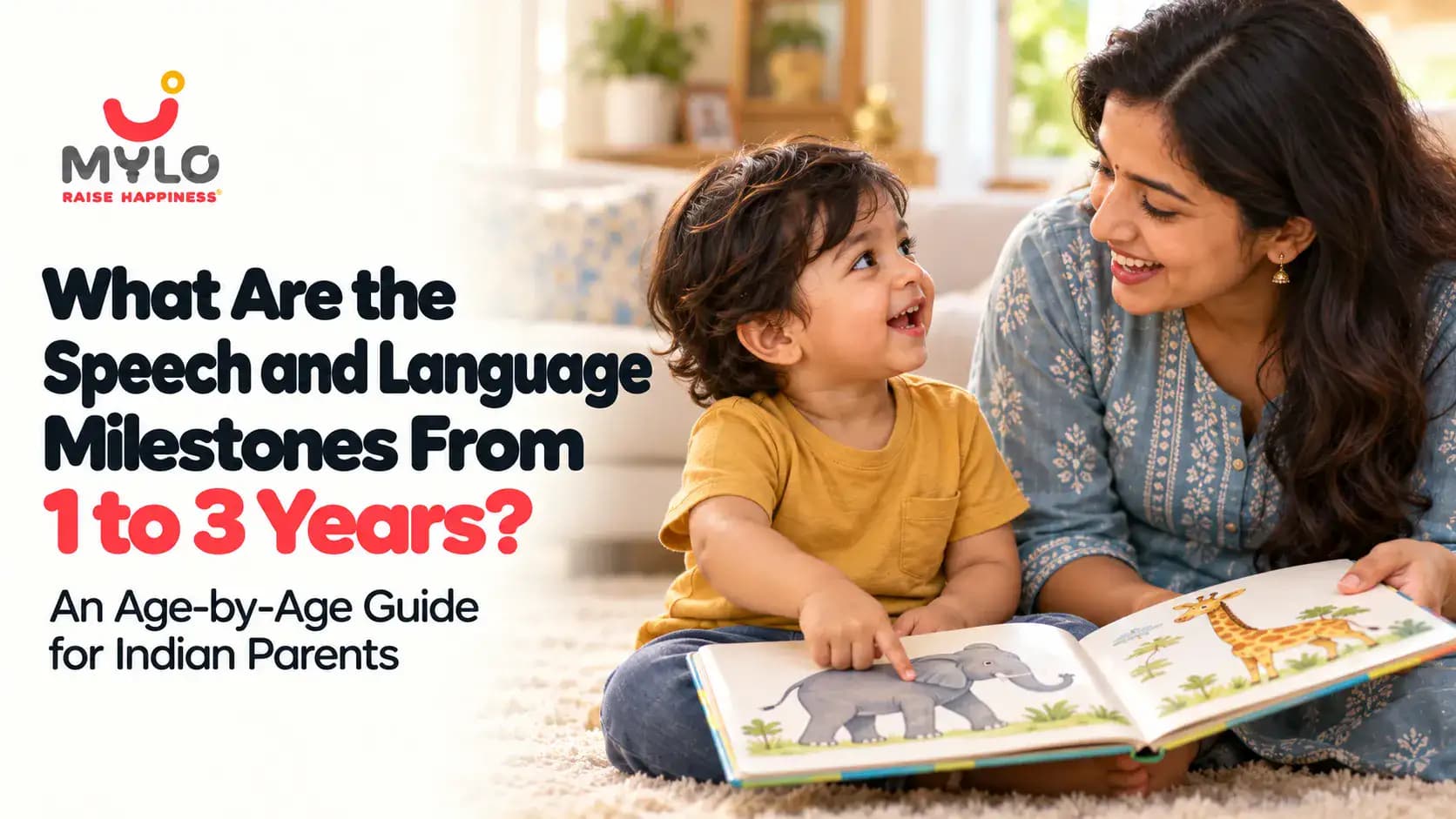
Read every day | Point and name: "Look, an elephant!" |
Sing with actions | "Machli Jal Ki Rani Hai", "Twinkle Twinkle" |
Get down to their level | Face-to-face helps them see your mouth |
Don't force them to repeat | Model the right word instead |
For 20 detailed ideas, read amazing ways to help your toddler talk.
Who Can Help if My Toddler Has a Speech Delay?
Short answer: Start with your pediatrician, who may refer you to an audiologist (for a hearing test) and a speech-language pathologist (speech therapist). Early help works best, and many children catch up well with support.
Professional | How They Help |
|---|---|
Pediatrician | First check-up and referrals |
Audiologist | Hearing tests |
Speech-language pathologist (SLP) | Assesses and treats speech and language delays |
ENT specialist | Checks ears, tonsils, adenoids and tongue tie |
Developmental pediatrician | Assesses overall development if there are several concerns |
Free Government Support in India
Service | What It Offers |
|---|---|
Rashtriya Bal Swasthya Karyakram (RBSK) | Free screening for developmental delays and hearing problems |
District Early Intervention Centres (DEIC) | Free assessment, speech therapy and audiology |
Anganwadi centres | Early learning activities and referrals |
Read our guide on identifying developmental disorders in toddlers.
What Should Indian Parents Keep in Mind?
Short answer: Don't wait and watch if you're worried, avoid comparing children, speak your home language freely, limit screens, and ask for a hearing test if speech is delayed.
Common Belief | Better Approach |
|---|---|
"Boys talk late, don't worry" | Any toddler who misses milestones should be checked |
"His father also talked late" | Family history doesn't replace a check-up |
"Two languages will confuse the child" | Speak your home language; bilingualism doesn't cause delay |
"She'll talk once she goes to school" | Early speech therapy works best before school |
Phone during meals | Talk and eat together |
Correcting every wrong word | Model the right word gently instead |
"Tongue tie is always the cause" | Most speech delays aren't caused by tongue tie; see a doctor |
Myths vs Facts About Speech and Language Milestones
Myth | Fact |
|---|---|
"Bilingual children always talk late" | Bilingual children meet milestones on a similar timeline (ASHA research) |
"Boys naturally talk late, so there's no need to check" | Any child missing milestones should be checked, regardless of gender |
"Only spoken words count" | Pointing, gestures and understanding are key milestones |
"Educational videos teach toddlers to talk" | Toddlers learn language best from real conversation |
"A late talker will always catch up on their own" | Many do, but some need help, so check early |
"Repeating words means my child has a stutter" | Repeating words is common between 2 and 5 years; check if it lasts or comes with struggle |
Frequently Asked Questions About Speech and Language Milestones
When do babies start talking?
Most babies say their first word around 12 months. Some start at 9 to 10 months, others a little after their first birthday.
Bachcha kab bolna shuru karta hai? (Hinglish)
Zyada tar bachche lagbhag 12 mahine mein pehla shabd bolte hain, jaise "mama", "papa" ya "dada". 18 mahine tak kam se kam 3 aur shabd, 2 saal tak 2 shabd jod kar ("aur doodh") aur 3 saal tak chhote vakya bolne lagte hain.
How many words should a 1-year-old say?
Usually 1 to 3 words, like "mama", "dada" or a special name. Gestures like waving and pointing are just as important.
How many words should an 18-month-old say?
At least 3 words besides "mama" or "dada". Many say more.
How many words should a 2-year-old say?
Many use about 50 words and join 2 words together, like "more milk".
When should a toddler speak in sentences?
Most join 2 words by 2 years and speak in short sentences of 3 or more words by 3 years.
How clear should a 3-year-old's speech be?
People outside the family should understand about 75% of what your child says, or "most of the time".
Do two languages cause speech delay?
No. Bilingual children meet milestones on a similar timeline. Count words in all languages together.
Mera 2 saal ka bachcha nahi bolta, kya karein? (Hinglish)
Agar bachcha 2 saal tak 2 shabd jod kar nahi bolta, bahut kam shabd bolta hai, ishaara nahi karta ya naam pukarne par nahi dekhta, toh doctor se milein aur hearing test karwayein. Speech therapy jaldi shuru karne se bahut fayda hota hai. Ghar par roz baat karein, kitaab padhein aur mobile kam karein.
Is repeating words normal at 2 to 3 years?
Often, yes. Many toddlers repeat words or sounds as their language grows. See a doctor if it lasts more than 6 months or comes with tension or distress.
Does screen time cause speech delay?
Too much screen time can reduce the conversation toddlers need to learn language. Limit screens and talk, read and play together instead.
When should I worry about my toddler's speech?
If your child doesn't point by 15 months, has fewer than 3 words at 18 months, isn't joining words by 2 years, is very hard to understand at 3, or loses words, speak to your pediatrician.
Related Reads on Mylo
References
American Speech-Language-Hearing Association (ASHA). "Communication Milestones: 13 to 18 Months." https://www.asha.org/public/developmental-milestones/communication-milestones-13-to-18-months/
American Speech-Language-Hearing Association (ASHA). "Communication Milestones: 19 to 24 Months." https://www.asha.org/public/developmental-milestones/communication-milestones-19-to-24-months/
American Speech-Language-Hearing Association (ASHA). "Communication Milestones: 2 to 3 Years." https://www.asha.org/public/developmental-milestones/communication-milestones-2-to-3-years/
American Speech-Language-Hearing Association (ASHA). "Communication Milestones: Age Ranges." https://www.asha.org/public/developmental-milestones/communication-milestones/
Journal of Speech, Language, and Hearing Research (ASHA). "Exploring Assumptions of the Bilingual Delay in Children With and Without Developmental Language Disorder" (2023). https://pubs.asha.org/doi/10.1044/2023_JSLHR-23-00117
"Speech Development Between 30 and 119 Months in Typical Children I: Intelligibility Growth Curves." PMC. https://www.ncbi.nlm.nih.gov/pmc/articles/PMC9132140/
Expressable. "How Well Should Your Child's Speech Be Understood?" https://www.expressable.com/learning-center/babies-and-toddlers/how-well-should-your-childs-speech-be-understood
American Academy of Pediatrics (AAP). "How Pediatricians Screen for Autism." HealthyChildren.org. https://www.healthychildren.org/English/health-issues/conditions/Autism/Pages/How-Doctors-Screen-for-Autism.aspx
Centers for Disease Control and Prevention (CDC). "CDC's Developmental Milestones." https://www.cdc.gov/act-early/milestones/index.html
Medical Disclaimer
This article is for information only and does not replace professional medical advice. Every child develops at their own pace. If you have concerns about your child's speech, language or hearing, please consult your pediatrician or a qualified speech-language pathologist.


Shop Now
Baby Essentials





Article Posted Under
Related Articles

Related Topics
.webp&w=32&q=75)
Medical Disclaimer
This content is for informational purposes only and should not replace professional medical advice. Consult with a physician or other health care professional if you have any concerns or questions about your health. If you rely on the information provided here, you do so solely at your own risk.


AWARDS AND RECOGNITION

Mylo wins Forbes D2C Disruptor award

Mylo wins The Economic Times Promising Brands 2022
AS SEEN IN












- Mylo Care: Effective and science-backed personal care and wellness solutions for a joyful you.
- Mylo Baby: Science-backed, gentle and effective personal care & hygiene range for your little one.
- Mylo Community: Trusted and empathetic community of 10mn+ parents and experts.


Product Categories
Baby Carrier | Baby Soap | Baby Wipes | Stretch Marks Cream | Baby Cream | Baby Shampoo | Baby Massage Oil | Baby Hair Oil | Stretch Marks Oil | Baby Body Wash | Baby Powder | Baby Lotion | Diaper Rash Cream | Newborn Diapers | Teether | Baby Kajal | Baby Diapers Pants | Cloth Diapers | Laundry Detergent | Lactation Granules |