


Orders
.png&w=48&q=75 "login")
Profile


Wallet

Pros and Cons of Disposable Diapers: An Honest Assessment
 18 min
Quick Answer
Disposable diapers win on convenience, dry surface time and no laundry, which is why most Indian families use them. They lose on recurring cost, landfill waste and the fact that there is no household recycling route for them in India. What they do not do is prevent diaper rash, and no good trial evidence shows they cause less rash than cloth.
Key Takeaways
The genuine advantage is the gel core, which converts urine into gel and keeps the surface drier for longer than cloth can.
The genuine disadvantage is cost over two to three years, and that it rises as your baby moves into larger sizes.
A Cochrane review found not enough randomised trial evidence to support or refute disposables for preventing nappy rash. The claim that they are better for skin is not established.
There is no household route to recycle a used disposable diaper in India. Containment and worker safety are the realistic goals, not recovery.
"Up to 12 hours" describes leak protection, not wear time, and misreading it is one of the real risks of the format.
Neither disposables nor cloth is straightforwardly greener. One creates landfill waste, the other uses water, detergent and energy.
What Are Disposable Diapers?
Single use absorbent garments built in layers, designed to pull urine away from the skin and lock it into a core.
Layer | What it does |
|---|---|
Top sheet | The soft non woven layer against the skin, which lets urine pass inward |
Acquisition or distribution layer | Spreads urine across the core rather than letting it pool in one place |
Absorbent core | Super absorbent polymer plus wood pulp. This is what converts urine to gel |
Back sheet | The waterproof outer film that keeps clothes dry |
Elastic cuffs and waistband | Create the seal that stops leaks |
Wetness indicator | On many products, a strip that changes colour as it gets wet |
The super absorbent polymer core is the whole reason disposables behave differently from cloth. Cloth holds urine as liquid in its fibres, so the wet layer is the layer touching your baby. A gel core holds it below the top sheet. Everything else in this comparison follows from that one difference.
They come in two formats, taped and pull on pants. If you are choosing between those, see taped diapers versus diaper pants.
What Are the Real Advantages?
Advantage | How real it is |
|---|---|
Dry surface time | Genuine, and the main one. The gel core keeps the top sheet drier than wet cloth fibres can, which is why a disposable can cover one long stretch such as night sleep |
No laundry | Genuine, and larger than it sounds in an Indian monsoon, when cloth inserts can take over a day to dry indoors |
Convenience for travel and clinic visits | Genuine. Trains, flights and hospital days give you no reliable place to rinse and store cloth |
Wetness indicator | Genuine and underrated. It replaces a judgement call with a visible signal, which matters when changes are shared with a grandparent or helper |
Predictable sizing | Reasonably genuine. Weight based sizes are broadly standardised, so moving up a size is straightforward |
No upfront cost | Genuine, and it matters for households that cannot spend on a cloth stash in one go |
Easier for shared caregiving | Genuine. Anyone can put one on correctly with almost no instruction |
"Keeps skin healthy" | Overstated. Keeping the surface drier is real, but it does not follow that rash is prevented. See the evidence section below |
What Are the Real Disadvantages?
Disadvantage | How much it matters |
|---|---|
Recurring cost | The biggest one. You buy roughly 300 to 360 a month in the newborn weeks and 150 to 240 a month later, for two to three years |
Cost rises with size | Larger diapers cost more each, so your monthly spend does not fall as fast as the number of changes does |
Landfill waste | Real. A disposable diaper combines plastic, absorbent polymer and cellulose, and does not break down within a human lifetime in landfill conditions |
No recycling route in India | Real. The technology exists in a few countries but not at scale here, so there is no household path to recovery |
Less breathable than cloth | Varies by product. In 35 degree heat a less breathable back sheet keeps skin damp for longer, which matters more in India than in temperate climates |
Absorbency claims invite leaving them on too long | Real, and arguably the most harmful drawback. "Up to 12 hours" describes leak protection, not wear time, and reading it as permission causes rashes |
Ongoing waste handling at home | Since 1 April 2026 used diapers are classified as sanitary waste in India and must be wrapped and kept separate. See how to dispose of used diapers |
Fit is fixed on pull on pants | Minor but real. Unlike tapes, you cannot fine tune the fit, so size errors show up as leaks |
You cannot reuse a barely wet one | Once the core absorbs urine it cannot be reset, which is a genuine source of waste and irritation |
Do Disposable Diapers Cause Less Diaper Rash Than Cloth?
The honest answer is that this has not been established, and it is worth saying clearly because the opposite is widely implied in advertising.
The mechanism argument is sound as far as it goes. Irritant diaper rash develops when three things line up: skin stays damp and over hydrated, it rubs against a wet surface, and it sits in urine and stool that raise the skin's pH and activate enzymes which break down the barrier. A gel core keeps the surface drier, so in principle it should reduce the first of those three.
But a Cochrane review looking at exactly this question concluded there is not enough evidence from good quality randomised controlled trials to support or refute the use of disposable nappies for preventing napkin dermatitis. The mechanism is plausible. The clinical outcome is not proven.
What is well supported is much simpler: change the diaper as soon as it is wet or soiled. That is the shared instruction from the NHS, the American Academy of Pediatrics and the Indian Academy of Pediatrics, and it does more for your baby's skin than the choice between formats. Cloth changed promptly is gentle. A disposable left on for six hours is not.
So the fair summary is that disposables give you more margin for error, not better skin outcomes. If your baby has a rash now, see how to treat diaper rash.
What Do Disposables Actually Cost?
Rather than quoting a savings figure that will be out of date by the time you read it, here is the calculation. It takes two minutes with your own prices.
Monthly spend = diapers per day x price per diaper x 30
Age | Diapers per day | Per month | What to watch |
|---|---|---|---|
0 to 6 weeks | 10 to 12 | 300 to 360 | Buy small packs. Babies leave New Born size within 4 to 6 weeks and large packs get wasted |
6 weeks to 3 months | 8 to 10 | 240 to 300 | Sizes still changing fast, so medium packs |
3 to 12 months | 6 to 8 | 180 to 240 | Jumbo packs pay off here, since babies stay in M and L longer |
1 to 3 years | 5 to 7 | 150 to 210 | Fewer changes but higher price per diaper, so spend falls less than you expect |
Three things that genuinely reduce the total:
Buy the largest pack you will finish before your baby changes size. Price per diaper drops meaningfully on jumbo packs, but only if you use them.
Use cloth for the daytime hours you can manage and disposables for nights, travel and monsoon weeks. This is the most common real world routine in India and it is a sensible allocation rather than a compromise. See the cloth diaper beginner guide.
Get the size right. Leaks mean discarded diapers plus laundry. Most leaks are size and fit problems, not absorbency problems.
Are Disposables Worse for the Environment?
On landfill, yes clearly. Overall, it is genuinely more balanced than either side admits.
Against disposables: they are single use, they combine plastic with absorbent polymer and cellulose, and they will not break down in landfill within a human lifetime. You will see figures like 200 to 500 years quoted widely. Those numbers are repeated far more often than they are evidenced, so it is more accurate to say simply that a disposable diaper does not decompose in any meaningful timeframe. And in India there is no household recycling route at all.
Against cloth: it shifts the impact rather than removing it. Hundreds of wash and dry cycles consume water, detergent and energy, and in parts of India where water is genuinely scarce that is not a trivial trade. How you wash and dry, and whether a second child uses the same set, changes the answer substantially.
What is not a real solution: biodegradable or compostable disposable diapers. Most require industrial composting conditions that Indian households cannot access, and in landfill they behave much like a standard diaper. Judge them on fit, absorbency and price rather than on the environmental claim.
If reducing waste matters to you, the honest levers are using cloth for part of the day, avoiding a size too small so you are not discarding barely used diapers, and wrapping in newspaper rather than a fresh plastic bag each time.
Who Do Disposables Suit Best?
Rather than a verdict, here is who each option genuinely fits.
Your situation | What tends to work |
|---|---|
You cannot reliably wash and dry every day | Disposables. A cloth routine you cannot sustain costs more than disposables would have |
You live somewhere with a long humid monsoon | Disposables for those months at least, because inserts that will not dry stop the rotation |
Long sleep stretches, or a baby with past rash | Disposables overnight. Cloth needs changing after roughly every pee |
Frequent travel, or hospital and clinic visits | Disposables for those days |
Running cost is your main concern | Cloth for the daytime hours, disposables for the rest |
Landfill waste is your main concern | Cloth for as much of the day as you can sustain |
Shared caregiving with several people | Disposables with a wetness indicator, because there is nothing to learn and nothing to judge |
Newborn under 5 kg | Either, but you need a genuine New Born size. Most one size cloth diapers start from about 3 months and gap at the legs on a small newborn |
What Should You Look For When Buying?
Briefly, because we cover this properly elsewhere. Prioritise the size that matches your baby's current weight, a breathable outer layer, soft leg elastic that does not leave a deep mark, fragrance free materials, and a wetness indicator. Compare price per diaper rather than price per pack.
What not to prioritise: absorbency. Nearly every disposable sold in India uses the same gel core technology, so it is the least differentiated thing on the pack. The full selection framework is in how to choose the best diaper for your baby, and sizes by weight are in the diaper size and weight chart.
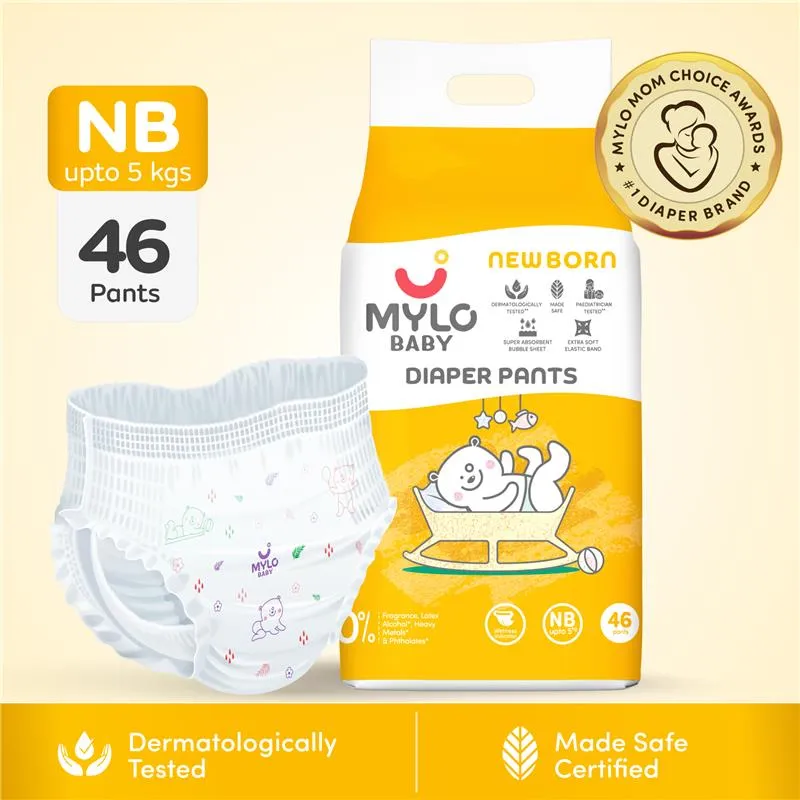
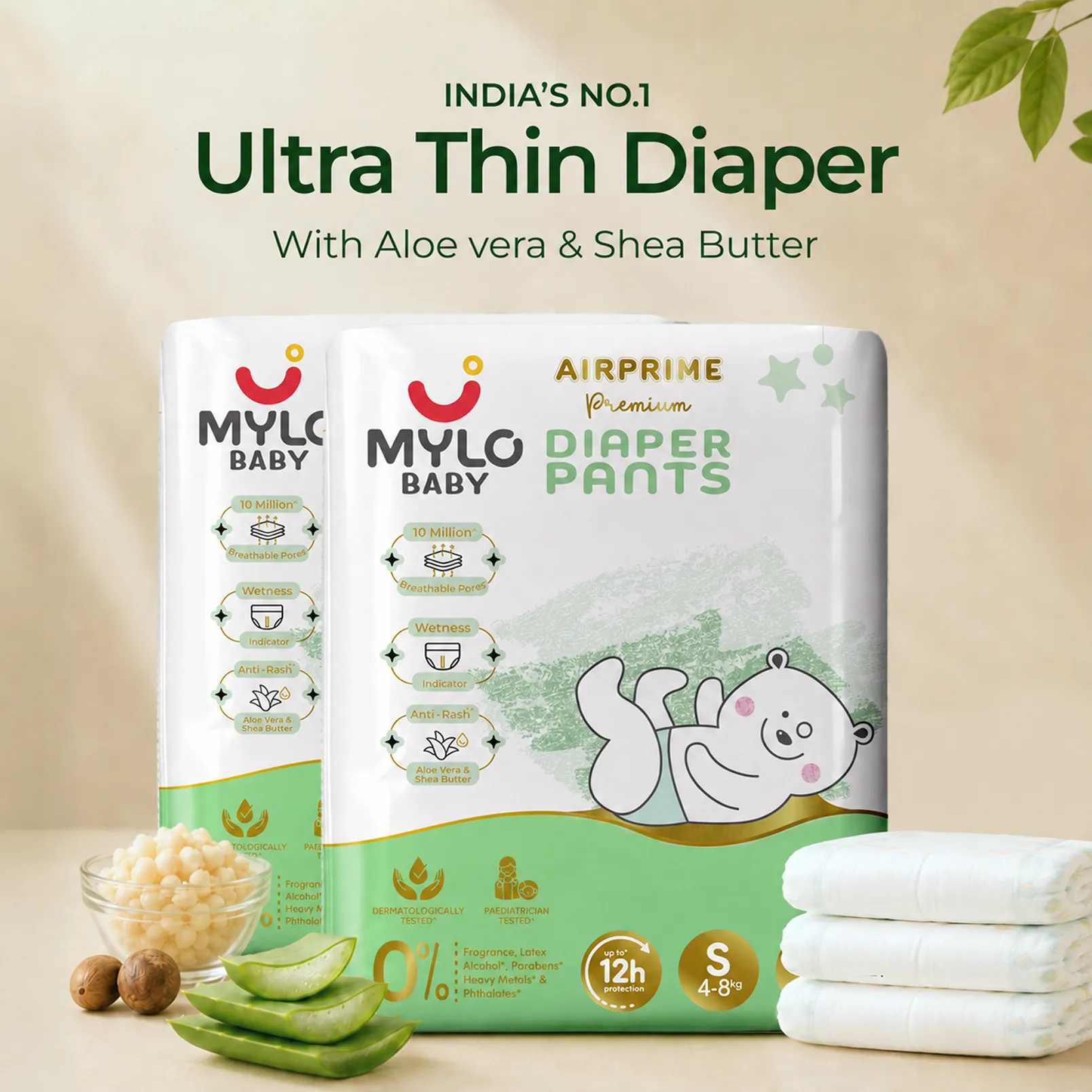
Mylo's own range covers New Born up to 5 kg in 46 count and 92 count, with a tape style option for while the umbilical stump heals, through to Airprime XL at 12 to 17 kg and XXL at 15 to 25 kg in the premium range. Compare everything in the baby diaper collection.
What no disposable diaper does, ours included: prevent diaper rash, or remove the need to check your baby. Absorbency figures describe capacity under test conditions, not how long a diaper should stay on.
Mylo Parents Asked
Are disposable diapers safe for my baby?
Used as intended, yes. They are in everyday use worldwide including in neonatal units. The two things that matter are changing promptly and getting the size right. If your baby has sensitive skin, choose fragrance free and dye free, and see our guide on diapers for sensitive skin and eczema.
Do disposable diapers cause diaper rash?
Not by themselves. Rash comes from prolonged contact with urine and stool plus friction, so a disposable left on too long causes rash just as cloth does. Changing promptly is what prevents it, and no diaper format prevents it on its own.
Are disposables better for my baby's skin than cloth?
They keep the surface drier, which is a real difference. But a Cochrane review found insufficient trial evidence to say disposables prevent nappy rash compared with cloth. They give you more margin for error rather than better skin outcomes.
How often should I change a disposable diaper?
Every 2 to 3 hours for a newborn, which is 10 to 12 times a day, and every 3 to 4 hours from about 3 months. Soiled diapers immediately. Full detail in how often to change your baby's diaper.
Does "up to 12 hours protection" mean I can leave it on for 12 hours?
No, and this is the most consequential misreading on any diaper pack. That figure describes how long the core resists leaking. It says nothing about whether your baby's skin should be against a full diaper for that long, and it says nothing at all if there is stool in it. Use high absorbency for one long stretch such as night sleep, and change normally the rest of the day.
Disposable or cloth, which is better?
Neither, in the abstract. Disposables win on convenience, dry surface time and no laundry. Cloth wins on running cost and landfill waste, provided you can change after every pee and dry reliably. Most Indian families end up using both, cloth for the predictable hours at home and disposables for nights, travel and monsoon.
Can I reuse a disposable diaper if it is only slightly wet?
No. Once the core has absorbed urine it cannot be reset, and putting it back means putting your baby's skin back against that moisture. If waste and cost are the concern, cloth for the daytime hours is the option that actually addresses it.
Are biodegradable disposable diapers worth paying more for?
Usually not in India. Most need industrial composting conditions that households do not have access to, and in landfill they behave much like a standard diaper. Judge them on fit, absorbency and price instead.
When Should You Speak to a Doctor?
Diaper choice is not a medical decision, but contact your paediatrician if you notice:
A rash that has not improved within 2 to 3 days of frequent changing and a thick barrier cream
Blisters, open sores, pus, yellow crusting or bleeding in the diaper area
A bright red rash with a clear border and small spots spreading beyond it, which suggests a fungal infection needing prescribed treatment
Fever alongside a rash in the diaper area
Deep marks or broken skin at the waist or thighs that do not settle after moving up a size
Far fewer wet diapers than usual, dark urine, or a baby who is unusually drowsy or hard to rouse
This article is general information and does not replace an examination.
Bottom Line
Disposables buy you convenience, dry surface time and freedom from laundry, and those are real. They cost you money every month for two to three years and they end up in landfill with no recycling route in India. What they do not buy you is protection from diaper rash, because that depends on how often you change rather than what you change into. Most families land on a mix, and that is a sensible answer rather than an indecisive one.
References
Baer EL, Davies MW, Easterbrook KJ. Disposable nappies for preventing napkin dermatitis in infants. Cochrane Database of Systematic Reviews.
NHS, UK. Nappy rash.
AAP, HealthyChildren.org. Common Diaper Rashes and Treatments.
Stamatas GN, Tierney NK. Diaper dermatitis. Pediatric Dermatology. 2014;31(1):1-7.
Indian Academy of Pediatrics. IAP Guidelines for Pediatric Skin Care. Indian Pediatrics. 2021.
StatPearls. Diaper Dermatitis.
Solid Waste Management Rules, 2026, Government of India, in force from 1 April 2026.

Shop Now
New Baby Essentials
.webp&w=1900&q=75)
Mylo Baby New Born Diaper Pants | 92 Count (Pack of 2)
Wetness Indicator | Lightweight | Rash Free | 12 Hours Protection | ADL Technology




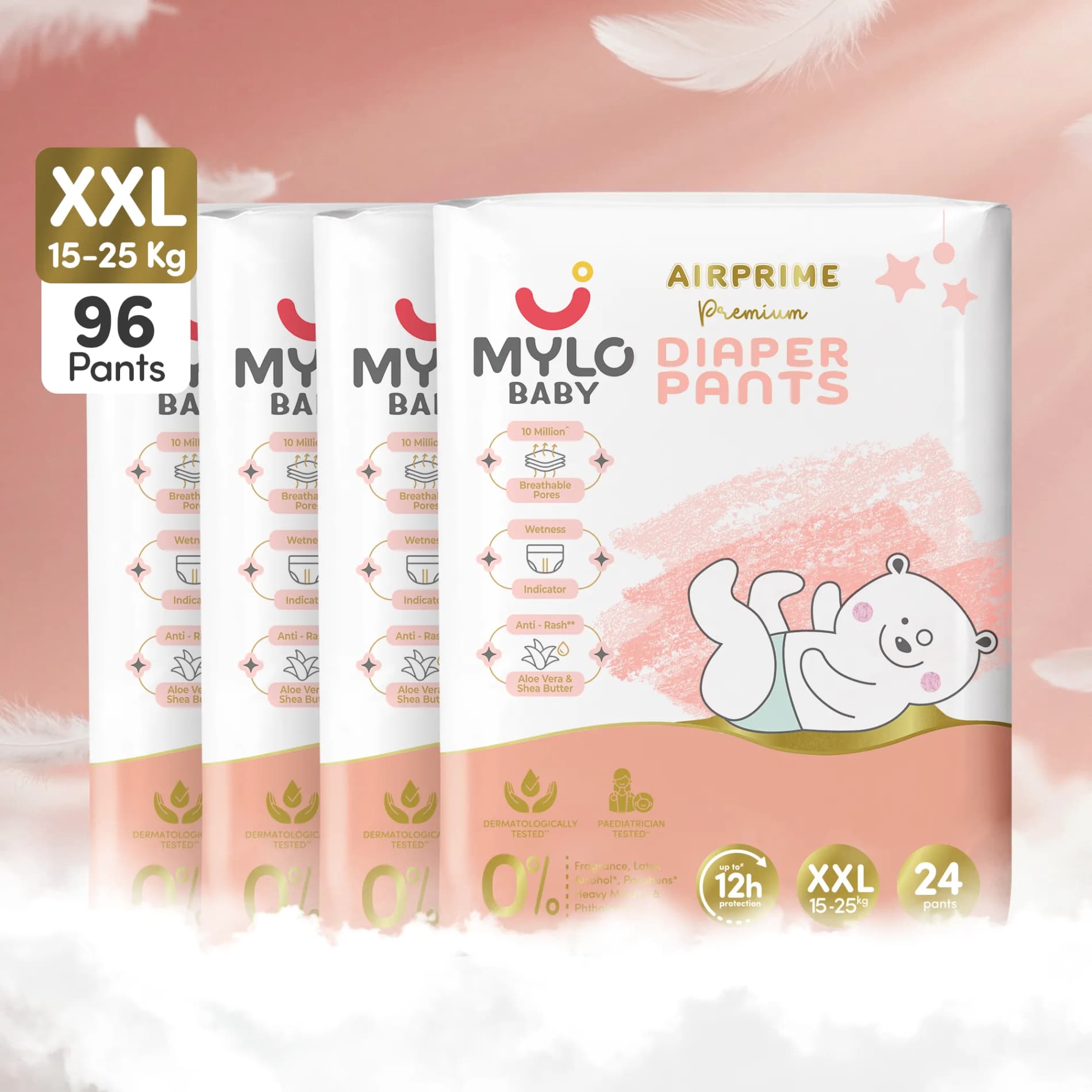
Mylo Airprime™ Premium Diapers Pants with Wetness Indicator - XXL(15-25 kgs) - 96 counts
Ultra-thin | 10 M+ Micro pores | Anti-Rash with Aloe Vera and Shea Butter

Article Posted Under
Related Articles


Related Topics
.webp&w=32&q=75)
Medical Disclaimer
This content is for informational purposes only and should not replace professional medical advice. Consult with a physician or other health care professional if you have any concerns or questions about your health. If you rely on the information provided here, you do so solely at your own risk.


AWARDS AND RECOGNITION

Mylo wins Forbes D2C Disruptor award

Mylo wins The Economic Times Promising Brands 2022
AS SEEN IN












- Mylo Care: Effective and science-backed personal care and wellness solutions for a joyful you.
- Mylo Baby: Science-backed, gentle and effective personal care & hygiene range for your little one.
- Mylo Community: Trusted and empathetic community of 10mn+ parents and experts.


Product Categories
Baby Carrier | Baby Soap | Baby Wipes | Stretch Marks Cream | Baby Cream | Baby Shampoo | Baby Massage Oil | Baby Hair Oil | Stretch Marks Oil | Baby Body Wash | Baby Powder | Baby Lotion | Diaper Rash Cream | Newborn Diapers | Teether | Baby Kajal | Baby Diapers Pants | Cloth Diapers | Laundry Detergent | Lactation Granules |