


Orders
.png&w=48&q=75 "login")
Profile


Wallet

Toddler Throwing Things: Why It Happens and What to Do
 20 min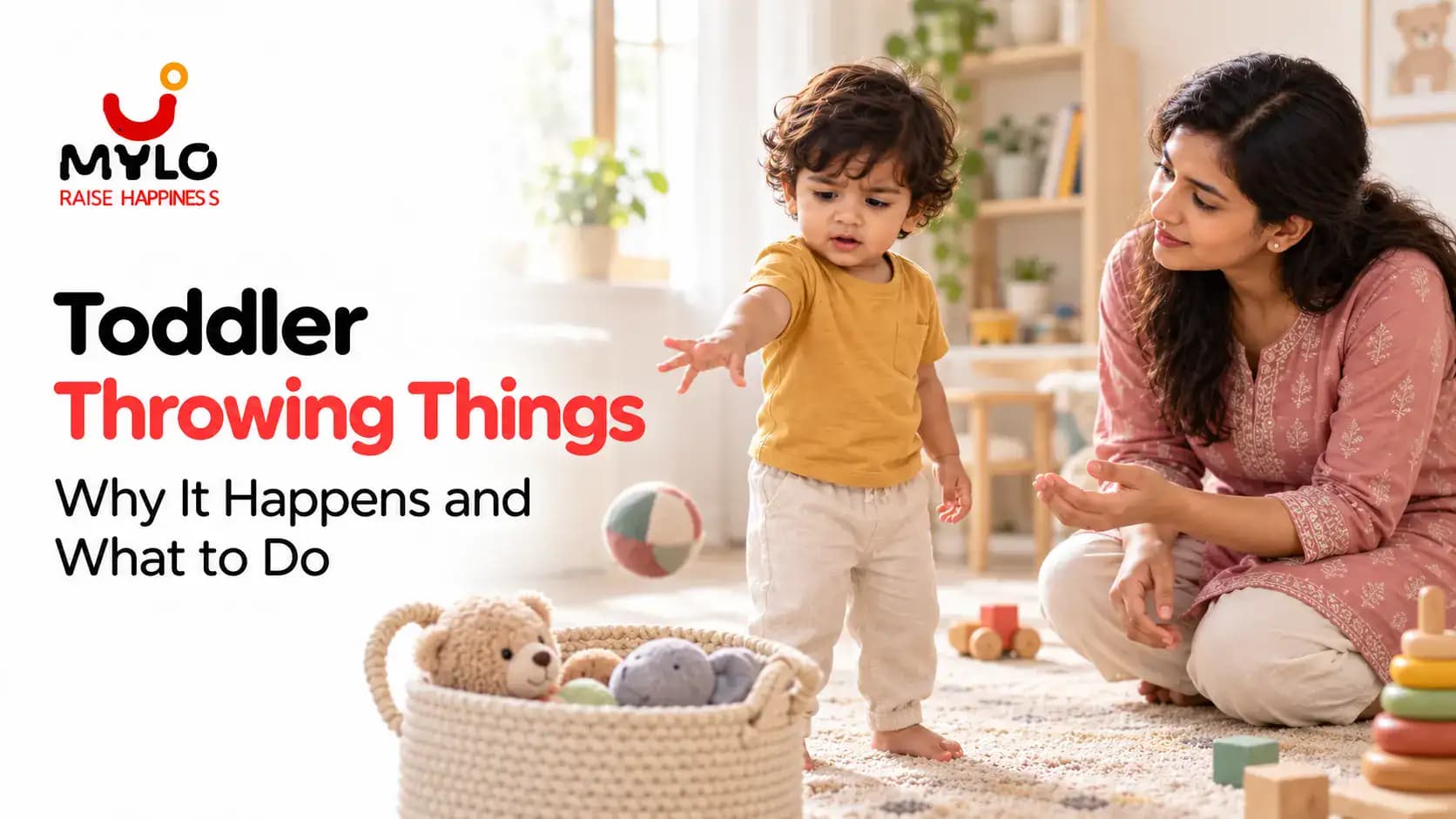
Quick Answer
Toddler throwing things is a normal phase. Toddlers throw to explore, practise a new skill, see what happens, or let out anger. Give safe things to throw, like soft balls, and calmly stop unsafe throwing: "I won't let you throw that. You can throw this ball." Throwing in anger usually fades by 3 to 4.
Toddler Throwing Things at a Glance
Question | Short Answer |
|---|---|
Is throwing normal? | Yes, it's a common phase between about 1 and 3 years |
Why do toddlers throw? | Learning cause and effect, practising a new skill, getting attention, feeling angry or frustrated |
What do they throw? | Toys, food, spoons, remotes, phones, and sometimes things at people or pets |
What to say | "I won't let you throw that. You can throw this ball." |
What to do | Stop unsafe throwing, offer something safe to throw, name the feeling, help clean up |
What not to do | Don't shout, hit, or turn it into a fun game |
When does it stop? | Throwing in anger usually becomes much less common by 3 to 4 years |
Key Facts Every Parent Should Know
Throwing is a skill: Babies start dropping things on purpose around 8 to 12 months, and most toddlers throw a small ball by about 15 to 18 months
It's how toddlers learn: Throwing teaches cause and effect, distance, gravity and how things fall
Anger throwing is common too: Many toddlers throw things when frustrated, especially between 18 months and 3 years
Redirect, don't just stop: Toddlers need safe ways to throw, not just "no"
Never hit: The American Academy of Pediatrics (AAP) advises against spanking, because it increases aggression
Safety first: Keep hard, heavy and breakable things out of reach
Why Do Toddlers Throw Things?
Short answer: Toddlers throw things because it's fun, it teaches them how the world works, and they're practising a new physical skill. They also throw things when they feel angry or frustrated and don't yet have the words to say so.
Reason | What It Looks Like |
|---|---|
Learning cause and effect | Dropping a spoon from the high chair again and again to see it fall |
Practising a new skill | Throwing balls, blocks and anything they can hold |
Exploring how things move | Watching how far a toy goes or how it bounces |
Wanting attention | Throwing and then looking at you to see your reaction |
Anger or frustration | Throwing a toy when a tower falls or when told "no" |
Feeling full or bored at meals | Throwing food when they've had enough |
Excitement | Throwing during happy, energetic play |
Copying | Seeing older children, cousins or people on screen throw |
Toddler Throwing by Age
Short answer: Dropping things starts around 8 to 12 months, throwing for fun peaks between 1 and 2 years, and throwing in anger is most common between 18 months and 3 years. Most children throw much less in anger by 3 to 4.
Age | What Throwing Usually Looks Like |
|---|---|
8 to 12 months | Dropping toys and food from the high chair or pram to watch them fall (the "dropping game") |
12 to 18 months | Throwing small toys and balls for fun, often without aiming |
18 months to 2 years | Throwing more, sometimes when frustrated; enjoys watching things fly |
2 to 3 years | Throwing when angry, testing limits, but also learning to throw a ball properly |
3 to 4 years | Throwing in anger becomes less common as words and self-control grow |
Is Throwing Things Just a Phase?
Short answer: Usually, yes. Most throwing is a normal part of learning and growing. It becomes a concern only if it's very frequent and aggressive, often hurts people, or continues strongly after 4 years.
Usually Normal | Talk to Your Doctor If |
|---|---|
Throws toys and food while playing or exploring | Throws things at people many times a day, every day |
Throws when angry, but calms down with help | Often throws heavy or dangerous things to hurt others |
Gets better with calm, consistent responses | Doesn't improve after several months of consistent guidance |
Throws less as speech improves | Still throws often in anger after 4 years |
Enjoys throwing balls outside | Throwing comes with speech delay, poor eye contact or loss of skills |
What to Do When Your Toddler Throws Things: 5 Calm Steps
Short answer: Stop unsafe throwing calmly, set a short limit, show a safe thing to throw instead, name the feeling if they're upset, and help them pick up what they threw.
Stop it calmly. Gently hold their hand or move the object out of reach. Stay calm.
Set a short limit. "I won't let you throw the remote. It can break."
Redirect to safe throwing. "You can throw this soft ball into the basket."
Name the feeling if they're upset. "You're angry because the tower fell."
Help them clean up. "Let's pick up the blocks together." This teaches responsibility without punishment.
What to say when your toddler throws
Situation | What to Say |
|---|---|
Throws a toy for fun | "Balls are for throwing. Blocks are for building." |
Throws something hard or breakable | "I won't let you throw that. It can hurt someone or break." |
Throws when angry | "You're angry. You can stamp your feet or squeeze this pillow." |
Throws something at you | "I won't let you throw things at me. Throwing hurts." |
Throws food | "Food stays on the plate. Are you all done?" |
After throwing | "Let's put the blocks back together." |
Why Does My Toddler Throw Things When Angry?
Short answer: When toddlers feel big feelings like anger or frustration, throwing is a quick, physical way to let them out. They don't yet have the words or self-control to say "I'm angry."
How to help:
Stay calm and keep everyone safe
Name the feeling: "You're frustrated because the puzzle won't fit."
Offer a safe way to let it out: Stamping feet, squeezing a soft toy, tearing old newspaper, or throwing a soft ball into a basket
Teach feeling words every day when your toddler is calm
Watch for triggers: Tiredness, hunger and too much screen time make anger throwing more likely
For more on angry outbursts, read toddler tantrums: meaning and why they happen.
Toddler Throwing Things at Me, the Baby or the Dog
Short answer: Throwing things at people or pets can hurt, so stop it quickly and calmly every time. Toddlers may do it for attention, out of frustration, or to see what happens.
Situation | What Helps |
|---|---|
Throwing things at you | Calmly hold their hands: "I won't let you throw things at me." Move the object away, and stay calm and serious so it doesn't become a game |
Throwing things at a baby sibling | Never leave them alone together; block it calmly: "I won't let you hurt the baby"; give your toddler daily one-to-one time |
Throwing things at the dog or cat | Supervise closely, move your toddler away, and teach "gentle hands"; pets may bite or scratch back |
Throwing things and hitting | Use the same calm "I won't let you" response for both |
If your toddler also hits, read our guide to toddler hitting and how to respond.
Why Does My Toddler Throw Food, and How Do I Stop It?
Short answer: Toddlers usually throw food when they're full, bored, exploring, or enjoying your reaction. Throwing food is often a sign that the meal is over.
Why They Throw Food | What Helps |
|---|---|
They're full | End the meal calmly: "You're throwing food. That tells me you're all done." |
Exploring textures and how food falls | Give small portions and add more when they ask |
Enjoying your reaction | Stay calm; don't laugh or make it a game |
Bored at the table | Keep meals short (about 15 to 20 minutes) and eat together as a family |
Don't like the food | Offer new foods alongside a familiar food |
Tips that help:
Teach a simple sign or word for "all done"
Put a mat or newspaper under the high chair for easy clean-up
Don't chase your toddler around the house with food
Avoid phones and TV at meals, so your toddler can focus on eating
Why Does My Toddler Keep Throwing Things on the Floor?
Short answer: Dropping and throwing things on the floor is often a "dropping game" that teaches toddlers cause and effect, gravity and object permanence. It's a normal stage, especially between 8 months and 2 years.
What helps:
Play the game on purpose for a while with safe, soft toys
Give only 1 or 2 toys at a time at the high chair, so there's less to drop
When you've had enough, calmly put the toy away: "We're done throwing for now."
Why Does My Toddler Throw Things in the Toilet?
Short answer: Toddlers love watching things splash and disappear. Throwing things in the toilet is usually curiosity, but it can block the toilet and is unsafe around water.
What helps:
Keep the bathroom door closed and use a toilet lid lock
Never leave a toddler alone near a toilet, bucket or tub of water
Offer safe water play instead: pouring cups in a tub or bucket, with you watching
Safe Throwing Activities for Toddlers
Short answer: Give your toddler plenty of chances to throw safely. This builds arm strength and coordination, and makes it easier to say "no" to unsafe throwing.
Activity | What You Need |
|---|---|
Throw balls into a basket | Soft balls and a laundry basket or bucket |
Rolled-sock throwing | Old socks rolled into balls |
Paper ball target game | Scrunched-up newspaper and a big box |
Bean bag toss | Small cloth bags filled with rice or dal, tightly sewn (supervise) |
Outdoor ball play | A big, light ball in the park or on the terrace |
Bubble chasing | Bubbles to chase and pop |
How to Prevent Unsafe Throwing
Prevention Tip | How It Helps |
|---|---|
Keep phones, remotes, glass and heavy things out of reach | Less to throw, and less risk of injury |
Keep a "throwing basket" of soft balls ready | Easy to redirect throwing |
Keep naps and meals on time | Tired, hungry toddlers throw more |
Give warnings before changes | "Two more minutes, then bath time" |
Teach feeling words | "Angry," "frustrated," "all done" |
Plenty of active play | Running, climbing and ball games use up energy |
Limit screens | Fast or aggressive content can make toddlers more physical |
What Not to Do When a Toddler Throws Things
Don't | Why |
|---|---|
Hit or slap | Teaches that hurting is okay when you're angry (AAP) |
Shout or give a big reaction | Big reactions can make throwing more exciting |
Laugh or chase after every thrown toy | Turns throwing into a fun game |
Give long lectures | Toddlers can't take in long explanations |
Take away all toys as punishment | Removing one thrown toy is enough |
Force them to say sorry | Teaching repair, like picking things up, works better |
When Should I See a Doctor About Throwing?
Short answer: Most throwing is normal. See your pediatrician if throwing is very frequent and aggressive, often hurts people, continues strongly after 4 years, or comes with other concerns.
Red Flag | Why It Matters |
|---|---|
Throws things at people many times a day, every day | May need help managing frustration |
Often throws hard or heavy things to hurt others | Safety risk; needs extra support |
No improvement after months of calm, consistent guidance | A child psychologist can help |
Still throws often in anger after 4 years | Most children throw much less by this age |
Throwing along with speech delay, poor eye contact or not responding to their name | May point to a developmental concern |
Sudden change in behaviour or loss of skills | See a doctor promptly |
Who Can Help?
Professional | How They Help |
|---|---|
Pediatrician | Checks health, sleep and development |
Child psychologist | Helps with frustration, aggression and parenting strategies |
Speech and language therapist | Helps if a speech delay is causing frustration |
Occupational therapist | Helps with sensory needs and motor skills |
Free government support in India
Service | What It Offers |
|---|---|
Rashtriya Bal Swasthya Karyakram (RBSK) | Free screening for developmental delays |
District Early Intervention Centres (DEIC) | Free assessment and therapy |
Tele-MANAS (14416) | Free mental health support for parents who feel stressed or overwhelmed |
What Should Indian Parents Keep in Mind?
Short answer: Throwing is a phase, not bad behaviour. Give safe things to throw, keep breakables out of reach, and respond the same calm way as a family.
Common Practice | Better Approach |
|---|---|
Scolding loudly: "Kitna phekta hai!" | Calmly say: "Balls are for throwing. Let's throw this one." |
Grandparents laughing and picking up every thrown toy | Ask everyone to respond the same calm way |
Chasing the toddler with food when they throw it | End the meal calmly; offer food again at the next meal or snack |
Giving the phone to stop throwing | Redirect to a basket of soft balls or active play |
Steel utensils, glass and remotes within reach | Keep hard and breakable things up high |
"Ek thappad lagao, sudhar jayega" | Hitting teaches hitting; calm limits work better |
Myths vs Facts About Toddlers Throwing Things
Myth | Fact |
|---|---|
"A toddler who throws things is naughty" | Throwing is a normal way toddlers learn and play |
"Throwing food means my toddler is spoilt" | It usually means they're full, bored or exploring |
"If I let them throw balls, they'll throw everything" | Safe throwing helps them learn what's okay to throw |
"Hitting will stop the throwing" | Hitting increases aggression and doesn't teach self-control (AAP) |
"Throwing in anger means my child will be aggressive" | It's common in toddlers and fades as they learn words |
"They'll stop on their own, so I don't need to do anything" | Calm, consistent limits help them learn faster |
Frequently Asked Questions About Toddlers Throwing Things
Why do toddlers throw things?
To explore, learn cause and effect, practise a new skill, get attention, or let out anger and frustration.
Is throwing things a normal phase?
Yes. Throwing is very common between about 1 and 3 years, and throwing in anger usually fades by 3 to 4.
How do I stop my toddler from throwing things?
Calmly stop unsafe throwing, say "I won't let you throw that," redirect to soft balls or a throwing basket, name the feeling, and help them pick things up.
Why does my toddler throw things when angry?
Because they feel big emotions but don't yet have the words or self-control to handle them. Name the feeling and offer safe ways to let it out.
Bachcha cheezein kyun phekta hai? (Hinglish)
Chhote bachche cheezein phek kar seekhte hain ki cheezein kaise girti hain, aur kabhi gussa bhi aise nikaalte hain. Shaant rahiye aur kahiye, "Yeh phekne ki cheez nahi hai. Tum yeh ball phek sakte ho." Bhaari aur tootne wali cheezein door rakhiye aur maariye mat.
Why does my toddler throw food?
Usually because they're full, bored, exploring, or enjoying your reaction. Calmly end the meal if they keep throwing food.
How do I stop my toddler from throwing food on the floor?
Give small portions, teach "all done", keep meals short and screen-free, stay calm, and end the meal when throwing starts.
My toddler throws things at me. What should I do?
Calmly hold their hands and say, "I won't let you throw things at me." Move the object away and stay serious so it doesn't become a game.
Bachcha khana phekta hai to kya kare? (Hinglish)
Bachcha aksar tab khana phekta hai jab uska pet bhar gaya ho ya woh khel raha ho. Shaant rahiye, thoda-thoda khana dijiye, aur agar woh phekta rahe toh kahiye "Lagta hai tumhara khana ho gaya," aur khana khatam kar dijiye. Khane ke peeche bhaagiye mat.
When should I worry about my toddler throwing things?
If throwing is very frequent and aggressive, often hurts people, continues strongly after 4 years, or comes with speech delay or other concerns, talk to your pediatrician.
Related Reads on Mylo
References
American Academy of Pediatrics (AAP). "Where We Stand: Spanking." HealthyChildren.org. https://www.healthychildren.org/English/family-life/family-dynamics/communication-discipline/Pages/Where-We-Stand-Spanking.aspx
Sege RD, Siegel BS, AAP Council on Child Abuse and Neglect. "Effective Discipline to Raise Healthy Children." Pediatrics, 2018.
Centers for Disease Control and Prevention (CDC). "CDC's Developmental Milestones." https://www.cdc.gov/act-early/milestones/index.html
Centers for Disease Control and Prevention (CDC). "Positive Parenting Tips." https://www.cdc.gov/child-development/positive-parenting-tips/index.html
NHS (UK). "Aggressive Behaviour in Children." https://www.nhs.uk/conditions/baby/babys-development/behaviour/aggressive-behaviour/
Ministry of Health and Family Welfare, Government of India. "Tele-MANAS" (14416). https://telemanas.mohfw.gov.in/
Medical Disclaimer
This article is for information only and does not replace professional medical advice. Every toddler is different. If you're worried about your toddler's behaviour or development, please consult your pediatrician.

Article Posted Under
Related Articles


Related Topics
.webp&w=32&q=75)
Medical Disclaimer
This content is for informational purposes only and should not replace professional medical advice. Consult with a physician or other health care professional if you have any concerns or questions about your health. If you rely on the information provided here, you do so solely at your own risk.


AWARDS AND RECOGNITION

Mylo wins Forbes D2C Disruptor award

Mylo wins The Economic Times Promising Brands 2022
AS SEEN IN













- Mylo Care: Effective and science-backed personal care and wellness solutions for a joyful you.
- Mylo Baby: Science-backed, gentle and effective personal care & hygiene range for your little one.
- Mylo Community: Trusted and empathetic community of 10mn+ parents and experts.


Product Categories
Baby Carrier | Baby Soap | Baby Wipes | Stretch Marks Cream | Baby Cream | Baby Shampoo | Baby Massage Oil | Baby Hair Oil | Stretch Marks Oil | Baby Body Wash | Baby Powder | Baby Lotion | Diaper Rash Cream | Newborn Diapers | Teether | Baby Kajal | Baby Diapers Pants | Cloth Diapers | Laundry Detergent | Lactation Granules |