


Orders
.png&w=48&q=75 "login")
Profile


Wallet

How to Teach Your Toddler to Share Toys
 20 min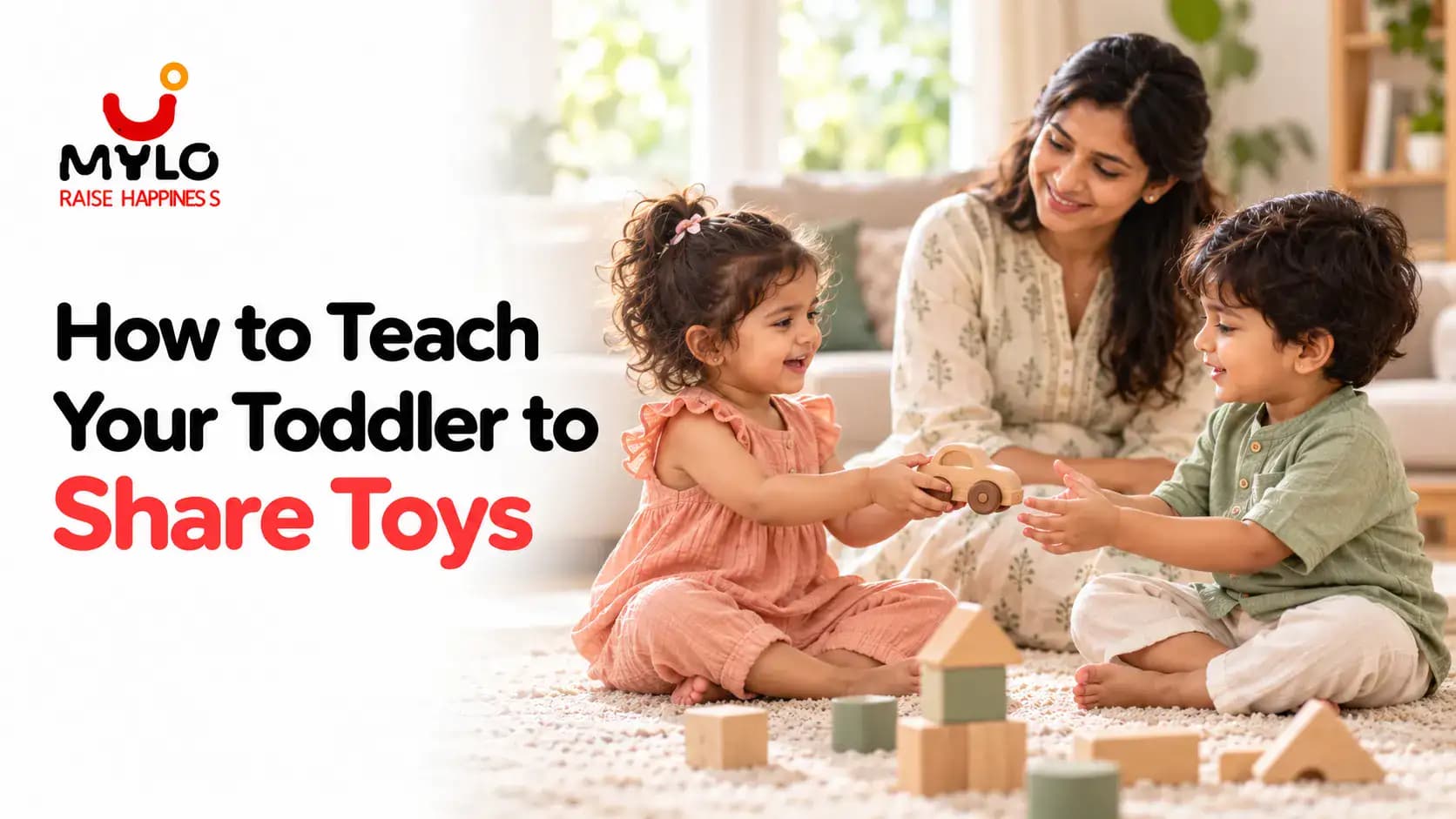
Quick Answer
Sharing means letting others use your toys or food. Most toddlers aged 1 to 3 won't share and say "mine" instead, which is normal. Toddlers are just learning that things can belong to them, and they can't wait long yet. Teach turn-taking instead of forcing sharing. Most children share more easily by 3 to 4.
Toddler Sharing at a Glance
Question | Short Answer |
|---|---|
Is it normal for a toddler not to share? | Yes, almost all toddlers find sharing hard |
Why does my toddler say "mine"? | They're learning that they are a separate person who can own things |
When do children start sharing? | Turn-taking with help around 3, sharing more willingly around 4 to 5 |
Should I force my toddler to share? | No. Teach taking turns instead |
What to say | "You can play with it until the timer rings. Then it's Riya's turn." |
How long can a toddler wait? | Usually only a few seconds to a minute or two |
When to worry | Little interest in other people, no pointing or showing by 18 months, or loss of skills |
Key Facts Every Parent Should Know
"Mine" is a milestone: Around 18 months to 2 years, toddlers begin to understand they are a separate person. Saying "mine" is part of that
Toddlers live in the now: They can't yet understand that a toy given away will come back
Turn-taking comes before sharing: Waiting for a turn is easier to learn than giving something up for good
Forced sharing often backfires: Snatching a toy away to "share" can make a toddler hold on even tighter next time
Patience grows slowly: The part of the brain that controls waiting and impulses keeps developing for many years
Your example matters most: Toddlers learn sharing by watching you share with them and with others
Why Is Sharing So Hard for Toddlers?
Short answer: Sharing is hard because a toddler's brain isn't ready yet. They don't fully understand other people's feelings, they can't wait, and they don't trust that a toy will come back. None of this means your child is selfish.
Reason | What It Means for Your Toddler |
|---|---|
Learning "me" and "mine" | They're discovering that they are a person who can own things |
Can't see others' point of view yet | They don't yet understand that another child wants the toy just as much |
No sense of time | "Later" and "in 5 minutes" mean nothing to a 2-year-old |
Doesn't trust it will come back | Giving a toy away feels like losing it forever |
Strong feelings, few words | They grab, hold or cry because they can't say "I'm not finished" |
Tired, hungry or unwell | Sharing is much harder when a toddler is already upset |
Special objects | A favourite soft toy or blanket feels like part of them |
New sibling | Toys can feel like the only thing that's still "theirs" |
Why Does My Toddler Say "Mine" to Everything?
Short answer: Saying "mine" is a normal phase, often called the "mine phase". It shows your toddler is building a sense of self. They may even say "mine" about your phone, your chappals or another child's toy.
Around 18 months, most toddlers start to recognise themselves in a mirror and use their own name. Soon after, "mine" becomes one of their favourite words. They are learning that they are a separate person with their own body, wants and things.
What helps:
Accept the word, guide the action: "Yes, that's your car. Rohan wants a turn. You can choose a car to give him."
Name what is really theirs: "This is your cup. This is Papa's cup." It helps them learn ownership the right way
Don't laugh at or shame it: Calling your child "selfish" or "kanjoos" doesn't teach them to share
Teach "my turn" and "your turn": These are easier words than "share"
When Do Toddlers Learn to Share?
Short answer: Most children start taking turns with an adult's help around age 3, and share more willingly around 4 to 5. Before 3, expect very little sharing, and that's okay.
Age | What Sharing Usually Looks Like |
|---|---|
12 to 18 months | Hands you toys, then wants them back right away. Loves "give and take" games with adults |
18 months to 2 years | The "mine" phase. Grabs toys from others, holds on tight. Plays next to other children, not with them |
2 to 3 years | Can wait a short time with help. Starts simple turn-taking, like rolling a ball back and forth |
3 to 4 years | Starts playing with other children, takes turns more often, may offer a toy on their own |
4 to 5 years | Understands "fair", shares more willingly, can wait longer for a turn |
Before 1, babies often hold out a toy to you. This is an early social skill, but they don't yet understand sharing. After 3, if your child still can't take turns at all, even with lots of help, talk to your pediatrician.
Sharing vs Turn-Taking: What's the Difference?
Short answer: Sharing means giving something up, often for good. Turn-taking means waiting for something that will come back. Turn-taking is much easier for toddlers, so teach it first.
Sharing | Turn-Taking | |
|---|---|---|
What happens | Child gives away a toy or food | Child waits, then gets the toy back |
How it feels to a toddler | Like losing something | Fair, with a clear end |
Right age to expect it | Around 4 to 5 | With help, from around 2 to 3 |
Example | Giving half a biscuit to a cousin | Using the swing until the timer rings, then letting a friend have it |
How to Teach a Toddler to Share: 10 Simple Ways
Short answer: Show sharing, practise turn-taking in play, use a timer, and praise every small try. Don't snatch toys away or force your child to hand them over.
Share with your toddler first: Offer them a bite of your roti or a turn with your spoon, and say "I'm sharing with you."
Play give-and-take games: Roll a ball back and forth and say "My turn. Your turn." This is your toddler's first lesson in sharing.
Use a timer: A sand timer or a phone timer makes "later" easy to see. "When the sand runs out, it's Anaya's turn."
Let them finish: Allow your toddler to finish their turn. "You can play until you are done, then it's his turn." Knowing a turn won't be cut short makes them more willing to give it up.
Put away special toys before guests come: Let your toddler choose 1 or 2 favourite toys to keep away. Everything left out is for everyone.
Keep 2 of popular toys: For playdates, two similar balls or two sets of blocks avoid many fights.
Name feelings: "You feel upset because you wanted the red car. It's hard to wait."
Offer a swap: "Can you give Aarav the truck and play with the bus?"
Praise the try, not just the result: "You gave Meera the doll. She looks so happy!" Specific praise works better than "good boy" or "good girl".
Read and pretend: Act out sharing with soft toys. "Teddy has the ball. Now Teddy gives Bunny a turn."
What to say when your toddler won't share
Situation | Try Saying |
|---|---|
Your toddler grabs a toy | "Riya was playing with that. Let's give it back. You can have a turn next." |
Your toddler refuses to give a turn | "You're not done yet. When the timer rings, it's Kabir's turn." |
Your toddler cries when their turn ends | "It's hard to stop. You're sad. You'll get another turn soon." |
Your toddler shares on their own | "You gave him the ball! That was kind." |
Another child grabs from your toddler | "Rohan, Anu is still playing. You can have it next." |
How to Teach a Toddler Patience
Short answer: Start with very short waits, a few seconds at a time, and make waiting fun. Toddlers can usually wait only a few seconds to a minute or two, so build up slowly.
Patience and sharing go together. A toddler who can wait a little is much better at taking turns.
Way to Practise | How to Do It |
|---|---|
Short planned waits | "Wait, I'm washing the apple. 1, 2, 3, 4, 5. Here it is!" Then slowly add more seconds |
Countdown songs | Sing a short rhyme while they wait for food or the bath |
Waiting games | Play Chidiya Ud, Statue or "Ready, steady... go!" with a ball. Your toddler must wait for the signal |
First-then words | "First shoes, then park." It shows that the good thing is coming |
Something to do while waiting | Give a small book or a few toys in the queue at the clinic or bank |
Notice good waiting | "You waited for your dosa. Well done!" |
Tip: Don't make your toddler wait too long when they're hungry, tired or sleepy. Patience runs out fastest then.
What Not to Do
Short answer: Don't force sharing, shout, hit, shame your toddler or take their toys away as punishment. These make toddlers hold on to their things even more.
Avoid | Why | Try Instead |
|---|---|---|
Snatching the toy to "share" | Teaches that grabbing is okay if you're bigger | Use a timer and let them finish their turn |
Calling them "selfish" or "kanjoos" | Toddlers believe the labels we give them | Name the feeling: "It's hard to give up a toy" |
Always making the younger or older child give in | Feels unfair and causes fights | Use the same turn rules for everyone |
Hitting or shouting | The AAP advises against spanking; it increases aggression | Stay calm, step in, guide them |
Long lectures | Toddlers can't follow long explanations | Use short words: "Your turn. My turn." |
Making them share every special thing | Even adults don't share everything | Let them keep 1 or 2 special toys away |
Why Is My Toddler Not Sharing With the New Baby or Siblings?
Short answer: A new baby changes everything for a toddler, so holding on to toys is a way of feeling safe. Protect a few of your toddler's toys, give them time alone with you, and praise any kindness to the baby.
Let your toddler choose which old toys go to the baby, instead of just handing them over
Keep some toys only for your toddler
Ask for help: "Can you choose a rattle for the baby?" Helping often feels better than sharing
Spend 10 to 15 minutes of one-on-one time with your toddler each day
For more help with jealousy and fights between children, read our guide on sibling rivalry.
What If My Toddler Hits or Bites When They Won't Share?
Short answer: Step in calmly and stop it at once. "I won't let you hit. Hitting hurts." Then help both children and go back to turn-taking.
Grabbing, hitting and biting over toys are common between 1 and 3 years, because toddlers have big feelings and few words. Stay close during playdates, step in early when you see a fight starting, and comfort the child who was hurt first.
Read more: Toddler Hitting: Why Toddlers Hit and How to Respond and Toddler Biting: Why Toddlers Bite and How to Stop It.
When Should I Worry?
Short answer: Not sharing is normal for toddlers. Talk to your pediatrician if your toddler shows little interest in people, doesn't point or show you things, or loses skills they had before.
Sign | Age |
|---|---|
Doesn't show you an object they like | By 15 months |
Doesn't point to show you something interesting | By 18 months |
Little or no interest in other children, even by watching them | By 2 to 3 years |
No pretend play (feeding a doll, talking on a toy phone) | By 2 to 3 years |
Can't take turns at all, even with lots of help | After 3 to 4 years |
Often hurts other children badly, or aggression is getting worse | Any age |
Loses words or social skills they had before | Any age |
The AAP recommends autism screening for all toddlers at 18 and 24 months. Many signs above are worth checking early, so mention them at your toddler's next visit.
Who Can Help?
Short answer: Start with your pediatrician. They can check your toddler's development and refer you to a child psychologist, developmental pediatrician or early intervention centre if needed.
Who | When to See Them |
|---|---|
Pediatrician | First stop for any worry about behaviour or development |
Developmental pediatrician | If there are concerns about social skills, speech or autism |
Child psychologist | For aggression, big emotions or behaviour that's hard to manage |
Speech therapist | If your toddler has very few words, which can make sharing fights worse |
Free government support in India
RBSK (Rashtriya Bal Swasthya Karyakram): Free health and development checks for children from birth to 18 years
DEIC (District Early Intervention Centre): Free checks and therapy for developmental delays, at district hospitals
Anganwadi centres: Early childhood care, play and pre-school activities where toddlers practise playing with others
Tele-MANAS (14416): Free mental health helpline, for parents who feel stressed or overwhelmed
Emergency: Call 108 or 112 if a child is badly hurt
What Should Indian Parents Keep in Mind?
Short answer: In Indian homes, children are often asked to share with cousins, guests and siblings. Gently explain to family that toddlers are still learning, and use turn-taking instead of "bhai ko de do".
Joint families and cousins: Many children at home means more chances to practise, but also more fights. Use the same turn rules for every child
"Give it to the guest's child": It's common to ask a toddler to give a toy to a visiting child. Put special toys away before guests arrive, so this feels easier
Elder child always gives in: Saying "you're older, let him have it" every time can lead to resentment. Be fair to both
Festivals and get-togethers: Diwali, Rakhi, weddings and birthdays are busy and tiring, so expect less sharing. Bring a few toys for your toddler
Food sharing: Sharing prasad, sweets or snacks is a lovely tradition. Model it gently: "Let's give one laddoo to Dadi"
Grandparents: Grandparents may give in to every demand. Share the same simple rules with them
Myths vs Facts
Myth | Fact |
|---|---|
A toddler who doesn't share is selfish | Not sharing is a normal stage. Toddlers aren't ready yet |
Forcing a toddler to share teaches them to share | Forced sharing often makes toddlers hold on tighter |
Only children never learn to share | Children learn sharing from play, preschool and family, with or without siblings |
If my toddler says "mine", I've spoiled them | "Mine" is a normal part of building a sense of self |
A 2-year-old should share like an older child | Willing sharing usually comes around 4 to 5 years |
Children should share everything | It's fine to keep a few special toys just for themselves |
Frequently Asked Questions
1. Is it normal for a 2-year-old not to share?
Yes. Most 2-year-olds find sharing very hard. They're learning what "mine" means and can only wait a short time. Start with simple turn-taking games.
2. At what age do toddlers learn to share?
Most children start taking turns with help around 3 and share more willingly around 4 to 5. Every child is different.
3. Should I make my toddler share with other children?
Don't force it. Instead, teach turn-taking. Let your toddler finish their turn, use a timer, and then help them give the toy to the other child.
4. Why does my toddler take toys from other children?
Toddlers grab because they want something now and don't have the words or patience to ask. Calmly give the toy back and say, "You can have a turn next."
5. How do I teach my toddler to wait?
Start with very short waits of a few seconds, count out loud, and praise them when they wait. Slowly make the waits longer.
6. My toddler won't share food. Is that okay?
Yes. Food sharing is hard for toddlers. Model it by sharing your food with them, and offer them a chance to share without forcing it.
7. Should I let my toddler keep some toys just for themselves?
Yes. Letting your toddler keep 1 or 2 special toys makes sharing everything else easier.
8. Baccha toys share nahi karta, kya yeh normal hai?
Haan, 1 se 3 saal ke bacchon mein yeh bilkul normal hai. Is umar mein baccha "mera" samajhna seekh raha hota hai. Zabardasti share mat karwaiye, pehle "meri baari, teri baari" wale khel sikhaiye.
9. Bacche ko sabar (patience) kaise sikhaye?
Chhote se intezaar se shuru kijiye, jaise 5 tak ginna. Chidiya Ud ya Statue jaise khel khilaiye, aur jab baccha intezaar kare to uski tareef kijiye.
Related Reads on Mylo
References
Centers for Disease Control and Prevention (CDC). "CDC's Developmental Milestones." https://www.cdc.gov/act-early/milestones/index.html
American Academy of Pediatrics (AAP). "Sharing Toys and Taking Turns." HealthyChildren.org. https://www.healthychildren.org
American Academy of Pediatrics (AAP). "Where We Stand: Spanking." HealthyChildren.org. https://www.healthychildren.org/English/family-life/family-dynamics/communication-discipline/Pages/Where-We-Stand-Spanking.aspx
Lipkin PH, Macias MM, AAP Council on Children with Disabilities. "Promoting Optimal Development: Identifying Infants and Young Children With Developmental Disorders Through Developmental Surveillance and Screening." Pediatrics, 2020.
ZERO TO THREE. "Sharing." https://www.zerotothree.org
Ministry of Health and Family Welfare, Government of India. "Rashtriya Bal Swasthya Karyakram (RBSK)." https://rbsk.mohfw.gov.in/
Ministry of Health and Family Welfare, Government of India. "Tele-MANAS" (14416). https://telemanas.mohfw.gov.in/
Medical Disclaimer
This article is for information only and does not replace professional medical advice. Every toddler is different. If you're worried about your toddler's behaviour or development, please consult your pediatrician.


Shop Now
Baby Essentials





Article Posted Under
Related Articles


Related Topics
.webp&w=32&q=75)
Medical Disclaimer
This content is for informational purposes only and should not replace professional medical advice. Consult with a physician or other health care professional if you have any concerns or questions about your health. If you rely on the information provided here, you do so solely at your own risk.


AWARDS AND RECOGNITION

Mylo wins Forbes D2C Disruptor award

Mylo wins The Economic Times Promising Brands 2022
AS SEEN IN













- Mylo Care: Effective and science-backed personal care and wellness solutions for a joyful you.
- Mylo Baby: Science-backed, gentle and effective personal care & hygiene range for your little one.
- Mylo Community: Trusted and empathetic community of 10mn+ parents and experts.


Product Categories
Baby Carrier | Baby Soap | Baby Wipes | Stretch Marks Cream | Baby Cream | Baby Shampoo | Baby Massage Oil | Baby Hair Oil | Stretch Marks Oil | Baby Body Wash | Baby Powder | Baby Lotion | Diaper Rash Cream | Newborn Diapers | Teether | Baby Kajal | Baby Diapers Pants | Cloth Diapers | Laundry Detergent | Lactation Granules |