


Orders
.png&w=48&q=75 "login")
Profile


Wallet

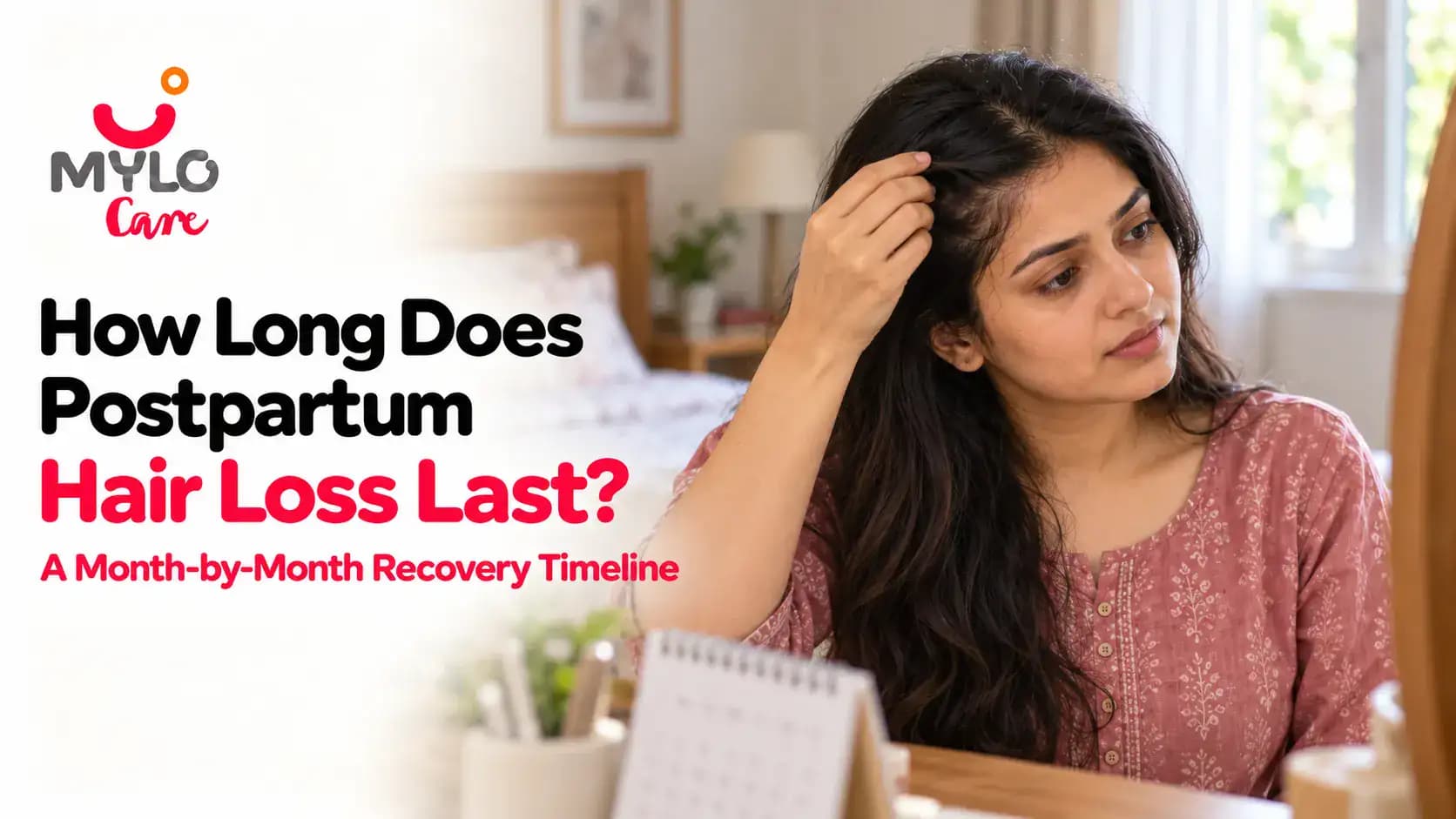
How Long Does Postpartum Hair Loss Last? A Month-by-Month Recovery Timeline
 16 min
Quick Answer
For most women, postpartum hair loss starts around 2 to 4 months after delivery, peaks between 3 and 5 months, then begins improving noticeably by 6 to 9 months. By around 12 months postpartum, most mothers regain their normal hair fullness. The shedding is temporary telogen effluvium, triggered by the drop in pregnancy hormones after birth, not a sign of permanent hair loss. Recovery timing varies from person to person, so some women bounce back sooner and others take a little longer, both of which are perfectly normal. Seeing short new "baby hairs" is one of the earliest signs regrowth has begun.
Introduction
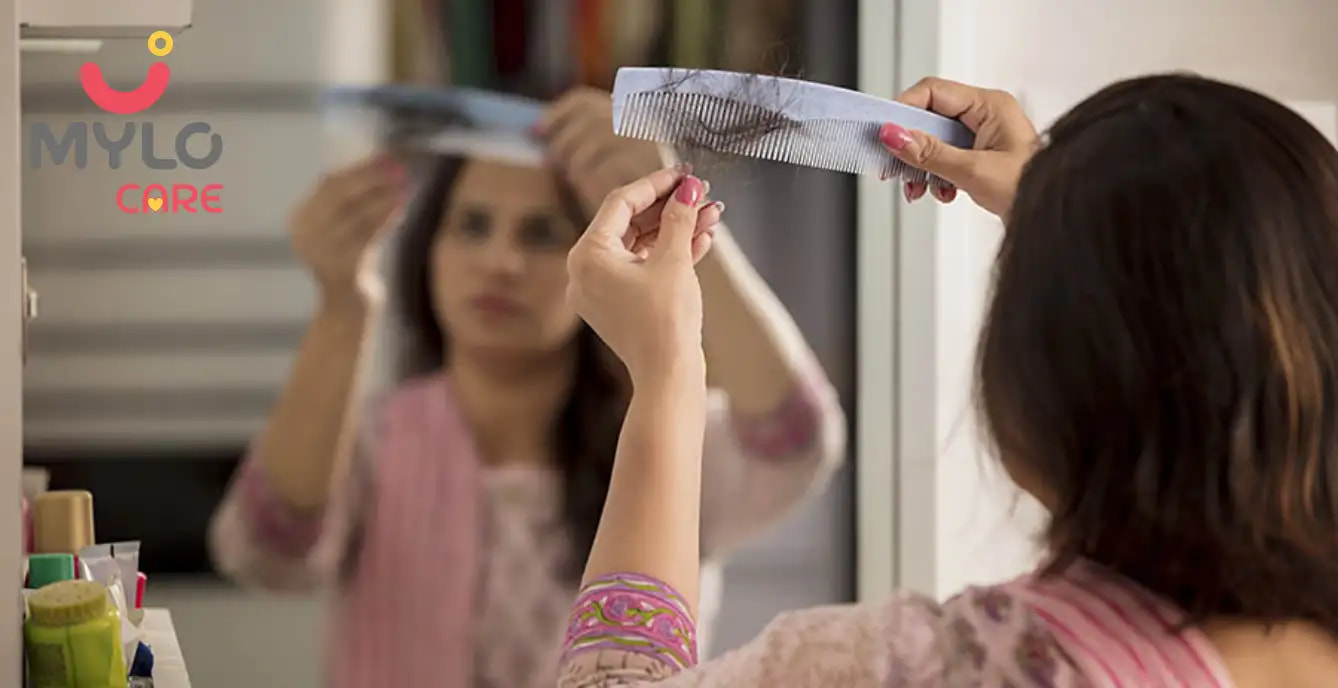
When you are in the thick of it, postpartum hair fall can feel like it will never end. You find strands on the pillow, wound around the baby's fingers, gathered in the shower drain, tangled in the brush after every single stroke. It is easy to start worrying that it won't stop, or that your hair won't come back the way it was.
Here is the reassuring truth: for the overwhelming majority of mothers, this is a temporary phase with a fairly predictable arc. Knowing roughly how long postpartum hair loss lasts, and what each stage looks like, takes a lot of the fear out of it. Instead of wondering whether something is wrong, you can recognise where you are on the timeline and what is coming next.
This guide maps the whole journey month by month, from when shedding starts to when your hair fills back in, along with what can speed recovery up, what can slow it down, and the signs that mean it is worth seeing a doctor.
Recovery Timeline at a Glance
Time After Delivery | What Usually Happens |
|---|---|
Birth to 2 months | Pregnancy hormones gradually decline; little noticeable shedding |
2 to 4 months | Hair shedding typically begins |
3 to 5 months | Shedding often reaches its peak |
6 to 9 months | Hair fall gradually slows; baby hairs become noticeable |
9 to 12 months | Hair density usually improves significantly |
Beyond 12 months | Persistent hair loss should be medically evaluated |
What Causes Postpartum Hair Loss?
The short version, since this article is really about the timeline: it is hormones and the hair-growth cycle, not anything you did wrong.
Your hair constantly cycles through a growth phase, a brief transition, and a resting phase before it sheds and regrows. During pregnancy, high estrogen extends the growth phase, so hair that would normally have shed stays put. That is why pregnancy hair often feels thick and full. According to Cleveland Clinic, estrogen falls sharply after delivery, and all that retained hair shifts into its resting phase together. A couple of months later, it sheds together too. This synchronised shed is called telogen effluvium, and it is why the loss looks so sudden and dramatic.
For a deeper look at why the shedding shows up around month three, read why your hair falls out 3 months after delivery. For home remedies, our guide on how to control hair fall after delivery has practical tips.
When Does Postpartum Hair Loss Usually Start?
Most women don't notice much shedding right after birth, which surprises people. The reason is timing: the resting phase itself lasts around three months before hair actually releases. So hair that entered the resting phase around delivery doesn't fall immediately. It rests first, then sheds a couple of months later.
That is why the shedding typically becomes noticeable somewhere between 2 and 4 months postpartum, rather than in those first hazy newborn weeks. If your hair fall starts in this window, it is a strong sign it is the normal postpartum process at work.
Month-by-Month Postpartum Hair Loss Timeline
Every woman's recovery is a little different, so treat this as a map rather than a strict schedule. Still, most journeys follow this general shape.
Month 1
Little to no obvious shedding yet. Your hair may still feel as thick and full as it did in late pregnancy, thanks to hormones that haven't fully reset. Enjoy it; for most women, this is the calm before the shed.
Month 2
Hormone levels are settling back toward pre-pregnancy baselines. Some women start noticing slightly more hair on the brush or in the shower, though many still see nothing dramatic. Your hair changed a lot through pregnancy too, and if you are curious about that whole arc, our piece on hair fall during pregnancy and how to deal with it covers the earlier chapters.
Month 3
This is when shedding often becomes unmistakable. You may see clumps in the shower drain, hair on your clothes, and strands everywhere around the house. It can feel alarming, but this is textbook timing, not a red flag. It is the retained pregnancy hair catching up all at once.
Month 4
Frequently the heaviest stretch. Many mothers describe this as the peak, when the daily volume looks its most dramatic. Thinning around the hairline and temples is very common now. Remind yourself: this is the top of the curve, and things improve from here.
Month 5
For many women, shedding is still noticeable but may be starting to level off. You are likely at or just past the peak. Hair may feel thinner overall, and your parting might look a little wider. Both are normal at this stage.
Month 6
A turning point for a lot of mothers. Active shedding often begins to slow, and if you look closely at your hairline, you may spot short, wispy new hairs standing up. These "baby hairs" are new growth and one of the most encouraging signs that recovery has started.
Months 7 to 9
Shedding continues to taper. The baby hairs get longer and more numerous, and overall density starts to visibly improve. Your hair may temporarily have an uneven texture as short regrowth mixes with longer strands. That is a good sign, not a problem.
Months 10 to 12
The American Academy of Dermatology notes that most women see their hair return to normal fullness by their child's first birthday. The regrowth blends in, density looks much closer to normal, and the shedding has usually settled back to an everyday amount. A few women notice their hair is slightly less thick than before pregnancy, or that its texture shifted a little, which can also be normal.
For practical ways to support your hair through these months, our guide on how to reduce postpartum hair fall naturally has hands-on tips you can start now.
When Does Postpartum Hair Loss Stop?
For most mothers, active shedding eases and begins reversing well before the first birthday, commonly slowing from around 6 months and filling back in by 9 to 12 months. A few points worth setting expectations on:
Recovery isn't a sudden switch-off. Shedding tapers gradually rather than stopping overnight, so you won't wake up one morning with it "done."
Texture may feel different for a while. New regrowth is short and fine, so your hair can feel wispy, flyaway, or uneven temporarily. This settles as the new hair matures.
Baby hairs are a win. Those little regrowth strands around your hairline are proof the cycle is normalising.
Timelines vary. Genetics, nutrition, stress, and whether you are breastfeeding can all nudge your personal timeline earlier or later.
What Can Delay Recovery?
Sometimes postpartum shedding drags on longer than expected, or recovery feels stalled. Several factors can play a role:
Iron deficiency, which is common after blood loss at delivery and can prolong shedding
Low protein intake, since hair is built from protein and needs the raw materials to regrow
Thyroid disorders, including postpartum thyroiditis, which can drive ongoing hair loss
Chronic stress, which can itself trigger or extend telogen effluvium
Poor sleep, an unavoidable reality of newborn life that affects overall recovery
Broader nutritional deficiencies, especially with a restricted or rushed diet
Rapid weight loss or crash dieting, which can worsen shedding
Underlying scalp conditions, which may need their own treatment
If your recovery seems stuck well past the typical window, review these with a doctor. Several are easily tested and treated.
What Helps Support Healthy Hair Recovery?
You can't switch off hormonal shedding, but you can create the best conditions for regrowth and avoid adding unnecessary breakage. Practical steps:
Prioritise protein at each meal: dal, eggs, paneer, dairy, fish, chicken, or soy
Eat iron-rich foods like lentils, leafy greens, beans, and lean meat
Support with vitamin D and zinc through diet and, where relevant, sunlight
Be gentle when washing and detangling, using a wide-tooth comb from the ends up
Skip tight hairstyles like high ponytails, tight braids, and extensions that pull
Minimise heat styling and harsh chemical treatments while hair is fragile
Manage stress where you realistically can; even small moments help
Sleep whenever practical. Snatching rest when the baby sleeps genuinely supports recovery.
To be clear: nutrition and gentle care support healthy regrowth and can stop a fixable problem like low iron from dragging things out, but they cannot instantly halt hormonally driven shedding. That part simply needs time.
.webp)

When Should You See a Doctor?
Postpartum shedding is usually self-resolving, but see a doctor or dermatologist if you notice:
Hair loss continuing beyond 12 months without recovery
Clearly visible bald patches, rather than even, all-over thinning
Scalp redness or pain
Severe itching or scaling
Eyebrow or eyelash loss
Symptoms of thyroid problems, such as fatigue, mood changes, heart-rate or temperature changes, or weight changes
Symptoms of iron deficiency, like extreme tiredness, breathlessness, or dizziness
Rapid worsening despite several months having passed
These can point to conditions beyond ordinary telogen effluvium, and most are treatable once identified. Research shows that shedding lasting more than a year after birth can be linked to female pattern hair loss, iron deficiency, or an underactive thyroid. If you are also feeling persistently low or anxious, read our guide on how long postpartum depression lasts and speak to your doctor.
Postpartum Hair Recovery: Stage-by-Stage Summary
Stage | Hair Fall | Hair Regrowth | What You Can Do |
|---|---|---|---|
Birth to 2 months | Minimal | Not yet | Rest, eat well, be patient |
2 to 4 months | Shedding begins | None visible | Gentle care, protein and iron |
3 to 5 months | Peak shedding | None visible yet | Avoid tight styles and heat; stay reassured |
6 to 9 months | Slowing | Baby hairs appear | Keep up nutrition and gentle handling |
9 to 12 months | Minimal | Density fills in | Maintain a healthy routine |
Beyond 12 months | Should be settled | Should be visible | See a doctor if still shedding heavily |
Can Nutrition Support Postpartum Hair Recovery?
Here is the balanced picture. Postpartum shedding is primarily hormone-driven, so it resolves on its own with time; no food or supplement switches it off. But adequate nutrition genuinely matters for your overall postpartum recovery and for the health of the new hair growing back, especially when a sleep-deprived new mother's diet has gaps.
That is the honest role of good nutrition: supporting recovery and filling gaps, not performing miracles. Mylo's upcoming postpartum nutrition and wellness range is designed with this in mind, offering protein-rich, recovery-focused nutritional support for the demanding early months, plus iron-supportive options where they are helpful, for times when balanced home-cooked meals are hard to manage. To build those meals, our guides on key nutrients to include after childbirth and the postpartum diet plan are good starting points.
To be completely clear: no product can stop, cure, or reverse postpartum hair loss, and anything claiming to is overpromising. Think of nutrition and supportive care as nourishing your recovery while your body does the rest. If you are breastfeeding and wondering about topical hair products, our guide on whether onion oil is safe during breastfeeding is worth a read.
Key Takeaway
Postpartum hair loss follows a predictable recovery timeline for most mothers. Although the shedding can seem dramatic, it is usually temporary, and seeing new baby hairs is often one of the earliest signs that recovery has begun.
Frequently Asked Questions
How long does postpartum hair loss usually last?
For most women, shedding starts around 2 to 4 months postpartum, peaks by 3 to 5 months, and improves by 6 to 9 months, with full recovery by around 12 months. Timing varies between individuals.
Does postpartum hair loss stop suddenly?
No, it tapers gradually rather than stopping overnight. Shedding slowly eases over months as new hair grows in, so recovery is a gentle transition, not a switch.
When will my hair become thick again after pregnancy?
Most women regain close to their pre-pregnancy fullness by around 12 months postpartum. You will often see short regrowth ("baby hairs") from about 6 months as an early sign.
Why am I still losing hair 6 months postpartum?
This is still within the normal range. Shedding often continues to slow around this point rather than being fully finished. If it is heavy or getting worse, though, ask your doctor to check your iron and thyroid levels.
Is hair loss normal 9 months after giving birth?
Some lingering shedding can be normal, but most women are seeing clear recovery by now. If yours is still heavy with no regrowth, it is worth a medical check.
Can postpartum hair loss last longer than a year?
It can in some cases, but heavy shedding that continues beyond 12 months isn't typical and should be evaluated. Iron deficiency, thyroid issues, or female pattern hair loss may be involved.
How do I know if my hair is growing back?
Look at your hairline and temples for short, fine, wispy strands standing up from the scalp. These baby hairs are new growth and one of the clearest signs recovery has started.
Does breastfeeding make postpartum hair loss last longer?
Breastfeeding isn't the direct cause; hormones are. But its nutritional demands, along with disrupted sleep and stress, can affect overall recovery, so nourishing yourself well matters.
What vitamins help postpartum hair recovery?
There is no magic vitamin, but adequate protein, iron, zinc, vitamin D, and B12 support healthy regrowth. Discuss supplements with your doctor rather than self-prescribing, especially while breastfeeding.
When should I see a dermatologist for postpartum hair loss?
See one if shedding continues beyond 12 months, you develop bald patches, your scalp is painful, red, scaly, or intensely itchy, or you lose eyebrow or eyelash hair.
Will my hair go back to exactly how it was before?
For most women, largely yes. A few notice slightly less density or a small change in texture afterward, which can also be a normal part of the postpartum reset.
Can I speed up postpartum hair regrowth?
You can't rush the hormonal timeline, but good nutrition, gentle hair care, stress management, and treating any iron or thyroid issues create the best conditions for healthy regrowth.
References
Hair Fall Control Kit for Moms
Stronger, healthier hair after pregnancy
.webp&w=1900&q=75)



Article Posted Under
Related Articles
Postpartum Hair Loss: Meaning, Tips & Symptoms
 60·
60· 6 min
6 min Post Pregnancy Weight Loss: Top 8 Ways to Shed the Extra Kilos
 219·4 min
 Is it necessary to ask your gynecologist before taking up any postpartum weight loss plan?
 30·5 min
 Fat Vagina (Mons Pubis): Average Size, Types, Causes, FUPA Explained and When to See a Doctor (2026)
 2·18 min
Medical Disclaimer
This content is for informational purposes only and should not replace professional medical advice. Consult with a physician or other health care professional if you have any concerns or questions about your health. If you rely on the information provided here, you do so solely at your own risk.


AWARDS AND RECOGNITION

Mylo wins Forbes D2C Disruptor award

Mylo wins The Economic Times Promising Brands 2022
AS SEEN IN













- Mylo Care: Effective and science-backed personal care and wellness solutions for a joyful you.
- Mylo Baby: Science-backed, gentle and effective personal care & hygiene range for your little one.
- Mylo Community: Trusted and empathetic community of 10mn+ parents and experts.


Product Categories
Baby Carrier | Baby Soap | Baby Wipes | Stretch Marks Cream | Baby Cream | Baby Shampoo | Baby Massage Oil | Baby Hair Oil | Stretch Marks Oil | Baby Body Wash | Baby Powder | Baby Lotion | Diaper Rash Cream | Newborn Diapers | Teether | Baby Kajal | Baby Diapers Pants | Cloth Diapers | Laundry Detergent | Lactation Granules |