


Orders
.png&w=48&q=75 "login")
Profile


Wallet

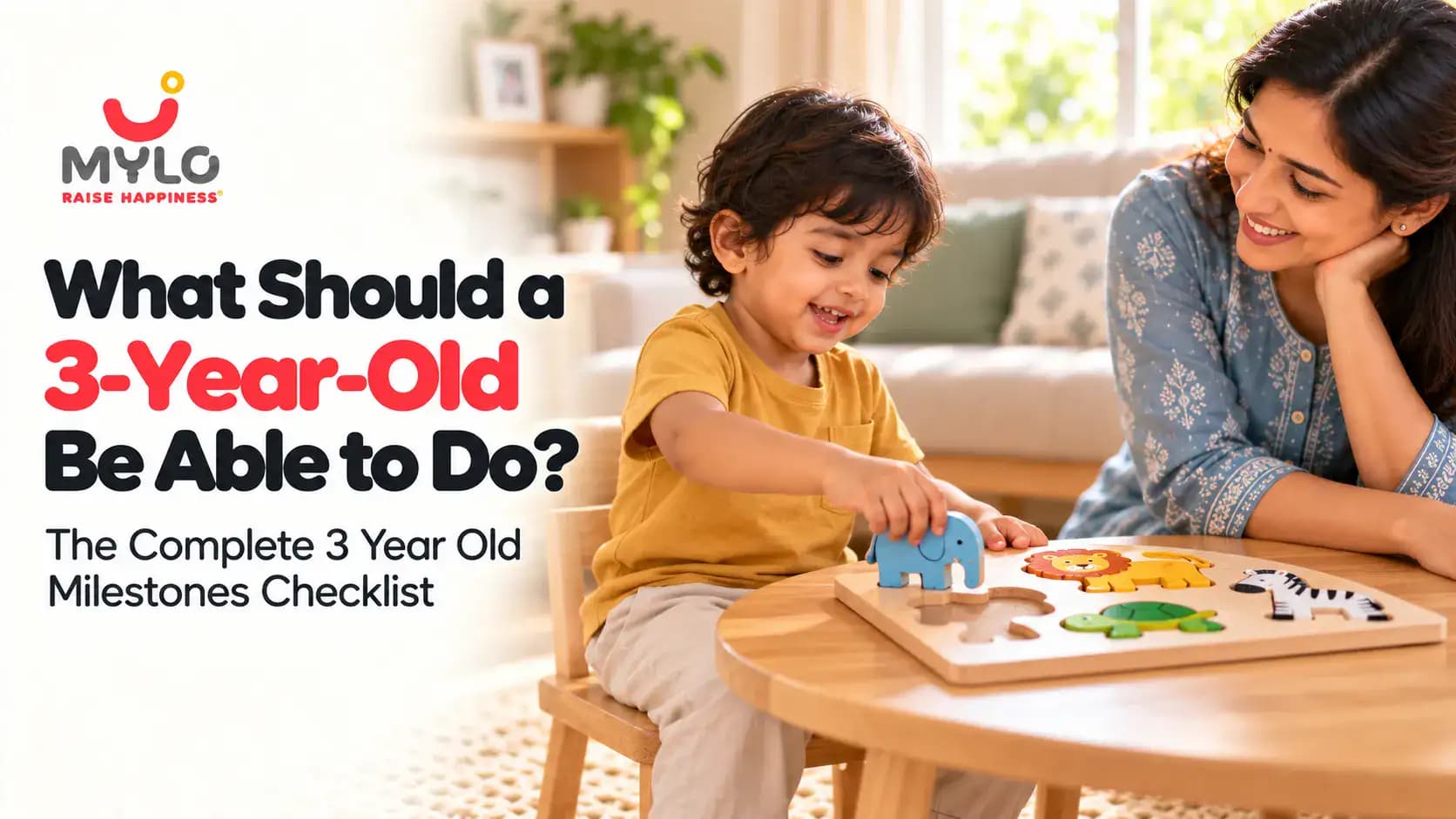
What Should a 3-Year-Old Be Able to Do? The Complete 3 Year Old Milestones Checklist (2026)
 24 min
Quick Answer
By 3 years, most children hold a conversation with at least 2 back-and-forth exchanges, ask "who", "what", "where" and "why" questions, say their first name, talk clearly enough for others to understand most of the time, join other children in play, calm down within 10 minutes after a parent leaves, draw a circle when shown, string large beads, put on some clothes and use a fork. These are the official 3-year milestones from the AAP and CDC. See your pediatrician if your child is hard to understand, doesn't speak in short sentences, doesn't play with other children, falls a lot or loses skills.
3 Year Old Milestones at a Glance
Area | Key Milestones by 3 Years | Coming Next (by 4 Years) | Talk to a Doctor If |
|---|---|---|---|
Language | Conversations with 2 or more exchanges, asks "why" questions | Tells simple stories, uses 4-word sentences | Doesn't use short sentences |
Speech clarity | Understood by others most of the time | Understood almost all the time | Even family can't understand them |
Social | Joins other children in play, calms within 10 minutes after drop-off | Has a favourite friend, takes turns | No interest in other children |
Thinking | Draws a circle when shown, avoids hot objects when warned | Names some colours, counts a few objects | Doesn't pretend play or follow simple instructions |
Movement | Runs, climbs, pedals a tricycle, walks up stairs with alternating feet | Hops, catches a large ball | Falls a lot, can't manage stairs |
Self-care | Puts on some clothes, uses a fork, mostly potty trained in the day | Dresses with little help | Loses self-care skills |
Sleep | 10 to 13 hours a day, many still nap | Naps may stop | Very poor sleep with snoring or other concerns |
Sources: Nemours KidsHealth, AAP.
Key Facts Every Parent Should Know
2 back-and-forth exchanges: The official conversation milestone at 3 years (Nemours KidsHealth)
"Most of the time": By 3, people outside the family should understand your child most of the time
10 minutes: Most 3-year-olds calm down within 10 minutes after a parent leaves, like at preschool drop-off
10 to 13 hours: Recommended daily sleep for ages 3 to 5 (AAP)
Pea-sized: The amount of fluoride toothpaste to use from age 3 (AAP)
About 480 ml: Daily milk and dairy for most 3-year-olds (Nemours KidsHealth)
First vision and blood pressure checks: Usually done at the 3-year visit
What Are the Official Milestones for a 3-Year-Old?
Short answer: The official AAP and CDC checklist lists 12 key milestones by 3 years across four areas. These show what most (75%) children can do by their third birthday.
Area | Milestone by 3 Years |
|---|---|
Social and Emotional | Calms down within 10 minutes after you leave, like at childcare drop-off |
Notices other children and joins them to play | |
Language and Communication | Talks with you in conversation using at least 2 back-and-forth exchanges |
Asks "who", "what", "where" or "why" questions, like "Where is Mumma?" | |
Says what action is happening in a picture or book, like "running" or "eating" | |
Says their first name when asked | |
Talks well enough for others to understand, most of the time | |
Cognitive | Draws a circle when you show them how |
Avoids touching hot objects, like a stove, when you warn them | |
Movement and Physical | Strings items together, like large beads or macaroni |
Puts on some clothes alone, like loose pants or a jacket | |
Uses a fork |
What Does a Complete 3 Year Old Milestones Checklist Look Like?
Short answer: Along with the official milestones, many 3-year-olds also speak in 3 to 4 word sentences, enjoy imaginative play, take turns with help, pedal a tricycle, use the potty during the day and show clear likes and dislikes. Tick what your child can do. Milestones marked ⭐ are official ones.
😊 Social and Emotional Checklist
☐ Calms down within 10 minutes after you leave ⭐
☐ Joins other children in play ⭐
☐ Takes turns in simple games, with help
☐ Shows affection for friends without being prompted
☐ Shows concern when a friend is crying
☐ Understands "mine", "his" and "hers"
☐ May have imaginary friends or new fears
🗣️ Language and Communication Checklist
☐ Has conversations with 2 or more back-and-forth exchanges ⭐
☐ Asks "who", "what", "where" or "why" questions ⭐
☐ Says what's happening in a picture ⭐
☐ Says their first name ⭐
☐ Is understood by others most of the time ⭐
☐ Uses 3 to 4 word sentences
☐ Uses words like "I", "me", "you" and plurals like "cars"
☐ Follows 2 to 3 step instructions
🧠 Cognitive Checklist
☐ Draws a circle when shown ⭐
☐ Avoids hot objects when warned ⭐
☐ Plays make-believe with dolls, animals and people
☐ Completes 3 to 4 piece puzzles
☐ Understands "same" and "different"
☐ Knows some colours
☐ Counts 2 or 3 objects
☐ Turns door handles and opens lids
🚶 Movement Checklist
☐ Strings large beads ⭐
☐ Puts on some clothes alone ⭐
☐ Uses a fork ⭐
☐ Runs easily and climbs well
☐ Walks up and down stairs, one foot on each step
☐ Pedals a tricycle
☐ Jumps with both feet
☐ Kicks and throws a ball
☐ Builds a tower of 6 or more blocks
How Well Should a 3-Year-Old Talk?
Short answer: By 3, most children talk in short sentences, hold simple conversations, ask lots of questions and can be understood by others most of the time (Nemours KidsHealth). Some sounds like "r", "s", "sh" and "th" may still be unclear, which is normal.
Communication Skill | By 2 Years | By 30 Months | By 3 Years |
|---|---|---|---|
Sentences | 2 words together | 2 or more words with an action word | 3 to 4 word sentences |
Conversation | Few exchanges | Short back-and-forth | At least 2 back-and-forth exchanges |
Questions | Few | "What's that?" | "Who", "what", "where", "why" |
Speech clarity | Family understands some | Family understands most | Others understand most of the time |
Name | Responds to name | Uses "I" and "me" | Says first name when asked |
Instructions | One-step | 2-step | 2 to 3 step |
Is My 3-Year-Old's Speech Delayed?
Probably Fine | Talk to Your Doctor |
|---|---|
Speaks in short sentences | Uses mainly single words or 2-word phrases |
Some sounds unclear, like "r" or "th" | Most speech is hard to understand, even for family |
Asks lots of questions | Rarely asks questions or starts conversations |
Repeats words sometimes when excited | Stutters with tension, facial struggle or distress, or for more than 6 months |
Follows 2-step instructions | Doesn't follow simple instructions |
Early help works best. If you're worried, ask your pediatrician for a hearing test and a speech-language assessment. Speech therapy at 3 can make a big difference before school starts.
How Can I Help My 3-Year-Old's Language?
Tip | Example |
|---|---|
Answer the "why" questions | "Why is it raining?" "Because the clouds are full of water!" |
Ask open questions | "What did you do at the park today?" |
Tell stories together | "Once upon a time, a little elephant..." and let them continue |
Read every day | Ask "What happens next?" |
Model correct words gently | Child: "I goed there." You: "Yes, you went there!" |
Talk in your home language | Every language helps |
Limit screens | Conversation builds language best |
What Social Skills Should a 3-Year-Old Have?
Short answer: By 3, most children notice other children and join them to play, calm down within 10 minutes after a parent leaves, show concern for friends and start taking turns with help. Pretend play becomes rich and imaginative.
Social Skill | Typical at 3 Years? | Talk to a Doctor If |
|---|---|---|
Joins other children in play | Yes | Shows no interest in other children |
Calms after drop-off within 10 minutes | Yes | Extreme distress for weeks after starting preschool |
Takes turns | With help | Never plays alongside others |
Shows empathy | Often | Doesn't respond to others' emotions |
Pretend play | Yes, with detail | No pretend play at all |
Makes eye contact | Yes | Rarely looks at people's faces |
Want to help your child greet elders and use good manners? Read our guide to social skills for toddlers. For shy children, see how to help your toddler overcome shyness.
What Movement Skills Should a 3-Year-Old Have?
Short answer: By 3, most children run easily, climb well, walk up stairs with one foot on each step, pedal a tricycle, jump with both feet, string large beads, draw a circle when shown and use a fork.
Movement Skill | Typical at 3 Years? | Talk to a Doctor If |
|---|---|---|
Runs and climbs | Yes | Falls very often or seems clumsy |
Walks up stairs with alternating feet | Many children | Can't manage stairs even with help |
Pedals a tricycle | Many children | Not a concern until about 3.5 to 4 years |
Jumps with both feet | Yes | Can't jump at all |
Draws a circle when shown | Yes (official milestone) | Can't hold a crayon |
Strings large beads | Yes (official milestone) | Very poor hand control |
Uses a fork | Yes (official milestone) | Can't use a spoon or fork |
Read more in running and jumping milestones and when your toddler will learn to scribble or draw.
Should My 3-Year-Old Be Potty Trained?
Short answer: Most children are potty trained during the day by around 3 years, though accidents are still common. Night-time dryness often takes longer, sometimes until 5 or 6 years, and that's normal.
Potty Skill | Typical at 3 Years? |
|---|---|
Uses the potty or toilet in the day | Most children |
Tells you when they need to go | Yes |
Occasional daytime accidents | Common |
Dry at night | Many, but not all; night wetting is normal until 5 to 6 years |
Wipes on their own | Still needs help, usually until around 4 years |
Talk to your doctor if your child was dry and starts having frequent accidents again, has pain while peeing, or is constipated. See our guide on treating UTI in toddlers.
Is My 3-Year-Old Ready for Preschool or Nursery?
Short answer: Many Indian children start nursery or pre-primary around age 3. Children who can calm down within 10 minutes after drop-off, communicate their needs, use the toilet with help and play with other children usually settle well.
Readiness Sign | Typical at 3 Years? |
|---|---|
Calms within 10 minutes after a parent leaves | Yes (official milestone) |
Says needs like "toilet", "water" and "help" | Yes |
Plays with other children | Yes (official milestone) |
Eats from a tiffin with a spoon or fork | Yes |
Follows simple classroom routines | Yes |
Read our guide on how to prepare your child for preschool for tips on separation anxiety and crying at drop-off.
What Activities Help a 3-Year-Old's Development?
Short answer: Imaginative play, storytelling, drawing, puzzles, outdoor play, music and dance, simple board games and helping at home all build skills. 3-year-olds learn best through play, questions and doing things themselves.
Skill Area | Best Activities | Household Items to Use |
|---|---|---|
Social | Playdates, turn-taking games, pretend shop or doctor | Toy money, old boxes, a toy stethoscope |
Language | Storytelling, rhymes, "What happens next?" books | Picture books, family photos |
Cognitive | Puzzles, sorting, counting, matching games | Spoons, buttons (supervised), socks |
Fine motor | Drawing circles, stringing beads, play dough, tearing paper | Crayons, macaroni and string, atta dough |
Gross motor | Tricycle, jumping, ball games, dancing, climbing | A soft ball, a playground |
Self-care | Dressing, washing hands, using a fork, tidying up | Step stool, toy basket, child-sized cutlery |
See our guide on toddler self-care: dressing, handwashing and eating.
What Should a 3-Year-Old Eat and Drink?
Short answer: At 3, children need 3 meals and 2 healthy snacks a day, about 480 ml of milk and dairy (Nemours KidsHealth), plenty of water, and a mix of grains, dal, vegetables, fruit, eggs or meat. Keep added sugar, salt and junk food low.
Food or Drink | At 3 Years | Tip |
|---|---|---|
Meals | 3 meals and 2 snacks | Eat together as a family |
Milk and dairy | About 480 ml a day | Toned milk may be suggested by your doctor |
Protein | Daily | Dal, eggs, paneer, chicken, fish, chana |
Fruit and vegetables | At every meal | Offer a rainbow of colours |
Water | Throughout the day | More in hot weather |
Juice | Not needed | Whole fruit is better |
Added sugar and junk food | Keep low | Under 5% of daily calories from sugar (ICMR-NIN) |
Picky eater? Common at this age. Read our guide on picky eating and food refusal in toddlers.
How Much Should a 3-Year-Old Sleep?
Short answer: Children aged 3 to 5 years need 10 to 13 hours of sleep in 24 hours, including naps (AAP). Many 3-year-olds still nap, but some stop.
Sleep Detail | Typical at 3 Years |
|---|---|
Total sleep | 10 to 13 hours a day |
Night sleep | About 10 to 12 hours |
Naps | Many still nap for 1 to 2 hours; some drop the nap |
Common problems | Bedtime stalling, nightmares, night fears |
See a doctor if | Loud snoring, pauses in breathing, or very restless sleep |
How Much Should a 3-Year-Old Weigh?
Short answer: Many 3-year-olds weigh around 13 to 15 kg and measure around 94 to 100 cm, but healthy children vary. Growth is slower and steadier after age 2. Steady growth along your child's own curve matters most.
Measurement | Typical at 3 Years |
|---|---|
Weight | Often 13 to 15 kg |
Height | Often 94 to 100 cm |
Teeth | All 20 milk teeth |
See our girls' growth chart for 24 to 36 months and height and weight chart for boys and girls in India.
What Happens at the 3-Year Doctor Visit?
Short answer: At the 3-year check-up, your pediatrician checks growth, development and speech, and usually does the first blood pressure check and a vision check if your child can cooperate (Nemours KidsHealth).
What the Doctor Checks | Questions You Can Ask |
|---|---|
Weight, height and BMI | Is my child growing well? |
Blood pressure | Is it normal? |
Vision | Does my child need a detailed eye test? |
Hearing and speech | Is my child's speech clear enough? |
Development | Is my child ready for preschool? |
Teeth | Are there any cavities? |
Sleep and behaviour | How do I handle tantrums and bedtime battles? |
Vaccines and Preventive Care Around 3 Years in India
There are usually no routine vaccines due at 3 years under the IAP schedule. The next boosters (DTP, IPV and MMR) are usually given at 4 to 6 years.
Influenza vaccine may be advised every year.
Vitamin A is given every 6 months until age 5 under the government programme.
Deworming every 6 months is recommended. See our guide to worms and deworming.
Dental Care at 3 Years
Brush twice a day with a pea-sized amount of fluoride toothpaste from age 3 (AAP)
Supervise brushing until about 8 years
Visit the dentist every 6 months
How Much Screen Time Is Okay for a 3-Year-Old?
Short answer: No more than about 1 hour a day of good-quality content, watched together when possible, and no screens in the bedroom (Nemours KidsHealth).
Instead of Solo Screen Time | Try This |
|---|---|
Videos to keep them busy | Drawing, puzzles or pretend play |
Cartoons during meals | Family conversation |
Phone to stop tantrums | Name the feeling and offer comfort |
Screens before bed | Books and a bedtime story |
How Can I Keep My 3-Year-Old Safe?
Short answer: At 3, children are more independent but still don't understand danger well. Use car seats, helmets on tricycles, window and balcony guards, supervise near water and roads, and teach simple safety rules.
Risk | How to Prevent It |
|---|---|
Road accidents | Car seat for every ride; always hold hands near roads |
Falls from windows and balconies | Grills and guards; move furniture away |
Drowning | Supervise near buckets, tanks, ponds and pools |
Poisoning | Lock medicines and chemicals away |
Burns | Teach "hot, don't touch" (an official milestone) but still keep hot things out of reach |
Tricycle falls | Helmet every time |
Getting lost | Teach their name and a parent's name and phone number |
Emergency number: Dial 108 for ambulance services in most states, or 112 for emergencies.
When Should I Worry About My 3-Year-Old's Development?
Short answer: Talk to your doctor if your child doesn't speak in short sentences, is hard to understand, doesn't play pretend or join other children, doesn't follow simple instructions, falls a lot, has trouble with stairs or loses skills. Early help before school makes a big difference.
Red Flag at 3 Years | What It May Relate To |
|---|---|
Loses skills they once had | See a doctor right away |
Doesn't speak in short sentences | Speech or language delay |
Very hard to understand, even for family | Speech sound or hearing concerns |
Doesn't ask questions or have conversations | Language or social communication |
No pretend play | Cognitive or social development |
No interest in other children | Social development |
Doesn't follow simple instructions | Understanding or hearing |
Falls often or can't manage stairs | Movement or muscle development |
Drools a lot or has very unclear speech | Oral-motor development |
Extreme distress at every separation | Anxiety or other concerns |
Where Can I Get Free Developmental Screening in India?
Service | What It Offers |
|---|---|
Rashtriya Bal Swasthya Karyakram (RBSK) | Free screening for developmental delays |
District Early Intervention Centres (DEIC) | Free assessment, speech and occupational therapy |
Anganwadi centres | Growth monitoring, preschool education, vitamin A and referrals |
Read our guide on identifying developmental disorders in toddlers.
What Should Indian Parents Keep in Mind at 3 Years?
Short answer: Don't ignore unclear speech, encourage independence, limit screens and junk food, and use the 3-year visit to check vision, teeth and development before school.
Common Practice | Better Approach |
|---|---|
"He'll speak clearly once he starts school" | Check early; speech therapy works best before school |
Feeding and dressing the child fully | Let them eat with a fork and dress themselves |
Pushing reading and writing at 3 | Play-based learning is best at this age |
Phone during meals and tantrums | Talk, read and play together |
Scolding for night-time wetting | Night dryness often comes later; stay patient |
Daily chips, biscuits and sweet drinks | Fruit, curd, roasted chana and homemade snacks |
Myths vs Facts About 3 Year Old Milestones
Myth | Fact |
|---|---|
"A 3-year-old should read and write" | Play-based learning, talking and drawing are more important at 3 |
"All 3-year-olds should be dry at night" | Night wetting is normal until about 5 to 6 years |
"Unclear speech at 3 is always normal" | Some unclear sounds are normal, but others should understand most of what they say |
"Two languages at home cause speech delay" | Children can learn two or more languages well |
"No vaccines at 3 means no doctor visit" | The 3-year visit checks vision, blood pressure, teeth and development |
"Shy children won't make friends" | Many shy children warm up and make close friends with time |
Frequently Asked Questions About 3 Year Old Milestones
What should a 3-year-old be able to do?
Most hold simple conversations, ask "why" questions, say their name, are understood by others most of the time, play with other children, draw a circle when shown, string beads, put on some clothes and use a fork.
3 saal ka bachcha kya-kya kar sakta hai? (Hinglish)
Zyada tar bachche 3 saal tak chhote vakyon mein baat karte hain, "kyun" aur "kahan" jaise sawaal poochhte hain, apna naam bataate hain, doosre log unki baat zyada tar samajh lete hain, doosre bachchon ke saath khelte hain, gola (circle) banate hain, kuch kapde khud pehente hain aur fork se khaate hain.
How many words should a 3-year-old say?
Most 3-year-olds use hundreds of words and speak in 3 to 4 word sentences. The key milestone is being able to hold a simple conversation.
Mera 3 saal ka bachcha saaf nahi bolta, kya karein? (Hinglish)
Kuch aawazein jaise "r" ya "sh" 3 saal par saaf na hon toh normal hai. Lekin agar ghar ke log bhi baat nahi samajh paate, bachcha chhote vakya nahi bolta ya sawaal nahi poochhta, toh doctor se milein aur hearing aur speech check karwayein. School se pehle speech therapy bahut madad karti hai.
Should my 3-year-old be potty trained?
Most children are potty trained during the day by around 3, though accidents are common. Night dryness can take until 5 or 6 years.
Is my 3-year-old ready for nursery?
If they can calm down after drop-off, communicate their needs, use the toilet with help and play with other children, they're usually ready.
How much should a 3-year-old sleep?
10 to 13 hours in 24 hours. Many still nap.
Are any vaccines due at 3 years?
Usually none. The next boosters are at 4 to 6 years. Check for missed doses, the yearly flu vaccine, vitamin A and deworming.
How much screen time is okay for a 3-year-old?
No more than about 1 hour a day of good-quality content, watched together, and no screens in the bedroom.
When should I worry about my 3-year-old's development?
If your child doesn't speak in short sentences, is hard to understand, doesn't play with others, falls a lot or loses skills, speak to your pediatrician.
Related Reads on Mylo
References
Nemours KidsHealth. "3-Year Well-Child Checkup." https://kidshealth.org/en/parents/checkup-3yrs.html
American Academy of Pediatrics (AAP). "AAP Endorses New Recommendations on Sleep Times." https://publications.aap.org/aapnews/news/6630/AAP-endorses-new-recommendations-on-sleep-times
American Academy of Pediatrics (AAP). "Good Oral Health Starts Early." HealthyChildren.org. https://www.healthychildren.org/English/healthy-living/oral-health/Pages/Brushing-Up-on-Oral-Health-Never-Too-Early-to-Start.aspx
Indian Academy of Pediatrics (IAP) ACVIP. "Recommended Immunization Schedule (2023)." Indian Pediatrics. https://link.springer.com/article/10.1007/s13312-024-3104-5
Centers for Disease Control and Prevention (CDC). "Milestones by 3 Years." https://www.cdc.gov/act-early/milestones/3-years.html
Medical Disclaimer
This article is for information only and does not replace professional medical advice. Every child develops at their own pace. If you have concerns about your child's growth, development, speech, hearing, vision or behaviour, please consult your pediatrician.


Show Now
Baby Essentials




Article Posted Under
Related Articles


Related Topics
.webp&w=32&q=75)
Medical Disclaimer
This content is for informational purposes only and should not replace professional medical advice. Consult with a physician or other health care professional if you have any concerns or questions about your health. If you rely on the information provided here, you do so solely at your own risk.


AWARDS AND RECOGNITION

Mylo wins Forbes D2C Disruptor award

Mylo wins The Economic Times Promising Brands 2022
AS SEEN IN












- Mylo Care: Effective and science-backed personal care and wellness solutions for a joyful you.
- Mylo Baby: Science-backed, gentle and effective personal care & hygiene range for your little one.
- Mylo Community: Trusted and empathetic community of 10mn+ parents and experts.


Product Categories
Baby Carrier | Baby Soap | Baby Wipes | Stretch Marks Cream | Baby Cream | Baby Shampoo | Baby Massage Oil | Baby Hair Oil | Stretch Marks Oil | Baby Body Wash | Baby Powder | Baby Lotion | Diaper Rash Cream | Newborn Diapers | Teether | Baby Kajal | Baby Diapers Pants | Cloth Diapers | Laundry Detergent | Lactation Granules |