


Orders
.png&w=48&q=75 "login")
Profile


Wallet

Toddler Vaccination Schedule 1 to 3 Years in India
 14 min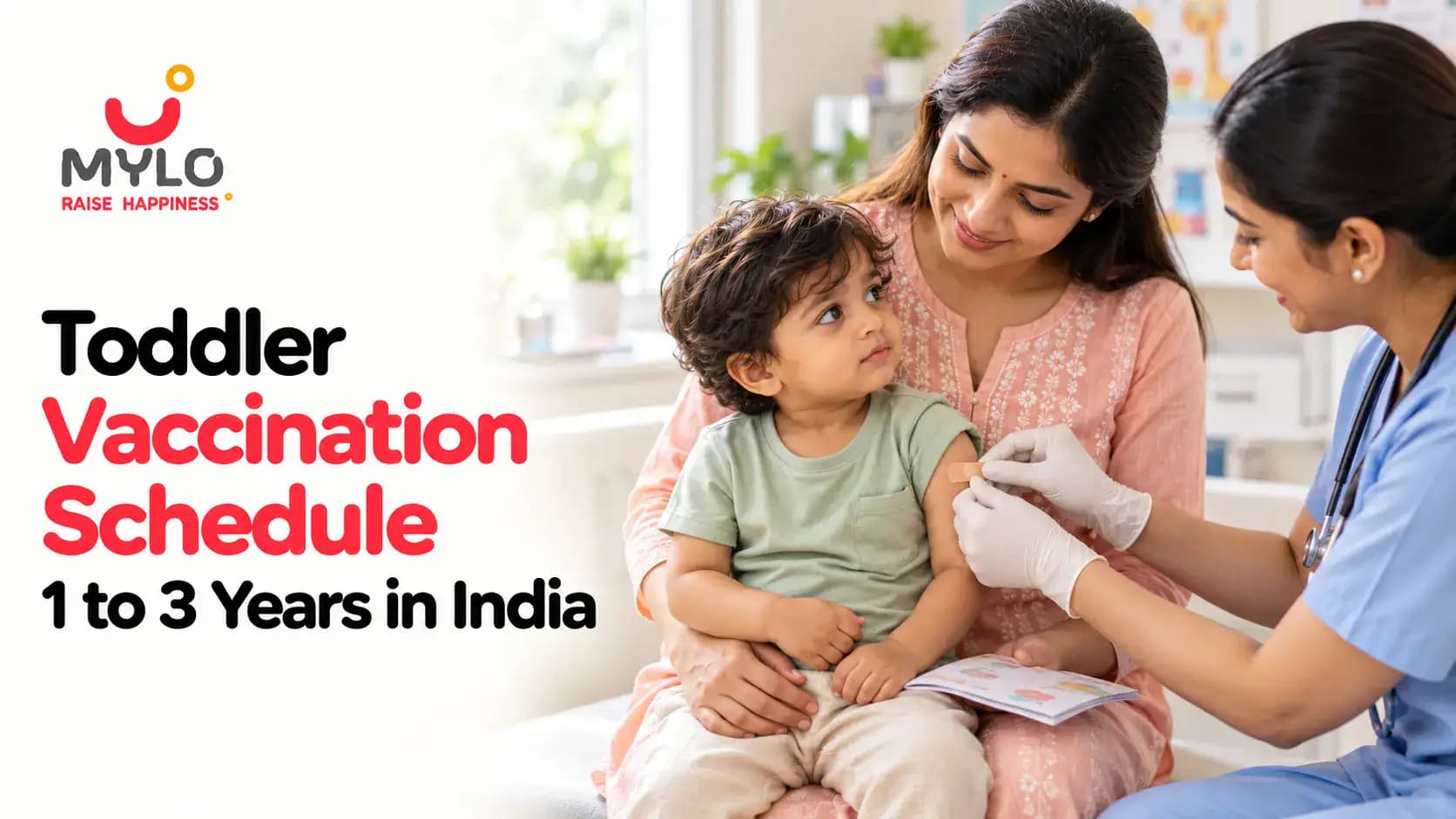
Quick Answer
A toddler vaccination schedule is the list of vaccines and boosters a child needs between 1 and 3 years. Key visits are at 12, 15 and 16 to 18 months, for MMR, chickenpox, hepatitis A, and DPT, polio and Hib boosters. Government vaccines are free. Always follow your doctor and MCP card.
Toddler Vaccines at a Glance
Question | Short Answer |
|---|---|
Which vaccines after 1 year? | Hepatitis A, MMR or MR second dose, chickenpox, PCV booster, and DPT, polio and Hib boosters |
Main vaccine visits | 12 months, 15 months, 16 to 18 months, and 18 to 24 months |
Are they free? | Government (UIP) vaccines are free at government centres. Some IAP-recommended vaccines are only available privately |
Flu vaccine? | Yearly from 6 months to 5 years, as your doctor advises |
Next boosters after toddlerhood | At 4 to 6 years |
Missed a dose? | Don't restart. Ask your doctor about catch-up doses |
Where to track | Your MCP card, the U-WIN record, or Mylo's free immunization scheduler |
Key Facts Every Parent Should Know
Boosters matter: Protection from baby vaccines fades. Toddler boosters keep it strong
Two schedules exist in India: The government Universal Immunization Programme (UIP) and the Indian Academy of Pediatrics (IAP) schedule. IAP includes some extra vaccines
Delays leave gaps: Measles and chickenpox spread fast among toddlers at playschool and family events
Mild fever is common: Low fever, fussiness or soreness for 1 to 2 days after vaccines is normal
A cold isn't a reason to delay: Mild illness usually doesn't stop vaccination. Your doctor will decide
Vaccines don't cause autism: Large studies have found no link between MMR and autism
Toddler Vaccination Chart: Government (UIP) Schedule
Short answer: Under India's Universal Immunization Programme, these vaccines are free at government health centres and Anganwadi immunisation sessions.
Age | Free UIP Vaccines |
|---|---|
9 to 12 months | MR dose 1, fIPV dose 3, PCV booster, JE dose 1 (in some districts), Vitamin A (first dose) |
16 to 24 months | MR dose 2, DPT booster 1, OPV booster, JE dose 2 (in some districts), Vitamin A (second dose) |
Every 6 months until 5 years | Vitamin A doses |
5 to 6 years | DPT booster 2 |
Toddler Vaccination Chart: IAP Schedule
Short answer: Many private pediatricians follow the IAP schedule, which adds vaccines like hepatitis A, chickenpox and Hib boosters.
Age | IAP-Recommended Vaccines |
|---|---|
12 months | Hepatitis A (dose 1) |
12 to 15 months | PCV booster |
15 months | MMR dose 2, Varicella (chickenpox) dose 1 |
16 to 18 months | DTP booster 1 (DTwP or DTaP), Hib booster, IPV booster |
18 to 19 months | Hepatitis A dose 2 (if the 2-dose type is used), Varicella dose 2 |
Every year (6 months to 5 years) | Influenza (flu) vaccine |
4 to 6 years | Next boosters (DTP, polio and others, as your doctor advises) |
Note: Schedules are updated from time to time. Your pediatrician may adjust the timing based on what your toddler has already had. Typhoid conjugate vaccine is usually given in infancy. Ask your doctor if your toddler needs a dose or booster.
What Is Each Toddler Vaccine For?
Vaccine | Protects Against |
|---|---|
MMR or MR | Measles, mumps, rubella |
Varicella | Chickenpox |
Hepatitis A | Hepatitis A, a liver infection spread through dirty food and water |
DTP booster | Diphtheria, tetanus, whooping cough |
Polio booster (OPV or IPV) | Polio |
Hib booster | Serious infections like meningitis and pneumonia |
PCV booster | Pneumonia, meningitis and ear infections caused by pneumococcus |
JE (in some districts) | Japanese encephalitis, a brain infection spread by mosquitoes |
Influenza | Flu |
The 15-Month Vaccines
Short answer: At 15 months, toddlers on the IAP schedule usually get the second MMR dose and the first chickenpox vaccine. A mild fever or rash may appear 1 to 2 weeks later.
Vaccine | Possible Side Effects |
|---|---|
MMR dose 2 | Mild fever or a light rash, usually 7 to 12 days after the shot |
Varicella | Soreness, mild fever, or a few small spots, usually within a few weeks |
The 16 to 18 Month Vaccines
Short answer: This visit includes the DTP, polio and Hib boosters. Soreness, swelling at the injection site and fever for 1 to 2 days are common, especially with the DTwP vaccine.
What Side Effects Are Normal After Toddler Vaccines?
Short answer: Mild fever, fussiness, sleepiness, poor appetite and a sore, red or swollen spot where the injection was given are normal. They usually go away in 1 to 3 days.
Normal | See a Doctor |
|---|---|
Mild fever for 1 to 2 days | High fever, or fever lasting more than 2 days |
Soreness, redness or swelling at the injection site | Swelling that keeps growing, or pus |
Fussiness or crying | Crying non-stop for more than 3 hours |
Sleepiness or poor appetite | Very sleepy, floppy or hard to wake |
Mild rash 1 to 2 weeks after MMR | A fit (seizure), or trouble breathing |
Emergency: Call 108 or 112 if your toddler has trouble breathing, swelling of the face or lips, or a seizure after a vaccine. Serious reactions are very rare.
How to care for your toddler after vaccines
Give extra cuddles, fluids and rest
Apply a cool, clean cloth to the injection site
Give paracetamol only if your doctor advises, in the dose they tell you
Never give aspirin to children
Dress your toddler in light clothes if they have a fever
Read more on how to soothe your child after vaccines.
How to Prepare Your Toddler for Vaccine Day
Short answer: Stay calm, be honest, hold your toddler on your lap, and use a toy or song to distract them.
Carry your MCP card or vaccine record
Tell your toddler simply: "It will pinch for a second, then a big hug"
Hold your toddler on your lap during the injection
Bring a favourite toy, book or snack
Breastfeed or cuddle right after
Praise them for being brave
For toddlers who are scared of doctors, see our guide on toddler fears and anxiety.
What If My Toddler Missed a Vaccine?
Short answer: Don't worry, and don't restart the series. Your doctor will give catch-up doses to complete the schedule.
Take your MCP card or records to your doctor
Most vaccines can be given late and still work
Several vaccines can be given on the same day safely
The government's Mission Indradhanush campaign helps children catch up on missed doses for free
Can My Toddler Get Vaccines When Unwell?
Short answer: Yes, usually. A mild cold, cough or low fever is usually not a reason to delay. Your doctor may wait if your toddler has a high fever or is very unwell.
Tell your doctor if your toddler:
Had a serious reaction to a previous vaccine
Has a weak immune system or takes steroid medicines
Recently had a blood transfusion
Has a severe allergy
How Much Do Toddler Vaccines Cost in India?
Short answer: UIP vaccines are free at government hospitals, primary health centres and Anganwadi immunisation sessions. Vaccines only on the IAP schedule, like hepatitis A, chickenpox and flu, are given at private clinics, and costs vary by brand and city.
Ask your pediatrician for the cost of each vaccine before your visit, and keep a record of what was given.
How Do I Keep Track of My Toddler's Vaccines?
Tool | How It Helps |
|---|---|
MCP (Mother and Child Protection) card | Paper record from your Anganwadi or hospital |
U-WIN | The government's digital record of vaccinations |
Mylo immunization scheduler | Free reminders for your child's vaccines |
Your pediatrician's records | Keep a copy at home |
Track your toddler's vaccines with Mylo's free immunization scheduler.
What Should Indian Parents Keep in Mind?
Short answer: Many toddlers miss boosters because there's a long gap after the first year of vaccines. Mark the dates and keep your vaccine record safe.
Boosters get missed: After the busy first year, the 15 and 18 month visits are easy to forget
Moving cities or going to Nani's house: Carry the MCP card, and get vaccines at any government centre
Monsoon and flu season: Ask your doctor about the yearly flu vaccine before the season
JE vaccine: Given in districts where Japanese encephalitis is common. Ask your local health centre
"Nazar" and fever after vaccines: A mild fever is the body building protection. It's normal and passes in a day or two
Vitamin A doses: Given free every 6 months until 5 years. Don't miss them
Myths vs Facts
Myth | Fact |
|---|---|
MMR causes autism | Large studies show no link |
Too many vaccines at once overload the immune system | Several vaccines on the same day are safe |
A cold means vaccines must be delayed | Mild illness usually isn't a reason to delay |
If a dose is missed, the series must restart | Missed doses can be caught up without restarting |
Toddlers don't need vaccines after 1 year | Boosters are needed to keep protection strong |
Fever after a vaccine means it didn't work | Mild fever is a normal sign the body is responding |
Frequently Asked Questions
1. Which vaccines are given after 1 year?
Hepatitis A, the second MMR or MR dose, chickenpox, the PCV booster, and the DPT, polio and Hib boosters, depending on the schedule your doctor follows.
2. Which vaccines are given at 15 months in India?
On the IAP schedule, usually MMR dose 2 and the first chickenpox (varicella) vaccine.
3. Which vaccines are given at 16 to 18 months?
DTP booster, polio booster and Hib booster. Under UIP, MR dose 2, DPT booster and OPV booster are given between 16 and 24 months.
4. Is fever normal after the 15-month vaccine?
Yes. A mild fever or rash can appear 7 to 12 days after MMR. See a doctor if the fever is high or lasts more than 2 days.
5. Are toddler vaccines free in India?
UIP vaccines are free at government centres. Some IAP vaccines, like hepatitis A and chickenpox, are paid at private clinics.
6. What if my toddler missed the 18-month booster?
Visit your doctor as soon as you can. The missed dose can be given late without restarting.
7. Does my toddler need the flu vaccine every year?
The IAP recommends a yearly flu vaccine from 6 months to 5 years. Ask your doctor.
8. 1 saal ke baad bacche ko kaun se teeke lagte hain?
1 saal ke baad Hepatitis A, MMR ka doosra teeka, chickenpox, aur 16 se 18 mahine par DPT, polio aur Hib ke booster lagte hain. Sarkari teeke muft hote hain. Apna MCP card saath rakhiye.
9. Teeke ke baad bukhar aaye to kya karein?
Halka bukhar 1 se 2 din mein theek ho jata hai. Bacche ko aaram, paani aur pyaar dijiye. Doctor ki salah se hi paracetamol dijiye. Tez bukhar ya daura pade to turant doctor ke paas jaiye.
Related Reads on Mylo
References
Ministry of Health and Family Welfare, Government of India. "National Immunization Schedule (Universal Immunization Programme)." https://nhm.gov.in
Indian Academy of Pediatrics Advisory Committee on Vaccines and Immunization Practices (ACVIP). "IAP Recommended Immunization Schedule for Children Aged 0 Through 18 Years." Latest edition.
Ministry of Health and Family Welfare, Government of India. "Mission Indradhanush." https://nhm.gov.in
Ministry of Health and Family Welfare, Government of India. "U-WIN." https://uwin.mohfw.gov.in
World Health Organization (WHO). "Vaccines and immunization." https://www.who.int/health-topics/vaccines-and-immunization
Taylor LE, Swerdfeger AL, Eslick GD. "Vaccines are not associated with autism: an evidence-based meta-analysis." Vaccine, 2014.
Medical Disclaimer
This article is for information only and does not replace professional medical advice. Vaccine schedules are updated from time to time. Always follow your pediatrician's advice and your child's MCP card.



Baby Essentials
Everything you need for the baby


Article Posted Under
Related Articles


Related Topics
.webp&w=32&q=75)
Medical Disclaimer
This content is for informational purposes only and should not replace professional medical advice. Consult with a physician or other health care professional if you have any concerns or questions about your health. If you rely on the information provided here, you do so solely at your own risk.


AWARDS AND RECOGNITION

Mylo wins Forbes D2C Disruptor award

Mylo wins The Economic Times Promising Brands 2022
AS SEEN IN












- Mylo Care: Effective and science-backed personal care and wellness solutions for a joyful you.
- Mylo Baby: Science-backed, gentle and effective personal care & hygiene range for your little one.
- Mylo Community: Trusted and empathetic community of 10mn+ parents and experts.


Product Categories
Baby Carrier | Baby Soap | Baby Wipes | Stretch Marks Cream | Baby Cream | Baby Shampoo | Baby Massage Oil | Baby Hair Oil | Stretch Marks Oil | Baby Body Wash | Baby Powder | Baby Lotion | Diaper Rash Cream | Newborn Diapers | Teether | Baby Kajal | Baby Diapers Pants | Cloth Diapers | Laundry Detergent | Lactation Granules |