


Orders
.png&w=48&q=75 "login")
Profile


Wallet

Toddler Hygiene Routine: Teeth, Hair, Nails and Eyes
 15 min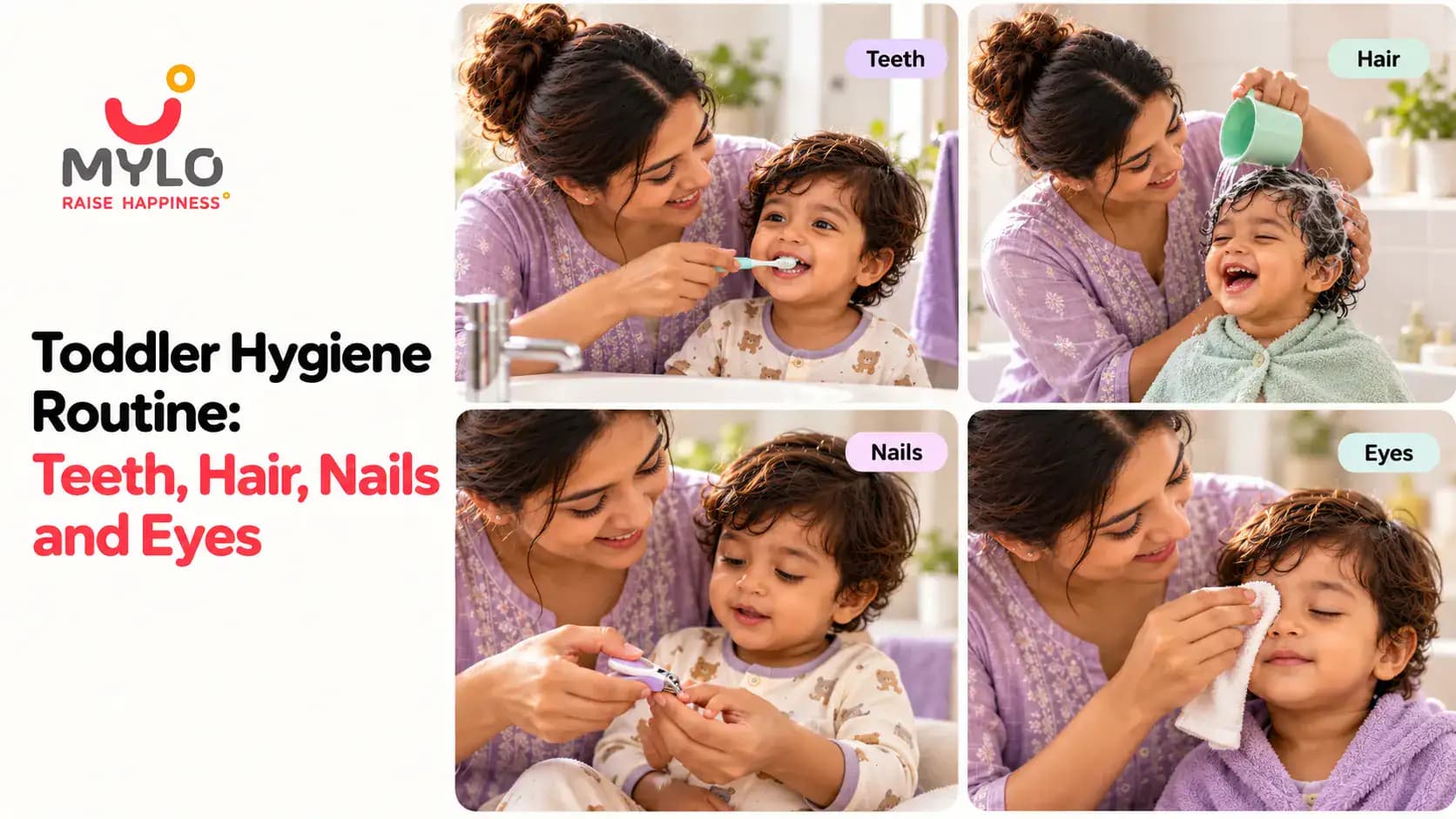
Quick Answer
Toddler hygiene means daily habits that keep a child aged 1 to 3 clean and healthy, like brushing teeth twice a day, washing hair, trimming nails and keeping eyes clean. Use a rice-grain smear of fluoride toothpaste, mild shampoo and baby nail clippers. Never put kajal or home remedies in the eyes.
Toddler Hygiene at a Glance
Area | How Often | Key Tip |
|---|---|---|
Teeth | Brush twice a day | Rice-grain smear of fluoride toothpaste. An adult brushes |
Dentist | First visit by age 1, then every 6 months | Earlier if you see white or brown spots |
Hair | Wash 2 to 3 times a week | Mild, tear-free shampoo. Check for lice |
Fingernails | Trim about once a week | After a bath, when nails are soft |
Toenails | Trim every 1 to 2 weeks | Cut straight across |
Eyes | Wipe gently when needed | Clean cotton and water only. No kajal |
Hands | Before meals and after the toilet | Soap and water for 20 seconds |
Key Facts Every Parent Should Know
Tooth decay is common in Indian toddlers: Bottles at night, sweets and late brushing are the main causes
Fluoride toothpaste is safe in the right amount: Just a rice-grain smear until age 3
Parents should brush for toddlers: Most children can't brush well on their own until about 7 or 8
Head lice are common at playschool: They're not a sign of being dirty
Kajal and surma aren't safe for eyes: They can cause infections, and some contain lead
Outdoor play is good for eyes: Time outdoors may help protect against short-sightedness
How to Brush Your Toddler's Teeth
Short answer: Brush your toddler's teeth twice a day, in the morning and before bed, with a soft toddler toothbrush and a rice-grain smear of fluoride toothpaste. An adult should do the brushing.
Step by step
Choose a soft, small-headed toddler toothbrush.
Use a rice-grain smear of fluoride toothpaste (about the size of a grain of rice) until age 3.
Position: Sit your toddler on your lap facing away, or lie them down with their head in your lap.
Brush gently in small circles on the front, back and chewing surfaces of every tooth, and along the gum line.
Brush for about 2 minutes. A song helps.
Let them spit, but don't rinse with lots of water. A little toothpaste left on the teeth helps protect them.
Brush last thing at night, after the last milk feed.
Toothpaste amount by age
Age | Amount of Fluoride Toothpaste |
|---|---|
First tooth to 3 years | A rice-grain smear |
3 to 6 years | A pea-sized amount |
What if my toddler refuses to brush?
Try This | Why It Helps |
|---|---|
Sing a 2-minute brushing song | Makes it fun and shows how long to brush |
Let them hold a brush too | Gives them some control |
Brush in front of a mirror | Toddlers love watching themselves |
Take turns: "You brush, then I brush" | Builds the habit while you do the real cleaning |
Brush a teddy's teeth first | Makes brushing playful |
Use a brushing chart with stickers | Rewards the daily habit |
Stay calm and keep it short | Fights make brushing harder |
How to prevent tooth decay
No bottle in bed: Milk or juice in bed is a common cause of cavities. Read more in our guide on stopping the bottle
Limit sweets and sugary drinks: Especially between meals
Don't share spoons or pre-chew food: Germs that cause decay can pass from adults to toddlers
Water after snacks: Rinse the mouth with a few sips
When should my toddler see a dentist?
The first dental visit is recommended by the first birthday, or within 6 months of the first tooth. After that, visit every 6 months. A dentist may apply fluoride varnish to help protect the teeth.
See a dentist sooner if you notice:
White, chalky spots near the gums (early decay)
Brown or black spots or holes
Swollen gums or a swelling on the face
Tooth pain or bad breath that doesn't go away
For electric toothbrushes, read is an electric toothbrush safe for toddlers.
Toddler Hair Care
Short answer: Wash your toddler's hair 2 to 3 times a week with a mild, tear-free shampoo. Comb gently, and check for lice regularly once they start playschool.
How to wash your toddler's hair
Use lukewarm water and a small amount of mild, tear-free shampoo.
Tilt their head back or use a cup to pour water, so it doesn't run into their eyes.
Rinse well, then pat dry with a soft towel.
Comb gently from the ends upwards to remove tangles.
Tip: A toy or a song during hair washing helps toddlers who dislike it.
Hair oil for toddlers
A light oil massage before washing is fine if your toddler enjoys it
Wash it off. Heavy oil left on the scalp in hot weather can cause itching and rashes
Use a small amount of a mild oil, and avoid hair products made for adults
Head lice
Head lice are tiny insects that live in the hair and are common at playschool.
Signs | What to Do |
|---|---|
Itchy scalp, especially behind ears and at the neck | Check the hair under good light |
Tiny white eggs (nits) stuck to the hair near the scalp | Use a fine-toothed lice comb on wet, conditioned hair |
Small moving insects | Ask your doctor about a lice treatment safe for your toddler's age |
Never use kerosene, insecticides or adult lice products on a toddler's head. Check and treat other family members too.
When to see a doctor about hair or scalp
Round patches of hair loss with scaling (possible scalp ringworm, which needs medicine)
Thick, greasy scales that don't improve
Sores, pus or a very itchy, red scalp
Sudden hair loss
Toddler Nail Care
Short answer: Trim fingernails about once a week and toenails every 1 to 2 weeks, using baby nail clippers or scissors. The best time is after a bath, when nails are soft.
How to trim toddler nails
Trim after a bath or while your toddler is sleepy or distracted.
Hold the finger firmly and press the fingertip pad away from the nail.
Cut fingernails following the curve of the finger.
Cut toenails straight across to prevent ingrown nails.
Smooth sharp edges with a soft nail file.
Don't cut too short, and never bite your toddler's nails off.
Keep nails clean
Wash hands with soap and water before meals and after the toilet
Clean under the nails gently with a soft brush
Short nails hold less dirt and help prevent infections and worms
See a doctor if the skin around a nail is red, swollen, painful or has pus, or if a toenail is growing into the skin.
If your toddler bites their nails, read our guide on nail biting in toddlers. For step-by-step trimming, see safely trimming your baby's nails.
Toddler Eye Care
Short answer: Clean your toddler's eyes gently with clean cotton and water when needed. Don't put kajal, surma or home remedies in the eyes. Watch for squinting, crossed eyes or a white glow in the pupil.
How to clean your toddler's eyes
Wash your hands first.
Dip clean cotton wool in boiled and cooled water.
Wipe gently from the inner corner (near the nose) outwards.
Use a fresh piece of cotton for each eye.
What not to put in your toddler's eyes
Avoid | Why |
|---|---|
Kajal or surma | Can cause eye infections. Some contain lead |
Breast milk, rose water or ghee | Can carry germs and cause infection |
Medicated eye drops without a doctor | Some can harm the eyes |
Read more in our guide on whether kajal is safe for babies' eyes.
Protecting your toddler's eyesight
Limit screens: WHO advises no screen time under 2 (except video calls), and no more than 1 hour a day for 2 to 4 year olds
Play outdoors every day: Outdoor time is good for developing eyes
Keep sharp objects and chemicals away: Eye injuries are common in toddlers
Eye checks: Ask your doctor to check your toddler's eyes at routine visits. Eye screening is part of RBSK checks
When to see a doctor about eyes
Sign | What to Do |
|---|---|
Red, sticky or watery eyes with discharge | Possible conjunctivitis. See a doctor. Read about conjunctivitis in toddlers |
Crossed eyes or one eye turning in or out | See an eye doctor |
A white or yellow glow in the pupil in photos | See an eye doctor urgently |
Squinting, holding things very close, or tilting the head to see | Get an eye check |
Injury, chemical splash or something stuck in the eye | Rinse with clean water and see a doctor immediately |
Swelling or redness around the eye with fever | See a doctor urgently |
Daily Toddler Hygiene Routine
Short answer: A simple daily routine makes hygiene easy and turns it into a habit.
Time | Hygiene Habit |
|---|---|
Morning | Brush teeth, wash face, wipe eyes if needed |
Before meals | Wash hands with soap |
After the toilet or diaper change | Wash hands |
After playschool or outdoor play | Wash hands and face, change clothes |
Bath time | Bath, hair wash (2 to 3 times a week), nail trim (weekly) |
Bedtime | Brush teeth after the last milk feed |
Tip: A picture chart of the routine helps toddlers follow along and feel proud.
What Should Indian Parents Keep in Mind?
Short answer: Some traditional practices, like kajal, datun and kerosene for lice, aren't safe for toddlers. Simple, gentle hygiene works best.
Kajal and surma: Common for nazar or "bigger eyes", but they can cause infections and some contain lead
Datun (neem twigs) and tooth powders: Too rough for toddler teeth. Use a soft toothbrush and fluoride toothpaste
Sweets and late-night milk: Brush after the last feed
Heavy hair oil in summer: Wash it off to avoid itching and rashes
Kerosene for lice: Dangerous. Ask your doctor for a safe treatment
Nail cutting customs: Some families avoid certain days. Regular trimming still matters
Mundan and haircuts: Keep scissors and razors clean, and soothe your toddler if they're scared. See our guide on toddler fears
Myths vs Facts
Myth | Fact |
|---|---|
Milk teeth don't matter because they fall out | Healthy milk teeth help with eating, speech and guiding adult teeth |
Toddlers shouldn't use fluoride toothpaste | A rice-grain smear is safe and helps prevent decay |
Kajal makes eyes bigger and stronger | Kajal doesn't change eyes and can cause infections |
Lice mean a child is dirty | Lice spread through head-to-head contact, not dirt |
Toddlers can brush on their own | Parents need to brush for them until about 7 or 8 |
Daily hair wash is needed | 2 to 3 times a week is enough for most toddlers |
Frequently Asked Questions
1. How much toothpaste should a toddler use?
A rice-grain smear of fluoride toothpaste until age 3, then a pea-sized amount.
2. When should my toddler first see a dentist?
By the first birthday, or within 6 months of the first tooth, then every 6 months.
3. My toddler refuses to brush. What can I do?
Sing a song, let them hold a brush too, brush in front of a mirror, and use a sticker chart. Keep it calm and short.
4. How often should I wash my toddler's hair?
2 to 3 times a week with a mild, tear-free shampoo is enough for most toddlers.
5. How often should I cut my toddler's nails?
Fingernails about once a week, toenails every 1 to 2 weeks.
6. Is kajal safe for toddlers' eyes?
No. Kajal and surma can cause eye infections, and some contain lead.
7. How do I get rid of lice in my toddler's hair?
Use a fine-toothed lice comb on wet hair, and ask your doctor for a treatment safe for your toddler's age. Never use kerosene.
8. Bacche ke daant kab se brush karne chahiye?
Pehla daant aate hi brush shuru kijiye. 3 saal tak chawal ke daane jitna fluoride toothpaste lagaiye, aur din mein do baar, subah aur raat ko sone se pehle, khud brush kijiye.
9. Kya bacche ki aankh mein kajal lagana chahiye?
Nahi. Kajal ya surma se aankh mein infection ho sakta hai, aur kuch mein lead hota hai. Aankh saaf karne ke liye sirf ubla aur thanda kiya hua paani aur saaf rui use kijiye.
Related Reads on Mylo
References
American Academy of Pediatric Dentistry (AAPD). "Policy on Use of Fluoride" and "Perinatal and Infant Oral Health Care." https://www.aapd.org
Indian Society of Pedodontics and Preventive Dentistry (ISPPD). Guidance on early childhood oral health.
American Academy of Pediatrics (AAP). "Head Lice." Clinical Report, Pediatrics, 2022.
American Academy of Pediatrics (AAP). "Visual System Assessment in Infants, Children, and Young Adults by Pediatricians." Pediatrics, 2016.
World Health Organization (WHO). "Guidelines on physical activity, sedentary behaviour and sleep for children under 5 years of age." 2019.
Ministry of Health and Family Welfare, Government of India. "Rashtriya Bal Swasthya Karyakram (RBSK)." https://rbsk.mohfw.gov.in/
Medical Disclaimer
This article is for information only and does not replace professional medical advice. If you notice changes in your toddler's teeth, eyes, scalp or nails, please consult your pediatrician, dentist or eye doctor.


Bath Time Basics
Everyday picks for clean, happy toddlers




Article Posted Under
Related Articles

Related Topics
.webp&w=32&q=75)
Medical Disclaimer
This content is for informational purposes only and should not replace professional medical advice. Consult with a physician or other health care professional if you have any concerns or questions about your health. If you rely on the information provided here, you do so solely at your own risk.


AWARDS AND RECOGNITION

Mylo wins Forbes D2C Disruptor award
Mylo wins The Economic Times Promising Brands 2022
AS SEEN IN












- Mylo Care: Effective and science-backed personal care and wellness solutions for a joyful you.
- Mylo Baby: Science-backed, gentle and effective personal care & hygiene range for your little one.
- Mylo Community: Trusted and empathetic community of 10mn+ parents and experts.


Product Categories
Baby Carrier | Baby Soap | Baby Wipes | Stretch Marks Cream | Baby Cream | Baby Shampoo | Baby Massage Oil | Baby Hair Oil | Stretch Marks Oil | Baby Body Wash | Baby Powder | Baby Lotion | Diaper Rash Cream | Newborn Diapers | Teether | Baby Kajal | Baby Diapers Pants | Cloth Diapers | Laundry Detergent | Lactation Granules |