


Orders
.png&w=48&q=75 "login")
Profile


Wallet

Reading to Toddlers: Benefits and Best Books (1 to 3 Years)
 21 min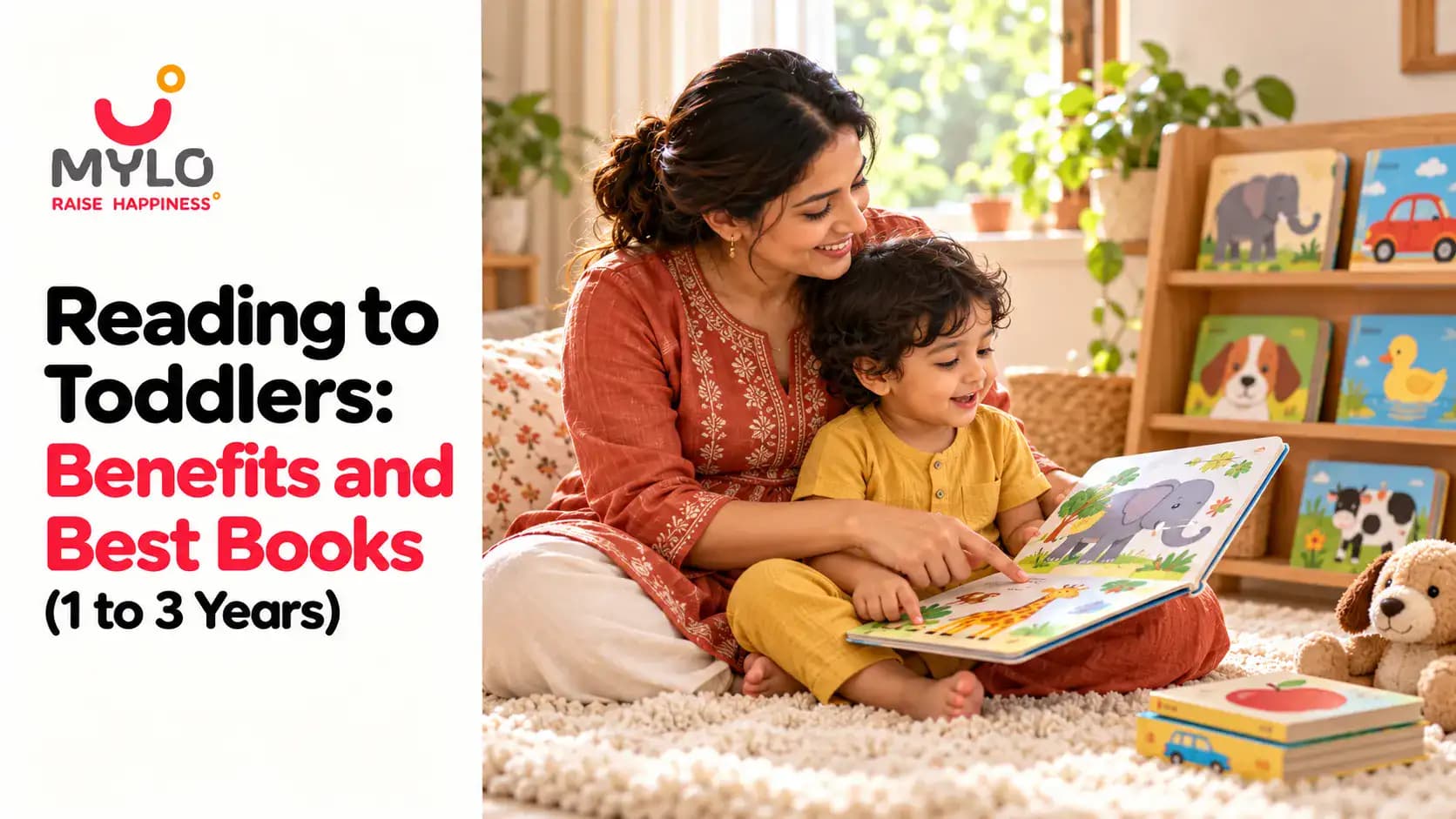
Quick Answer
Reading to your toddler means sharing books aloud together, pointing, naming and talking about the pictures, not just reading the words. For example, asking your 2 year old "Where is the cow?" on each page is reading. Just 10 to 15 minutes a day builds language, attention and bonding.
At a Glance
Age | Best Book Type | How Long at a Time | What Your Toddler Can Do |
|---|---|---|---|
12 to 18 months | Sturdy board books, touch and feel, lift the flap | 2 to 5 minutes | Turn thick pages, point, pat pictures, babble |
18 to 24 months | Simple picture books, animals, rhymes, daily routines | 5 to 10 minutes | Name objects, make animal sounds, ask for the same book again |
2 to 3 years | Short stories, repeating lines, feelings, counting, colours | 10 to 15 minutes | Fill in words, answer simple questions, retell parts |
Key Facts
The American Academy of Pediatrics recommends reading aloud to children every day, starting from infancy.
A study from Ohio State University estimated that children read five books a day hear about 1.4 million more words by age 5 than children who are never read to.
Toddlers learn more when parents talk about the book and ask questions, not just read the text.
Reading the same book again and again is normal and helps toddlers learn.
Books in your home language count just as much as English books.
What Are the Benefits of Reading to Toddlers?
Short answer: Reading aloud builds vocabulary, listening, attention and imagination, and gives your toddler close, calm time with you. It also prepares the brain for reading and school later.
Benefit | How Reading Helps |
|---|---|
Language | Toddlers hear new words they don't hear in daily talk, like "enormous", "whisper" or "jungle" |
Speech | Repeating lines and naming pictures gives practice in saying words |
Attention | Sitting with a book slowly stretches focus time |
Bonding | Sitting in your lap with your full attention makes toddlers feel safe |
Emotions | Stories about feelings help toddlers name "happy", "sad" and "angry" |
Routine and sleep | A bedtime book is a calm signal that sleep is coming |
School readiness | Early book handling, pictures and sounds prepare children for reading later |
For how stories and rhymes support baby brain development in the first year, read role of stories and rhymes in your baby's brain development.
When Should You Start Reading to Your Toddler?
Short answer: As early as possible. Reading can start from birth, but it is never too late. If you have not started yet, begin today, even with one short book a day.
A 1 year old may chew the book, turn three pages at once or crawl away after a minute. That is normal and still counts. The goal at this age is enjoying books together, not finishing them.
How Many Books Should You Read to a Toddler a Day?
Short answer: Aim for 10 to 15 minutes of reading a day, which is usually 2 to 5 short books for a toddler. Short sessions spread across the day work better than one long session.
Age | Books a Day | Tip |
|---|---|---|
12 to 18 months | 2 to 3 short board books | A few minutes at a time, whenever your toddler brings a book |
18 to 24 months | 3 to 4 books | One after nap, one at bedtime, others during play |
2 to 3 years | 3 to 5 books | Include one longer story at bedtime |
Repeating the same book counts. Quality time together matters more than the number of books.
How to Read to a Toddler: Step by Step
Short answer: Sit close, let your toddler hold the book and turn pages, point to pictures, use expressive voices, ask simple questions, and stop when they lose interest.
Step | What to Do | Example |
|---|---|---|
1. Pick a calm time | After a nap, after a bath, before bed | Same time every day helps |
2. Sit close | In your lap or side by side on the floor | Hold the book so both can see |
3. Let them lead | Let your toddler choose the book and turn pages | Even if they skip pages |
4. Point and name | Point to pictures and say the word | "Look, a red ball!" |
5. Use voices and sounds | Change your voice, make animal sounds | "The lion says ROAR!" |
6. Ask questions | Simple ones they can answer by pointing or one word | "Where is the cat?" |
7. Connect to real life | Link pictures to their world | "We have a bus like this outside!" |
8. Stop on a happy note | End before they get bored or upset | It is okay to read only 3 pages |
Talk, Don't Just Read: The PEER Method
Researchers call this "dialogic reading". It works well from about 2 years:
Letter | Means | Example |
|---|---|---|
P | Prompt your child to say something about the book | "What is this?" |
E | Evaluate their answer kindly | "Yes, it's a dog!" |
E | Expand on what they said | "It's a big brown dog." |
R | Repeat and let them say it again | "Can you say big brown dog?" |
Reading Tips by Age
Age | Tips |
|---|---|
12 to 18 months | Use board books they can grab and chew. Point and name. Copy their sounds. Short sessions, many times a day |
18 to 24 months | Pause and let them say the animal sound or name. Ask "Where is...?" questions. Read the same favourites often |
2 to 3 years | Pause before the last word of a repeating line so they fill it in. Ask "What happens next?" Talk about feelings in the story |
Why Does My Toddler Want the Same Book Again and Again?
Short answer: Repetition is how toddlers learn. Each time they hear the same story, they understand more, predict what comes next, and feel confident. It is completely normal.
You may be tired of reading "Brown Bear, Brown Bear" for the 20th time, but your toddler is learning new words, sounds and patterns each time. Try adding a new question or a new voice to keep it fun for you both.
What If My Toddler Won't Sit Still for a Book?
Short answer: Most toddlers don't sit still for long, and that is okay. Keep books short and interactive, read while they play nearby, and try different times of the day.
Problem | Try This |
|---|---|
Runs away after 1 page | Read just 1 or 2 pages. Try again later |
Only wants to turn pages | Let them. Name what you see on each page |
Grabs or tears books | Use board books or cloth books |
Prefers the phone | Keep books in reach and screens out of sight. See screen time for toddlers |
Very active toddler | Act out the story: stomp like an elephant, hop like a frog |
Gets bored with long stories | Tell the story in your own simple words using the pictures |
Short attention is normal at this age. See toddler attention span by age.
Best Story Books for 1 Year Olds
Short answer: Choose sturdy board books with bright pictures, one object per page, touch and feel textures, flaps to lift, and simple rhymes.
Book | Author | Why Toddlers Love It |
|---|---|---|
Dear Zoo | Rod Campbell | Lift the flaps to find animals |
Where's Spot? | Eric Hill | Lift the flap hide and seek |
That's Not My Puppy (and others in the series) | Fiona Watt, Usborne | Touch and feel textures |
Peek-a-Who? | Nina Laden | Peekaboo with cut-out pages |
Brown Bear, Brown Bear, What Do You See? | Bill Martin Jr., Eric Carle | Repeating lines, colours and animals |
Goodnight Moon | Margaret Wise Brown | Calm, gentle bedtime book |
First word board books (animals, fruits, vehicles) | Various Indian publishers | Real photos of familiar things, including Indian fruits and vehicles |
Best Story Books for 2 Year Olds
Short answer: Two year olds enjoy simple stories with repeating lines, animals, colours, counting, everyday routines and books they can join in with.
Book | Author | Why Toddlers Love It |
|---|---|---|
The Very Hungry Caterpillar | Eric Carle | Days, food, counting, holes to poke fingers through |
Where Is the Green Sheep? | Mem Fox | Funny sheep, opposites, repeating question |
Each Peach Pear Plum | Janet and Allan Ahlberg | Rhyming "I spy" game |
Owl Babies | Martin Waddell | Missing mummy and her coming back, good for separation worries |
Guess How Much I Love You | Sam McBratney | Gentle, loving bedtime book |
We're Going on a Bear Hunt | Michael Rosen | Sounds and actions to join in |
Gajapati Kulapati | Ashok Rajagopalan, Tulika Books | Indian elephant story with fun sounds |
Best Story Books for 3 Year Olds
Short answer: Three year olds can follow longer stories with simple plots, humour, feelings and characters they can talk about.
Book | Author | Why Toddlers Love It |
|---|---|---|
The Gruffalo | Julia Donaldson | Rhyming, clever mouse, a little bit scary in a fun way |
Room on the Broom | Julia Donaldson | Rhyming, friendship, repeating lines |
The Tiger Who Came to Tea | Judith Kerr | Funny, simple story about an unexpected guest |
Llama Llama Red Pajama | Anna Dewdney | Bedtime worries and being reassured |
Don't Let the Pigeon Drive the Bus! | Mo Willems | Children shout "No!" to the pigeon |
Where's That Cat? | Manjula Padmanabhan, Tulika Books | Indian home setting, search and find |
Simple Panchatantra board books | Various Indian publishers | Short animal stories with a lesson |
Hindi Story Books and Indian Books for Toddlers
Short answer: Books in Hindi and other Indian languages are just as good for your toddler's brain as English books. Reading in your home language builds a strong base for learning English later.
Source | What It Offers |
|---|---|
Tulika Books | Picture books set in India, many in several Indian languages |
Pratham Books and StoryWeaver | Low-cost and free books in many Indian languages. StoryWeaver Level 1 books are short and simple |
Karadi Tales | Picture books and Karadi Rhymes, Indian rhymes with audio |
Indian first word board books | Words like roti, aam, auto, gaay with pictures of things your toddler sees every day |
Your own stories | Tell family stories, festival stories and grandparents' stories using simple words |
Learning two languages does not confuse toddlers. Read toddler learning two languages.
Books for Special Moments
Short answer: Books can help toddlers understand big changes like a new baby, starting daycare, feelings, or potty training.
Situation | Look for Books About | Related Read |
|---|---|---|
New baby coming | Becoming a big brother or sister | |
Starting daycare or playschool | First day, mummy comes back | |
Big feelings and tantrums | Naming feelings, calming down | |
Fear of the dark or doctors | Bedtime, visiting the doctor | |
Learning colours, shapes and numbers | Concept books | |
Potty training | Using the potty, saying bye bye to diapers |
Books for Toddlers With Speech Delay
If your toddler is a late talker, choose books with:
One clear picture and one word per page
Repeating lines ("Brown bear, brown bear, what do you see?")
Animal and vehicle sounds ("moo", "beep beep") that are easy to copy
Real photos of familiar things
Pause and wait a few seconds after a familiar line to give your child a chance to fill in a sound or word. Always discuss speech worries with your paediatrician. See toddler stuttering and when babies start talking.
How to Choose a Good Book for Your Toddler
Short answer: Look for sturdy pages, big clear pictures, few words, rhythm or repetition, and topics your toddler loves, like animals, vehicles or food.
Look For | Avoid |
|---|---|
Thick board pages or cloth books (under 2 years) | Thin paper pages for young toddlers |
Big, bright, clear pictures | Busy, crowded pictures |
Few words per page | Long paragraphs |
Rhymes and repeating lines | Complicated plots |
Familiar things: food, animals, family, vehicles | Scary images for young toddlers |
Rounded corners, non-toxic printing | Small parts, button batteries in sound books |
Check sound books for loose battery covers. Button batteries are very dangerous if swallowed.
Building a Bedtime Reading Routine
Short answer: Make one or two short books the last step of your toddler's bedtime routine, in the same order every night, with lights dim and screens off.
Time | Step |
|---|---|
7:30 pm | Bath or wash, change into night clothes |
7:45 pm | Gentle massage or cuddle |
7:50 pm | Brush teeth |
7:55 pm | 1 to 2 books in bed, lights dim |
8:05 pm | Lights off, goodnight song |
Adjust the times to your family's schedule. For more on sleep routines, read toddler sleep chart by age and bedtime stories for babies.


How to Build a Home Library on a Budget
Short answer: You don't need many books. Start with 5 to 10 good books, rotate them, use free libraries, and swap books with other parents.
Keep a small basket of books at your toddler's height.
Rotate books every week or two so old ones feel new.
Use StoryWeaver for free books in Indian languages (read together on a big screen if needed, or print).
Swap books with friends, cousins and your building's parent group.
Ask for books instead of toys on birthdays.
Visit your local library or community reading corner.
For more tips on growing a reading habit as your child gets older, read top tips to develop reading habit in your child.
Indian Context: What Parents Should Know
Grandparents as storytellers: dadi and nani stories, rhymes like "Machli Jal Ki Rani Hai" and "Chanda Mama Door Ke" are great early literacy.
Home language first: speaking and reading in your mother tongue gives a strong language base. English can come alongside.
Anganwadi and early learning: many Anganwadi centres include stories and songs as part of early childhood education.
National Education Policy 2020: places strong focus on early childhood care and education and foundational literacy from age 3.
Older stories for later: classic Indian stories like Panchatantra, Tenali Raman and Akbar and Birbal are best enjoyed from about 3 to 4 years, in short, simple versions.
Myths vs Facts
Myth | Fact |
|---|---|
Toddlers are too young to understand books | Toddlers learn words, sounds and pictures from books long before they can read |
You must read every word on the page | Talking about the pictures in your own words is just as good |
English books are better than Hindi books | Any language you speak well and enjoy reading is best |
Reading the same book is boring and useless | Repetition helps toddlers learn and feel confident |
Story videos are the same as reading | Reading together is interactive. Videos are not |
Reading must be done at bedtime only | Any calm time of the day works |
My toddler must sit still to benefit | Toddlers learn even while moving around and listening |
FAQs
1. When should I start reading to my toddler?
As early as possible. You can start from birth, and if you haven't started yet, begin today with one short book a day.
2. How long should I read to my toddler each day?
About 10 to 15 minutes a day in total is a good goal, split into short sessions of 2 to 10 minutes based on your child's interest.
3. How many books does a toddler need?
A small set of 5 to 10 good books is enough. Rotate them and add new ones slowly.
4. Is it okay to read the same book every night?
Yes. Toddlers love repetition, and it helps them learn words and predict what comes next.
5. Should I teach my 2 year old to read letters?
There is no need to push letters at this age. Reading together, talking and rhymes build the strongest base for reading later.
6. Are e-books or story videos okay for toddlers?
Printed books shared with a parent are best. Screens are not advised before 2 years. After 2, keep screen time short and watch together.
7. Bacche ko kitabein padhna kab se shuru karein?
Janam se hi shuru kar sakte hain. 1 saal ke bacche ko moti board books dikhaiye, pictures par ungli rakhkar naam bataiye, aur roz 5 se 10 minute saath baithkar padhiye.
8. 1 saal ke bacche ke liye kaun si books achhi hain?
Moti board books, touch and feel books aur lift the flap books sabse achhi hain. Badi aur saaf pictures, ek page par ek cheez, aur janwaron ya fal jaise jaane pehchaane cheezon wali books chuniye. Hindi ki books bhi utni hi faydemand hain.
Related Reads
References
American Academy of Pediatrics. Literacy Promotion: An Essential Component of Primary Care Pediatric Practice. Pediatrics, 2014. https://publications.aap.org/pediatrics/article/134/2/404/62935
Logan JAR, Justice LM, et al. When Children Are Not Read to at Home: The Million Word Gap. Journal of Developmental and Behavioral Pediatrics, 2019.
Whitehurst GJ, et al. Accelerating language development through picture book reading (dialogic reading). Developmental Psychology, 1988.
American Academy of Pediatrics, HealthyChildren.org. Reading aloud to children. https://www.healthychildren.org
ZERO TO THREE. Early literacy and language. https://www.zerotothree.org
Reach Out and Read. https://reachoutandread.org
Ministry of Education, Government of India. National Education Policy 2020. https://www.education.gov.in
Medical Disclaimer
This article is for general information only and does not replace advice from your paediatrician. If you are concerned about your toddler's speech, hearing or development, please consult your doctor.
Extra Changes, Less Fuss
Easy-change diaper pants for days when tummies need extra care.




Article Posted Under
Related Articles
Right Side Abdominal Pain: Common Causes, Home Care and When to See a Doctor
 14 min
 Growth Scan in Pregnancy: When It Is Done, What It Checks and What Your Report Means
 17 min
 Hair Colour During Pregnancy: Is It Safe? Trimester Guide, Mehndi and Safer Options
 14 min
 Mylo: The Made-in-India Pregnancy and Parenting App Built for Indian Parents
 7 min
7 min
Related Topics
.webp&w=32&q=75)
Medical Disclaimer
This content is for informational purposes only and should not replace professional medical advice. Consult with a physician or other health care professional if you have any concerns or questions about your health. If you rely on the information provided here, you do so solely at your own risk.


AWARDS AND RECOGNITION

Mylo wins Forbes D2C Disruptor award

Mylo wins The Economic Times Promising Brands 2022
AS SEEN IN













- Mylo Care: Effective and science-backed personal care and wellness solutions for a joyful you.
- Mylo Baby: Science-backed, gentle and effective personal care & hygiene range for your little one.
- Mylo Community: Trusted and empathetic community of 10mn+ parents and experts.


Product Categories
Baby Carrier | Baby Soap | Baby Wipes | Stretch Marks Cream | Baby Cream | Baby Shampoo | Baby Massage Oil | Baby Hair Oil | Stretch Marks Oil | Baby Body Wash | Baby Powder | Baby Lotion | Diaper Rash Cream | Newborn Diapers | Teether | Baby Kajal | Baby Diapers Pants | Cloth Diapers | Laundry Detergent | Lactation Granules |