


Orders
.png&w=48&q=75 "login")
Profile


Wallet

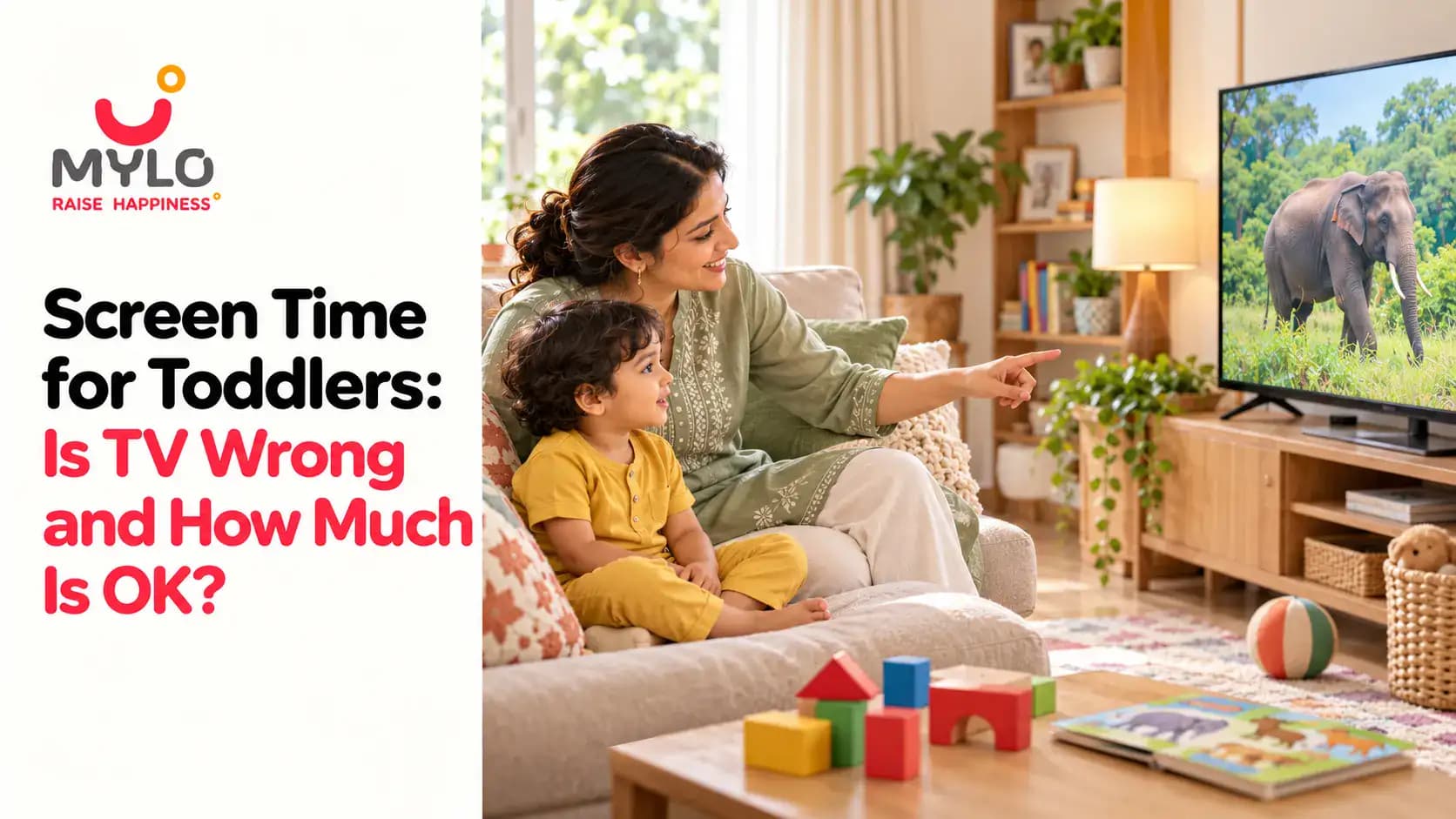
Screen Time for Toddlers: Is TV Wrong and How Much Is OK?
 108 Likes|
 20 min
Key Takeaways
Quick overview in 30 seconds.webp&w=32&q=75)
- Excessive screen time exposes toddlers to inappropriate content, radiation, and eye damage, while also promoting a sedentary lifestyle that affects their overall physical health.
- Too much TV and gadget use can lead to addiction, sleep deprivation, poor social skills, and weaker bonding with family members during crucial developmental years.
- A toddler's day should be balanced with play, bonding, eating, sleeping, and active learning methods like books and hands-on experiments rather than passive screens.
- Looking for screen-free ways to engage your toddler? Explore our Adjustable & Reusable Cloth Diaper - Rainbow, Pet Love & Heart Doodles - Pack of 3.

 4.0
4.0 4.2
4.2Quick Answer
Screen time is the time a child spends watching or using TV, mobile phones, tablets or laptops. For example, a 2 year old watching cartoons on a phone during lunch is screen time. Experts advise no screens before 2 years (except video calls) and up to 1 hour a day from 2 to 5 years. Small changes help.
At a Glance
Age | How Much Screen Time | What Experts Say |
|---|---|---|
Under 18 months | None, except video calls with family | WHO, AAP, IAP |
18 to 24 months | Ideally none. If used, short, high-quality content watched with a parent | AAP. IAP and WHO advise none before 2 years |
2 to 3 years | Up to 1 hour a day, less is better | WHO, AAP, IAP |
All ages | No screens during meals or in the hour before bedtime | IAP, AAP |
All ages | No screens in the bedroom | AAP |
Key Facts
The Indian Academy of Pediatrics (IAP) advises no screen time for children under 2 years and no more than 1 hour a day for ages 2 to 5.
Video calls with grandparents and family do not count as harmful screen time, especially when a parent joins in.
Studies link high screen time in the first two years with a higher chance of speech and communication delays.
Toddlers learn language best from real conversations, not from videos, even "educational" ones.
Screens during meals can lead to overeating or undereating because the child is not noticing hunger and fullness.
Is TV and Screen Time Wrong for My Toddler?
Short answer: Screens are not "poison", but too much screen time, especially before 2 years, takes away time from talking, playing, moving and sleeping, which toddlers need for healthy development.
A toddler's brain grows fastest in the first three years. It grows through back-and-forth interaction: you talk, your child babbles back, you respond. A screen cannot respond to your child. That is why experts are strict about screens for children under 2.
From 2 years, small amounts of slow-paced, good-quality content, ideally watched with you, can be okay. The problem is when screens replace play, sleep and family time.
How Much Screen Time Is OK for a Toddler?
Short answer: For children under 2, avoid screens except video calls. For 2 to 3 year olds, limit screens to 1 hour a day or less, with good content and an adult nearby.
Screen Time Guidelines by Age
Age | WHO (2019) | AAP | IAP (2021) |
|---|---|---|---|
Under 1 year | Not recommended | Avoid, except video chatting | Zero screen time |
1 to 2 years | Not recommended for 1 year olds. For 2 year olds, no more than 1 hour | 18 to 24 months: only high-quality content with a parent | Zero screen time under 2 |
2 to 3 years | No more than 1 hour a day, less is better | 1 hour a day of high-quality content, watched together | Maximum 1 hour a day |
3 to 5 years | No more than 1 hour a day | 1 hour a day | Maximum 1 hour a day |
What Counts as Screen Time?
Counts | Does Not Count as Harmful |
|---|---|
Cartoons on mobile or TV | Video calls with nani, dadi or papa at work (with you joining in) |
YouTube or Reels | Looking at family photos together and talking about them |
Games on a tablet | Listening to rhymes or stories on audio (no screen) |
TV running in the background while the child plays |
Background TV also counts. Even when a toddler is not watching, a TV playing in the room reduces how much parents talk to the child and how well the child focuses on play.
What Are the Effects of Too Much Screen Time on Toddlers?
Short answer: Too much screen time is linked with speech delay, poor sleep, less active play, shorter attention, tantrums when screens are taken away, and more eating problems.
Area | What Too Much Screen Time Can Do |
|---|---|
Speech and language | Fewer conversations, linked with a higher chance of speech delay |
Sleep | Later bedtimes and broken sleep, especially with screens before bed |
Attention | Fast-moving videos make slower, real-world play feel boring |
Behaviour | More tantrums and meltdowns when the screen is switched off |
Eating | Eating without noticing hunger or fullness, refusing to eat without a phone |
Physical activity | Less running, climbing and outdoor play |
Eyes | Eye strain and less outdoor time. Outdoor light helps protect children's eyes from short-sightedness (myopia) |
Social skills | Less eye contact and fewer back-and-forth interactions with people |
Does Screen Time Cause Speech Delay?
Short answer: Screen time does not directly "cause" speech delay in every child, but research links high screen time in toddlers with a higher risk of speech and communication delays, mainly because it replaces talking and play.
One study found that toddlers who used handheld screens more at 18 months had a higher chance of expressive speech delay. A large study from Japan found that more screen time at 1 year was linked with delays in communication and problem-solving at ages 2 and 4.
If your toddler is not saying words by 18 months or not joining two words by 2 years, cut screens and talk to your paediatrician. Read toddler stuttering and when babies start talking for speech milestones.
Does Screen Time Cause Autism?
Short answer: No. Screen time does not cause autism. But heavy screen use can lead to poor eye contact and fewer words, which can look similar. If you notice these signs, cut screens and see your paediatrician for a proper check.
Signs that need a check include no response to their name by 12 months, no pointing by 14 months, no words by 16 months, or losing words or skills they had. See toddler behaviour red flags.
Why Do Indian Toddlers Get So Much Screen Time?
Short answer: In many Indian homes, phones are used to feed toddlers, keep them quiet during work or calls, and calm them in public. Busy schedules, small homes and lack of safe play spaces add to it.
Common Situation | Better Option |
|---|---|
Phone to make the child eat | Eat together at the table, small portions, talk during meals |
Cartoons while mother cooks | Give a "kitchen job": washing vegetables, stacking steel bowls, playing with atta dough |
Phone in a restaurant or wedding | Carry a small bag of stickers, crayons and a small book |
Grandparents use YouTube rhymes to keep child busy | Ask them to sing the rhymes they know |
TV on all day at home | Switch it off when no one is watching |
Phone to stop a tantrum | Stay calm, name the feeling, offer a hug or a different activity |
Mobile While Eating: How to Stop It
Short answer: Stop screens during meals gradually. Eat together, keep portions small, involve your toddler in serving food, and talk or sing instead. Expect a few hard days before it gets easier.
Feeding a toddler with a phone in front of them is one of the most common habits in India. It feels easier in the moment, but children eat without noticing taste, hunger or fullness, and many later refuse to eat without a screen.
Day | What to Do |
|---|---|
Days 1 to 3 | Keep the phone but turn the volume off. Talk about the food: "Yellow dal, hot roti!" |
Days 4 to 6 | Phone face down on the table. Sing a song or tell a short story |
Days 7 to 10 | No phone. Eat together. Let your toddler feed themselves with fingers or a spoon |
After that | Meals stay screen free for the whole family |
Tips that help:
Offer meals at fixed times and avoid milk or snacks just before meals.
Give small portions and let them ask for more.
End the meal after 20 to 30 minutes without forcing.
Accept that some meals will be small. Toddlers' appetite changes daily.
For meal ideas your toddler can eat by themselves, read Indian toddler meal and snack ideas.
How to Reduce Screen Time for Toddlers
Short answer: Cut down step by step, make some places and times screen free, keep other activities ready, and use screens less yourself in front of your child.
Step | What to Do |
|---|---|
1. Know your baseline | Note how much screen time your toddler gets for 3 days |
2. Set screen-free zones | Bedroom, dining table, car rides under 1 hour |
3. Set screen-free times | Meals, the hour before bed, first hour after waking |
4. Reduce slowly | Cut 15 to 30 minutes every few days |
5. Prepare alternatives | Keep a box of toys, blocks, crayons and books within reach |
6. Give warnings | "Two more minutes, then TV goes off." Use a kitchen timer |
7. Stay firm and kind | Expect protest. Stay calm and offer a hug or a new activity |
8. Model it | Keep your own phone away during play and meals |
9. Get everyone on board | Grandparents, nanny and partner follow the same rules |
How to Handle Tantrums When You Switch Off the TV
Give a warning before switching off.
Let your toddler press the off button, so they feel some control.
Name the feeling: "You are sad the cartoon finished."
Offer the next fun thing straight away: "Let's go water the plants."
Do not switch it back on to stop the crying. That teaches crying works.
More help: how to handle toddler tantrums in public and emotional regulation in toddlers.
Screen Detox Week for Toddlers
Day | Goal |
|---|---|
Day 1 | No screens during meals |
Day 2 | No screens in the hour before bed |
Day 3 | TV off when no one is watching |
Day 4 | Cut daily screen time by half |
Day 5 | One fully screen-free morning |
Day 6 | One screen-free outing (park, market, temple) |
Day 7 | Keep the new routine, review what worked |
Screen-Free Activities for Toddlers at Home
Short answer: Simple home activities like water play, atta dough, stacking, scribbling, rhymes, picture books, kitchen help and outdoor play keep toddlers busy and help their development more than screens.
Activities by Age
Activity | 1 to 2 Years | 2 to 3 Years | Skills Built |
|---|---|---|---|
Atta or clay dough | Squeezing, poking | Rolling rotis, making shapes | Hand strength, creativity |
Stacking steel katoris or cups | Stack 2 to 3 | Stack 6 or more, sort by size | Hand-eye coordination |
Water play in a tub (always supervised) | Pouring, splashing | Pouring between cups, washing toys | Senses, coordination |
Scribbling with crayons | Big scribbles | Circles, lines | Pre-writing. See toddler drawing stages |
Picture books | Pointing at pictures | Naming, short stories | Language |
Rhymes and action songs | Clapping, actions | Singing along | Language, memory |
Kitchen helper | Washing vegetables | Peeling bananas, tearing coriander | Independence |
Sorting game | Big and small | Colours and shapes. See teaching colours and shapes | Thinking skills |
Counting games | Counting stairs with you | Counting rotis, steps, toys. See how toddlers learn to count | Early maths |
Pretend play | Feeding a doll | Kitchen set, doctor play | Imagination, language |
Outdoor play | Walking, ball rolling | Running, climbing, sand play | Motor skills, sleep |
Plant watering | With help | On their own with a small mug | Responsibility |
Screen-Free Ideas for Car Rides and Outings
Situation | Try This |
|---|---|
Car or train travel | Window "I spy" (colours, cows, buses), stickers, small board books |
Restaurant | Crayons and paper, small toy car, let them hold the menu |
Waiting at the doctor | Rhymes, finger games, "find something red" |
Weddings and family functions | Small activity bag, a quiet corner, a walk outside |
How long a toddler stays with one activity is short and normal. See toddler attention span by age.
How to Make Screen Time Better When You Do Use It
Short answer: For children over 2, choose slow-paced, age-appropriate content, watch together, talk about what you see, keep sessions short, and turn off autoplay.
Do | Avoid |
|---|---|
Slow, simple shows with songs and real-life situations | Fast, noisy videos with constant scene changes |
Watch together and talk: "Where is the dog going?" | Handing over the phone and leaving |
Use TV instead of a small phone screen held close to the face | Phone screens held very close to the eyes for long |
Pick a show in advance, then switch off | Autoplay and endless suggested videos |
Use YouTube Kids or saved videos with parental controls | Open YouTube or Reels |
Video calls with family | Screens to calm every upset |
When to See a Paediatrician
Short answer: See your paediatrician if your toddler has speech delay, poor eye contact, no response to their name, extreme tantrums when screens stop, or sleep problems that do not improve after reducing screen time.
Sign | Why It Matters |
|---|---|
No words by 16 to 18 months, no two-word phrases by 2 years | Possible speech delay |
Not responding to name, little eye contact, not pointing | Needs a development check |
Loss of words or skills they had before | Always needs a doctor's review |
Severe tantrums, hitting or head-banging when screen stops, every day | Behaviour support may help |
Sleep problems that continue after cutting screens | Other causes need checking |
Squinting, rubbing eyes, holding things very close | Eye check needed |
Indian Context: What Parents Should Know
IAP guidelines: the Indian Academy of Pediatrics released screen time guidelines in 2021 advising zero screen time under 2 years and up to 1 hour for ages 2 to 5, with no screens during meals and before bed.
Joint families: agree on screen rules with grandparents. Read handling grandparent and parenting conflict.
Nanny or daycare: give clear screen rules in writing. See daycare vs nanny.
RBSK and DEIC: if you are worried about speech or development, government District Early Intervention Centres (DEIC) under RBSK offer developmental checks.
Small homes: use your building's corridor, terrace, a nearby park or Anganwadi play time for active play.
Myths vs Facts
Myth | Fact |
|---|---|
Educational videos teach toddlers to talk | Toddlers learn words best from real people talking with them |
Rhyme videos are fine all day | Even rhyme videos count as screen time. Singing together is better |
My child eats only with the phone, so I have no choice | Most toddlers adjust within 1 to 2 weeks of screen-free meals |
Background TV doesn't matter if the child isn't watching | Background TV reduces talk and play in the room |
Video calls with grandparents are bad | Video calls with a parent joining in are fine and encouraged |
Screens cause autism | Screens do not cause autism, but heavy use can affect speech and social interaction |
Once a habit forms, it can't change | Toddler habits change quickly with a consistent plan |
FAQs
1. Is it okay for my 1 year old to watch rhymes on the phone?
Experts advise no screen time under 2 years, except video calls. Sing rhymes together instead. Your voice and face teach more than any video.
2. How much TV can a 2 year old watch?
Up to 1 hour a day of good-quality content, ideally watched with an adult. Less is better.
3. Is screen time before bed bad for toddlers?
Yes. Screens before bed can delay sleep and cause more night waking. Stop screens at least 1 hour before bedtime. Read toddler not sleeping at night.
4. Are video calls with grandparents okay for toddlers?
Yes. Video calls are interactive, and experts make an exception for them, especially when a parent joins in.
5. Can too much screen time cause speech delay?
High screen time is linked with a higher risk of speech delay because it replaces talking and play. If your toddler is not talking as expected, reduce screens and see your paediatrician.
6. My toddler throws a tantrum when I take away the phone. What should I do?
Give a warning before switching off, name the feeling, offer another activity, and stay firm. The tantrums usually reduce within a week or two.
7. Bacche ka mobile kaise chhudayen?
Ek dum se band karne ki jagah dheere dheere kam kijiye. Khana khate waqt aur sone se pehle mobile bilkul band rakhiye, ghar mein khilone, books aur atta jaisi cheezein ready rakhiye, aur khud bhi bacche ke saamne mobile kam chalaiye.
8. Chhote bacche ko mobile dekhna chahiye ya nahi?
2 saal se chhote bacche ko mobile ya TV nahi dikhana chahiye, sirf family video call theek hai. 2 se 5 saal tak din mein 1 ghante se zyada nahi, aur behtar hai ki aap saath baithkar dekhein.
Related Reads
References
World Health Organization. Guidelines on physical activity, sedentary behaviour and sleep for children under 5 years of age, 2019. https://www.who.int/publications/i/item/9789241550536
American Academy of Pediatrics. Media and Young Minds. Pediatrics, 2016. https://publications.aap.org/pediatrics/article/138/5/e20162591/60503
Indian Academy of Pediatrics. Screen Time Guidelines for Parents, 2021. https://iapindia.org
van den Heuvel M, Birken CS, et al. Mobile media device use is associated with expressive language delay in 18-month-old children. Journal of Developmental and Behavioral Pediatrics, 2019.
Takahashi I, et al. Screen time at age 1 year and communication and problem-solving developmental delay at 2 and 4 years. JAMA Pediatrics, 2023.
American Academy of Pediatrics, HealthyChildren.org. Family Media Plan. https://www.healthychildren.org/English/fmp/Pages/MediaPlan.aspx
Medical Disclaimer
This article is for general information only and does not replace advice from your paediatrician. Every child is different. If you are worried about your toddler's speech, behaviour, sleep or eyesight, please consult your doctor.


Loved by Parents Raising Curious Little Toddlers
Encourage active play and creative learning with engaging toys and books that gently replace screen time with joyful discovery.






Article Posted Under
Related Articles


Related Topics
.webp&w=32&q=75)
Medical Disclaimer
This content is for informational purposes only and should not replace professional medical advice. Consult with a physician or other health care professional if you have any concerns or questions about your health. If you rely on the information provided here, you do so solely at your own risk.


AWARDS AND RECOGNITION

Mylo wins Forbes D2C Disruptor award

Mylo wins The Economic Times Promising Brands 2022
AS SEEN IN













- Mylo Care: Effective and science-backed personal care and wellness solutions for a joyful you.
- Mylo Baby: Science-backed, gentle and effective personal care & hygiene range for your little one.
- Mylo Community: Trusted and empathetic community of 10mn+ parents and experts.


Product Categories
Baby Carrier | Baby Soap | Baby Wipes | Stretch Marks Cream | Baby Cream | Baby Shampoo | Baby Massage Oil | Baby Hair Oil | Stretch Marks Oil | Baby Body Wash | Baby Powder | Baby Lotion | Diaper Rash Cream | Newborn Diapers | Teether | Baby Kajal | Baby Diapers Pants | Cloth Diapers | Laundry Detergent | Lactation Granules |