


Orders
.png&w=48&q=75 "login")
Profile


Wallet

What Are the Fine Motor Milestones From 1 to 3 Years? An Age-by-Age Checklist for Indian Parents (2026)
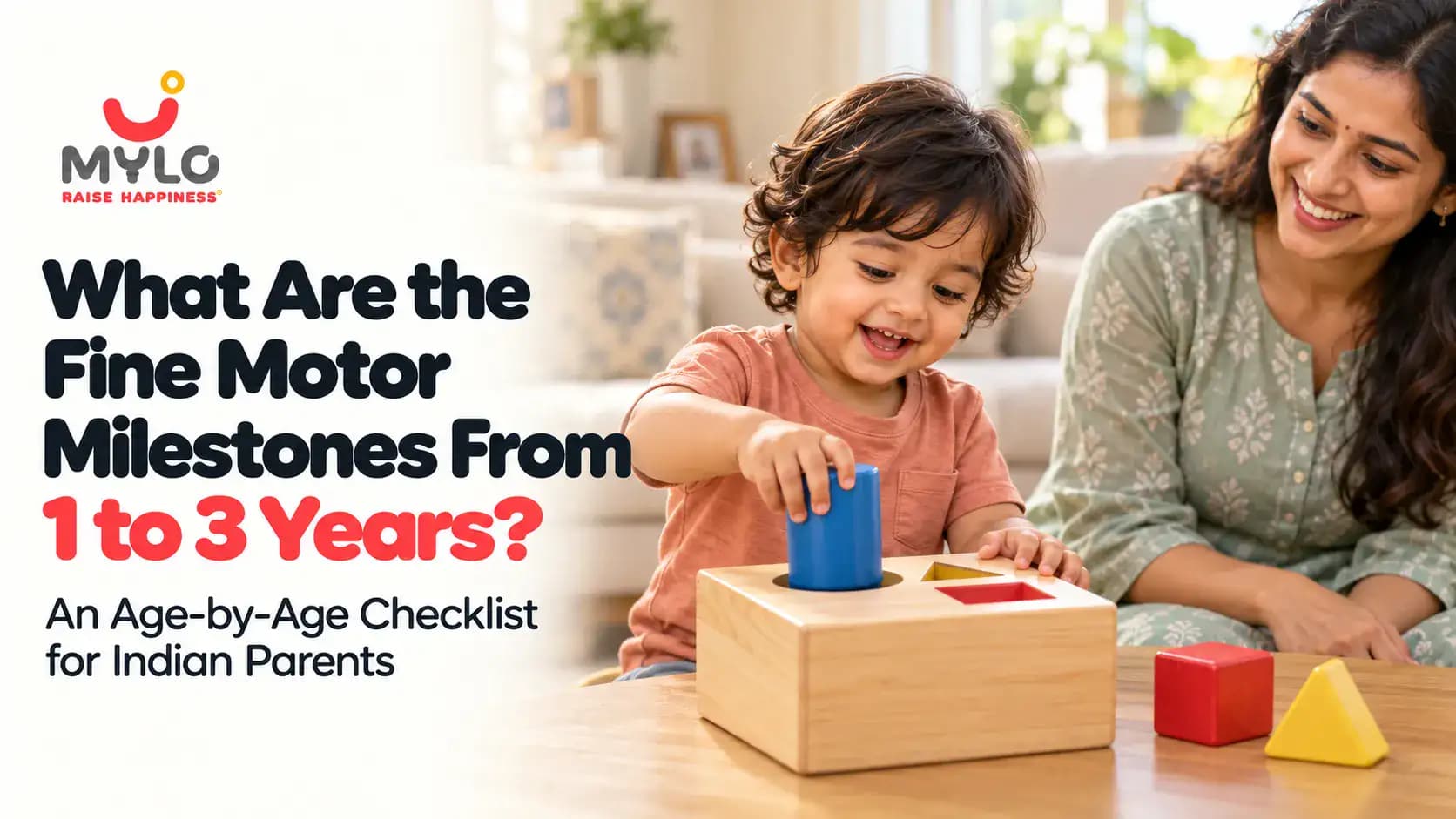
 21 min
Quick Answer
Fine motor skills are small, precise movements of the hands and fingers, like picking up food, stacking blocks, scribbling, using a spoon and turning pages. Between 1 and 3 years, most children go from a pincer grasp (12 months) and stacking 2 blocks (15 months) to scribbling and trying a spoon (18 months), turning knobs and eating with a spoon (2 years), unscrewing lids and turning pages one at a time (30 months), and drawing a circle when shown, stringing large beads and using a fork (3 years). See your pediatrician if your child can't pick up small objects by 12 to 15 months, shows a strong hand preference before 18 months, keeps hands fisted, or loses skills they had.
Fine Motor Milestones 1 to 3 Years at a Glance
Age | Key Fine Motor Milestones | Block Tower | Talk to a Doctor If |
|---|---|---|---|
12 months | Pincer grasp (thumb and finger), puts objects in a container, bangs toys together | Not yet | Can't pick up small food or objects |
15 months | Finger feeds, stacks 2 blocks, scribbles a little, uses objects the right way | 2 blocks | Doesn't pick up or release objects |
18 months | Scribbles, tries a spoon, drinks from an open cup, turns thick pages | 3 to 4 blocks | Doesn't scribble or try to feed themselves |
24 months | Eats with a spoon, turns knobs and buttons, holds with one hand while using the other | About 6 blocks | Can't use both hands together |
30 months | Twists lids and doorknobs, turns pages one at a time, takes off loose clothes | 6 to 8 blocks | Can't twist or turn objects |
36 months | Draws a circle when shown, strings large beads, uses a fork, puts on some clothes | About 9 blocks | Can't copy a circle or hold a crayon |
Sources: Official AAP and CDC milestone checklists (CDC), PedsCases Developmental Milestones Chart, Nemours KidsHealth.
Key Facts Every Parent Should Know
Pincer grasp by 12 months: Picking up small things between the thumb and pointer finger is a key 1-year milestone
2 blocks by 15 months, 6 by 2 years, 9 by 3 years: A classic way doctors check fine motor progress (PedsCases)
Fisted grip at 1 to 1.5 years: Toddlers hold crayons with the whole hand at first (The OT Toolbox)
Tripod grip at 3.5 to 4 years: The "proper" pencil grip usually comes after age 3, so there's no need to force it earlier (Associates in Pediatric Therapy)
Hand preference: Usually starts to show between 2 and 4 years. A strong preference before 18 months should be checked by a doctor.
Self-feeding is fine motor practice: Every meal with a spoon builds hand skills
What Are Fine Motor Skills?
Short answer: Fine motor skills are small, controlled movements of the hands, fingers and wrists, working together with the eyes. They help children feed themselves, play with toys, dress, draw and, later, write. They're different from gross motor skills, which use large muscles for walking, running and jumping.
Fine Motor Skills | Gross Motor Skills |
|---|---|
Use small muscles of the hands and fingers | Use large muscles of the legs, arms and body |
Picking up small objects | Walking and running |
Stacking blocks, turning pages | Climbing and jumping |
Scribbling and drawing | Kicking and throwing a ball |
Using a spoon or fork | Balancing and pedalling |
Buttons, zips and lids | Climbing stairs |
Why fine motor skills matter:
Independence: eating, dressing and washing hands on their own
Play and learning: puzzles, blocks, drawing and pretend play
School readiness: holding a crayon, cutting and, later, writing
Brain development: hand-eye coordination, problem-solving and focus
Confidence: "I did it myself!" moments
For big movements, see our guide to gross motor milestones from 1 to 3 years. For the bigger picture, read physical development in children.
How Does Grasp Develop From 1 to 3 Years?
Short answer: Around 12 months, babies master the pincer grasp (thumb and pointer finger). Toddlers then hold crayons with a fisted grip (1 to 1.5 years), move to a fingers-pointing-down grip (2 to 3 years) and usually develop a tripod grip (thumb, index and middle finger) between 3.5 and 4 years.
Grasp Stage | Typical Age | What It Looks Like |
|---|---|---|
Pincer grasp | By 12 months | Picks up a pea or puff between thumb and pointer finger |
Palmar (fisted) crayon grip | 1 to 1.5 years | Holds the crayon in a fist; the whole arm moves |
Digital pronate grip | 2 to 3 years | Palm faces down, fingers point along the crayon; the wrist and forearm move |
Four-finger or static tripod grip | 3.5 to 4 years | Thumb and fingers hold the crayon; the hand moves as one unit |
Dynamic tripod grip | 4 to 7 years | Fingers move the pencil, the mature writing grip |
Sources: The OT Toolbox, Associates in Pediatric Therapy.
Tip: Don't force the "correct" pencil grip on a 2 or 3-year-old. Offer short, thick crayons or broken crayon pieces. Small pieces naturally encourage a finger grip.
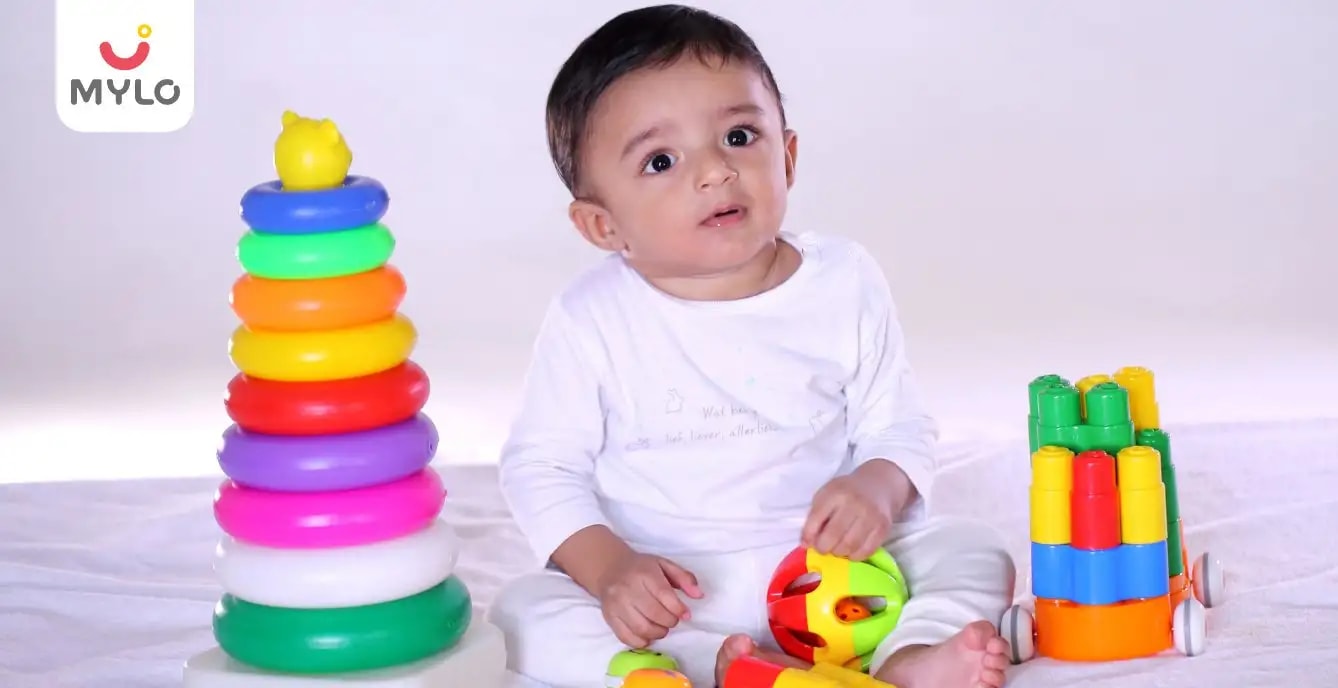
When Do Toddlers Stack Blocks?
Short answer: Most toddlers stack 2 blocks by 15 months, 3 to 4 blocks by 18 months, about 6 blocks by 2 years and about 9 blocks by 3 years (PedsCases). Stacking shows hand control, hand-eye coordination and planning.
Age | Block Skill |
|---|---|
12 months | Bangs 2 blocks together, puts a block in a cup |
15 months | Stacks 2 blocks |
18 months | Stacks 3 to 4 blocks |
24 months | Stacks about 6 blocks, lines blocks up like a "train" |
30 months | Stacks 6 to 8 blocks |
36 months | Stacks about 9 blocks, may copy a simple 3-block "bridge" |
No blocks at home? Steel katoris, small dabbas, matchboxes (empty) or cardboard boxes work just as well.
When Do Toddlers Scribble and Draw?
Short answer: Most toddlers make marks or scribble by 15 to 18 months, scribble freely and imitate a line by 2 to 2.5 years, and draw a circle when shown by 3 years. Recognisable pictures, like a person with a head and legs, usually come after age 3.
Age | Drawing Skill |
|---|---|
12 to 15 months | Makes marks on paper, often by accident |
18 months | Scribbles on purpose |
2 years | Scribbles in circles and lines, copies a vertical line |
2.5 years | Imitates a horizontal line |
3 years | Draws a circle when shown how |
4 years | Copies a cross and may draw a simple person |
How to Encourage Drawing
Offer chunky crayons, washable markers or chalk
Tape a big sheet of paper to the floor or table so it doesn't slide
Try drawing on the floor with chalk or on a steamy bathroom mirror
Let them paint with fingers, sponges or cotton buds
Praise the process: "You made big swirly lines!" instead of "What is it?"
When Do Toddlers Use a Spoon, Fork and Cup?
Short answer: Most toddlers try to use a spoon by 18 months, eat with a spoon by 2 years and use a fork by 3 years. They drink from an open cup with help by 12 months and on their own, with some spills, by 18 months.
Age | Self-Feeding Skill |
|---|---|
12 months | Finger feeds, drinks from an open cup you hold |
15 months | Finger feeds well, holds a spoon |
18 months | Tries to use a spoon, drinks from an open cup with spills |
2 years | Eats with a spoon |
30 months | Uses a spoon with fewer spills, starts using a fork |
3 years | Uses a fork, pours from a small jug with help |
Self-feeding is one of the best fine motor workouts. Read our guides on teaching toddlers to eat by themselves and picky eating.
When Can Toddlers Turn Pages, Twist Lids and Use Buttons?
Short answer: Most toddlers turn thick board-book pages (a few at a time) by 18 months, turn knobs and press buttons on toys by 2 years, twist doorknobs, unscrew lids and turn pages one at a time by 30 months, and string large beads by 3 years.
Skill | Typical Age |
|---|---|
Turns thick board-book pages, a few at a time | 12 to 18 months |
Presses buttons and turns knobs on toys | By 2 years |
Holds a container in one hand and opens the lid with the other | By 2 years |
Twists doorknobs and unscrews lids | By 30 months |
Turns paper pages one at a time | By 30 months |
Strings large beads or macaroni | By 3 years |
Snips with child-safe scissors (with help) | 2.5 to 3 years |
Undoes large buttons | 3 years and older |
When Do Toddlers Show Left or Right Hand Preference?
Short answer: Most children use both hands in the first 2 years. A hand preference usually starts to show between 2 and 4 years and becomes clearer by 4 to 6 years. A strong hand preference before 18 months can be a sign of weakness on the other side and should be checked.
Age | What's Typical |
|---|---|
Under 18 months | Uses both hands freely |
18 months to 2 years | May switch hands often |
2 to 4 years | Starts showing a preferred hand |
4 to 6 years | Hand preference is usually clear |
Should I force my child to use the right hand? No. Being left-handed is completely normal. Forcing a hand switch can cause frustration and make writing harder later.
What Activities Build Fine Motor Skills at Each Age?
Short answer: Everyday play and household tasks build fine motor skills best. Try play dough, stacking, posting objects into containers, tearing paper, drawing, threading and self-feeding. Always supervise small objects to prevent choking.
Age | Best Activities | Household Items to Use |
|---|---|---|
12 to 18 months | Picking up puffs or peas, dropping things into a container, banging, stacking 2 to 3 items, turning board-book pages | Steel katori, spoons, a dabba with a lid, board books |
18 to 24 months | Scribbling, simple shape sorters, putting lids on and off, tearing paper, sticking stickers | Chunky crayons, old newspaper, dabbas, stickers |
2 to 2.5 years | Play dough, stacking towers, turning knobs, simple puzzles, washing hands | Atta dough, blocks, puzzles, soap |
2.5 to 3 years | Threading large beads, drawing lines and circles, snipping paper, pouring water, opening lids | Macaroni and string, crayons, child-safe scissors, small jug |
Fun Indian Kitchen Activities for Little Hands
Rolling mini rotis with atta dough (great for hand strength)
Tearing coriander or methi leaves for cooking
Pouring rice or dal from one katori to another (supervised)
Shelling peas (for 2.5 to 3 year olds, with supervision)
Making "rangoli" with fingers in flour or on paper
Squeezing a soft sponge during bath time
Pressing a clothes peg onto a steel plate's edge
⚠️ Choking warning: Never leave toddlers alone with small items like beads, dry rice, peas, buttons, coins or batteries. Put them away after play.
What Helps and What Hurts Fine Motor Development?
Short answer: Hands-on play, self-feeding and messy activities help fine motor skills grow. Too much screen time, doing everything for your child and too few chances to practise can slow it down.
Helps | Slows It Down |
|---|---|
Self-feeding, even if messy | Always spoon-feeding |
Play dough, blocks and puzzles | Long hours of screen time (tapping and swiping aren't enough) |
Drawing and scribbling daily | Forcing a pencil grip too early |
Helping in the kitchen | Doing all tasks for the child |
Dressing and undressing practice | Always dressing the child fully |
Messy play with sand, water and paint | Keeping hands "clean" and busy with phones |
When Should I Worry About My Toddler's Fine Motor Skills?
Short answer: Talk to your doctor if your child can't pick up small objects by 12 to 15 months, keeps their hands fisted, shows a strong hand preference before 18 months, doesn't scribble by 18 to 24 months, can't use both hands together by 2 years, or loses skills they had. An occupational therapist can help.
Age | Red Flag |
|---|---|
Any age | Loses skills they once had (see a doctor right away) |
Any age | Keeps hands tightly fisted most of the time |
Any age | Seems very weak, floppy or stiff in the hands and arms |
Before 18 months | Strong preference for one hand, ignoring the other |
12 to 15 months | Can't pick up small objects or release them |
18 months | Doesn't scribble or try to feed themselves |
2 years | Can't use a spoon, turn knobs or use both hands together |
3 years | Can't hold a crayon, draw a line or circle, or string large beads |
Who Can Help?
Professional | How They Help |
|---|---|
Pediatrician | First check-up; rules out medical causes and refers you |
Pediatric occupational therapist (OT) | Activities to build hand strength, coordination and self-care skills |
Developmental pediatrician | Assesses overall development if there are several concerns |
Neurologist | If there's muscle weakness, stiffness or loss of skills |
Free Government Support in India
Service | What It Offers |
|---|---|
Rashtriya Bal Swasthya Karyakram (RBSK) | Free screening for developmental delays |
District Early Intervention Centres (DEIC) | Free assessment, occupational therapy and physiotherapy |
Anganwadi centres | Growth monitoring, preschool activities and referrals |
Read our guide on identifying developmental disorders in toddlers.
What Should Indian Parents Keep in Mind?
Short answer: Let your child feed and dress themselves, give them real hands-on play instead of screens, don't force a writing grip or the right hand, and supervise small objects closely.
Common Practice | Better Approach |
|---|---|
Spoon-feeding until school age | Let your child self-feed from 12 months |
Pushing alphabet writing at 2 to 3 years | Scribbling, drawing and play first; writing comes later |
Forcing the right hand | Let your child choose their hand |
Phone and tablet games for "learning" | Play dough, blocks and kitchen activities |
Dressing the child fully | Let them pull off socks, pants and jackets |
Keeping hands clean, no messy play | Sand, water, dough and paint are great for hands |
Myths vs Facts About Fine Motor Milestones
Myth | Fact |
|---|---|
"Toddlers should hold a pencil correctly by 2" | The tripod grip usually develops between 3.5 and 4 years (Associates in Pediatric Therapy) |
"Tapping on a tablet builds fine motor skills" | Real hand play like dough, blocks and crayons builds strength and control much better |
"Left-handed children should be switched to the right" | Left-handedness is normal; forcing a switch causes frustration |
"Messy eating is bad manners" | Messy self-feeding is great fine motor practice |
"Early handedness means a talented child" | A strong hand preference before 18 months should be checked |
"Writing practice at 2 prepares them for school" | Play, drawing and self-care prepare hands for writing best |
Frequently Asked Questions About Fine Motor Milestones
What are fine motor skills?
Small, precise movements of the hands and fingers, like picking up food, stacking blocks, scribbling, using a spoon, turning pages and opening lids.
Fine motor skills kya hote hain? (Hinglish)
Fine motor skills haathon aur ungliyon ki chhoti aur sahi harkatein hain, jaise chhoti cheez uthana, blocks rakhna, crayon se likhna, chammach se khana, kitaab ke panne palatna aur dhakkan kholna.
When should a baby use the pincer grasp?
Most babies pick up small objects between the thumb and pointer finger by 12 months.
When do toddlers start scribbling?
Most toddlers scribble on purpose by about 18 months.
How many blocks should a 2-year-old stack?
About 6 blocks. Most stack 2 by 15 months and about 9 by 3 years.
When should a toddler use a spoon?
Most try a spoon by 18 months and eat with a spoon by 2 years. A fork usually comes by 3 years.
When does a child draw a circle?
Most children can draw a circle when shown how by 3 years.
How should a 2-year-old hold a crayon?
With a fisted or fingers-pointing-down grip. The tripod grip usually comes between 3.5 and 4 years.
Mera bachcha left hand se khata hai, kya right hand sikhana chahiye? (Hinglish)
Nahi. Left hand use karna bilkul normal hai. Zabardasti right hand karwane se bachcha pareshaan ho sakta hai aur aage likhne mein dikkat ho sakti hai. Lekin agar 18 mahine se pehle bachcha sirf ek hi haath use karta hai aur doosra bilkul nahi, toh doctor ko dikhayein.
What activities help fine motor skills?
Play dough, stacking blocks, scribbling, tearing paper, threading large beads, self-feeding and simple kitchen tasks like rolling mini rotis.
Does screen time affect fine motor skills?
Too much screen time can mean less real hand play. Tapping and swiping don't build hand strength like dough, blocks and crayons.
When should I worry about my toddler's fine motor skills?
If your child can't pick up small objects by 12 to 15 months, keeps hands fisted, prefers one hand strongly before 18 months, doesn't scribble by 18 to 24 months or loses skills, speak to your pediatrician.
Related Reads on Mylo
Gross Motor Milestones From 1 to 3 Years (link once live)
Physical Development in Children: Signs, Milestones and How to Support It
References
PedsCases. "Snapshots of Developmental Milestones." https://pedscases.com/sites/default/files/SNAPSHOTS_Developmental_Milestones_Chart_UPDATED_Aug_2014.pdf
The OT Toolbox. "Pencil Grasp Development." https://www.theottoolbox.com/pencil-grasp-development/
Associates in Pediatric Therapy. "Pencil Grip Development." https://kidtherapy.org/pencil-grip-development/
The OT Toolbox. "Fine Motor Skills With Building Blocks." https://www.theottoolbox.com/fine-motor-development-with-building-blocks/
Nemours KidsHealth. "3-Year Well-Child Checkup." https://kidshealth.org/en/parents/checkup-3yrs.html
Nemours KidsHealth. "18-Month Well-Child Checkup." https://kidshealth.org/en/parents/checkup-18mos.html
Centers for Disease Control and Prevention (CDC). "CDC's Developmental Milestones." https://www.cdc.gov/act-early/milestones/index.html
Medical Disclaimer
This article is for information only and does not replace professional medical advice. Every child develops at their own pace. If you have concerns about your child's hand skills, grip, feeding or drawing, please consult your pediatrician or a pediatric occupational therapist.


Shop Now
Baby Essentials




Article Posted Under
Related Articles
What Is the Significance of Motor Skills in Children & How to Develop Them?
 606·
606· 5 min
5 min Late Walking in Toddlers: Why Is My Toddler Not Walking and When Should I Worry? (2026)
 63·14 min
 A New Parent's Guide to Baby Language Skills
 6 min
6 min Baby Growth Stages Month-by-Month (0 to 12): The Complete 2026 Chart with Milestones, Weight, Height & Development Guide
 100·18 min
Related Topics
.webp&w=32&q=75)
Medical Disclaimer
This content is for informational purposes only and should not replace professional medical advice. Consult with a physician or other health care professional if you have any concerns or questions about your health. If you rely on the information provided here, you do so solely at your own risk.


AWARDS AND RECOGNITION

Mylo wins Forbes D2C Disruptor award

Mylo wins The Economic Times Promising Brands 2022
AS SEEN IN













- Mylo Care: Effective and science-backed personal care and wellness solutions for a joyful you.
- Mylo Baby: Science-backed, gentle and effective personal care & hygiene range for your little one.
- Mylo Community: Trusted and empathetic community of 10mn+ parents and experts.


Product Categories
Baby Carrier | Baby Soap | Baby Wipes | Stretch Marks Cream | Baby Cream | Baby Shampoo | Baby Massage Oil | Baby Hair Oil | Stretch Marks Oil | Baby Body Wash | Baby Powder | Baby Lotion | Diaper Rash Cream | Newborn Diapers | Teether | Baby Kajal | Baby Diapers Pants | Cloth Diapers | Laundry Detergent | Lactation Granules |