


Orders
.png&w=48&q=75 "login")
Profile


Wallet

Diaper Rash Treatment: What Works, What to Avoid, and When to See a Doctor
 19 min
Quick Answer
Change the diaper more often, clean gently with water or a fragrance free wipe, pat the skin properly dry, then apply a thick layer of a zinc oxide or petrolatum barrier cream at every change. Add some nappy free air time. Most mild to moderate rashes start improving within 3 to 4 days. If it is not improving by then, or it blisters or comes with fever, see a doctor.
Key Takeaways
Apply barrier cream thickly, not thinly. The American Academy of Pediatrics describes the right amount as being like icing on a cupcake.
Zinc oxide and petrolatum are both good choices, and fragrance free versions are best.
Do not use products containing baking soda, boric acid, camphor, phenol, benzocaine, diphenhydramine or salicylates. Mayo Clinic warns these can be toxic for babies.
Do not use over the counter antibiotic ointment on a diaper rash. The AAP notes ingredients in these can worsen the irritation.
A bright red rash with a clear border and small spots spreading beyond it is usually yeast, and it needs a prescribed antifungal. Barrier cream alone will not clear it.
Use a slightly larger, looser diaper while the rash heals, and skip plastic or tight fitting covers.
How Do You Treat Diaper Rash at Home?
Six steps, and the order matters. This is the standard approach recommended by the NHS, the American Academy of Pediatrics and the Indian Academy of Pediatrics.
Change the diaper much more often. During an active rash, change at every wetting and immediately after every stool. Contact time is the thing driving the rash, so reducing it is the treatment, not an add-on to it.
Clean gently. Plain water and cotton wool, or a fragrance free and alcohol free wipe. Pat rather than rub, because friction on inflamed skin makes it worse. Front to back, and into every skin fold.
Dry the skin properly before anything goes on it. A cream applied over damp skin traps the moisture underneath.
Apply a thick layer of barrier cream. Zinc oxide or petrolatum, fragrance free. The AAP describes the right quantity as applying it "like icing on a cupcake", which is considerably more than most parents use. You should not be able to see the skin through it.
Allow nappy free air time. Short periods without a diaper or cream, such as during a nap on a towel, genuinely speed healing. Mayo Clinic specifically recommends increasing air exposure to the area.
Go up a size and loosen the fit while it heals, and avoid plastic or tight fitting covers. A slightly larger diaper reduces friction and improves airflow.
A daily bath in plain warm water while the rash is clearing also helps. Keep it short, use no soap or a non-soap cleanser on the area, and dry thoroughly afterwards.
One important point about the barrier cream. Do not wipe it all off at the next change. Clean off the stool and the worst of the soiling, then reapply on top. Scrubbing the barrier away at every change removes the protection you are trying to build and adds friction to already sore skin.
What Should You Never Put on Diaper Rash?
This matters more than the treatment list, because several widely suggested remedies are either useless or genuinely unsafe.
Do not use | Why |
|---|---|
Baking soda, boric acid, camphor, phenol, benzocaine, diphenhydramine or salicylates | Mayo Clinic advises avoiding products containing any of these, because these ingredients can be toxic for babies. Check the label of anything you have been given |
Over the counter antibiotic ointment | The AAP advises against it for diaper rash, because ingredients in these products can sometimes worsen the skin irritation |
Talcum or baby powder | The AAP advises against baby and talcum powders on babies, because inhaled talc can cause severe lung damage and breathing problems. It also clumps in skin folds |
Steroid creams that were not prescribed for your baby | Skin in the diaper area absorbs more than skin elsewhere, and a steroid on an undiagnosed fungal rash can make it considerably worse |
Anything fragranced | Fragrance is a well recognised contact allergen and inflamed skin is more reactive than healthy skin |
Antiseptic liquid, Dettol type solutions or diluted spirit | These are irritants on broken skin. They are for surfaces, not for a baby's bottom |
Essential oils | Undiluted or poorly diluted essential oils can irritate and sensitise infant skin. There is no good evidence they treat diaper rash |
On traditional Indian remedies. Several are commonly recommended by family members and it is worth being straightforward about them. Besan or gram flour paste, haldi paste, mustard oil, neem paste and ash or raakh are all used, and none has good evidence behind it for diaper rash. On intact skin most are unlikely to do harm, but on broken or weeping skin they add particles, irritants and an infection risk to a barrier that is already damaged. If the skin is broken, use a plain zinc oxide or petrolatum barrier and nothing else.
On coconut oil, which parents ask about constantly. It is a reasonable emollient on intact skin and it is unlikely to cause harm, but it is not equivalent to a zinc oxide barrier and there is not good evidence that it treats an established rash. Use it if you want to, but not instead of a proper barrier cream, and not on broken skin.
On cornstarch, which is often suggested as a talc substitute: it is not recommended. It does not form a barrier, and there is a longstanding concern that it may make a yeast rash worse. [Flag for medical reviewer: confirm current position before publishing.]
How Long Should Diaper Rash Take to Clear?
Mild to moderate rash usually starts healing within 3 to 4 days of proper care, and severe rash can take up to about a week.
Use that as your decision point. If you have been changing frequently, drying properly and applying a thick barrier cream for 3 days and the rash is no better or is worse, stop persisting with the same approach and get it looked at. Something else is usually going on, most often yeast.
What Type of Diaper Rash Is It?
Four main types, and they need different treatment. The appearance and the pattern are what separate them, so it is worth photographing the rash in good light before an appointment.
Type | How it looks | What it needs |
|---|---|---|
Irritant contact dermatitis | Red, sore, sometimes shiny skin on the buttocks, genitals and inner thighs. Worst on the convex surfaces the diaper presses against, with the deep skin folds relatively spared | The home treatment above. Usually clears in 3 to 4 days |
Yeast or candida dermatitis | Bright red, with a clearly defined border. Small red spots or pustules scattered beyond the main patch, called satellite lesions. The skin folds are involved rather than spared. Often follows a period of irritant rash, antibiotics, or diarrhoea | Needs a doctor and usually a prescribed topical antifungal. Barrier cream alone will not clear it, and it will keep returning if treated as irritant rash |
Bacterial dermatitis | Pus filled spots, yellow crusting, weeping, boils, or a bright red spreading area that looks and feels hot. Your baby may be unsettled or unwell | Needs same day medical assessment. May require prescribed antibiotic treatment |
Allergic contact dermatitis | Itchy, scaly patches or small blisters that follow the shape of whatever touched the skin. A band across each outer buttock and hip points to the diaper elastics. The outline of a printed design points to dyes | Identify and remove what is touching the skin, changing one thing at a time. A dermatologist can confirm with patch testing if it recurs |
Other rashes that turn up in the diaper area:
Heat rash or prickly heat. Tiny red or clear bumps, common in Indian summer and under plastic covers. Cool the baby down, loosen clothing, and it usually settles quickly on its own.
Seborrhoeic dermatitis. Greasy yellowish scaling, usually also present on the scalp, behind the ears or in the neck folds. Treated differently from irritant rash, so it needs a doctor's look.
Eczema. Worth knowing that atopic dermatitis characteristically spares the diaper area, because the moist environment inside a diaper supports the skin barrier and prevents scratching. So a rash confined to the diaper area is usually not eczema. We cover this in detail in our guide to diapers for babies with eczema and sensitive skin.
Psoriasis and other conditions can present in the diaper area rarely. If a rash is persistent, unusual, or not responding to anything, that is a reason for a dermatology opinion rather than more creams.
Do not try to make this diagnosis yourself and start a treatment on it. The two most common mistakes are treating yeast with barrier cream alone, which does not work, and using a leftover steroid cream on a fungal rash, which makes it worse.
What Causes Diaper Rash?
The core mechanism is the same for the commonest type. Three things line up: skin stays damp and over hydrated, it rubs against a wet surface, and it sits in urine and stool that raise the skin's pH and activate enzymes which break down its protective barrier. Once the barrier is damaged, irritation and then infection become much easier.
What makes it more likely:
Factor | Why it raises the risk |
|---|---|
Diapers left on too long | The single biggest factor, because it is contact time that does the damage |
Diarrhoea | Frequent, enzyme rich stool. Rash can appear within hours |
Starting solids | Stool changes in composition and acidity, and rashes often appear around this transition |
Antibiotics, for baby or a breastfeeding mother | Disturb the normal balance of organisms and make yeast overgrowth more likely |
A diaper that is too small or too tight | Increases friction and reduces airflow |
Fragranced wipes, soaps or creams | Add an irritant or allergen to already stressed skin |
Indian heat and humidity | Sweat on top of urine keeps skin damp for longer, and heat rash can occur alongside |
Scrubbing at changes | Friction damages a barrier that is already compromised |
How Do You Stop It Coming Back?
Once it clears, four habits keep it away.
Change every 2 to 3 hours for a newborn and every 3 to 4 hours from about 3 months, and immediately after every stool. See how often to change your baby's diaper.
Dry properly every time, which is the step most often skipped when you are in a hurry.
Use a thin barrier cream preventively if your baby is prone to rash, and at every change during any bout of diarrhoea.
Check the size. A diaper leaving deep marks at the waist or thighs is adding friction. Two fingers should slide in at the waist, and the leg elastic should sit in the thigh crease. Our diaper size and weight chart covers this by weight.
And to be clear about what does not prevent rash: no diaper, however absorbent or premium, prevents diaper rash on its own. Absorbency reduces leaks. It does not reduce how long your baby's skin is in contact with urine, because that is decided by when you change it.
When Should You See a Doctor?
Contact your paediatrician if you notice:
No improvement after 2 to 3 days of frequent changing and a thick barrier cream, or a rash that is getting worse
A bright red rash with a clear border and small spots or pustules spreading beyond it, which suggests yeast and needs a prescribed antifungal
Blisters, open sores, weeping, bleeding, pus or yellow crusting, which suggest bacterial infection
Fever alongside the rash
A rash spreading well beyond the diaper area, or appearing elsewhere on the body
Your baby seeming unwell, unusually drowsy, or in obvious pain
Pain, swelling or crying when passing urine
A rash that keeps returning in the same distinctive shape, such as bands along the elastics
Rash in a baby under 6 weeks old, which is worth a lower threshold for review
This article is general information and does not replace an examination. Any diagnosis, prescription cream or antifungal for your baby should come from your own doctor.
Where Mylo Products Fit
Treatment first, product second. Changing frequently and applying a thick barrier is the treatment. A product supports that, it does not replace it.
For the barrier step: the Mylo Baby Diaper Rash Cream, or compare options in the diaper rash cream range. What matters in any barrier cream is that it is fragrance free and that you apply it thickly enough to hide the skin.
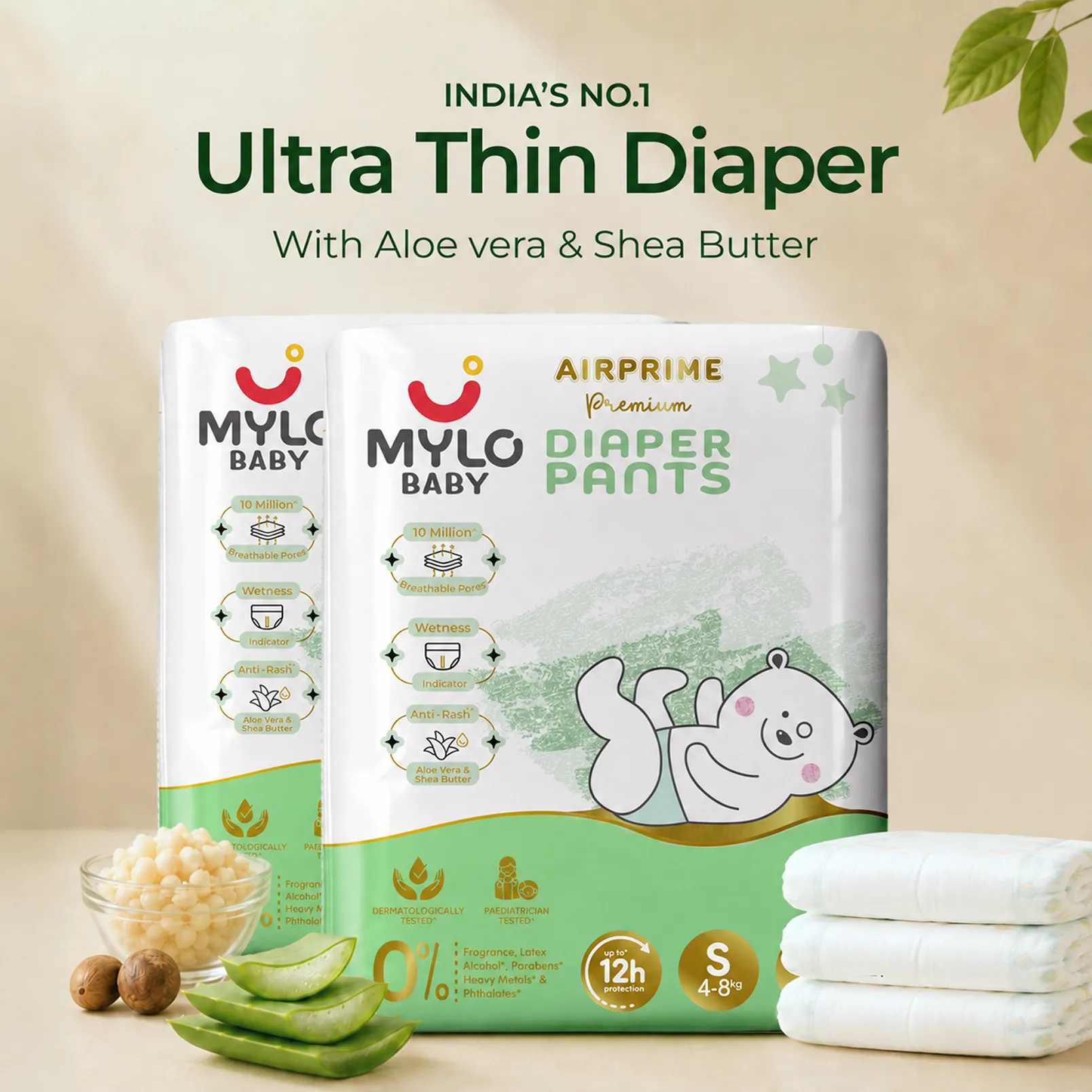
For changing promptly, which is the actual treatment, a wetness indicator removes the guesswork. The Airprime Premium range uses a colour changing strip.
For the healing period, go one size up and looser. Check the full diaper range for the size that matches your baby's current weight.
What we will not claim. No diaper prevents diaper rash, ours included, and no cream is a substitute for a prescribed antifungal if the rash is yeast. If a barrier cream has not helped in 2 to 3 days, the answer is a doctor rather than a different cream.
Mylo Parents Asked
Bacche ki diaper rash kaise theek karein?
Diaper zyada baar badlein, har potty ke baad turant. Saada paani aur rui se halke se saaf karein, rub na karein. Twacha ko poori tarah sukhaein. Phir zinc oxide wali barrier cream ki moti tah lagaein, itni ki twacha dikhe hi nahi. Din mein kuch der bina diaper rakhein. Halki rash 3 se 4 din mein theek hone lagti hai. Powder, Dettol, ya bina doctor ki salah wali steroid cream na lagaein.
Kaunsi diaper rash mein doctor ko dikhana zaroori hai?
Agar 2 se 3 din ilaaj ke baad bhi sudhaar na ho, rash chamakdar laal ho aur uske kinaare saaf dikhein saath hi chote daane phail rahe hon, phole ya mavaad ho, bukhaar ho, ya bachcha bimaar lag raha ho. 6 hafte se chote bachche mein rash ho to jaldi dikhana behtar hai.
How do I know if it is a yeast diaper rash?
Yeast rash is bright red with a clearly defined border, and there are usually small red spots or pustules scattered beyond the main patch. It typically involves the skin folds rather than sparing them, and it often appears after a spell of ordinary rash, after antibiotics, or after diarrhoea. It needs a prescribed antifungal, so see your doctor rather than continuing with barrier cream.
Can I use talcum powder for diaper rash?
No. The American Academy of Pediatrics advises against baby and talcum powders on infants, because inhaled talc can cause severe lung damage and breathing problems. Powder also clumps in the skin folds where you least want it. Use a zinc oxide or petrolatum barrier cream instead.
Is coconut oil good for diaper rash?
It is a reasonable emollient on intact skin and unlikely to cause harm, but it is not a substitute for a zinc oxide barrier and there is not good evidence it treats an established rash. Do not use it on broken skin, and do not use it in place of a prescribed antifungal if the rash is yeast.
How much barrier cream should I apply?
More than you think. The AAP describes it as applying like icing on a cupcake. You should not be able to see the skin through it. And do not scrub it all off at the next change: clean off the soiling and reapply on top.
Should I stop using diapers until the rash heals?
Not entirely, but more air time genuinely helps. Give short diaper free periods, such as during a nap on a towel, and in between use a slightly larger, looser diaper rather than a tight one. Avoid plastic or tight fitting covers while it heals.
Which diaper is best to avoid rashes?
The one that fits your baby's current weight, is fragrance free, and is breathable. But the diaper is the smaller factor. How often you change it is what determines whether a rash develops, and no diaper prevents rash on its own.
Can teething cause diaper rash?
It is widely believed, and teething often coincides with looser stools and more frequent nappies, which can irritate the skin. Teething itself is not a direct cause. Treat the rash the same way regardless, and do not dismiss a persistent rash as "just teething".
Bottom Line
Change more often, clean gently with water, dry properly, and apply a fragrance free zinc oxide or petrolatum barrier thickly at every change, with some air time. That clears most rashes in 3 to 4 days. Do not use talcum powder, antiseptic liquids, unprescribed steroid creams, or anything containing baking soda, boric acid, camphor, phenol, benzocaine, diphenhydramine or salicylates. If it is not improving in 3 days, or it is bright red with spots spreading past a clear border, it is probably yeast and needs a doctor.
References
AAP, HealthyChildren.org. Common Diaper Rashes and Treatments. Barrier paste guidance, the icing on a cupcake description, and the advice against OTC antibiotic ointment.
Mayo Clinic. Diaper rash: Diagnosis and treatment. Ingredients to avoid, and air exposure guidance.
NHS, UK. Nappy rash. Healing timelines.
AAP, HealthyChildren.org. Make Baby's Room Safe. Talcum and baby powder.
Stamatas GN, Tierney NK. Diaper dermatitis. Pediatric Dermatology. 2014;31(1):1-7.
StatPearls. Diaper Dermatitis.
Di Altobrando A and colleagues. Allergic contact dermatitis caused by the elastic borders of diapers. Contact Dermatitis, 2020.
Indian Academy of Pediatrics. IAP Guidelines for Pediatric Skin Care. Indian Pediatrics. 2021.

Shop Now
New Baby Essentials
.webp&w=1900&q=75)




Article Posted Under
Related Articles




Related Topics
.webp&w=32&q=75)
Medical Disclaimer
This content is for informational purposes only and should not replace professional medical advice. Consult with a physician or other health care professional if you have any concerns or questions about your health. If you rely on the information provided here, you do so solely at your own risk.


AWARDS AND RECOGNITION

Mylo wins Forbes D2C Disruptor award

Mylo wins The Economic Times Promising Brands 2022
AS SEEN IN













- Mylo Care: Effective and science-backed personal care and wellness solutions for a joyful you.
- Mylo Baby: Science-backed, gentle and effective personal care & hygiene range for your little one.
- Mylo Community: Trusted and empathetic community of 10mn+ parents and experts.


Product Categories
Baby Carrier | Baby Soap | Baby Wipes | Stretch Marks Cream | Baby Cream | Baby Shampoo | Baby Massage Oil | Baby Hair Oil | Stretch Marks Oil | Baby Body Wash | Baby Powder | Baby Lotion | Diaper Rash Cream | Newborn Diapers | Teether | Baby Kajal | Baby Diapers Pants | Cloth Diapers | Laundry Detergent | Lactation Granules |