


Orders
.png&w=48&q=75 "login")
Profile


Wallet

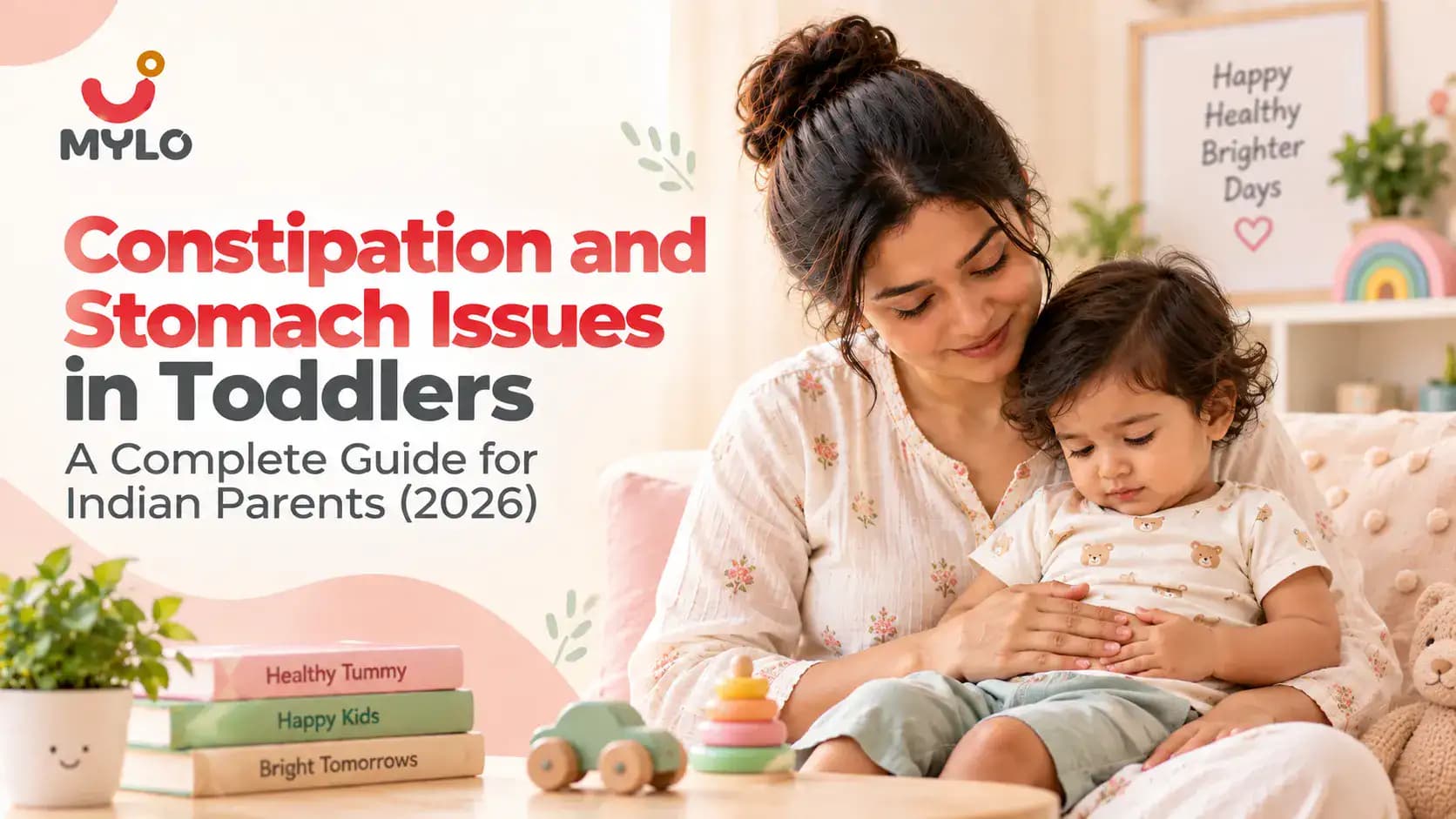
Constipation and Stomach Issues in Toddlers: A Complete Guide for Indian Parents (2026)


MBBS, DCH, DNB (Pediatrics), FICM (Fellowship in Intensive Care Medicine), FIDM (Fellowship in Diabetes Mellitus), MNAMS · 18 years experience
 24 min
TL;DR
Constipation is one of the most common tummy problems in toddlers. Most cases are functional, which means there is no serious illness behind it. The usual causes are low fibre, not enough water, too much milk, and a painful poop that makes the child start holding it in. Potty training and starting playschool are common triggers. Fix it with fibre-rich Indian foods (papaya, pear, dalia, ragi, dal, soaked raisins), enough fluids, about 300 to 500 ml of milk a day, and a relaxed potty routine after meals. For other stomach issues like diarrhoea, keep feeding and give ORS and zinc. See a doctor urgently if there is blood in the stool, green vomit, a swollen tummy, high fever or severe pain.
Quick Answer
A toddler is constipated if they poop fewer than 3 times a week, or their poop is hard, large or painful to pass. It's usually caused by low fibre, too little water, too much milk or holding poop in. Offer fruits, vegetables, whole grains and dal every day, give enough water, limit milk, and sit your child on the potty for 5 minutes after meals. Don't give laxatives, enemas or home remedies like castor oil without a doctor's advice.
Key Takeaways
Most toddler constipation is functional (not caused by a disease) and very treatable
A painful poop often starts a cycle of withholding, which makes constipation worse
Too much milk (over about 500 ml a day) is a common hidden cause
A simple fibre rule for kids is age in years + 5 grams a day
Potty training, playschool and travel are common triggers
Soiling in the underwear can be a sign of constipation, not a potty-training failure
For diarrhoea, give ORS and zinc and keep feeding. Don't stop food.
Worms, gas, reflux and food intolerance can also cause tummy trouble
Blood in the stool, green vomit, a swollen belly or severe pain need urgent medical care
How Often Should a Toddler Poop?
Every child is different. Most toddlers poop anywhere from 2 to 3 times a day to once every 2 to 3 days. What matters more than frequency is how the poop looks and whether it hurts to pass.
Toddler Poop Chart: What's Normal?
Stool Type | What It Looks Like | What It Means |
|---|---|---|
Type 1 | Hard, separate lumps like pebbles | Constipated |
Type 2 | Lumpy, sausage-shaped | Mildly constipated |
Type 3 | Sausage-shaped with cracks | Normal |
Type 4 | Smooth, soft, like a banana | Ideal |
Type 5 | Soft blobs with clear edges | Normal to slightly loose |
Type 6 | Mushy, fluffy pieces | Loose, may be early diarrhoea |
Type 7 | Watery, no solid pieces | Diarrhoea |
Based on the Bristol Stool Scale used by doctors worldwide.
Wondering about the colour of your child's poop? Read our guide on what your baby's poop colour says about their health.
What Is Constipation in Toddlers?
Constipation means pooping less often than usual, or passing poop that is hard, dry, large or painful. According to the American Academy of Pediatrics, it is one of the most common reasons children visit a doctor. About 95% of cases in children are functional, meaning there is no underlying disease.
Featured Answer: Constipation in toddlers means pooping fewer than 3 times a week, or passing hard, large or painful stools. It is usually caused by low fibre, not enough fluids, too much milk or holding poop in. It improves with fibre-rich foods, enough water, less milk and a regular, relaxed potty routine.
Signs Your Toddler Is Constipated
Fewer than 3 poops a week
Hard, dry, pebble-like or very large poop
Straining, crying or pain while pooping
Hiding in a corner, crossing legs, standing on tiptoes or going red in the face (signs of holding poop in)
Tummy pain or a hard, bloated tummy
Streaks of bright red blood on the poop or nappy (usually from a small tear called an anal fissure)
Loss of appetite or crankiness
Soiling: small smears or runny poop in the underwear in a toilet-trained child. This happens when liquid stool leaks around a hard blockage, and it is often mistaken for diarrhoea.
What Causes Constipation in Toddlers?
Cause | What Is Happening |
|---|---|
Low fibre diet | Too many refined foods (maida, biscuits, white bread, packaged snacks) and too few fruits, veggies and whole grains |
Not enough fluids | Poop becomes dry and hard |
Too much milk | Milk is filling and low in fibre; it crowds out other foods |
Holding poop in | After one painful poop, toddlers fear the next one and hold it, so poop gets harder |
Potty training | Pressure, fear of the toilet or starting too early |
Playschool or daycare | Not wanting to use an unfamiliar toilet |
Picky eating | Eating only a few "safe", low-fibre foods |
Routine changes | Travel, festivals, illness or a new sibling |
Less activity | Less running around slows the gut |
Medicines | Iron drops and some other medicines can harden stools |
Rare medical causes | Hirschsprung's disease, hypothyroidism, celiac disease or spine problems (a doctor will check for these) |
The Withholding Cycle
This is the most common reason toddler constipation keeps coming back:
Your child has one hard, painful poop
They get scared and start holding in the next one
The poop stays in longer, loses water and gets bigger and harder
The next poop hurts even more
The fear grows, and the cycle continues
Breaking this cycle, by making poop soft and pooping pain-free again, is the key to treatment. Painful pooping is the most common trigger for functional constipation in young children.
Is Your Toddler Drinking Too Much Milk?
Too much cow's milk is one of the most common hidden causes of constipation in Indian toddlers. It fills small tummies, leaving less room for fibre-rich food.
Age | Suggested Milk and Dairy |
|---|---|
1 to 2 years | About 300 to 500 ml a day, plus curd or paneer |
2 to 5 years | About 400 to 500 ml a day across milk, curd and paneer |
If your toddler drinks several bottles a day and eats very little, reducing milk can help both constipation and appetite. Read more in our guide to picky eating and food refusal in toddlers.
How Much Fibre and Water Does a Toddler Need?
Fibre: A simple rule used by pediatricians is age in years + 5 = grams of fibre per day. A 2-year-old needs about 7 grams, and a 4-year-old about 9 grams. Research shows that more than 80% of children don't get enough fibre.
Water: Most toddlers need around 1 litre of fluids a day from all drinks, including milk. They need more in hot weather, during illness or when very active. Offer water regularly through the day, not just at meals. Pale yellow urine is a good sign your child is drinking enough.
Increase fibre slowly. A sudden jump can cause gas and tummy pain. Always increase water along with fibre.
Indian Foods That Help Relieve Constipation in Toddlers
Food Group | Best Choices |
|---|---|
Fruits | Papaya, pear (nashpati), guava, ripe banana, orange, chikoo, plum, watermelon |
Dry fruits | Soaked raisins (kishmish), soaked figs (anjeer), soaked and chopped prunes, soaked dates |
Vegetables | Spinach, carrot, beans, lauki, pumpkin, sweet potato, peas, beetroot |
Whole grains | Dalia, oats, ragi, jowar, bajra, whole wheat roti, brown rice, poha |
Pulses | Moong dal, masoor dal, rajma and chana (well cooked and mashed for young toddlers) |
Probiotics | Homemade curd, buttermilk (chaas) |
Healthy fats | A small amount of ghee in dal or roti |
Foods to Limit When Your Toddler Is Constipated
Too much milk, cheese and paneer
Maida-based foods: biscuits, white bread, rusks, noodles, bakery items
Packaged snacks, chips and namkeen
Raw (unripe) banana
Too much white rice without dal or vegetables
Sugary drinks and packed juices
Sample 1-Day Fibre-Friendly Menu
Meal | What to Offer |
|---|---|
Early morning | Warm water with 4 to 5 soaked raisins (mashed for young toddlers) |
Breakfast | Vegetable dalia or ragi porridge with chopped pear |
Mid-morning | Papaya cubes and water |
Lunch | Whole wheat roti with ghee, moong dal and soft lauki or spinach sabzi |
Evening snack | Guava slices or a soaked anjeer, plus water |
Dinner | Vegetable khichdi with curd |
Milk | A small cup after dinner, not before meals |
Cut foods into small, soft pieces. Avoid whole nuts, whole grapes and hard raw vegetables in children under 4 to prevent choking.
Potty Habits That Help
Toilet time after meals: Sit your child on the potty for 3 to 5 minutes, 15 to 30 minutes after meals, when the gut is naturally most active
Use a footstool: Feet flat and knees higher than hips (a squat position) makes pooping easier
Keep it relaxed: Read a book or sing a song. Never force or scold.
Praise the try, not the result: "You sat on the potty, well done!"
Try a sticker chart for sitting on the potty, especially for 3 to 5 year olds
Pause potty training if your child is very constipated or scared. Treat the constipation first, then restart.
Talk to the playschool about toilet access and reminders
Get moving: Running, jumping, dancing and playing outdoors help the gut work well
Home Remedies: What's Safe and What's Not
Safe to Try | Avoid Without a Doctor's Advice |
|---|---|
More fruits, vegetables and whole grains | Castor oil (arandi ka tel) |
More water through the day | Soap sticks, oil or anything inserted into the bottom |
Soaked raisins, prunes or figs | Enemas and suppositories |
A little ghee in food | Isabgol (psyllium) without a doctor's dose |
Tummy massage in a clockwise direction | Adult laxatives or "churan" |
Warm bath to relax tummy muscles | Janam ghutti or herbal mixtures |
Cycling their legs gently (for younger toddlers) | Repeated "cleaning" of the stomach |
If diet and routine changes don't work within 1 to 2 weeks, see your pediatrician. They may prescribe a stool softener that is safe for children. Polyethylene glycol (PEG) and lactulose are commonly used. These are usually needed for several months, not just a few days. Stopping too early is one of the most common reasons constipation comes back. Never start or stop these medicines without your doctor's advice.
Other Common Stomach Issues in Toddlers
1. Diarrhoea (Loose Motions)
Diarrhoea means 3 or more loose or watery stools in a day. In toddlers it is usually caused by a viral stomach infection, contaminated food or water, or antibiotics. It becomes more common during the monsoon and post-monsoon season.
What to do:
Give low-osmolarity ORS after every loose stool, in small sips
Give zinc for 10 to 14 days, as advised by your doctor. WHO recommends ORS plus zinc for childhood diarrhoea.
Keep feeding normal home food like khichdi, curd rice, banana, dal and roti. Don't starve your child.
Avoid packed juices, soft drinks and glucose water, which can make diarrhoea worse
Wash hands and utensils well, and give boiled or filtered water
Learn more in our detailed guide to baby diarrhoea: causes, symptoms and treatment.
2. Toddler's Diarrhoea
Some healthy, happy toddlers have frequent loose stools, often with bits of undigested food like peas or carrots. This is called toddler's diarrhoea (functional diarrhoea). It's usually linked to too much fruit juice, a low-fat diet or eating very frequently. Children grow normally and it goes away by school age. Cutting down juice and adding a little healthy fat like ghee often helps.
3. Tummy Pain
Toddlers often say "pet dard" when they are constipated, gassy, hungry, anxious or even tired. Most tummy pain passes on its own. Look for patterns: pain after milk, before playschool or when they haven't pooped in days.
4. Gas and Bloating
Common causes include eating too fast, lots of beans or cabbage at once, fizzy drinks, or a sudden increase in fibre. Gentle tummy massage, bicycle legs and slowing down at meals can help.
5. Vomiting
Usually caused by a stomach bug and settles in 1 to 2 days. Give small, frequent sips of ORS. Seek care if vomiting is green, contains blood, doesn't stop, or your child shows signs of dehydration.
6. Worms (Stomach Worms)
Worm infections are common in Indian children. Signs include an itchy bottom (especially at night), tummy pain, poor appetite, poor weight gain and sometimes visible worms in the stool. India runs National Deworming Day twice a year, with free deworming tablets for children aged 1 to 19 at Anganwadis and schools. Read our guide on how to know if your toddler has worms in the stomach.
7. Acidity and Reflux
Some toddlers get reflux, with frequent spitting up, burping, sour breath or refusing food. Avoid large meals before bed, fried and spicy foods, and lying down right after eating. See a doctor if it's frequent or affects weight gain.
8. Food Intolerance or Allergy
Cow's milk protein allergy, lactose intolerance or celiac disease (gluten) can cause ongoing diarrhoea, constipation, bloating or poor weight gain. Don't remove whole food groups on your own. Speak to your pediatrician for proper testing.
When to See a Doctor
See a Doctor Soon If Your Child:
Hasn't improved after 1 to 2 weeks of diet and routine changes
Has constipation that keeps coming back
Is soiling their underwear regularly
Has small streaks of blood from a tear in the bottom
Has poor appetite or poor weight gain (see our guide on what to do if your toddler is underweight)
Has diarrhoea lasting more than 3 days, or tummy pain that keeps coming back
Has pain or burning while peeing along with tummy pain (could be a UTI in toddlers)
🚨 Go to the Emergency Room Immediately If Your Child Has:
Green or yellow-green vomit
A very swollen, hard or tender tummy
Blood in the stool, or dark red jelly-like stool
Severe tummy pain that comes in waves, with your child drawing their legs up and crying, then going pale or floppy. These can be signs of intussusception, a bowel emergency most common between 6 months and 3 years.
Pain that starts around the belly button and moves to the lower right side (possible appendicitis)
High fever with tummy pain
Signs of dehydration: very few wet nappies, no tears, dry mouth, sunken eyes, unusual sleepiness
Weakness in the legs, or problems with peeing along with constipation
Constipation that started from birth, or a baby who didn't pass their first poop within 48 hours of birth
Emergency number: Dial 108 for ambulance services in most states, or 112 for emergencies.
How Doctors Diagnose Constipation
Most of the time, your pediatrician can diagnose constipation by asking about your child's poop habits and diet and gently examining their tummy. Tests are rarely needed. They may suggest blood tests (thyroid, celiac), an X-ray or an ultrasound only if there are warning signs or the constipation doesn't respond to treatment. The NICE guideline on constipation in children recommends that most children don't need tests.
What Does Treatment Cost in India?
Item | Typical Cost (₹) | Note |
|---|---|---|
Diet changes, water and potty routine | Free | Most effective first step |
Pediatrician consultation | ₹500 to ₹1,500 | Free at government centres |
ORS sachet | ₹20 to ₹25 each | Also free at government health centres |
Zinc syrup or tablets | ₹30 to ₹80 | As advised by the doctor |
Stool softener (PEG or lactulose) | ₹150 to ₹450 per bottle or pack | Only on prescription |
Stool test | ₹150 to ₹500 | If your doctor suggests it |
Abdominal ultrasound | ₹800 to ₹2,500 | Only if needed |
Pediatric gastroenterologist | ₹1,000 to ₹2,500 | For long-lasting or complex cases |
Deworming tablet | Free at Anganwadi or ₹10 to ₹30 | Given on National Deworming Day |
Indian Context: What Indian Parents Should Know
Avoid "pet saaf" remedies: Castor oil, soap sticks, churan and janam ghutti are still common but can be harmful. Always check with your doctor.
Don't rely on milk alone: Many Indian toddlers drink a lot of milk and eat very little. Keep milk to about 300 to 500 ml a day.
Swap maida for whole grains: Replace biscuits, rusks and white bread with ragi, jowar, bajra, dalia and whole wheat.
Use seasonal fruit: Papaya, guava, pear and oranges are affordable, fibre-rich and available almost year-round.
Monsoon hygiene: Stomach infections rise during and after the monsoon. Give boiled or filtered water, wash hands and avoid street food for toddlers.
Keep up with deworming: Use National Deworming Day (February and August) or ask your pediatrician.
Anganwadi services: Free ORS, zinc, deworming and growth monitoring are available at Anganwadis and government health centres.
Myths vs Facts
Myth | Fact | Source |
|---|---|---|
"My child must poop every day" | Anywhere from 2 to 3 times a day to once every 2 to 3 days can be normal if poop is soft | |
"More milk will make my child strong and regular" | Too much milk often causes constipation | |
"Stool softeners make the gut lazy" | Doctor-prescribed softeners like PEG are safe for children and often needed for months | |
"Soiling means my child is being lazy or naughty" | Soiling is often leakage from constipation, not bad behaviour | |
"Stop food during diarrhoea" | Keep feeding normal food and give ORS and zinc | |
"Castor oil is a safe way to clean the stomach" | It can cause cramps, dehydration and other harm in young children | IAP |
"Every tummy ache needs medicine" | Most toddler tummy pain comes from constipation, gas or a mild bug and settles on its own | AAP |
FAQs: Constipation and Stomach Issues in Toddlers
How do I know if my toddler is constipated?
Signs include fewer than 3 poops a week, hard or pebble-like poop, straining or crying while pooping, holding poop in, tummy pain and sometimes streaks of blood on the poop.
Bachche ko kabz ho toh kya karein? (Hinglish)
Bachche ko roz fruits (papaya, nashpati, amrood), sabziyan, dalia, ragi aur dal dein. Paani zyada pilayein aur doodh 300 se 500 ml tak rakhein. Khane ke baad 5 minute potty par bithayein. Castor oil ya ghutti bina doctor ke na dein. 1 se 2 hafte mein aaram na mile toh doctor se milein.
What can I give my toddler for instant constipation relief?
There is no safe "instant" fix at home. Offer water, soaked raisins or prunes, papaya or pear, a warm bath and a clockwise tummy massage. If your child is in pain or hasn't pooped for several days, see a doctor rather than using enemas or adult laxatives.
Is it normal for a toddler not to poop for 3 days?
It can be normal if the poop is soft and easy to pass when it comes. If the poop is hard or painful, or your child seems uncomfortable, it's constipation and needs attention.
Can milk cause constipation in toddlers?
Yes. Drinking a lot of cow's milk (over about 500 ml a day) is a common cause, because it fills them up and leaves less room for fibre-rich food.
Why is my toddler holding in their poop?
Usually because a past poop hurt, they're scared of the potty, or they're too busy playing. Making poop soft with diet and fluids, and keeping potty time relaxed, helps break the cycle.
Does banana cause constipation?
Ripe bananas are fine and can help. Raw or unripe bananas can be binding and may worsen constipation.
Is ghee good for constipation in toddlers?
A small amount of ghee in dal or roti is a traditional practice and can make meals more nourishing. But ghee alone won't fix constipation. Fibre, water and less milk matter much more.
Bachche ke pet mein dard ho raha hai, kya karein? (Hinglish)
Zyada tar pet dard kabz, gas ya halke infection se hota hai aur khud theek ho jaata hai. Paani, halka khana aur aaram dein. Agar hari ulti, potty mein khoon, pet phoola hua ho, tez bukhar ho ya dard bahut zyada ho, toh turant doctor ke paas jaayein.
What should I give my toddler during diarrhoea?
Give ORS after every loose stool, zinc as advised by your doctor, and keep feeding normal home food like khichdi, curd and banana. Avoid juices and soft drinks.
How do I know if my toddler is dehydrated?
Watch for fewer wet nappies or less peeing, dark yellow urine, a dry mouth, no tears when crying, sunken eyes and unusual sleepiness. See a doctor right away if you notice these.
Can worms cause stomach pain in toddlers?
Yes. Worms can cause tummy pain, an itchy bottom, poor appetite and poor weight gain. Deworming as advised by your doctor or on National Deworming Day helps.
Are stool softeners safe for toddlers?
Yes, when prescribed by a pediatrician. Medicines like PEG and lactulose are commonly used and safe. They often need to be continued for a few months, so don't stop them early without your doctor's advice.
When should I worry about my toddler's constipation?
See a doctor if there's no improvement in 1 to 2 weeks, it keeps coming back, or there's soiling or poor weight gain. Go to the emergency room for green vomit, blood in the stool, a swollen tummy, severe pain or fever.
Related Reads on Mylo
References
American Academy of Pediatrics (AAP). "Constipation in Children." HealthyChildren.org. https://www.healthychildren.org/English/health-issues/conditions/abdominal/Pages/constipation.aspx
National Institute for Health and Care Excellence (NICE). "Constipation in Children and Young People: Diagnosis and Management (CG99)." https://www.nice.org.uk/guidance/cg99
ESPGHAN and NASPGHAN. "2024 Protocol for Paediatric Functional Constipation Treatment Guidelines." PMC. https://pmc.ncbi.nlm.nih.gov/articles/PMC11795385/
ESPGHAN and NASPGHAN. "Evaluation and Treatment of Functional Constipation in Infants and Children." PubMed. https://pubmed.ncbi.nlm.nih.gov/24345831/
StatPearls. "Pediatric Functional Constipation." NCBI Bookshelf. https://www.ncbi.nlm.nih.gov/books/NBK537037/
"Dietary Fiber in Pediatric Gastrointestinal Health: A Narrative Review of Evidence and Challenges" (2026). PMC. https://pmc.ncbi.nlm.nih.gov/articles/PMC13244058/
World Health Organization (WHO). "Diarrhoeal Disease: Fact Sheet." https://www.who.int/news-room/fact-sheets/detail/diarrhoeal-disease
Indian Pediatrics. "Approach to Constipation in Children." https://www.indianpediatrics.net/apr2016/319.pdf
Indian Journal of Pediatrics. "Functional Constipation in Children." https://link.springer.com/article/10.1007/s12098-024-05387-5
American Academy of Family Physicians. "Constipation in Children and Adolescents: Evaluation and Treatment." https://www.aafp.org/afp/2022/0500/p469
Ministry of Health and Family Welfare, National Health Mission. "National Deworming Day." https://nhm.gov.in
Medical Disclaimer
This article is for information only and does not replace professional medical advice. Always consult your pediatrician before giving any medicine, supplement or home remedy to your child, and seek emergency care if you notice any warning signs.


Shop Now
Baby Essentials




Article Posted Under
Related Articles
Best Pregnancy and Parenting App in India: 5 Must-Have Features to Look For (2026)
 20 min
 Best Hairstyles for Postpartum Hair Loss and Regrowth
 10 min
 HairVivine Pro: What This Pumpkin Seed Hair Active Does and What the Studies Show
 15 min
 Postpartum Hair Loss and Confidence: Why It Hits So Hard and What Helps
 9 min
9 min
Related Topics
.webp&w=32&q=75)
Medical Disclaimer
This content is for informational purposes only and should not replace professional medical advice. Consult with a physician or other health care professional if you have any concerns or questions about your health. If you rely on the information provided here, you do so solely at your own risk.


AWARDS AND RECOGNITION

Mylo wins Forbes D2C Disruptor award

Mylo wins The Economic Times Promising Brands 2022
AS SEEN IN













- Mylo Care: Effective and science-backed personal care and wellness solutions for a joyful you.
- Mylo Baby: Science-backed, gentle and effective personal care & hygiene range for your little one.
- Mylo Community: Trusted and empathetic community of 10mn+ parents and experts.


Product Categories
Baby Carrier | Baby Soap | Baby Wipes | Stretch Marks Cream | Baby Cream | Baby Shampoo | Baby Massage Oil | Baby Hair Oil | Stretch Marks Oil | Baby Body Wash | Baby Powder | Baby Lotion | Diaper Rash Cream | Newborn Diapers | Teether | Baby Kajal | Baby Diapers Pants | Cloth Diapers | Laundry Detergent | Lactation Granules |