


Orders
.png&w=48&q=75 "login")
Profile


Wallet

Toddler Teeth Chart: When Do Molars and Canines Come In?
 12 min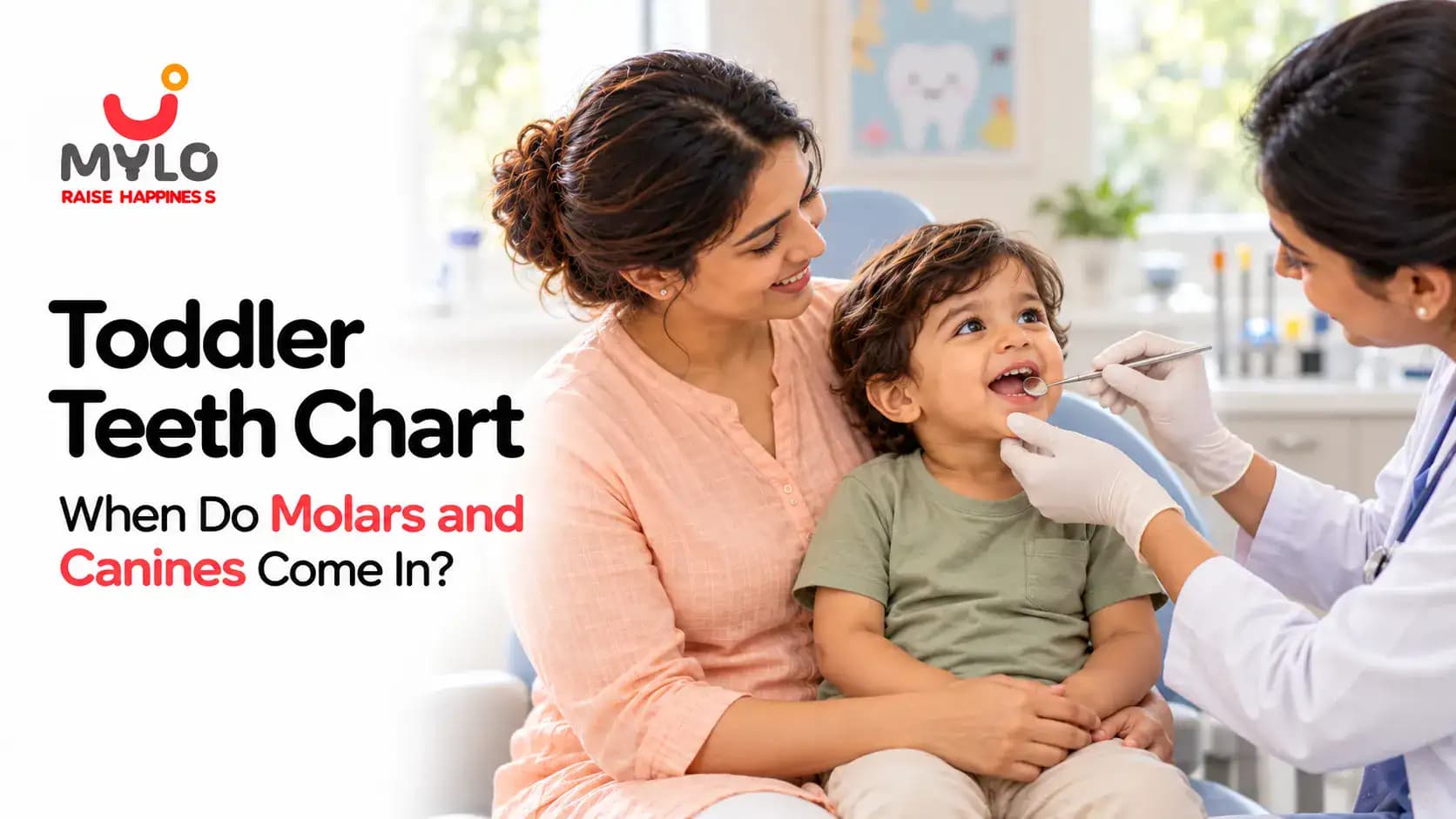
Quick Answer
Most toddlers get their first molars between 13 and 19 months, canines between 16 and 23 months, and second molars between 23 and 33 months. That completes all 20 milk teeth by about age 3. Molars often come before canines, so a gap is normal. Fussiness and drooling are common. A real fever is not a teething sign.
Which teeth come in after a toddler's first birthday?
Short answer: After the front teeth (incisors), toddlers get first molars, then canines, then second molars.
At one year, most toddlers have about 4 to 8 front teeth. The bigger teeth arrive between 1 and 3 years. If you'd like a refresher on the first teeth, see when babies get their first teeth.
What does the toddler teeth chart look like?
Short answer: These ranges come from the American Dental Association eruption chart.
Upper teeth
Tooth | Comes in | Falls out (approx.) |
|---|---|---|
Central incisor | 8 to 12 months | 6 to 7 years |
Lateral incisor | 9 to 13 months | 7 to 8 years |
Canine | 16 to 22 months | 10 to 12 years |
First molar | 13 to 19 months | 9 to 11 years |
Second molar | 25 to 33 months | 10 to 12 years |
Lower teeth
Tooth | Comes in | Falls out (approx.) |
|---|---|---|
Central incisor | 6 to 10 months | 6 to 7 years |
Lateral incisor | 10 to 16 months | 7 to 8 years |
Canine | 17 to 23 months | 9 to 12 years |
First molar | 14 to 18 months | 9 to 11 years |
Second molar | 23 to 31 months | 10 to 12 years |
The AAPD dental growth reference gives similar ranges. Every child has their own timeline, so a few months either way is normal.
How many teeth should my toddler have at each age?
Age | Typical teeth so far | What's usually coming next |
|---|---|---|
12 months | 4 to 8 front teeth | First molars |
18 months | 8 to 12 teeth | Canines |
24 months | 12 to 16 teeth | Second molars |
30 months | 16 to 20 teeth | Last second molars |
3 years | 20 teeth (full milk set) | Nothing until about 6 years |
These counts are rough guides worked out from the ADA ranges. They aren't targets.
Why do molars come before canines?
Short answer: It's the normal order. First molars usually erupt a few months before canines.
The usual order is:
Lower front teeth
Upper front teeth
Side incisors
First molars
Canines
Second molars
So a space next to the front teeth at 15 to 18 months is usually a canine still on its way, not a missing tooth.
What are the signs of molar teething in toddlers?
Short answer: Drooling, chewing, gum rubbing, poor sleep and fussiness. A real fever, diarrhoea or rash is not caused by teething.
A study in Pediatrics linked these to the days around a tooth coming in:
Common with teething | Not caused by teething (see a doctor) |
|---|---|
Biting and chewing everything | Fever of 38°C (100.4°F) or more |
Extra drooling | Loose motions or diarrhoea |
Rubbing gums, pulling at the ear | Vomiting |
Waking at night, clinginess | Rash all over the body |
Eating fewer solids for a day or two | Refusing all fluids, fewer wet diapers |
Slight temperature rise (under 38°C) | Fussiness that lasts more than a few days |
Molars are wide and flat, so they can feel more sore than front teeth. Blaming teething for a fever can delay care for ear or urine infections. The AAP's HealthyChildren symptom guide gives the same advice.
How can I soothe my toddler's molar pain safely?
Short answer: Use cold, firm things to chew on and gentle gum massage. Skip gels and necklaces.
✅ Safe to try | ❌ Avoid |
|---|---|
Chilled (not frozen) silicone teether | Teething gels with benzocaine or lidocaine |
Rubbing the gums with a clean finger | Amber or bead teething necklaces |
A cold, damp clean cloth to chew | Honey on the gums (never under 1 year) |
Cold foods your toddler already eats, like chilled cucumber or curd, while supervised | Hard biscuits used as teethers |
Paracetamol only if a doctor advises it, at the dose they give | Rubbing alcohol, clove oil, home pastes |
The US FDA warns against benzocaine teething products and amber necklaces. They can cause choking, strangulation or a rare blood problem. For more ideas, see how to soothe toddler gums, when to use a teether and home remedies for teething.
How should I brush my toddler's new molars?
Short answer: Brush twice a day with a rice-grain smear of fluoride toothpaste until age 3.
Age | Toothpaste amount | Tip |
|---|---|---|
First tooth to 3 years | A rice-grain smear | Brush the backs of the molars, where food gets stuck |
3 to 6 years | A pea-sized amount | Teach your child to spit, not rinse |
This follows the AAP oral health advice. Molars have deep grooves, so they get cavities more easily than front teeth. Plan the first dental visit by the first birthday.
When should I worry about late teething?
Short answer: See a doctor or dentist if your child has no teeth by 18 months or isn't close to 20 teeth by about age 3.
Sign | What to do |
|---|---|
No teeth at all by 18 months | Get a paediatric dental check |
Very uneven eruption, such as teeth on one side only | Ask a dentist |
White, brown or black spots on teeth | Possible early cavities. See a dentist soon. |
Swelling, pus or a bump on the gum | Possible infection. See a doctor the same day. |
Late teeth along with poor weight gain or other delays | Ask your paediatrician (see toddler underweight and developmental delay) |
Late teeth on their own are usually just family genes. KidsHealth notes that the timing varies a lot from child to child.
What should Indian parents know about toddler teeth?
Night-time milk bottles and sugar cause cavities. Milk with sugar, jaggery or a "health drink" left on the teeth overnight leads to early childhood caries. Move to a cup by 12 to 18 months.
Sweets and biscuits between meals wear down molar grooves fast. Keep sweets to mealtimes and give water afterwards.
RBSK screening covers dental caries in children. Ask at your Anganwadi or government health centre for a free check and referral.
Emergencies: for a high fever, a swollen face or trouble breathing, call 108 or 112.
Myths vs facts
Myth | Fact |
|---|---|
"Daant nikalne pe dast lagte hain." (Teething causes loose motions.) | Diarrhoea is not a teething symptom. Check for infection. |
Milk teeth fall out, so cavities don't matter. | Milk molars stay until about 10 to 12 years. Decay can hurt and harm the adult teeth underneath. |
A gap at 18 months means a tooth is missing. | Canines often come in after the first molars. |
An amber necklace eases teething pain. | No proof it works, and it's a choking and strangulation risk. |
Toothpaste isn't needed until all the teeth are in. | Use a rice-grain smear from the very first tooth. |
FAQs
1. Bachche ke molar daant kab aate hain?
First molars usually come in between 13 and 19 months, and second molars between 23 and 33 months.
2. Canine (keeli) daant kab nikalte hain?
Usually between 16 and 23 months, often after the first molars.
3. 2 saal ke bachche ke kitne daant hone chahiye?
Usually 12 to 16 teeth. All 20 milk teeth are normally in by about age 3.
4. Kya daant nikalte waqt bukhaar aata hai?
Only a slight warmth. A temperature of 38°C or more is not caused by teething, so see a doctor.
5. Molar teething kitne din chalta hai?
The soreness usually lasts a few days around the time the tooth breaks through the gum.
6. Kya teething gel use kar sakte hain?
Avoid gels with benzocaine or lidocaine. Use a cold teether or gum massage instead.
7. 18 mahine tak ek bhi daant nahi aaya, kya karein?
Get a paediatric dentist to check. It's often genetic, but it's worth an exam.
Related reads on Mylo
References
American Dental Association. Primary and permanent tooth eruption chart.
American Academy of Pediatric Dentistry. Dental growth and development reference.
Macknin ML et al. Symptoms associated with infant teething. Pediatrics, 2000.
AAP HealthyChildren. Teething symptoms and oral health.
US FDA. Safely soothing teething pain.
KidsHealth (Nemours). Teething.
Ministry of Health and Family Welfare. Rashtriya Bal Swasthya Karyakram (RBSK).
Medical disclaimer
This article is for general information only and does not replace advice from your paediatrician or paediatric dentist. Every child develops at their own pace. Please see a qualified professional about your child's teeth, fever or pain.

Shop Now
Baby Essentials




Article Posted Under
Related Articles
Hair Colour During Pregnancy: Is It Safe? Trimester Guide, Mehndi and Safer Options
 14 min
 Mylo: The Made-in-India Pregnancy and Parenting App Built for Indian Parents
 7 min
7 min Diwali During Pregnancy: Safety Tips for Pregnant Women on Crackers, Sweets and Diet
 17 min
 Best Pregnancy and Parenting App in India: 5 Must-Have Features to Look For (2026)
 20 min
Related Topics
.webp&w=32&q=75)
Medical Disclaimer
This content is for informational purposes only and should not replace professional medical advice. Consult with a physician or other health care professional if you have any concerns or questions about your health. If you rely on the information provided here, you do so solely at your own risk.


AWARDS AND RECOGNITION

Mylo wins Forbes D2C Disruptor award

Mylo wins The Economic Times Promising Brands 2022
AS SEEN IN













- Mylo Care: Effective and science-backed personal care and wellness solutions for a joyful you.
- Mylo Baby: Science-backed, gentle and effective personal care & hygiene range for your little one.
- Mylo Community: Trusted and empathetic community of 10mn+ parents and experts.


Product Categories
Baby Carrier | Baby Soap | Baby Wipes | Stretch Marks Cream | Baby Cream | Baby Shampoo | Baby Massage Oil | Baby Hair Oil | Stretch Marks Oil | Baby Body Wash | Baby Powder | Baby Lotion | Diaper Rash Cream | Newborn Diapers | Teether | Baby Kajal | Baby Diapers Pants | Cloth Diapers | Laundry Detergent | Lactation Granules |