


Orders
.png&w=48&q=75 "login")
Profile


Wallet

Stages of Play by Age: When Toddlers Play With Other Kids
 15 min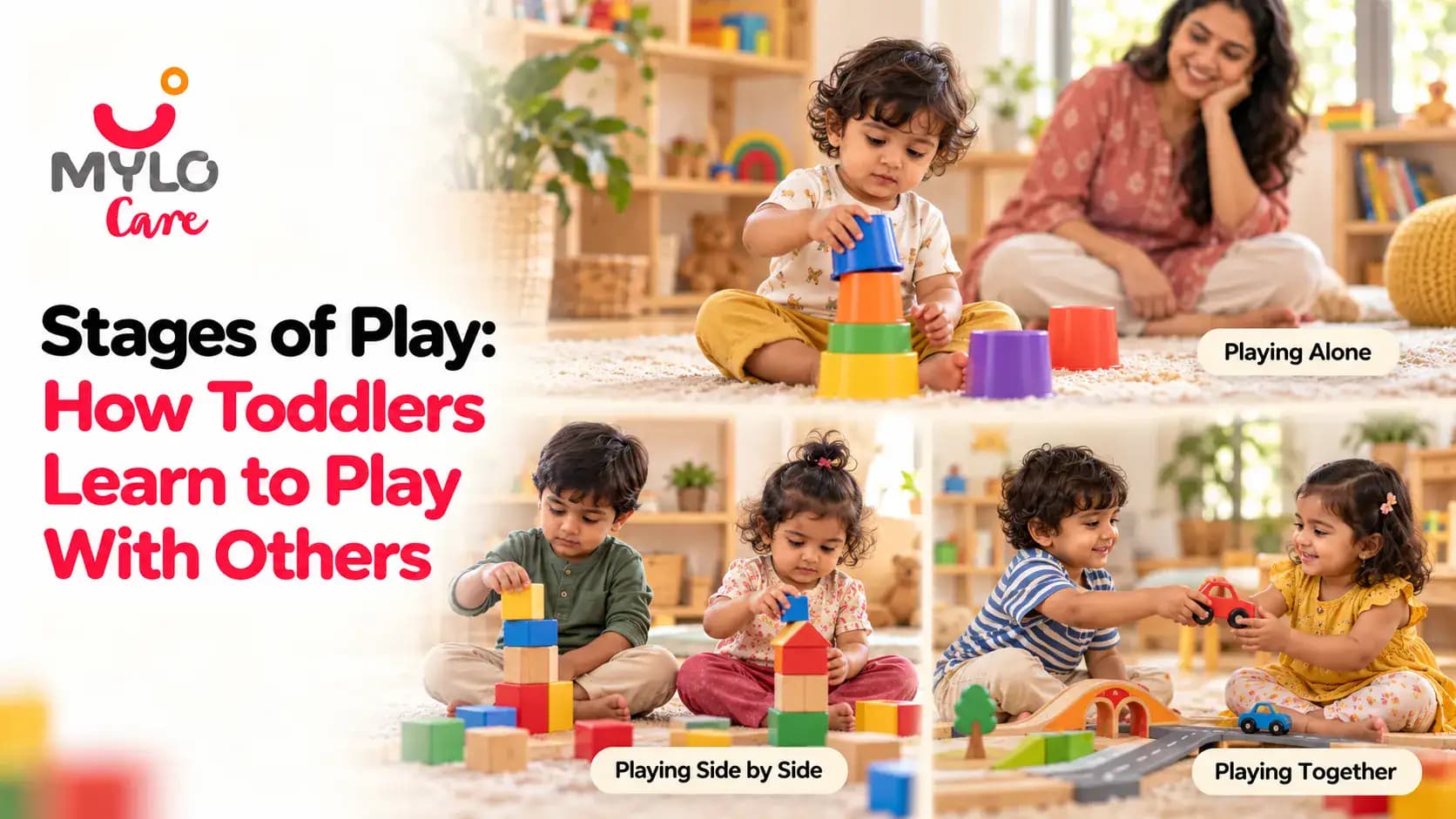
Quick Answer
Stages of play are the steps through which children learn to play with others, from playing alone to playing side by side and finally playing together. For example, two 2 year olds building separate towers next to each other are in parallel play. This is normal, and real friendships usually start after 3.
At a Glance
Age (Approximate) | Stage of Play | What It Looks Like |
|---|---|---|
0 to 2 years | Solitary play | Plays alone with toys, may ignore other children |
Around 2 years | Onlooker play | Watches other children play without joining |
2 to 3 years | Parallel play | Plays next to other children, doing similar things, but not together |
3 to 4 years | Associative play | Plays with others, shares toys, but no common goal |
4 years and above | Cooperative play | Plays together with rules, roles and a shared goal |
These ages are a rough guide. Children move between stages and often go back to earlier ones.
Key Facts
The stages of play were first described by sociologist Mildred Parten in the 1930s and are still widely used today.
Parallel play is a normal and important stage for 2 to 3 year olds, not a sign that your child is antisocial.
Toddlers don't understand sharing or friendship the way older children do. These skills develop mostly after 3 years.
Some toddlers are "slow to warm up" by temperament and need extra time in new groups.
Not responding to their name, little eye contact or no interest in people at all are different from shyness and should be checked.
Why Doesn't My Toddler Play With Other Kids?
Short answer: Most toddlers under 3 prefer to play alone or next to other children rather than with them. Their brains are still learning to share, take turns and understand other people's feelings.
Reason | What's Happening |
|---|---|
Age and stage | Under 3, playing alone or side by side is normal |
"Mine" phase | Toddlers are just learning that things belong to them. Sharing comes later |
Limited words | It's hard to play together without enough language |
Temperament | Some children are naturally cautious and watch before joining |
New place or people | Toddlers need time to feel safe |
Tired, hungry or unwell | Less interest in others |
For help with the "mine" phase, read how to teach a toddler to share toys.
What Is Parallel Play?
Short answer: Parallel play is when toddlers play next to each other, often with similar toys, without playing together. It usually appears around 2 years and is a key step towards playing with others.
Example of Parallel Play | What Your Toddler Is Learning |
|---|---|
Two toddlers digging in the same sandpit | Being near peers feels safe |
Each child pushing their own toy car | Watching and copying others |
Side by side scribbling on paper | New ideas from another child |
Both "cooking" in separate toy kitchens | Early interest in what others do |
Toddlers in parallel play often copy each other, glance at each other and sometimes hand over a toy. These small moments are the start of social play.
How Toddler Play Changes From 1 to 3 Years
Short answer: At 1, toddlers mainly play alone and with adults. By 2, they watch and play near other children. By 3, many start simple play together, like chasing games and pretend play.
Age | Social Play Milestones |
|---|---|
12 to 18 months | Plays alone, enjoys adults, may hand you a toy, copies simple actions |
18 to 24 months | Watches other children with interest, plays near them, may grab toys |
2 to 2.5 years | Parallel play, copies other children, simple back-and-forth like rolling a ball |
2.5 to 3 years | Starts joining in simple games, short pretend play with others, begins taking turns with help |
3 years and above | Plays with others more, has favourite playmates, shares with reminders |
For other milestones, read toddler development 12 to 36 months.
How to Help Your Toddler Make Friends
Short answer: Give your toddler regular, relaxed time with the same few children, play alongside them, model friendly words, and don't force interaction. Friendships grow slowly through repeated contact.
Tip | How |
|---|---|
Regular meetups | See the same 1 or 2 children often, like a neighbour or cousin |
Play alongside | Sit with your toddler and gently include the other child: "Riya is building too!" |
Model words | "Can I have a turn?", "Here you go", "Let's play together" |
Name feelings | "She is sad because her ball rolled away" |
Praise kind actions | "You gave him the spoon. That was kind!" |
Pretend play at home | Use dolls or soft toys to act out sharing and saying hello |
Read books about friends | Talk about the characters' feelings |
Don't force it | Let your toddler watch first. Pushing makes shy children more anxious |
For manners, greetings and other social skills, read how to develop social skills in toddlers.
Playdates for Toddlers: How to Make Them Work
Short answer: Keep toddler playdates short (about an hour), small (1 or 2 children), at a familiar place, at a time when children are rested and fed, with a parent nearby and simple toys that can be shared.
Playdate Tip | Why It Helps |
|---|---|
1 or 2 children only | Large groups overwhelm toddlers |
45 to 60 minutes | Ends before children get tired and cranky |
After nap and snack | Rested, fed toddlers play better |
Familiar place | Your home, a nearby park or the building garden |
Put away special toys | Avoids fights over favourite toys |
Duplicate toys | Two buckets, two balls, so both can play the same thing |
Parents stay | Toddlers need adults close by to feel safe and resolve conflicts |
Simple snack | Banana, cut fruits, makhana, small sandwiches |
End on a happy note | "Bye bye! See you next time!" before meltdowns start |
Playdate Ideas for Toddlers
Activity | Why It Works for Toddlers |
|---|---|
Sandpit or mud play | Easy parallel play, no rules needed |
Bubbles | Everyone can chase and pop |
Water play in tubs (supervised) | Fun with cups and toys |
Music and dancing | Freeze dance, action songs together |
Big blocks | Building side by side or together |
Ball rolling | Simple turn taking |
Story time | Sitting together for a short book |
Play dough | Each child gets their own piece |
More ideas in best activities for toddlers by age.

What to Do When Toddlers Fight During Play
Short answer: Grabbing, pushing and crying over toys are normal at this age. Stay close, stay calm, step in early, describe what happened, and help both children find a solution.
Situation | What to Do |
|---|---|
Grabbing a toy | "Aarav is using the truck. You can have a turn next." Offer another toy |
Pushing or hitting | Separate calmly: "I won't let you hit. Hitting hurts." Check on both children |
Biting | Comfort the bitten child first, then stay calm with the biter. Read toddler biting |
Both want the same toy | Use a timer for turns, or bring out a second similar toy |
Meltdown | Take your child to a quiet spot to calm down. Read emotional regulation in toddlers |
For more on hitting and pushing, read hitting, biting and bad language in toddlers.
Helping a Shy Toddler Play With Others
Short answer: Shy toddlers need time and support. Arrive early before the group gets big, stay close, let them watch first, and never label them as "shy" in front of others.
Arrive early so your child can settle before other children come.
Stay close and play with your child near the group.
Let them watch. Watching is part of learning.
Start small: one familiar child is easier than a group.
Avoid labels: say "She likes to watch first" instead of "She's so shy."
Praise small steps: "You waved at Riya!"
When to Worry About Your Toddler's Social Play
Short answer: Talk to your paediatrician if your toddler shows little interest in people at all, doesn't respond to their name, avoids eye contact, doesn't point to show you things, or loses social skills they had.
Age | Check With Your Doctor If |
|---|---|
12 months | No response to name, no babbling, doesn't point or wave |
18 months | Doesn't point to show you things, no interest in people, no words |
2 years | Doesn't copy others, no interest in other children at all, no two-word phrases |
3 years | No pretend play, doesn't join in any play with others, very hard to understand |
Any age | Loses words or social skills, very little eye contact, repetitive movements |
Not playing with other children by itself is common in toddlers. These signs together need a check. Read toddler behaviour red flags.
Indian Context: What Parents Should Know
Joint families and cousins: many Indian toddlers learn social skills with cousins and relatives, which is a great start.
Society and park play: building gardens and parks are perfect for daily parallel play with neighbours' children.
Family functions: big gatherings can overwhelm toddlers. Stay close and give quiet breaks.
Comparisons: relatives may say "Why doesn't he play with other kids?" Explain that playing alongside is normal at this age.
Playschool: playgroup is one place to meet other children, but not the only one. Read choosing a playschool in India.
Myths vs Facts
Myth | Fact |
|---|---|
A toddler who plays alone is antisocial | Solitary and parallel play are normal stages |
Toddlers should share willingly | Sharing develops mostly after 3 years, with lots of practice |
Shy toddlers will always be shy | Many shy toddlers become confident with time and support |
Fights over toys mean bad behaviour | Toy conflicts are normal learning moments |
More playdates make a toddler more social | A few relaxed, regular playdates are better than many busy ones |
Toddlers need many friends | One or two familiar playmates are plenty |
FAQs
1. At what age do toddlers start playing with other kids?
Toddlers start playing near others (parallel play) around 2 years. Playing together with shared ideas usually starts around 3 to 4 years.
2. Is it normal for my 2 year old not to play with other children?
Yes. Most 2 year olds play alone or next to other children. This is normal.
3. What is parallel play?
It is when toddlers play side by side with similar toys but not together. It is a normal stage, usually from about 2 to 3 years.
4. How long should a toddler playdate be?
About 45 to 60 minutes is enough for most toddlers.
5. How can I help my shy toddler make friends?
Meet the same one or two children regularly, stay close, let your toddler watch first, and praise small steps.
6. When should I worry about my toddler's social skills?
If your toddler doesn't respond to their name, avoids eye contact, doesn't point, shows no interest in people, or loses skills, talk to your doctor.
7. 2 saal ka baccha doosre bacchon ke saath kyon nahi khelta?
2 saal ke bacche zyadatar akele ya doosre bacchon ke paas baithkar alag khelte hain. Ise parallel play kehte hain aur yeh bilkul normal hai. Saath milkar khelna aam taur par 3 saal ke baad shuru hota hai.
8. Bacche ke dost kaise banwayein?
Roz ek do jaane pehchaane bacchon ke saath park ya ghar par thodi der khelne dijiye, aap paas rahiye, aur bacche ko zabardasti mat bhejiye. Dheere dheere woh khud khulne lagega.
Related Reads
References
Parten MB. Social participation among pre-school children. Journal of Abnormal and Social Psychology, 1932.
American Academy of Pediatrics, HealthyChildren.org. Social development in toddlers; Playing with others. https://www.healthychildren.org
ZERO TO THREE. Social-emotional development. https://www.zerotothree.org
Centers for Disease Control and Prevention. Milestone checklists. https://www.cdc.gov/ncbddd/actearly
Thomas A, Chess S. Temperament and Development. 1977.
Medical Disclaimer
This article is for general information only and does not replace advice from your paediatrician. If you have concerns about your toddler's social development, please consult your doctor.
Wellness Kit for Your Growing Toddler
Everyday care for curious, active little ones





Article Posted Under
Related Articles
Right Side Abdominal Pain: Common Causes, Home Care and When to See a Doctor
 14 min
 Growth Scan in Pregnancy: When It Is Done, What It Checks and What Your Report Means
 17 min
 Hair Colour During Pregnancy: Is It Safe? Trimester Guide, Mehndi and Safer Options
 14 min
 Mylo: The Made-in-India Pregnancy and Parenting App Built for Indian Parents
 7 min
7 min
Related Topics
.webp&w=32&q=75)
Medical Disclaimer
This content is for informational purposes only and should not replace professional medical advice. Consult with a physician or other health care professional if you have any concerns or questions about your health. If you rely on the information provided here, you do so solely at your own risk.


AWARDS AND RECOGNITION

Mylo wins Forbes D2C Disruptor award

Mylo wins The Economic Times Promising Brands 2022
AS SEEN IN













- Mylo Care: Effective and science-backed personal care and wellness solutions for a joyful you.
- Mylo Baby: Science-backed, gentle and effective personal care & hygiene range for your little one.
- Mylo Community: Trusted and empathetic community of 10mn+ parents and experts.


Product Categories
Baby Carrier | Baby Soap | Baby Wipes | Stretch Marks Cream | Baby Cream | Baby Shampoo | Baby Massage Oil | Baby Hair Oil | Stretch Marks Oil | Baby Body Wash | Baby Powder | Baby Lotion | Diaper Rash Cream | Newborn Diapers | Teether | Baby Kajal | Baby Diapers Pants | Cloth Diapers | Laundry Detergent | Lactation Granules |