


Orders
.png&w=48&q=75 "login")
Profile


Wallet

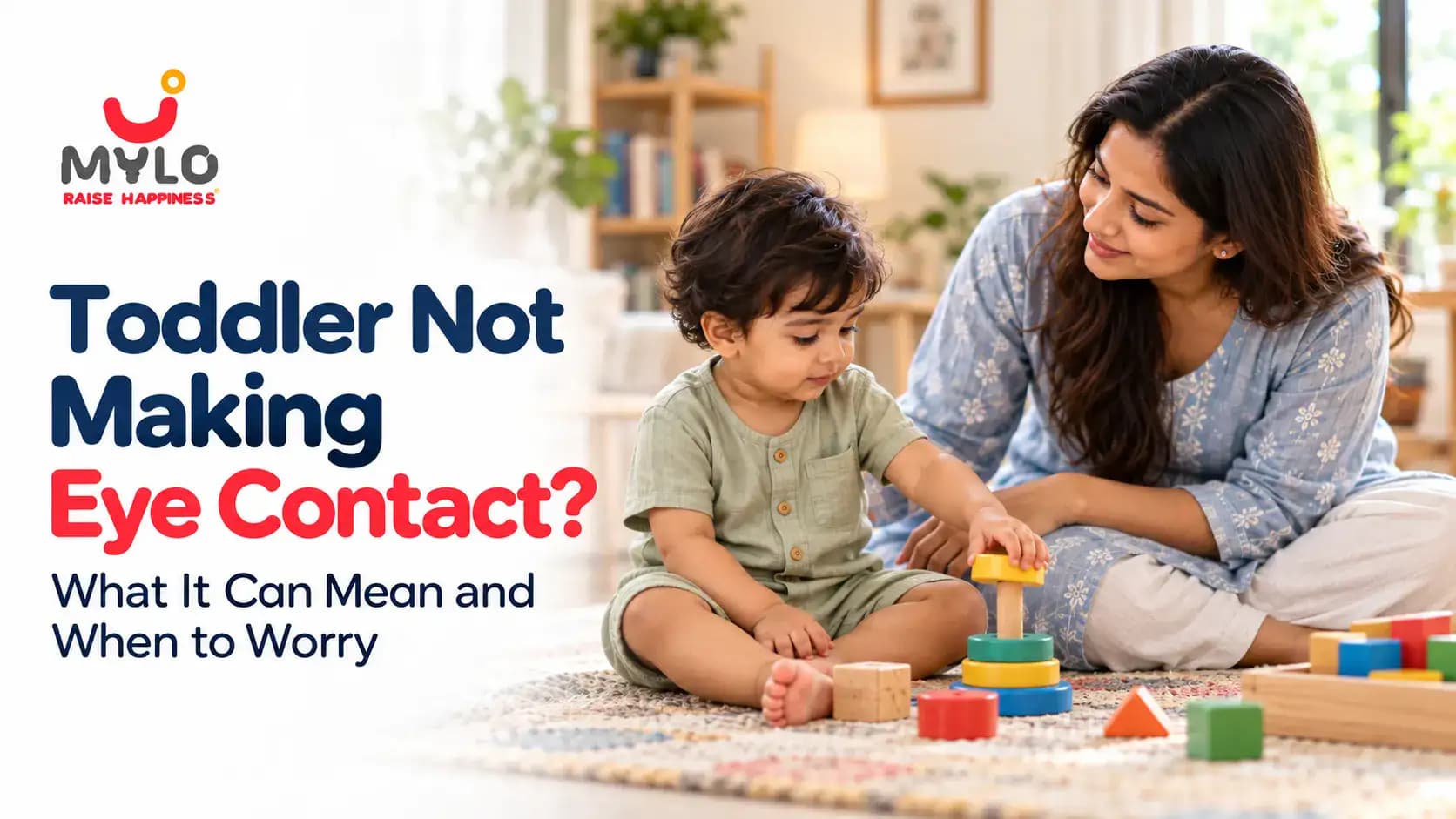
Toddler Not Making Eye Contact? What It Can Mean and When to Worry (2026)
 16 min
Quick Answer
A toddler who avoids eye contact isn't always autistic. Shyness, tiredness, hearing or vision problems and speech delay can also play a part. What matters is the pattern: see a doctor if poor eye contact comes with no pointing, not responding to their name, few words or lost skills.
What Can Poor Eye Contact Mean? At a Glance
Possible Reason | Other Signs You May Notice | How Common |
|---|---|---|
Shyness or a cautious temperament | Looks at you, but avoids strangers; warms up with time | Very common |
Tired, busy or overstimulated | Looks away during play or in crowds, but connects at calm times | Very common |
Vision problem (e.g. squint) | Eyes turn in or out, squints, tilts head, sits close to the TV | Less common |
Hearing problem | Doesn't respond to sounds or name, speech delay | Less common |
Speech or language delay | Few words, but may still point and share interest | Common |
Sensory sensitivities | Strong reactions to noise, touch or busy places | Less common |
Autism spectrum disorder | No pointing, no response to name, little shared interest, repetitive behaviours | Less common, needs assessment |
Poor eye contact alone is not enough to diagnose any condition. Doctors look at the whole picture.
Key Facts Every Parent Should Know
Eye contact alone doesn't mean autism: Many toddlers look away when shy, tired or busy playing
Patterns matter: Doctors look at eye contact together with pointing, responding to name, sharing interest, words and play
Early research: A Nature study found that attention to eyes declines between 2 and 6 months in some infants later diagnosed with autism, which is why early checks matter
18 and 24 months: When the AAP recommends autism screening for all children
Hearing and vision checks are an important first step
Never force eye contact: It can make toddlers more uncomfortable
How Much Eye Contact Is Normal for a Toddler?
Short answer: Toddlers don't stare at your eyes all the time. They naturally look at your face when talking, sharing something exciting, asking for help or during games like peekaboo, then look away while playing or exploring. What matters is that they connect with you through their eyes at key moments.
Normal Toddler Eye Contact | May Need Attention |
|---|---|
Looks at you when you call their name (most of the time) | Rarely looks up when called |
Looks at your face during games, songs and cuddles | Avoids faces even with familiar people |
Looks from a toy to you to "share" excitement | Doesn't look between objects and people |
Looks away when shy, busy or tired | Avoids eye contact in all situations |
Checks your face in new situations | Doesn't look to you for reassurance |
For babies, see when do babies make eye contact.
Does Poor Eye Contact Mean My Toddler Has Autism?
Short answer: Not on its own. Limited eye contact can be an early sign of autism, but many toddlers with limited eye contact don't have autism. Doctors look for a pattern of social communication differences, not a single sign (Cleveland Clinic).
Signs That Together May Suggest Autism
Social Communication | Behaviour and Play |
|---|---|
Limited or unusual eye contact | Repetitive movements (hand-flapping, spinning, rocking) |
Doesn't respond to their name by about 12 months | Lines up toys or plays the same way repeatedly |
Doesn't point to show interest by 15 to 18 months | Strong, unusual interest in parts of objects (wheels, fans) |
Doesn't bring objects to show you | Gets very upset by small changes in routine |
Few gestures (waving, nodding) | Unusual reactions to sounds, textures, lights or smells |
Little interest in other children | Little or no pretend play by 2 to 3 years |
Loses words or social skills | Walks on tiptoes a lot |
Based on signs described by the CDC and the UNC Autism Research Center.
If you notice several of these, talk to your pediatrician. Early support helps children communicate and connect, whatever the cause.
What Else Can Cause Poor Eye Contact in Toddlers?
Short answer: Common non-autism causes include shyness, tiredness, overstimulation, vision or hearing problems, speech delay, sensory sensitivities and less face-to-face interaction, for example when screen time is high.
Cause | What to Look For | What Helps |
|---|---|---|
Shyness | Connects with family, avoids new people | Give time to warm up; don't force |
Tiredness or overstimulation | Worse when sleepy, hungry or in crowds | Try connecting during calm moments |
Vision problems | Squinting, eyes not aligned, head tilting, rubbing eyes | Eye check with a pediatric eye specialist |
Hearing problems | Doesn't turn to sounds or name, speech delay, frequent ear infections | Hearing test (audiologist) |
Speech and language delay | Few words, but may still point and play | Speech assessment |
Sensory sensitivities | Overwhelmed by noise, touch or busy places | |
Less face-to-face time | Lots of screen time, little play together | More talking, singing and playing face to face |
Family and cultural habits | Some children are taught to lower their eyes with elders | Usually normal if they connect in other ways |
How Can I Check My Toddler's Eye Contact at Home?
Short answer: Watch your toddler during calm, happy moments over a few days. Notice whether they look at you when called, during games, when excited, or when they need help.
Try This | What to Notice |
|---|---|
Call their name from behind (when they're not too busy) | Do they turn and look at you? |
Play peekaboo | Do they look at your face and laugh? |
Hold a favourite toy near your eyes | Do they look at the toy and then your face? |
Point at something interesting | Do they look where you point? |
Blow bubbles, then pause | Do they look at you to ask for more? |
Sing a favourite rhyme, then stop | Do they look at you or gesture to continue? |
Tip: Make short notes or videos to show your doctor. They help the doctor see what happens at home.
How Can I Encourage My Toddler to Make Eye Contact?
Short answer: Don't force eye contact. Instead, make faces fun and easy to look at. Get down to your toddler's level, play face-to-face games, hold toys near your eyes and pause to give them a chance to look at you.
Tip | Example |
|---|---|
Get to their eye level | Sit or lie on the floor face to face |
Hold toys near your face | Bring a ball up to your eyes before giving it |
Play face games | Peekaboo, funny faces, "Where's my nose?" |
Sing and pause | Stop mid-song and wait for them to look at you |
Follow their interest | Join their play instead of redirecting |
Use their name, then wait | Give them time to respond |
Limit screens | More face-to-face play, less passive watching |
Praise connection gently | Smile and respond warmly when they look at you |
Avoid: Holding their face, saying "Look at me!" repeatedly, or scolding. Forcing eye contact can make toddlers more anxious.
When Should I See a Doctor About Eye Contact?
Short answer: See your pediatrician if poor eye contact continues and comes with any other signs, like not responding to their name, not pointing, few words or gestures, little interest in people, repetitive behaviours or loss of skills. Ask for hearing and vision checks too.
Age | Talk to Your Doctor If Your Toddler |
|---|---|
Any age | Loses words, eye contact or social skills they had (see a doctor soon) |
12 months | Rarely makes eye contact, doesn't respond to name, no babbling or gestures |
15 to 18 months | Doesn't point to share interest, doesn't look where you point, few or no words |
2 years | Little eye contact with family, no 2-word phrases, little interest in other children |
3 years | Avoids eye contact in most situations, little pretend play, doesn't join others in play |
What Will the Doctor Do?
Check | Why |
|---|---|
Ask about development and behaviour | To look at the full picture |
Autism screening (M-CHAT) | Recommended for all children at 18 and 24 months (AAP) |
Hearing test | Hearing loss can affect eye contact and speech |
Eye check | To check for squint or vision problems |
Referral if needed | Developmental pediatrician, child psychologist, speech therapist or occupational therapist |
A screening isn't a diagnosis. If the screening shows concerns, it means your child needs a closer look.
Free Support in India
Free developmental screening and early intervention (speech therapy, occupational therapy and more) are available at District Early Intervention Centres (DEIC) under Rashtriya Bal Swasthya Karyakram (RBSK). Ask your pediatrician, ASHA or Anganwadi worker.
What Should Indian Parents Keep in Mind?
Short answer: Don't ignore persistent poor eye contact, but don't panic either. Check hearing and vision, limit screens, play face to face, and ask for a developmental check if other signs are present.
Common Belief | Better Approach |
|---|---|
"He's just shy, he'll grow out of it" | Often true, but check if other signs are present |
"Boys develop late, no need to worry" | Any child with several warning signs should be checked |
"Too much screen time causes autism" | Screens don't cause autism, but heavy screen use can reduce face-to-face interaction |
"Forcing eye contact will fix it" | Forcing makes it harder; make faces fun instead |
Waiting until school age | Early checks and support work best |
Worrying about what relatives will say | Your child's needs come first |
Myths vs Facts
Myth | Fact |
|---|---|
"No eye contact always means autism" | Poor eye contact alone isn't a diagnosis; doctors look for a pattern |
"Autistic children never make eye contact" | Many autistic children do make some eye contact |
"If my child looks at me sometimes, there's no need to check" | If other signs are present, a check is still helpful |
"Screens cause autism" | Screens don't cause autism, though they can reduce social interaction |
"Early checks will label my child" | Early checks help your child get support sooner |
"Forcing eye contact teaches good manners" | It can cause stress; gentle encouragement works better |
FAQs: Toddler Not Making Eye Contact
What does it mean if my toddler doesn't make eye contact?
It can mean shyness, tiredness, overstimulation, a hearing or vision problem, speech delay, sensory sensitivities or, sometimes, autism. Doctors look at the whole pattern.
Bachcha aankh milakar nahi dekhta, kya matlab hai? (Hinglish)
Iska matlab hamesha autism nahi hota. Sharmilapan, thakaan, zyada bheed-bhaad, sunne ya dekhne mein dikkat, ya der se bolna bhi karan ho sakte hain. Agar bachcha naam pukarne par nahi dekhta, ishaara nahi karta, bahut kam bolta hai ya seekhi hui cheezein bhoolne lagta hai, toh doctor se zaroor milein.
Is poor eye contact a sign of autism?
It can be one early sign, but not on its own. Autism is considered when several social communication and behaviour signs appear together.
At what age should a toddler make eye contact?
Babies usually start making eye contact in the first 2 to 3 months. Toddlers should look at familiar people during play, talking and games.
Can hearing problems affect eye contact?
Yes. A toddler who can't hear well may not turn when called or look at speakers. A hearing test is an important first step.
Can too much screen time affect eye contact?
Heavy screen time can reduce face-to-face interaction. Screens don't cause autism, but more play together helps.
Should I force my toddler to look at me?
No. Make faces fun, get to their level, and hold toys near your eyes instead.
Mere 2 saal ke bachche ka eye contact kam hai, kya karein? (Hinglish)
Zabardasti aankh milane ko na kahein. Bachche ke level par baithkar khelein, khilona apni aankhon ke paas rakhkar dein, gaana gaate hue ruk kar intezaar karein aur mobile kam karein. Agar saath mein naam par jawab na dena, ishaara na karna ya kam bolna bhi hai, toh doctor se milein aur hearing aur eye check karwayein.
When should I worry about my toddler's eye contact?
If poor eye contact comes with not responding to their name, not pointing, few words, little interest in people, repetitive behaviours or lost skills, speak to your pediatrician.
Where can I get my toddler checked in India?
Start with your pediatrician. Free screening and early intervention are available at District Early Intervention Centres (DEIC) under RBSK.
Related Reads on Mylo
How Do I Know if My Toddler Has Sensory Processing Disorder?
Social and Emotional Milestones From 1 to 3 Years (link once live)
References
Jones W, Klin A. "Attention to Eyes Is Present but in Decline in 2 to 6-Month-Old Infants Later Diagnosed With Autism." Nature, 2013. https://www.nature.com/articles/nature12715
American Academy of Pediatrics (AAP). "How Pediatricians Screen for Autism." HealthyChildren.org. https://www.healthychildren.org/English/health-issues/conditions/Autism/Pages/How-Doctors-Screen-for-Autism.aspx
Cleveland Clinic. "Autism Spectrum Disorder (ASD): Symptoms and Causes." https://my.clevelandclinic.org/health/articles/autism
UNC Autism Research Center. "Autism: Definition and Signs." https://autism.unc.edu/resources/autism-definition-and-signs/
Centers for Disease Control and Prevention (CDC). "Signs and Symptoms of Autism Spectrum Disorder." https://www.cdc.gov/autism/signs-symptoms/index.html
Medical Disclaimer
This article is for information only and does not replace professional medical advice or diagnosis. Poor eye contact can have many causes. If you're concerned about your child's eye contact, communication or development, please consult your pediatrician.


Shop Now
More Face-to-Face Time, Less Daily Fuss





Article Posted Under
Related Articles


Related Topics
.webp&w=32&q=75)
Medical Disclaimer
This content is for informational purposes only and should not replace professional medical advice. Consult with a physician or other health care professional if you have any concerns or questions about your health. If you rely on the information provided here, you do so solely at your own risk.


AWARDS AND RECOGNITION

Mylo wins Forbes D2C Disruptor award

Mylo wins The Economic Times Promising Brands 2022
AS SEEN IN













- Mylo Care: Effective and science-backed personal care and wellness solutions for a joyful you.
- Mylo Baby: Science-backed, gentle and effective personal care & hygiene range for your little one.
- Mylo Community: Trusted and empathetic community of 10mn+ parents and experts.


Product Categories
Baby Carrier | Baby Soap | Baby Wipes | Stretch Marks Cream | Baby Cream | Baby Shampoo | Baby Massage Oil | Baby Hair Oil | Stretch Marks Oil | Baby Body Wash | Baby Powder | Baby Lotion | Diaper Rash Cream | Newborn Diapers | Teether | Baby Kajal | Baby Diapers Pants | Cloth Diapers | Laundry Detergent | Lactation Granules |