


Orders
.png&w=48&q=75 "login")
Profile


Wallet

Toddler Growth Chart: Height and Weight From 1 to 3 Years for Boys and Girls (WHO Standards, 2026)
 18 min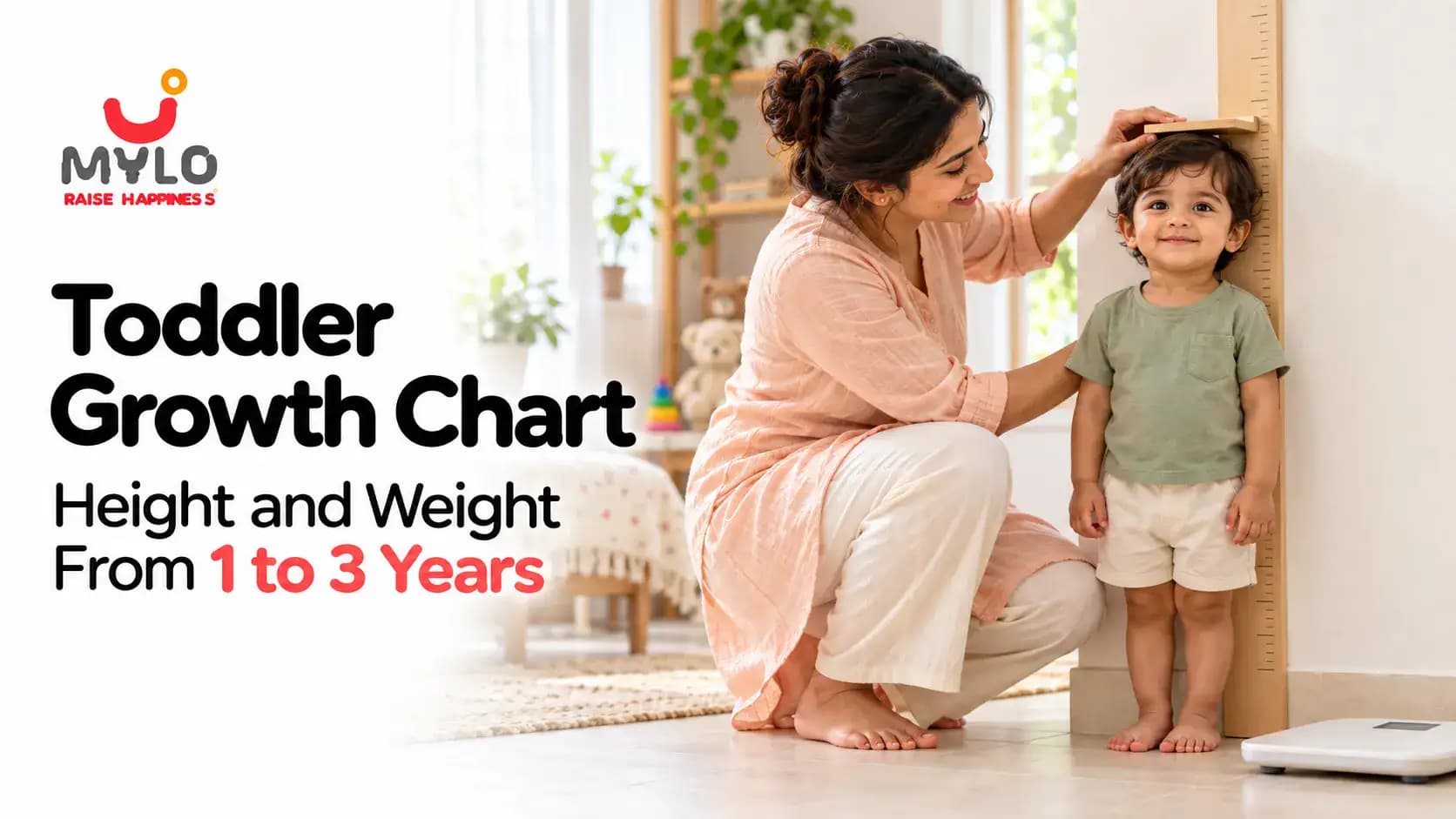
Quick Answer
At 1 year, the average boy weighs about 9.6 kg and is 75.7 cm long; the average girl weighs 8.9 kg and is 74 cm. By 3 years, boys average 14.3 kg and 96.1 cm, and girls 13.9 kg and 95.1 cm. Anything between the 3rd and 97th percentile is usually normal. Steady growth matters most.
Toddler Height and Weight at a Glance (WHO Averages)
Age | Boys: Weight | Boys: Height | Girls: Weight | Girls: Height |
|---|---|---|---|---|
1 year (12 months) | 9.6 kg | 75.7 cm | 8.9 kg | 74.0 cm |
1.5 years (18 months) | 10.9 kg | 82.3 cm | 10.2 kg | 80.7 cm |
2 years (24 months) | 12.2 kg | 87.1 cm* | 11.5 kg | 85.7 cm* |
2.5 years (30 months) | 13.3 kg | 91.9 cm | 12.7 kg | 90.7 cm |
3 years (36 months) | 14.3 kg | 96.1 cm | 13.9 kg | 95.1 cm |
*Averages are the WHO 50th percentile. From 2 years, height is measured standing, which reads about 0.7 cm less than lying-down length. Source: WHO Child Growth Standards.
Key Facts Every Parent Should Know
India uses WHO charts for children under 5: The Indian Academy of Pediatrics and the Government of India use WHO standards for growth assessment under 5 years (IAP)
About 2.5 kg and 12 cm: The typical weight and height gain between 1 and 2 years (WHO averages)
About 2 kg and 9 cm: The typical gain between 2 and 3 years
3rd to 97th percentile: The range where most healthy children fall
Growth slows after age 1: So appetite often drops too, which is normal
The trend matters more than one reading: Doctors look at whether your child follows their own curve
What Is the Growth Chart for Boys From 1 to 3 Years?
Short answer: Most healthy boys aged 1 to 3 years fall between the 3rd and 97th percentile. At 1 year, that's about 7.8 to 11.8 kg and 71 to 80 cm. At 3 years, it's about 11.4 to 18.0 kg and 89 to 103 cm.
Boys: Weight and Height by Age (WHO)
Age | Weight 3rd % | Weight 50th % (Average) | Weight 97th % | Height 3rd % | Height 50th % (Average) | Height 97th % |
|---|---|---|---|---|---|---|
12 months | 7.8 kg | 9.6 kg | 11.8 kg | 71.3 cm | 75.7 cm | 80.2 cm |
15 months | 8.4 kg | 10.3 kg | 12.7 kg | 74.4 cm | 79.1 cm | 83.9 cm |
18 months | 8.9 kg | 10.9 kg | 13.5 kg | 77.2 cm | 82.3 cm | 87.3 cm |
21 months | 9.3 kg | 11.5 kg | 14.3 kg | 79.7 cm | 85.1 cm | 90.5 cm |
24 months | 9.8 kg | 12.2 kg | 15.1 kg | 81.4 cm | 87.1 cm | 92.9 cm |
27 months | 10.2 kg | 12.7 kg | 15.9 kg | 83.5 cm | 89.6 cm | 95.7 cm |
30 months | 10.7 kg | 13.3 kg | 16.6 kg | 85.5 cm | 91.9 cm | 98.3 cm |
33 months | 11.1 kg | 13.8 kg | 17.3 kg | 87.4 cm | 94.1 cm | 100.8 cm |
36 months | 11.4 kg | 14.3 kg | 18.0 kg | 89.1 cm | 96.1 cm | 103.1 cm |
Sources: WHO weight-for-age (boys), length-for-age (boys, 0 to 2 years) and height-for-age (boys, 2 to 5 years). Height up to 21 months is lying-down length; from 24 months it's standing height.
What Is the Growth Chart for Girls From 1 to 3 Years?
Short answer: Most healthy girls aged 1 to 3 years fall between the 3rd and 97th percentile. At 1 year, that's about 7.1 to 11.3 kg and 69 to 79 cm. At 3 years, it's about 11.0 to 17.8 kg and 88 to 102 cm.
Girls: Weight and Height by Age (WHO)
Age | Weight 3rd % | Weight 50th % (Average) | Weight 97th % | Height 3rd % | Height 50th % (Average) | Height 97th % |
|---|---|---|---|---|---|---|
12 months | 7.1 kg | 8.9 kg | 11.3 kg | 69.2 cm | 74.0 cm | 78.9 cm |
15 months | 7.7 kg | 9.6 kg | 12.2 kg | 72.4 cm | 77.5 cm | 82.7 cm |
18 months | 8.2 kg | 10.2 kg | 13.0 kg | 75.2 cm | 80.7 cm | 86.2 cm |
21 months | 8.7 kg | 10.9 kg | 13.8 kg | 77.9 cm | 83.7 cm | 89.4 cm |
24 months | 9.2 kg | 11.5 kg | 14.6 kg | 79.6 cm | 85.7 cm | 91.8 cm |
27 months | 9.6 kg | 12.1 kg | 15.4 kg | 81.9 cm | 88.3 cm | 94.6 cm |
30 months | 10.1 kg | 12.7 kg | 16.2 kg | 84.0 cm | 90.7 cm | 97.3 cm |
33 months | 10.5 kg | 13.3 kg | 17.0 kg | 86.0 cm | 92.9 cm | 99.8 cm |
36 months | 11.0 kg | 13.9 kg | 17.8 kg | 87.9 cm | 95.1 cm | 102.2 cm |
Sources: WHO weight-for-age (girls), length-for-age (girls, 0 to 2 years) and height-for-age (girls, 2 to 5 years).
Need month-by-month values for a girl aged 2 to 3? See our girls' growth chart for 24 to 36 months.
How Do I Read a Growth Chart Percentile?
Short answer: A percentile compares your child with 100 healthy children of the same age and sex. 50th percentile means average. 25th percentile means your child is heavier or taller than 25 children and lighter or shorter than 75. Anywhere from the 3rd to the 97th percentile is usually normal.
Percentile | What It Means |
|---|---|
Below 3rd | Smaller than 97 out of 100 children. Talk to your doctor. |
3rd to 15th | On the smaller side, usually normal if growth is steady |
15th to 85th | Typical range |
85th to 97th | On the bigger side, usually normal if growth is steady |
Above 97th | Bigger than 97 out of 100 children. Talk to your doctor. |
A low or high percentile isn't a problem on its own. A child who stays on the 10th percentile, growing steadily, is often perfectly healthy. Small parents often have small children.
How Much Should a Toddler Grow Each Year?
Short answer: Growth slows after the first birthday. Between 1 and 2 years, toddlers usually gain about 2.5 kg and grow about 12 cm. Between 2 and 3 years, they gain about 2 kg and grow about 9 cm.
Period | Average Weight Gain | Average Height Gain |
|---|---|---|
Birth to 1 year | About 6 kg (weight roughly triples) | About 25 cm |
1 to 2 years | About 2.5 kg | About 12 cm |
2 to 3 years | About 2 kg | About 9 cm |
Calculated from WHO average (50th percentile) values.
Why is my toddler eating less? Because growth slows after age 1, appetite naturally drops too. Read our guide on picky eating and food refusal in toddlers.
How Do I Measure My Toddler at Home?
Short answer: Weigh your toddler on the same scale each time (weigh yourself holding them, then subtract your weight). Measure height lying down until age 2 and standing from age 2, without shoes, against a wall.
Measurement | How to Do It |
|---|---|
Weight | Weigh yourself, then weigh yourself holding your child. Subtract the two. Use the same scale and similar clothing each time. |
Length (under 2) | Lay your child flat, head touching a wall, legs straight. Mark the heel and measure. |
Height (2 and older) | Stand your child against a wall, barefoot, heels together, looking straight ahead. Place a book flat on their head and mark. |
How often | Monthly is plenty. Weekly readings can be confusing. |
For accurate tracking, use the measurements from your pediatrician or Anganwadi visits. In India, the Mother and Child Protection (MCP) card given at Anganwadis includes a growth chart.
What Affects a Toddler's Height and Weight?
Short answer: Genes (parents' height), nutrition, illness, sleep, birth weight or prematurity and activity all affect growth. Short-term dips during illness are common and usually catch up.
Factor | How It Affects Growth |
|---|---|
Parents' height and build | The biggest factor for height |
Nutrition | Enough calories, protein, iron, calcium and vitamin D are needed |
Frequent illness or diarrhoea | Can slow weight gain temporarily |
Worms | Can reduce appetite and nutrient absorption (worms in toddlers) |
Prematurity or low birth weight | Use corrected age until 2; many catch up by 2 to 3 years |
Too much milk | Can reduce appetite for food and lower iron |
Sleep | Growth hormone is released during deep sleep |
Medical conditions | Thyroid, gut or heart problems can affect growth (rare) |
When Should I Worry About My Toddler's Growth?
Short answer: Talk to your doctor if your child is below the 3rd or above the 97th percentile, drops across 2 major percentile lines (for example from the 50th to below the 15th), hasn't gained weight for 2 to 3 months, or is losing weight.
Red Flag | Why It Matters |
|---|---|
Below the 3rd percentile for weight or height | May point to undernutrition or a medical condition |
Above the 97th percentile for weight | May point to overweight |
Crossing 2 major percentile lines downward | Growth faltering, needs a check |
No weight gain for 2 to 3 months | Could relate to diet, illness or worms |
Weight loss | Always needs a check |
Height falling behind while weight is normal | Doctors check for hormone or other causes |
Very fast weight gain | Can lead to obesity later |
Underweight, Stunting and Wasting: What Do They Mean?
Term | What It Means |
|---|---|
Underweight | Low weight for age |
Stunting | Low height for age, a sign of long-term undernutrition |
Wasting | Low weight for height, a sign of recent weight loss or acute undernutrition |
Overweight | High weight for height |
These are common concerns for Indian children, which is why regular growth monitoring at check-ups and Anganwadis matters. If your child is underweight, read what to do if your toddler is underweight.
How Can I Support Healthy Growth?
Short answer: Offer 3 meals and 2 snacks of varied home food, keep milk to about 300 to 500 ml a day, include iron and protein, ensure enough sleep, deworm every 6 months and keep up with check-ups and vaccines.
Habit | Why It Helps |
|---|---|
Varied home food: dal, roti, rice, vegetables, fruit, curd, eggs, paneer | Balanced nutrition |
Iron-rich foods: ragi, dal, spinach, eggs, rajma | Prevents anaemia, supports growth |
Milk 300 to 500 ml a day | Enough calcium without crowding out food |
Limit sugar and junk food | Avoids empty calories and poor appetite |
11 to 14 hours of sleep (1 to 2 years) | Supports growth hormone |
Deworming every 6 months | Prevents nutrient loss |
Active play every day | Builds strength and healthy appetite |
Regular growth checks | Catches problems early |
What Should Indian Parents Keep in Mind?
Short answer: Use WHO charts (as IAP recommends), track the trend rather than single numbers, don't compare with cousins, and use free Anganwadi growth monitoring.
Common Belief | Better Approach |
|---|---|
"A chubby baby is a healthy baby" | Steady growth within the normal range matters, not chubbiness |
"She's small, so give her a health drink" | Talk to your doctor; real food is better than sugary drinks |
"Our cousin's child is much bigger" | Compare with growth charts, not other children |
Weighing the child every week | Monthly readings are enough |
"He doesn't eat, so he must be underweight" | Check the chart first; many picky eaters grow normally |
Ignoring a percentile drop | Talk to your doctor if your child crosses 2 percentile lines |
Myths vs Facts
Myth | Fact |
|---|---|
"The 50th percentile is the target" | Anywhere from the 3rd to 97th percentile is usually normal |
"Indian children need different charts under 5" | IAP and the Government of India use WHO charts under 5 (IAP) |
"Bigger is always healthier" | Steady growth along a curve is what matters |
"A drop in appetite means a growth problem" | Growth slows after 1, so appetite naturally drops |
"One low reading means my child is underweight" | Doctors look at the trend over several readings |
"Tonics make toddlers grow taller" | Height depends mostly on genes, nutrition and sleep |
FAQs: Toddler Growth Chart 1 to 3 Years
What is the average weight of a 1-year-old?
About 9.6 kg for boys and 8.9 kg for girls (WHO 50th percentile). Most healthy 1-year-olds weigh between about 7 and 12 kg.
What is the average weight of a 2-year-old?
About 12.2 kg for boys and 11.5 kg for girls.
What is the average weight of a 3-year-old?
About 14.3 kg for boys and 13.9 kg for girls.
What is the average height of a 2-year-old?
About 87 cm for boys and 86 cm for girls (standing height).
1.5 saal ke bachche ka weight kitna hona chahiye? (Hinglish)
WHO ke anusaar 1.5 saal (18 mahine) ke ladke ka average weight lagbhag 10.9 kg aur ladki ka 10.2 kg hota hai. Ladkon ke liye 8.9 se 13.5 kg aur ladkiyon ke liye 8.2 se 13 kg ke beech weight aam taur par normal maana jaata hai.
2 saal ke bachche ki lambai kitni honi chahiye? (Hinglish)
2 saal ke ladke ki average lambai lagbhag 87 cm aur ladki ki lagbhag 86 cm hoti hai. Ladkon ke liye 81 se 93 cm aur ladkiyon ke liye 80 se 92 cm normal range hai.
How much weight should a toddler gain per year?
About 2.5 kg between 1 and 2 years, and about 2 kg between 2 and 3 years.
What percentile is normal for a toddler?
Anywhere between the 3rd and 97th percentile is usually normal, as long as growth is steady.
Does India use WHO growth charts?
Yes. IAP and the Government of India use WHO growth standards for children under 5.
When should I worry about my toddler's weight?
If your child is below the 3rd or above the 97th percentile, drops across 2 percentile lines, hasn't gained weight for 2 to 3 months, or is losing weight, see your doctor.
Related Reads on Mylo
References
World Health Organization (WHO). "Weight-for-Age: Child Growth Standards." https://www.who.int/tools/child-growth-standards/standards/weight-for-age
World Health Organization (WHO). "Length/Height-for-Age: Child Growth Standards." https://www.who.int/tools/child-growth-standards/standards/length-height-for-age
WHO. "Weight-for-Age Boys, Birth to 5 Years (Percentiles)." https://cdn.who.int/media/docs/default-source/child-growth/child-growth-standards/indicators/weight-for-age/wfa-boys-0-5-percentiles.pdf?sfvrsn=488e74e6_11
WHO. "Weight-for-Age Girls, Birth to 5 Years (Percentiles)." https://cdn.who.int/media/docs/default-source/child-growth/child-growth-standards/indicators/weight-for-age/wfa-girls-0-5-percentiles.pdf?sfvrsn=1a008a84_11
WHO. "Length-for-Age Boys, Birth to 2 Years (Percentiles)." https://cdn.who.int/media/docs/default-source/child-growth/child-growth-standards/indicators/length-height-for-age/lfa-boys-0-2-percentiles.pdf?sfvrsn=6fef3f25_7
WHO. "Length-for-Age Girls, Birth to 2 Years (Percentiles)." https://cdn.who.int/media/docs/default-source/child-growth/child-growth-standards/indicators/length-height-for-age/lfa-girls-0-2-percentiles.pdf?sfvrsn=d5f0d7c1_5
WHO. "Height-for-Age Boys, 2 to 5 Years (Percentiles)." https://cdn.who.int/media/docs/default-source/child-growth/child-growth-standards/indicators/length-height-for-age/hfa-boys-2-5-percentiles.pdf?sfvrsn=c5967382_7
WHO. "Height-for-Age Girls, 2 to 5 Years (Percentiles)." https://cdn.who.int/media/docs/default-source/child-growth/child-growth-standards/indicators/length-height-for-age/hfa-girls-2-5-percentiles.pdf?sfvrsn=adc3b954_7
Indian Academy of Pediatrics. "Revised IAP Growth Charts for Height, Weight and Body Mass Index for 5- to 18-Year-Old Indian Children" (2015). Indian Pediatrics. https://indianpediatrics.net/jan2015/jan-47-55.htm
Medical Disclaimer
This article is for information only and does not replace professional medical advice. Growth charts are a guide. Please talk to your pediatrician about your child's individual growth, especially if you notice a drop across percentile lines or no weight gain.


Shop Now
Growing Fast? Match the Diaper to the Weight





Article Posted Under
Related Articles



Related Topics
.webp&w=32&q=75)
Medical Disclaimer
This content is for informational purposes only and should not replace professional medical advice. Consult with a physician or other health care professional if you have any concerns or questions about your health. If you rely on the information provided here, you do so solely at your own risk.


AWARDS AND RECOGNITION

Mylo wins Forbes D2C Disruptor award

Mylo wins The Economic Times Promising Brands 2022
AS SEEN IN













- Mylo Care: Effective and science-backed personal care and wellness solutions for a joyful you.
- Mylo Baby: Science-backed, gentle and effective personal care & hygiene range for your little one.
- Mylo Community: Trusted and empathetic community of 10mn+ parents and experts.


Product Categories
Baby Carrier | Baby Soap | Baby Wipes | Stretch Marks Cream | Baby Cream | Baby Shampoo | Baby Massage Oil | Baby Hair Oil | Stretch Marks Oil | Baby Body Wash | Baby Powder | Baby Lotion | Diaper Rash Cream | Newborn Diapers | Teether | Baby Kajal | Baby Diapers Pants | Cloth Diapers | Laundry Detergent | Lactation Granules |