


Orders
.png&w=48&q=75 "login")
Profile


Wallet

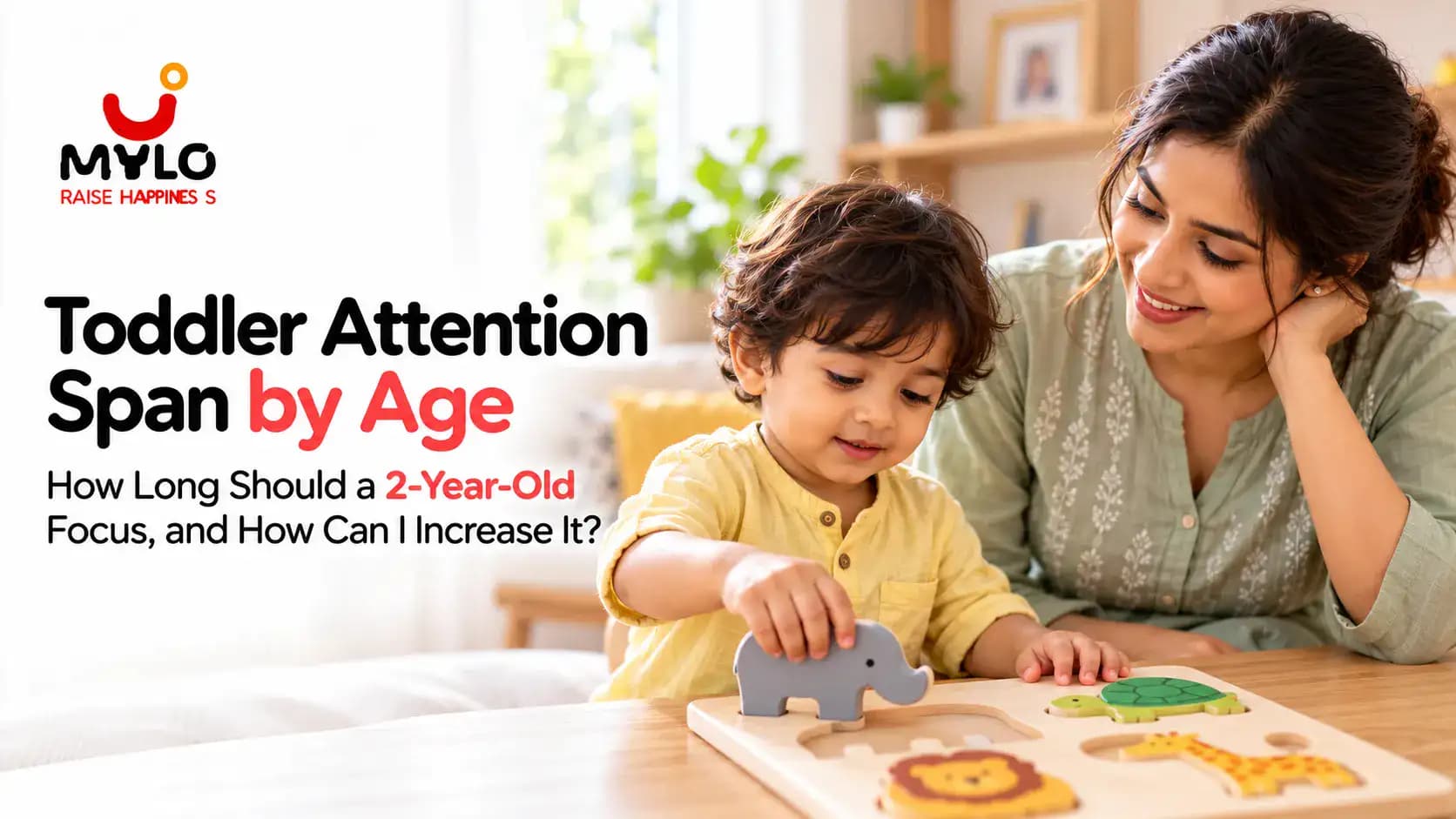
Toddler Attention Span by Age: How Long Should a 2-Year-Old Focus, and How Can I Increase It? A Guide for Indian Parents (2026)
 18 min
Quick Answer
A toddler's attention span is how long they can focus on one activity. A common rule of thumb is about 2 to 3 minutes for every year of age: roughly 4 to 6 minutes at 2 years and 6 to 9 minutes at 3. Toddlers focus much longer on things they love. Short focus is normal.
Toddler Attention Span by Age (Chart)
Age | Typical Attention Span on One Activity | What It Looks Like | Talk to a Doctor If |
|---|---|---|---|
12 months | 1 to 3 minutes (longer with a favourite toy) | Moves quickly from toy to toy, loves exploring | Doesn't look at or play with toys even briefly |
18 months | 2 to 4 minutes | Plays with one toy for a short while, gets distracted easily | Doesn't respond to their name or show interest in people |
2 years | 4 to 6 minutes | Listens to a short board book, stacks blocks, then moves on | Can't focus on any toy or activity, even ones they like |
2.5 years | 5 to 7 minutes | Does a simple puzzle, plays pretend for a few minutes | Very restless all the time, much more than other toddlers |
3 years | 6 to 9 minutes | Sits for a short story, plays with dough or blocks | Can't sit for even a very short story, along with other delays |
These are rule-of-thumb ranges, not strict limits. Toddlers often focus for 10 to 15 minutes or more on something they love, and for much less on something an adult chooses.
After 3 years: Most 4-year-olds focus for about 8 to 12 minutes, and 5-year-olds for about 10 to 15 minutes on one task.
Key Facts Every Parent Should Know
Short is normal: Toddlers are built to explore, so moving quickly from one thing to the next is healthy
Rule of thumb: About 2 to 3 minutes of focus for every year of age
Interest matters: Toddlers focus much longer on things they choose and enjoy
Screens: The WHO advises no screen time for children under 2, and no more than 1 hour a day for 2 to 4 year olds
ADHD is rarely diagnosed before 4: A short attention span, high energy and tantrums are normal in toddlers
Sleep affects focus: Toddlers aged 1 to 2 need 11 to 14 hours of sleep a day, and 3-year-olds need 10 to 13 hours (WHO)
What Is a Normal Attention Span for a Toddler?
Short answer: A normal toddler attention span is short: just a few minutes on most activities. Attention grows slowly as the brain develops, and most of the big gains come after age 3.
Things that change how long your toddler can focus:
Makes Focus Longer | Makes Focus Shorter |
|---|---|
An activity your toddler chose | An activity an adult chose |
Being well rested and fed | Being tired, hungry or unwell |
A calm, quiet room | A noisy room with the TV on |
A few toys out at a time | Lots of toys scattered everywhere |
You playing alongside | Being left alone with the activity |
How Long Is the Attention Span of a 2-Year-Old?
Short answer: Most 2-year-olds focus on one activity for about 4 to 6 minutes. They may play with a favourite toy for 10 minutes or more, but lose interest in a "learning" task within a minute or two.
What a 2-year-old can usually focus on:
A short board book read together
Stacking blocks or nesting cups
Pushing a toy car or pulling a toy along
Short action rhymes and songs
Scribbling for a few minutes
What a 2-year-old usually can't do yet:
Sit through a 20-minute class or puja without moving
Finish a long story
Do worksheets or tracing
Stay seated through a long family meal
Boys and girls: Both develop attention at roughly the same pace. Some boys are more physically active, but a 2-year-old boy should not be expected to sit still for longer or shorter than a girl.
How Long Is the Attention Span of a 3-Year-Old?
Short answer: Most 3-year-olds focus for about 6 to 9 minutes on one activity. They can sit for a short story, play pretend, or do a simple puzzle, especially if an adult joins in.
What a 3-year-old can usually focus on:
A short picture book from start to finish
Pretend play (kitchen, doctor, shop) for several minutes
Simple puzzles with 4 to 12 pieces
Play dough, colouring or painting
Short circle time at playschool (about 5 to 10 minutes)
How to Increase Attention Span and Concentration in Toddlers: 10 Simple Ways
Short answer: Follow your toddler's interests, reduce distractions, play together, and build focus slowly with short, fun activities. Good sleep and less screen time also help a lot.
Follow their interest. Toddlers focus longest on what they choose. If your toddler loves cars, read car books and build roads.
Put out fewer toys. Keep 4 to 6 toys out and rotate the rest every week. Too many toys make toddlers jump from one to the next.
Turn off the background TV. Research shows a TV playing in the background shortens toddlers' play, even when they aren't watching it.
Play together. Sit on the floor and join in. Toddlers focus longer when an adult is engaged with them.
Start short and build slowly. Begin with 2 to 3 minutes, then add a minute at a time as your toddler grows.
Read together every day. Choose short books, point to pictures and let your toddler turn the pages.
Give one instruction at a time. "Pick up the ball" instead of "Pick up the ball, put it away and get your shoes".
Praise focus. "You built such a tall tower! You worked so hard on that."
Warn before changes. "Two more minutes, then bath time." This helps toddlers finish and move on calmly.
Protect sleep and active play. Tired toddlers can't focus. Running, climbing and outdoor play every day help them settle better for quiet activities.
Attention Span Activities for Toddlers
Age | Activities That Build Focus | Household Items to Use |
|---|---|---|
12 to 18 months | Posting toys into a box, stacking cups, filling and emptying containers, peek-a-boo | A shoebox with a slot, steel bowls, a basket |
18 months to 2 years | Board books, simple shape sorters, scribbling, water play | Board books, crayons, a tub of water and cups |
2 to 2.5 years | 2 to 4 piece puzzles, play dough, threading big beads, pretend cooking | Atta dough, big wooden beads, steel utensils |
2.5 to 3 years | Short stories, sorting by colour, simple matching games, building towers | Storybooks, coloured blocks, picture cards |
Fun Indian-style focus activities
Aate ki loi: Let your toddler roll and squeeze dough while you make rotis
Sorting rajma and moong: For toddlers near 3, sorting large dals into two bowls (with close supervision for choking)
Kitchen helper: Washing vegetables in a bowl of water or tearing coriander leaves
Rangoli dots: Pressing fingers in colour or chalk to make simple dots and lines
Story time with dadi-nani: Short, repeated stories with lots of expression
Bubble chasing and kite watching: Following one moving thing builds visual focus
Can Screens Affect My Toddler's Attention Span?
Short answer: Yes, they can. Fast-moving cartoons and videos hold attention easily but don't build the toddler's own ability to focus. Studies have linked heavy screen time in the early years with attention problems later on.
Screen Habit | Better Choice |
|---|---|
Phone videos during every meal | Talk about the food, colours and the day |
TV on in the background all day | TV off unless someone is watching it |
Phone to calm every tantrum | Hug, name the feeling, and offer a calm activity |
Fast cartoons for hours | No screens under 2; up to 1 hour of slow, simple shows for 2 to 4 year olds, watched together |
Tablet in the car or restaurant | Small books, crayons or a simple toy |
My Toddler Can't Sit Still While Eating. Is That Normal?
Short answer: Yes, mostly. Toddlers usually manage to sit for about 10 to 15 minutes at a meal. Wanting to get up, play with food or eat on the move is very common at this age.
How to help:
Serve meals at a regular time, when your toddler is hungry but not overtired
Seat your toddler at the table or on a mat with the family
Keep meals short, about 15 to 20 minutes
Avoid phones and TV at mealtimes
Let your toddler feed themselves with their hands or a spoon
Don't chase your toddler around the house with food
Signs of ADHD in Toddlers: When Should I Worry?
Short answer: Most short attention spans in toddlers are normal. ADHD is rarely diagnosed before age 4, because high energy, impulsiveness and short focus are typical for toddlers. Talk to your doctor if your toddler's activity or attention is much more extreme than other children's, or comes with other delays.
Usually Normal Toddler Behaviour | Worth Discussing With Your Doctor |
|---|---|
Moves from toy to toy every few minutes | Can't focus on anything, even a favourite toy or show, for more than a few seconds |
Very active and loves to run and climb | So active that they often get hurt or are in danger, much more than other toddlers |
Can't sit still through a long meal or function | Can't sit for even 1 to 2 minutes for a book or a meal, by 3 years |
Has tantrums when tired or frustrated | Has very frequent, long tantrums along with other concerns |
Sometimes ignores you when busy playing | Often doesn't respond to their name at all |
Other red flags to check
Sign | What It Might Mean |
|---|---|
Doesn't respond to their name or to sounds | Possible hearing problem or autism; see your doctor |
Little eye contact, doesn't point or share interest | Possible autism; ask about a screening |
Loud snoring, restless sleep, very sleepy in the day | Poor sleep can cause poor focus; tell your doctor |
Speech delay along with short attention | A speech assessment may help |
Loses skills they had | See a doctor right away |
Important: Only a doctor can diagnose ADHD, usually after age 4. For young children with ADHD, the American Academy of Pediatrics (AAP) recommends parent training in behaviour management as the first step, before any medicine.
Who Can Help?
Professional | How They Help |
|---|---|
Pediatrician | First check-up, checks hearing, vision, sleep and overall development |
Developmental pediatrician | Assesses attention, behaviour and development |
Child psychologist | Assesses behaviour and teaches parents helpful strategies |
Speech and language therapist | Helps if speech delays affect attention and listening |
Occupational therapist | Helps with sensory needs and sitting for activities |
Free government support in India
Service | What It Offers |
|---|---|
Rashtriya Bal Swasthya Karyakram (RBSK) | Free screening for developmental delays |
District Early Intervention Centres (DEIC) | Free assessment, therapy and early intervention |
Anganwadi centres | Play-based early learning and referrals |
What Should Indian Parents Keep in Mind?
Short answer: A short attention span is part of being a toddler. Don't expect long sitting for classes, functions or worksheets, and replace screens with play and talk.
Common Practice | Better Approach |
|---|---|
Phone videos to make the toddler eat | Family meals without screens; let your toddler self-feed |
Expecting a 2-year-old to sit through a puja, shaadi or long function | Bring a small book or toy, and take short breaks outside |
Tuition or worksheets at 2 to 3 years | Short, playful activities your toddler enjoys |
Lots of toys out at once | 4 to 6 toys out, rotated weekly |
TV on all day in the background | TV off when no one is watching |
Labelling an active toddler as "naughty" or "ADHD" | Most toddlers are naturally active; talk to your doctor if you're worried |
Comparing with a cousin who "sits quietly" | Every toddler is different |
Myths vs Facts About Toddler Attention Span
Myth | Fact |
|---|---|
"A toddler who can't sit still has ADHD" | Short focus and high energy are normal in toddlers; ADHD is rarely diagnosed before 4 |
"Cartoons improve concentration" | Fast cartoons hold attention but don't build the toddler's own focus |
"My toddler watches TV for an hour, so their attention span is fine" | Screens grab attention; real focus is built through play and reading |
"More toys keep toddlers busy longer" | Fewer toys help toddlers focus longer on each one |
"Boys can never sit still" | Both boys and girls develop attention at a similar pace |
"Toddlers should sit for classes like school children" | Toddlers learn best through short, active play |
"Attention span is fixed from birth" | Attention grows with age, sleep, play and practice |
Frequently Asked Questions About Toddler Attention Span
What is the normal attention span of a toddler?
About 2 to 3 minutes for every year of age as a rough guide: about 4 to 6 minutes at 2 years and 6 to 9 minutes at 3. Toddlers focus longer on things they love.
What is the attention span of a 2-year-old?
Most 2-year-olds focus for about 4 to 6 minutes on one activity, and sometimes 10 minutes or more on a favourite toy.
What is the attention span of a 3-year-old?
Most 3-year-olds focus for about 6 to 9 minutes on one activity, like a short story or a simple puzzle.
How can I improve my toddler's attention span, focus and concentration?
Follow their interests, put out fewer toys, turn off background TV, play together, read daily, and build focus slowly with short activities. Good sleep and active play help too.
Bachche ka focus aur concentration kaise badhaye? (Hinglish)
Bachche ke pasand ke khel se shuru kariye, ek baar mein kam khilone dijiye, TV band rakhiye aur saath baith kar kheliye. Roz chhoti kahani padhiye. 2 saal ke bachche ka focus 4 se 6 minute tak rehna normal hai.
My toddler can't sit still. Is it ADHD?
Usually not. Toddlers are naturally active and move from one thing to another. ADHD is rarely diagnosed before 4. Talk to your doctor if your toddler's activity is extreme, dangerous, or comes with other delays.
Mera 2 saal ka bachcha ek jagah nahi baithta, kya yeh normal hai? (Hinglish)
Haan, yeh bilkul normal hai. 2 saal ke bachche kudrati taur par bahut active hote hain aur kuch hi minute ek cheez par dhyan dete hain. Agar bachcha naam pukarne par jawab nahi deta, bolne mein bahut peeche hai, ya kisi bhi cheez par dhyan nahi deta, toh doctor se baat karein.
Does screen time reduce attention span in toddlers?
Heavy screen time in the early years has been linked to attention problems later. The WHO advises no screens under 2 and no more than 1 hour a day for 2 to 4 year olds.
How long should a toddler sit at a meal?
About 10 to 15 minutes is typical for toddlers. Keep meals short, regular and screen-free.
When should I worry about my toddler's attention span?
If your toddler can't focus on anything even briefly, is extremely active to the point of danger, doesn't respond to their name, has speech delays, or loses skills, speak to your pediatrician.
Related Reads on Mylo
References
Centers for Disease Control and Prevention (CDC). "CDC's Developmental Milestones." https://www.cdc.gov/act-early/milestones/index.html
Centers for Disease Control and Prevention (CDC). "Symptoms of ADHD." https://www.cdc.gov/adhd/signs-symptoms/index.html
World Health Organization (WHO). "Guidelines on Physical Activity, Sedentary Behaviour and Sleep for Children Under 5 Years of Age." https://www.who.int/publications/i/item/9789241550536
Wolraich ML, et al. "Clinical Practice Guideline for the Diagnosis, Evaluation, and Treatment of Attention-Deficit/Hyperactivity Disorder in Children and Adolescents." Pediatrics (AAP), 2019.
Schmidt ME, Pempek TA, Kirkorian HL, Lund AF, Anderson DR. "The Effects of Background Television on the Toy Play Behavior of Very Young Children." Child Development, 2008.
Christakis DA, Zimmerman FJ, DiGiuseppe DL, McCarty CA. "Early Television Exposure and Subsequent Attentional Problems in Children." Pediatrics, 2004.
Medical Disclaimer
This article is for information only and does not replace professional medical advice. Every toddler develops at their own pace. If you have concerns about your toddler's attention, behaviour or development, please consult your pediatrician.
Article Posted Under
Related Articles
Toddler Attention Span by Age: How Long Should a 2-Year-Old Focus, and How Can I Increase It? A Guide for Indian Parents (2026)
 18 min
 How Toddlers Learn to Count: When Will My Child Count to 10 and Understand Numbers? An Age-by-Age Guide for Indian Parents (2026)
 18 min
 What Are the Developmental Red Flags From 1 to 3 Years? An Age-by-Age Checklist for Parents (2026)
17 min Punjabi Baby Boy Names: The Complete Guide With Meanings (ਪੰਜਾਬੀ ਮੁੰਡਿਆਂ ਦੇ ਨਾਮ)
 8 min
8 min
Related Topics
.webp&w=32&q=75)
Medical Disclaimer
This content is for informational purposes only and should not replace professional medical advice. Consult with a physician or other health care professional if you have any concerns or questions about your health. If you rely on the information provided here, you do so solely at your own risk.


AWARDS AND RECOGNITION

Mylo wins Forbes D2C Disruptor award

Mylo wins The Economic Times Promising Brands 2022
AS SEEN IN













- Mylo Care: Effective and science-backed personal care and wellness solutions for a joyful you.
- Mylo Baby: Science-backed, gentle and effective personal care & hygiene range for your little one.
- Mylo Community: Trusted and empathetic community of 10mn+ parents and experts.


Product Categories
Baby Carrier | Baby Soap | Baby Wipes | Stretch Marks Cream | Baby Cream | Baby Shampoo | Baby Massage Oil | Baby Hair Oil | Stretch Marks Oil | Baby Body Wash | Baby Powder | Baby Lotion | Diaper Rash Cream | Newborn Diapers | Teether | Baby Kajal | Baby Diapers Pants | Cloth Diapers | Laundry Detergent | Lactation Granules |