


Orders
.png&w=48&q=75 "login")
Profile


Wallet

Using Diapers for Newborns: Is It Safe? Dos and Don'ts
 19 min

RMNCH+A, MCH & Midwifery, Program Management & National Trainer (ToT/ToN), WHO, MoHFW, ECHO Model · 11 years experience

Key Takeaways
Quick overview in 30 seconds.webp&w=32&q=75)
- Diapers are safe for newborns from birth, keeping them dry, warm, and comfortable while preventing leaks when chosen and used correctly.
- Choose newborn-specific diapers with wetness indicators, soft breathable materials, hypoallergenic lining, and good absorbency to protect delicate skin from rash.
- Change diapers 8-10 times daily, clean the area gently with wipes or warm water, pat dry, and apply diaper cream if rash appears.
- Looking for gentle diapers and wipes for your newborn? Explore our Adjustable & Reusable Cloth Diaper - Rainbow, Pet Love & Heart Doodles - Pack of 3.
.webp&w=1900&q=75)
 4.4
4.4Quick Answer
Yes, disposable diapers are safe to use on a newborn from the first day. They are used routinely in hospitals and newborn units worldwide, including for premature babies. What matters is not whether you use them but how: change every 2 to 3 hours, keep the diaper below the healing umbilical stump, and dry the skin properly before putting a fresh one on.
Key Takeaways
Diapers are safe from birth. No major paediatric body advises against them for newborns.
The infertility worry comes from a real observation about temperature, but it does not lead to the conclusion people draw from it. Boys do not produce sperm until adolescence.
Diapers do not cause bow legs or hip problems. The genuine hip risk is tight swaddling with the legs straightened, which is a separate practice and common in Indian homes.
The concern that has real substance is heat. In an Indian summer, sweat plus urine keeps skin damp for longer, so change more often and allow air time.
A langot is not safer than a diaper. It needs changing after every single pee, because cloth holds urine against the skin.
Almost every problem blamed on diapers traces back to leaving one on too long or using the wrong size.
Is It Safe to Use Diapers on a Newborn?
Yes. This is worth answering plainly because it is asked so often, usually after someone in the family has said otherwise.
Disposable diapers are standard in maternity wards and neonatal units around the world, including for premature and low birth weight babies who are far more fragile than a healthy term newborn. Guidance from the NHS, the American Academy of Pediatrics and the Indian Academy of Pediatrics covers how to change a diaper and how to care for the skin. None of them advises against using diapers.
What those bodies do say, consistently, is to change the diaper as soon as it is wet or soiled. That single instruction accounts for most of what goes wrong when it is ignored, and most of what goes right when it is followed.
So the honest framing is this: the question is not whether diapers are safe. It is whether they are being changed often enough and fitted correctly. Those are the two things in your control, and they matter far more than the choice of product.
When Can You Start Using Diapers?
From birth. There is no waiting period.
In hospital, your baby will almost certainly be in a diaper within the first hour. Many hospitals supply them for the first day or two, so check before packing too many.
Use New Born size, which covers up to about 5 kg. If your baby is low birth weight or preterm, a smaller size may be needed and the hospital will usually provide it.
Tape style is easier for the first weeks than a pull on pant, because you can fold the front edge below the healing umbilical stump and set the fit precisely on a small body.
Expect 10 to 12 changes a day. That is normal, not excessive.
For how many to buy and how to judge the size, see newborn baby diapers: how many you need and what size.
Six Concerns Indian Families Raise, Answered Honestly
These come up in almost every household, and they deserve straight answers rather than dismissal. Two of them contain a grain of truth. Four do not.
1. "Diapers cause infertility in boys"
There is a real observation underneath this, but it does not support the conclusion.
Research has found that scrotal temperature is around one degree Celsius higher in babies wearing plastic lined disposable diapers than in cotton ones, which blunts the body's natural testicular cooling mechanism. That finding is genuine and it is where the worry originates.
What does not follow is the leap to adult infertility. Boys do not produce sperm until adolescence, so there is nothing for a temperature difference in infancy to damage. The research itself reports the temperature effect without demonstrating any effect on adult fertility, and no paediatric or fertility body recommends avoiding diapers on these grounds.
The reasonable takeaway: the temperature point is a good argument for breathable diapers, air time and prompt changing, especially in Indian heat. It is not an argument against using diapers.
2. "Diapers cause bow legs or hip problems"
No, and this one is worth correcting carefully, because the real risk lies elsewhere.
A diaper holds the hips in slight flexion and abduction, meaning bent and spread slightly apart. That is the position paediatric orthopaedic guidance describes as hip healthy, and it is why wide or double diapering is sometimes used as part of managing mild hip instability rather than being a cause of it.
The genuine risk factor is tight swaddling with the hips and knees straightened and held together. The International Hip Dysplasia Institute and the American Academy of Orthopaedic Surgeons both warn that swaddling with legs extended and adducted increases the risk of developmental dysplasia of the hip. Traditional tight swaddling practices in several cultures, including parts of India, are associated with higher rates of it.
So if someone in your family is worried about your baby's hips, the thing to look at is how tightly the legs are being wrapped, not the diaper. Swaddle the upper body if you wish, and leave room for the legs to bend up and out at the hips.
Separately, bow legs in a toddler are usually normal. Physiological bowing is common in the first couple of years and typically corrects itself. Mention it to your paediatrician if it is pronounced, worsening, or affects one leg only, but it is not caused by diapers.
3. "Diapers cause urinary infections"
Not the diaper itself. Prolonged contact with a soiled diaper is the issue.
There is no good evidence that using diapers causes urinary tract infections. What does matter is hygiene: stool sitting against the skin for a long time, and wiping back to front, both increase the chance of bacteria reaching the urethra. This is particularly relevant for baby girls, whose urethra is shorter.
So change soiled diapers immediately, always clean front to back, and wash your hands before and after. A langot left on just as long carries the same risk.
4. "Diapers cause rash, cloth does not"
Neither prevents rash, and cloth is not automatically gentler.
Irritant diaper rash happens when skin stays damp and over hydrated, rubs against a wet surface, and sits in urine and stool that raise its pH and activate enzymes which break down the barrier. Contact time is the driver.
Cloth holds urine as liquid in its fibres, so the wet layer is the layer touching your baby. A disposable converts urine to gel and holds it below the surface. That means cloth needs changing after roughly every pee, while a disposable has more margin. Cloth changed promptly is very gentle. Cloth left on for hours is the worst of the two options.
A Cochrane review found insufficient trial evidence to say disposables prevent nappy rash compared with cloth, so neither side of this argument can claim the evidence.
5. "Diapers delay potty training"
There is no strong evidence for this, though the mechanism people describe is not unreasonable.
The argument is that a diaper keeps the surface dry, so a child does not learn to associate the sensation with the act. That is why training pants exist, deliberately less absorbent so a child feels wetness, and why some parents use cloth during potty learning.
But potty training readiness is driven by developmental maturity, not by what your baby wore as a newborn. Nothing you decide in the first six weeks will determine when your child is ready.
6. "A langot is more natural and therefore better"
Natural and better are not the same thing, and the honest comparison is mixed.
A langot is breathable, cheap, reusable and familiar. Those are real advantages. But it holds almost nothing, so it needs changing after every single pee, and it offers no containment for stool. In practice the question is whether you can keep up with that, and whether you can dry them, which is genuinely hard in a monsoon.
Langot or cloth | Disposable diaper | |
|---|---|---|
Breathability | Better | Varies by product |
Cost | Much cheaper to run | Recurring monthly cost |
How long it can stay on | Until the next pee | 2 to 3 hours for a newborn |
Containing stool | Poor | Good |
Skin contact when wet | Wet fibres touch the skin | Urine held below the top sheet |
Night and travel | Difficult | Easier |
Laundry | Constant, and hard in monsoon | None |
Waste | None | Landfill, with no recycling route in India |
Many Indian families use both, and that is sensible: langot or cloth for the daytime hours at home when changes are easy, disposables for nights, travel and clinic visits. For the cloth routine in detail, see the cloth diaper beginner guide.
The Concern That Does Have Substance: Heat
Of everything on that list, this is the one worth acting on.
In an Indian summer, sweat combines with urine to keep the skin damp for longer than it would in a temperate climate. A less breathable back sheet traps more of that humidity. That does not make diapers unsafe, but it does mean the international advice on change frequency is a floor rather than a ceiling when it is 38 degrees.
What to do:
Change more often than the guidance says in peak summer, and immediately after any stool.
Choose a breathable outer layer, which matters more here than most global marketing reflects.
Allow nappy free air time, ten or fifteen minutes on a towel a couple of times a day where the room allows.
Change in the coolest room you have, and let the skin air for a moment before the fresh diaper goes on.
Do not layer a plastic sheet or tight cloth over the diaper, which is common and which undoes any breathability the diaper has.
Watch for heat rash, tiny red or clear bumps, which is common in Indian summer and settles when the baby cools down.
Diapering Dos
Change every 2 to 3 hours for a newborn, and immediately after every stool.
Keep everything within arm's reach before you start, and keep one hand on your baby at all times on any raised surface.
Clean front to back, into every skin fold at the thighs and groin.
Use plain water and cotton wool for the first few weeks. It is the gentlest option and costs almost nothing.
Dry the skin properly before the fresh diaper goes on.
Fold the front edge below the umbilical stump until it separates, and leave the stump uncovered and dry.
Check the fit: two fingers should slide in at the waist, and the leg elastic should sit flat in the thigh crease rather than folded inward.
Point downward when dressing a boy, and keep a cloth over the area while cleaning.
Apply a thin barrier cream if the skin looks pink, and at every change during any bout of diarrhoea.
Wash your hands with soap for at least 20 seconds, before feeding as well as after changing.
Diapering Don'ts
Do not leave your baby unattended on a raised surface, even for a second. Falls from changing surfaces are among the most common home injuries in infants.
Do not use talcum or baby powder. The American Academy of Pediatrics advises against it, because inhaled talc can cause serious lung damage in babies. It also clumps in skin folds.
Do not clean with Dettol, savlon, spirit or any antiseptic liquid. These are for surfaces, not for a baby's skin, and they irritate broken skin.
Do not apply a steroid cream unless a doctor prescribed it for your baby. Skin in the diaper area absorbs more than skin elsewhere.
Do not cover the umbilical stump with the diaper, a belly band or tight clothing, and do not put oil or powder on it.
Do not swaddle with the legs straightened and held together. Leave room for the hips to bend up and out.
Do not fasten the diaper tightly thinking it will stop leaks. It causes marks and chafing, and leaks are usually a size or cuff problem.
Do not reuse a diaper that is only slightly wet. Once the core absorbs urine it cannot be reset.
Do not leave a wet diaper on because your baby seems content. Babies do not always protest, and skin damage builds before it shows.
Do not flush a diaper or a wipe. They do not break down and they block plumbing and sewers.
Which Diaper Should You Use for a Newborn?
Briefly, since it is covered properly elsewhere. Choose New Born size for up to about 5 kg, tape style while the umbilical stump is healing, fragrance free, and with a breathable outer layer. A wetness indicator is genuinely useful in the newborn weeks, because you are counting wet diapers to check feeding.
Tape style for the first weeks: the New Born tape style diaper for up to 5 kg.
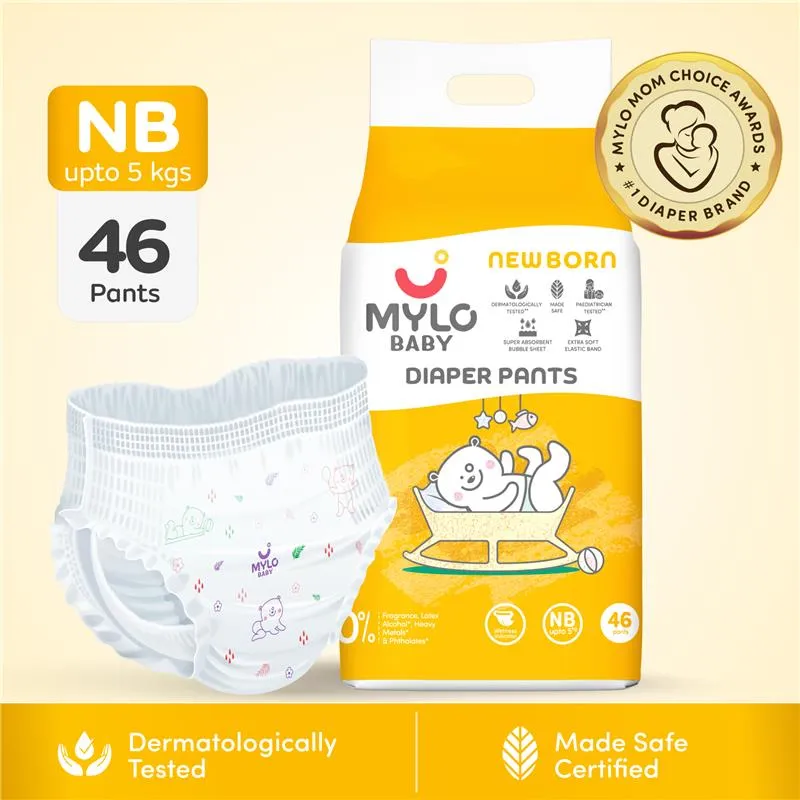
Pull on New Born pants: 46 count or 92 count, both with a wetness indicator. Start with the smaller pack, since most babies leave this size within 4 to 6 weeks.
For cloth from about 3 months: the adjustable cloth diaper with insert pads. Most one size cloth diapers gap at the legs on a newborn.
Compare across the full diaper range.
What no diaper does: prevent diaper rash, or replace checking your baby.
Mylo Parents Asked
Kya newborn baby ko diaper pehnana safe hai?
Haan, pehle din se safe hai. Duniya bhar ke hospitals aur NICU mein diaper istemal hote hain, premature babies par bhi. Zaroori baat yeh hai ki har 2 se 3 ghante mein badlein, potty hone par turant badlein, aur nabhi sookhne tak diaper ka agla hissa uske neeche mod kar rakhein.
Kya diaper se ladke ko infertility hoti hai?
Nahi. Yeh baat ek sahi observation se shuru hui thi, ki plastic lined diaper mein scrotum ka temperature karib ek degree zyada hota hai. Lekin ladke adolescence tak sperm banate hi nahi, isliye bachpan ke temperature ka adult fertility par asar dikhaya nahi gaya hai. Koi bhi bade medical sangathan is wajah se diaper mana nahi karte. Haan, garmi ke mausam mein breathable diaper lein, jaldi badlein aur kuch der bina diaper rakhein.
Can I use a diaper on my newborn from day one?
Yes. Your baby will usually be in one within the first hour in hospital. Use New Born size for up to 5 kg, and tape style is easier while the umbilical stump is healing because you can fold the front below the navel.
Do diapers cause bow legs or hip problems?
No. A diaper holds the hips slightly bent and spread apart, which is the hip healthy position, and wide diapering is sometimes used to help mild hip instability. The real risk is tight swaddling with the legs straightened and pressed together, which paediatric orthopaedic bodies do warn about. Bow legs in toddlers are usually a normal stage that corrects itself.
Is it safe to use diapers at night for a newborn?
Yes. In the first weeks your baby will wake to feed every 2 to 3 hours anyway, and that is the natural moment to change them. A soiled diaper should be changed even if it wakes your baby.
Do diapers cause urine infections?
Not the diaper itself. Stool sitting against the skin for a long time, and wiping back to front, are what raise the risk. Change soiled diapers immediately and always clean front to back. A langot left on as long carries the same risk.
Is a langot better than a diaper for a newborn?
Not better, different. A langot is breathable and cheap but holds almost nothing, so it needs changing after every pee and it does not contain stool. Many families use cloth by day at home and disposables for nights and travel, which is a sensible split rather than a compromise.
How many hours can a newborn wear one diaper?
Two to three hours, and immediately if there is stool. Absorbency claims quoted in hours describe leak protection, not how long a diaper should stay on. See how often to change your baby's diaper.
When Should You Call a Doctor?
In the newborn period keep the threshold low. Contact your paediatrician the same day if you notice:
Redness, swelling, pus or a foul smell around the umbilical stump, or bleeding more than a spot or two
Fewer than 6 heavy wet diapers a day after the first week, or no urine passed in 24 hours
No stool passed in the first 48 hours
A rash that has not improved in 2 to 3 days, or that blisters, weeps, bleeds or develops pus or yellow crusting
A bright red rash with a clear border and small spots spreading beyond it, which suggests a fungal infection needing prescribed treatment
Fever, or a temperature below normal. Any fever in a baby under 3 months needs same day assessment
Yellow colour of the skin or eyes appearing, deepening, or appearing after the first week
A baby who is very sleepy, difficult to wake, floppy, or refusing feeds
Pain or crying on passing urine, or blood in the urine or stool
A clicking or clunking sensation in the hips, uneven leg length, or asymmetric thigh creases, which should be checked for hip dysplasia
This article is general information and does not replace an examination.
Bottom Line
Diapers are safe for newborns from the first day, and no paediatric body advises otherwise. The infertility worry rests on a temperature finding that does not lead where people take it, and the hip worry belongs to tight swaddling rather than to diapers. The concern with real substance is heat, so in an Indian summer change more often, choose something breathable and allow air time. Beyond that, almost everything blamed on diapers comes down to leaving one on too long or using the wrong size.
References
International Hip Dysplasia Institute. Hip healthy swaddling.
American Academy of Orthopaedic Surgeons. Position Statement: Swaddling and Developmental Hip Dysplasia.
Partsch CJ and colleagues. Scrotal temperature is increased in disposable plastic lined nappies. Archives of Disease in Childhood. [Confirm full citation and the authors' own statement that adult fertility was not shown to be affected.]
Baer EL, Davies MW, Easterbrook KJ. Disposable nappies for preventing napkin dermatitis in infants. Cochrane Database of Systematic Reviews.
NHS, UK. Caring for a newborn.
AAP, HealthyChildren.org. Common Diaper Rashes and Treatments.
Indian Academy of Pediatrics. IAP Guidelines for Pediatric Skin Care. Indian Pediatrics. 2021.
StatPearls. Developmental Dysplasia of the Hip.

Trusted by New Parents for Their Newborn's Comfort
Soft, absorbent diapers and gentle wipes designed to keep your little one dry, rash-free, and happily snuggled all day.



Article Posted Under
Related Articles

Related Topics
.webp&w=32&q=75)
Medical Disclaimer
This content is for informational purposes only and should not replace professional medical advice. Consult with a physician or other health care professional if you have any concerns or questions about your health. If you rely on the information provided here, you do so solely at your own risk.


AWARDS AND RECOGNITION

Mylo wins Forbes D2C Disruptor award

Mylo wins The Economic Times Promising Brands 2022
AS SEEN IN













- Mylo Care: Effective and science-backed personal care and wellness solutions for a joyful you.
- Mylo Baby: Science-backed, gentle and effective personal care & hygiene range for your little one.
- Mylo Community: Trusted and empathetic community of 10mn+ parents and experts.


Product Categories
Baby Carrier | Baby Soap | Baby Wipes | Stretch Marks Cream | Baby Cream | Baby Shampoo | Baby Massage Oil | Baby Hair Oil | Stretch Marks Oil | Baby Body Wash | Baby Powder | Baby Lotion | Diaper Rash Cream | Newborn Diapers | Teether | Baby Kajal | Baby Diapers Pants | Cloth Diapers | Laundry Detergent | Lactation Granules |