


Orders

Profile

Papaya (Papita) In Pregnancy: Ripe Vs Unripe, Daily Limit, Trimester Guide, And The Truth About Miscarriage Risk For 2026
 1 Likes|
 19 min
Diabetes, Weight Loss, Thyroid, PCOS · 8 years experience
Fully ripe papaya is safe in pregnancy in small amounts; unripe (green) papaya, semi-ripe papaya, papaya latex, papaya seeds, and papaya leaves are not safe because they can stimulate uterine contractions.
Quick Answer: Fully ripe, yellow-orange papaya is safe in pregnancy at around 100 g a day. Unripe (green) and semi-ripe papaya, papaya latex, and papaya seeds contain papain and the alkaloid carpaine, which can stimulate uterine contractions in animal studies and in isolated human uterine tissue (Adebiyi et al, British Journal of Nutrition, 2002). Avoid these forms throughout pregnancy.
Key Takeaways
- Fully ripe papaya: Safe in pregnancy in moderation, around 100 g a day.
- Unripe and semi-ripe papaya: Avoid entirely throughout pregnancy.
- Papaya latex (the milky sap from unripe fruit): Avoid.
- Papaya seeds: Avoid in pregnancy.
- Papaya leaves and leaf juice (used for dengue): Avoid in pregnancy unless prescribed by a doctor.
- Why: Papain (enzyme) and carpaine (alkaloid) in unripe parts can stimulate uterine smooth muscle (Adebiyi et al, 2002; Cherian, J Ethnopharmacol, 2000).
- Per 100 g of ripe papaya: 43 kcal, 60.9 mg vitamin C, 37 mcg folate, 950 IU vitamin A, 182 mg potassium (USDA FoodData Central).
- Mylo's editorial stance: Eat ripe papaya in moderation, prefer the deep-orange flesh of a fully soft fruit, and avoid every other form of papaya during pregnancy.
Definitions: The Eight Terms You Will See
| Term | Definition |
|---|---|
| Papaya (Carica papaya) | A tropical fruit with orange flesh when ripe; called papita in Hindi and pawpaw in some regions. |
| Ripe papaya | A fully ripe fruit, soft to the touch, with yellow-to-orange skin and deep orange flesh. |
| Unripe (green) papaya | A firm, green-skinned fruit with white-to-pale flesh; eaten in green papaya salads. |
| Semi-ripe papaya | A partially ripened fruit, with green-and-yellow skin and lighter orange flesh. |
| Papaya latex | The white, milky sap that oozes from unripe papaya skin and stems. |
| Papain | A proteolytic enzyme concentrated in unripe papaya latex and papaya seeds. |
| Carpaine | An alkaloid found in papaya leaves and unripe fruit with uterotonic activity. |
| Uterotonic | A substance that stimulates uterine contractions. |
Multilingual Glossary For Quick Reference
| English | Hindi | Urdu | Marathi | Bengali | Tamil | Telugu | Kannada | Malayalam |
|---|---|---|---|---|---|---|---|---|
| Papaya | पपीता | پپیتا | पपई | পেঁপে | பப்பாளி | బొప్పాయి | ಪಪ್ಪಾಯಿ | പപ്പായ |
| Ripe papaya | पका पपीता | پکا پپیتا | पिकलेली पपई | পাকা পেঁপে | பழுத்த பப்பாளி | పండిన బొప్పాయి | ಮಾಗಿದ ಪಪ್ಪಾಯಿ | പഴുത്ത പപ്പായ |
| Unripe papaya | कच्चा पपीता | کچا پپیتا | कच्ची पपई | কাঁচা পেঁপে | காய் பப்பாளி | పచ్చి బొప్పాయి | ಹಸಿ ಪಪ್ಪಾಯಿ | പച്ച പപ്പായ |
Is Papaya Safe During Pregnancy?
Fully ripe papaya is safe in pregnancy in small amounts; unripe and semi-ripe papaya are not. This is the most important distinction in papaya safety, and most internet confusion comes from treating "papaya" as one food rather than as a fruit that changes in chemistry as it ripens.
The biology behind the rule: the unripe fruit, its skin, and its seeds contain papaya latex, a milky sap rich in papain (a proteolytic enzyme) and carpaine (an alkaloid). Both have shown the ability to stimulate uterine smooth muscle in laboratory and animal studies. The landmark paper, Adebiyi, Adaikan and Prasad, British Journal of Nutrition, 2002, tested ripe and unripe papaya extracts on isolated rat uteruses and found:
- Ripe papaya extract had no significant effect on uterine contractility.
- Unripe and semi-ripe papaya extracts caused dose-dependent uterine contractions similar to oxytocin and prostaglandin F2-alpha.
- Crude papaya latex caused contractions even in non-pregnant uterine tissue.
A second paper, Cherian, Journal of Ethnopharmacology, 2000, and the older Gopalakrishnan and Rajasekharasetty, Indian Journal of Physiology and Pharmacology, 1978, reached similar conclusions. These are the studies cited globally for the warning, and they all point in the same direction: ripeness matters.
Which Forms Of Papaya Are Safe And Which Are Not?
Ripe yellow-orange papaya in moderation is safe. Every other form is not.
| Form of papaya | Safety in pregnancy | Why |
|---|---|---|
| Fully ripe (yellow-orange, soft, sweet) | Safe in moderation | Papaya latex has dropped to negligible levels; no contraction signal in studies |
| Semi-ripe (green and yellow, firm) | Avoid | Still contains active latex |
| Unripe (green, firm, white flesh) | Avoid | High latex; uterotonic in animal and isolated-tissue studies |
| Papaya latex (visible white sap) | Avoid | The active uterotonic source |
| Green papaya salad (Thai som tam) | Avoid | Made from unripe fruit |
| Papaya seeds (whole or ground) | Avoid | High in carpaine and papain |
| Papaya leaves and leaf juice | Avoid unless your doctor prescribes for dengue | High in alkaloids; not studied as safe in pregnancy |
| Papaya enzyme supplements (capsules) | Avoid | Concentrated papain |
| Fermented papaya pulp | Avoid | Inconsistent enzyme load |
| Frozen ripe papaya cubes | Safe in moderation | Same as fresh ripe |
How Much Papaya Can I Eat Per Day During Pregnancy?
About 100 g of fully ripe papaya per day is the safe upper limit for most pregnant women. That is roughly half a cup of cubes or 4 to 5 small chunks. Indian dietary guidelines from the Indian Council of Medical Research, National Institute of Nutrition, 2024 recommend 200 to 400 g of mixed fruit a day in pregnancy; papaya can be one portion among several.
| Amount per day | Suitable for | Notes |
|---|---|---|
| Up to 50 g | Anxiety about risk or history of miscarriage | Reassuring, well below any concern level |
| 100 g (about ½ cup) | Most pregnant women | Optimal portion |
| 150 g | Acceptable if well-tolerated | Spread across two snacks |
| Above 200 g a day | Not recommended | Risk of diarrhoea, sugar spike, or, in theory, cumulative uterotonic load |
If you have a history of miscarriage, preterm labour, or are in your first trimester, choose other fruit (apple, pear, watermelon, muskmelon) and reintroduce ripe papaya in the second trimester.
What Is The Nutritional Value Of Ripe Papaya Per 100 G?
Per 100 g of ripe papaya you get 43 kcal, 60.9 mg vitamin C, 37 mcg folate, and 950 IU vitamin A. Values are drawn from USDA FoodData Central and the Indian Food Composition Tables, ICMR-NIN, 2020.
| Nutrient (per 100 g, ripe) | Amount | % of pregnancy daily need |
|---|---|---|
| Calories | 43 kcal | ~1.8% |
| Water | 88 g | Hydrating |
| Carbohydrates | 11 g | ~4% |
| Sugars | 7.8 g | Natural fruit sugar |
| Fibre | 1.7 g | ~6% of 30 g |
| Protein | 0.5 g | ~1% |
| Vitamin C | 60.9 mg | ~76% of 80 mg |
| Vitamin A (beta-carotene) | 950 IU | ~10% as RAE |
| Folate | 37 mcg | ~6% of 600 mcg |
| Potassium | 182 mg | ~4% of 4,700 mg |
| Calcium | 20 mg | ~2% |
| Iron | 0.25 mg | ~1% |
| Magnesium | 21 mg | ~6% |
For broader supplementation context, read folic acid for pregnancy and foetal growth and development during pregnancy.
What Are The Benefits Of Eating Ripe Papaya During Pregnancy?
Ripe papaya supports vitamin C status, eases nausea, helps constipation, and provides hydration during pregnancy. Each benefit has a clear nutrient mechanism.
| Benefit | What it does | Mechanism |
|---|---|---|
| Vitamin C boost | Strengthens immunity and helps iron absorption | 60.9 mg per 100 g (more than oranges) |
| Eases morning sickness | Mild on the stomach, settles nausea | High water content; gentle enzymes in fully ripe fruit |
| Constipation relief | Helps bowel movement | 1.7 g fibre and natural sorbitol |
| Heartburn relief | Mild antacid effect | Alkaline-forming nature when ripe |
| Foetal eye development | Supports retina formation | Beta-carotene precursor of vitamin A |
| Skin health for mother | Improves collagen synthesis | Vitamin C |
| Healthy weight gain | Low calorie at 43 kcal per 100 g | Satiating, hydrating snack |
For trimester-related symptoms, read nausea and vomiting during pregnancy, constipation in early pregnancy, and heartburn during early pregnancy.
Can I Eat Papaya In The First, Second, And Third Trimester?
Fully ripe papaya is safe in all three trimesters in small amounts; the first trimester is the most cautious window. A trimester view:
| Trimester | Weeks | Ripe papaya | Unripe / seeds / latex | Why |
|---|---|---|---|---|
| First | 1 to 12 | Optional; up to 100 g a day if well-tolerated | Avoid completely | Highest miscarriage-risk window |
| Second | 13 to 27 | Safe in moderation, 100 g a day | Avoid completely | Stable pregnancy; nutrients are useful |
| Third | 28 to 40 | Safe in moderation, 100 g a day | Avoid completely | Helps with late-pregnancy constipation |
If you have any history of miscarriage, threatened miscarriage, or preterm contractions, defer all forms of papaya until your doctor clears it. Read miscarriage during early pregnancy and preterm labour for context.
Can Papaya Cause Miscarriage?
Ripe papaya in moderation does not cause miscarriage in published human evidence; unripe papaya, papaya latex, and papaya seeds carry a biologically plausible risk based on animal and isolated-tissue studies. This is the most important nuance to understand.
- Ripe papaya: No human case reports or epidemiological studies link ordinary ripe papaya consumption to miscarriage. The Adebiyi 2002 paper specifically tested ripe papaya extract and found no uterotonic activity.
- Unripe papaya: Animal models (rats, isolated rat and human uterine tissue) show clear uterine contractions from unripe papaya extract and crude latex. No randomised human trial exists for ethical reasons, but the mechanism is well established.
- Papaya seeds: Carpaine alkaloid content makes seeds the highest-risk part of the fruit.
- Papaya leaf juice (used as a dengue platelet booster): Not studied in pregnancy; routinely advised against by Indian obstetricians.
The traditional advice in many Indian families to "avoid papaya entirely" is conservative but understandable. The science-based middle path is: ripe yes, unripe and seeds no.
For other foods to handle with care, read foods that cause miscarriage and fruits to avoid during pregnancy.
Can Papaya Be Used To Prevent An Unwanted Pregnancy?
No, papaya is not a reliable form of contraception or pregnancy termination. This question shows up in search trends because of the same uterotonic biology, but the dose required to trigger a clinical effect is far higher than dietary intake. Relying on papaya for either contraception or abortion is unsafe and ineffective. If you need either, consult a gynaecologist for proper medical options, including the levonorgestrel emergency contraceptive (within 72 hours of unprotected sex), copper IUD, or a supervised medical termination.
What About Papaya During IVF Or After Embryo Transfer?
Avoid all forms of papaya, including ripe papaya, from the IVF stimulation phase through the first trimester of an IVF pregnancy. The two-week wait after embryo transfer and the early IVF pregnancy weeks are sensitive periods, and most IVF specialists advise the most conservative dietary approach. Reintroduce ripe papaya only after your IVF doctor clears it, usually after a confirmed first-trimester scan.
How Do I Tell Ripe Papaya From Unripe Papaya?
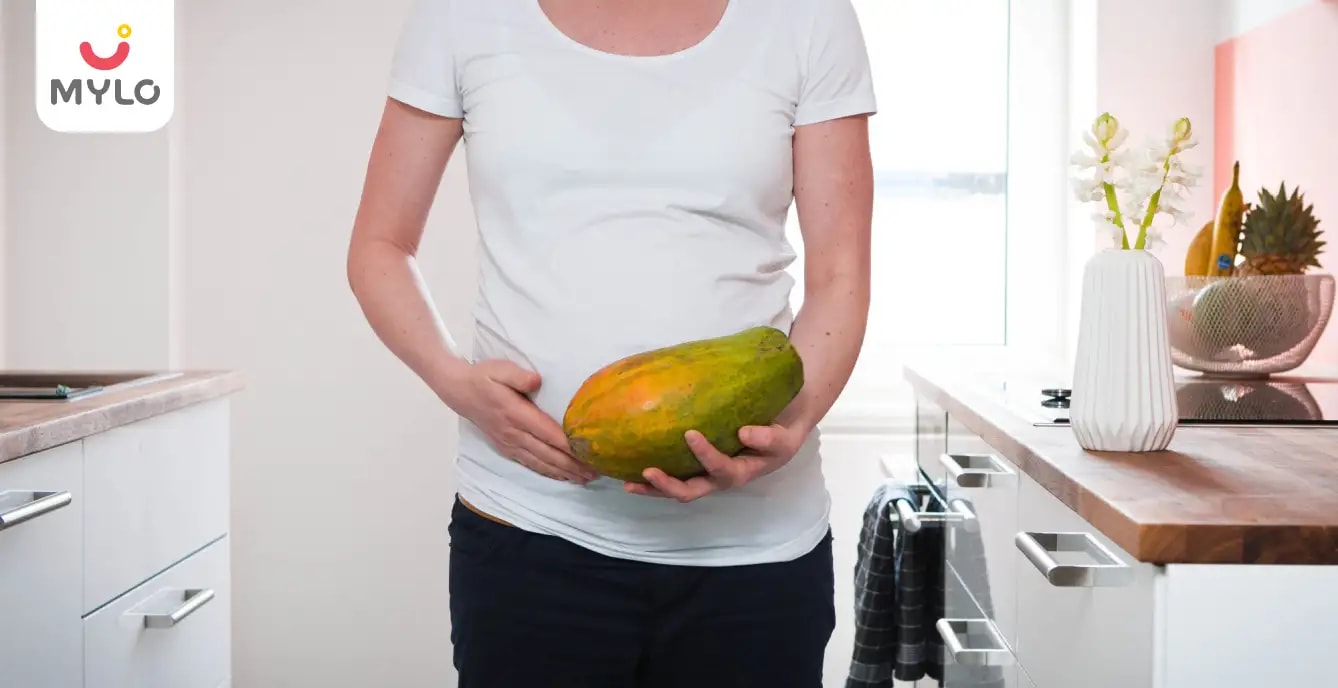
A fully ripe papaya is yellow to orange on the skin, soft when pressed gently, and has deep orange flesh inside. An unripe papaya is firm, green-skinned, and has white or pale flesh. Practical tests:
- Press test: Ripe papaya yields gently under your thumb; unripe is hard.
- Skin colour: Bright yellow to orange means ripe; any large green patches mean semi-ripe and not safe in pregnancy.
- Smell: Ripe papaya has a sweet, slight musky aroma; unripe has almost no smell.
- Cut test: If you cut and see white sap (latex) on the skin or flesh, the fruit is not fully ripe; do not eat it during pregnancy.
- Flesh colour: Deep orange is fully ripe; pale orange or yellow with green tinges is semi-ripe.
If you are not sure, keep the fruit on the kitchen counter for 1 to 3 more days and re-check.
How Should I Eat Ripe Papaya During Pregnancy?
Eat freshly cut ripe papaya, scoop out all seeds, wash hands and knife before cutting, and consume within 24 hours of cutting. Practical preparations:
- Plain cubes: 100 g with a squeeze of lime and a pinch of black salt.
- Fruit chaat: Combined with ripe banana, pomegranate, apple, and chaat masala.
- Smoothie: Half a cup of papaya blended with curd, a few ice cubes, and a teaspoon of honey.
- Breakfast bowl: Ripe papaya cubes with curd, soaked chia, and a handful of nuts.
Avoid raw papaya salad (som tam), green papaya curry, papaya jam from unknown sources, and papaya supplements during pregnancy.
What Are The Side Effects Of Eating Papaya During Pregnancy?
Overeating ripe papaya may cause loose motions, sugar spike, or, very rarely, allergic reaction; the major risk lies with unripe papaya and seeds. Watch for these:
| Side effect | Trigger | What to do |
|---|---|---|
| Loose motions | Eating over 150 g a day; ripe papaya is mildly laxative | Reduce to 50 to 100 g |
| Sugar spike | Eating large amounts on an empty stomach in gestational diabetes | Pair with curd or nuts |
| Allergic reaction | Personal latex or papaya allergy | Stop and consult your doctor |
| Heartburn | Eating very ripe or fermented papaya at night | Eat earlier in the day |
| Uterine cramps (rare with ripe) | Likely from semi-ripe or contaminated batch | Stop and call your doctor immediately |
| Threatened miscarriage symptoms | After consuming unripe papaya, latex, or seeds | Seek emergency care |
For loose motions, read pregnancy loose motion: causes, treatment, home remedies.
Is Papaya Safe With Gestational Diabetes?
Ripe papaya has a moderate glycaemic index of around 60 and should be eaten in half-cup portions (50 to 75 g) by women with gestational diabetes. Pair with protein like curd, paneer, or a few nuts to flatten the post-meal sugar spike. Avoid papaya juice (no fibre, faster sugar absorption). Check your blood sugar 1 to 2 hours after eating to learn your individual response.
Mylo's Editorial Stance
Mylo recommends eating fully ripe papaya in 100 g portions per day during pregnancy and avoiding every other form: unripe, semi-ripe, latex, seeds, leaves, and concentrated enzyme supplements. The science behind the safe-ripe and avoid-unripe rule is consistent across the studies cited above. The traditional Indian caution applies to unripe papaya (correctly) and historically extended to ripe papaya (conservatively). Choose the middle path: enjoy ripe papaya for its vitamin C, hydration, and folate; skip every other form to be safe.
For related guides, read muskmelon in pregnancy, watermelon in pregnancy, amla in pregnancy, drumstick in pregnancy, and corn in pregnancy.
Frequently Asked Questions
Is ripe papaya safe in the first trimester of pregnancy?
Yes, fully ripe papaya is safe in the first trimester in small amounts of up to 100 g a day, but if you have a history of miscarriage or any threatened miscarriage symptoms, defer all papaya until the second trimester. Avoid unripe papaya, semi-ripe papaya, papaya latex, and papaya seeds throughout pregnancy (Adebiyi et al, 2002).
Can papaya cause miscarriage?
Ripe papaya in moderation does not cause miscarriage in published human evidence. Unripe and semi-ripe papaya, papaya latex, and papaya seeds carry a biologically plausible risk based on animal studies that show uterine contractions from the papain and carpaine they contain. Avoid these forms throughout pregnancy and stay with fully ripe fruit only.
Is green or unripe papaya safe during pregnancy?
No, green or unripe papaya is not safe during pregnancy at any stage. It contains high levels of papain and the alkaloid carpaine in its latex, both of which can stimulate uterine contractions (Cherian, J Ethnopharmacol, 2000). Avoid green papaya salads (Thai som tam), green papaya curry, and any preparation that uses unripe fruit.
Can I eat papaya seeds during pregnancy?
No, avoid papaya seeds entirely throughout pregnancy. The seeds have the highest concentration of carpaine and active enzymes compared to the flesh, and they are linked to uterotonic activity in laboratory studies. Scoop out all seeds before eating ripe papaya, and do not use papaya seed powder or supplements.
Is papaya leaf juice safe during pregnancy for dengue?
No, papaya leaf juice is not recommended during pregnancy, even for dengue. Carpaine and other alkaloids in the leaves have uterotonic potential and have not been studied as safe in pregnancy. If you have dengue, your obstetrician will manage platelet counts through hospitalisation and fluid balance rather than papaya leaf preparations.
How much ripe papaya can I eat per day in pregnancy?
Around 100 g of fully ripe papaya per day, roughly half a cup of cubes, is the safe upper limit for most pregnant women. Spread your portion across two snacks if you want a smaller serving at one go. Reduce to 50 g a day if you have gestational diabetes or are in the first trimester with any spotting history.
Is papaya safe with gestational diabetes?
Yes, in moderation. Ripe papaya has a moderate GI of about 60. Limit to half a cup (50 to 75 g) at a time, pair with protein like curd or nuts, and check your blood sugar 1 to 2 hours after eating. Avoid papaya juice in gestational diabetes; the lack of fibre speeds up sugar absorption.
Can papaya prevent or terminate an unwanted pregnancy?
No, papaya is not a reliable contraceptive or abortifacient. The dose needed to trigger a clinical effect is far higher than dietary intake. Do not rely on papaya for contraception or pregnancy termination; consult a gynaecologist for proper medical options.
Can I eat papaya after embryo transfer or in early IVF pregnancy?
Avoid all forms of papaya, including ripe papaya, from the IVF stimulation phase through the first trimester of an IVF pregnancy. Most IVF specialists recommend the most conservative dietary approach during these sensitive weeks. Reintroduce ripe papaya only after your IVF doctor clears it.
Pregnancy me papita kha sakte hain?
Pregnancy me sirf poori tarah paka hua papita (peela aur narm) thodi maatra me (lagbhag 100 gram) khaaya ja sakta hai. Kachcha aur ardh-paka papita, papite ki safed doodh jaisi resh (latex), papite ke beej, aur papite ke patte bilkul nahi khane chahiye, kyonki inme papain aur carpaine hote hain jo garbhashay me sankuchan kar sakte hain (Adebiyi et al, 2002). Pehle trimester me extra savdhaani rakhein.
Papita pregnancy ke liye accha hai ya bura?
Paka hua papita pregnancy ke liye accha hai, agar moderation me khaaya jaaye. Isme vitamin C (60.9 mg per 100 g), folate, beta-carotene aur fibre hota hai jo immunity, constipation aur morning sickness me madad karte hain. Lekin kachcha papita aur uske beej pregnancy me dangerous hain, isliye sirf paka peela papita hi chuni.
Pawpaw is good for pregnant women?
Yes, fully ripe pawpaw (the same fruit as papaya in many regions of Africa, the Caribbean, and Southeast Asia) is safe in pregnancy in small amounts of up to 100 g a day. Avoid unripe pawpaw, pawpaw seeds, pawpaw leaves, and pawpaw latex, which contain papain and carpaine that can stimulate uterine contractions in animal studies. Choose the fully ripe fruit only.
 Yes
Yes
 No
No
Your parenting partner
in your pocket.
supportive community.

Your parenting partner
in your pocket.
supportive community.


Helpful Tools & Calculators

.webp&w=32&q=75)














I have worked in various hospitals, healthcare sectors and wellness organizations. I have catered to various health conditions like diabetes, hypertension, obesity and also looked into pregnancy, lactation cases.
Related Articles

Questions about this article
- Asked when 33 weeks pregnant
Influenza and boostrix injection kisiko laga hai kya 8 month pregnancy me and q lagta hai ye plz reply me
- Asked when 7 weeks pregnant
Hai.... My last period was in feb 24. I tested in 40 th day morning 3:30 .. That is faint line .. I conculed mylo thz app also.... And I asked tha dr wait for 3 to 5 days ... Im also waiting ... Then I test today 4:15 test is sooooo faint ... And I feel in ma body no pregnancy symptoms. What can I do .
- 26 weeks pregnant
Baby kicks KB Marta hai Plz tell mi
- trying to conceive
PCOD kya hota hai
- Asked when trying to conceive
How to detect pcos
Related Topics
.webp&w=32&q=75)
Recently Published Articles
Your body needs extra nutrition this trimester - these can help.
Drumstick (Sahjan, Shevga, Murungai) In Pregnancy: Pods Vs Leaves Vs Root, How Much Is Safe, Trimester-By-Trimester Guide For 2026

220+ Modern Hindu Baby Girl Names with Meanings (2026): Trending, Goddess Inspired, Unique
Betnesol Injection In Pregnancy: Why It Is Given, When It Is Given, The 12 Mg Dose, Side Effects, And What Indian Gynaecologists Recommend In 2026

Navel Displacement (Naaf Utarna, Dharan, Pechoti): What It Really Means, What Could Actually Be Causing It, And When To See A Doctor In 2026

220+ Bengali Baby Girl Names with Meanings (2026): Modern, Uncommon, Goddess, A-Z and Dak Naam Collection for Your Little Princess
Medical Disclaimer
This content is for informational purposes only and should not replace professional medical advice. Consult with a physician or other health care professional if you have any concerns or questions about your health. If you rely on the information provided here, you do so solely at your own risk.


AWARDS AND RECOGNITION

Mylo wins Forbes D2C Disruptor award

Mylo wins The Economic Times Promising Brands 2022
AS SEEN IN












- Mylo Care: Effective and science-backed personal care and wellness solutions for a joyful you.
- Mylo Baby: Science-backed, gentle and effective personal care & hygiene range for your little one.
- Mylo Community: Trusted and empathetic community of 10mn+ parents and experts.


Product Categories
Baby Carrier | Baby Soap | Baby Wipes | Stretch Marks Cream | Baby Cream | Baby Shampoo | Baby Massage Oil | Baby Hair Oil | Stretch Marks Oil | Baby Body Wash | Baby Powder | Baby Lotion | Diaper Rash Cream | Newborn Diapers | Teether | Baby Kajal | Baby Diapers Pants | Cloth Diapers | Laundry Detergent | Lactation Granules |