


Orders
.png&w=48&q=75 "login")
Profile


Wallet

How to Teach Alphabets to Toddlers: Age, Tips and Games
 14 min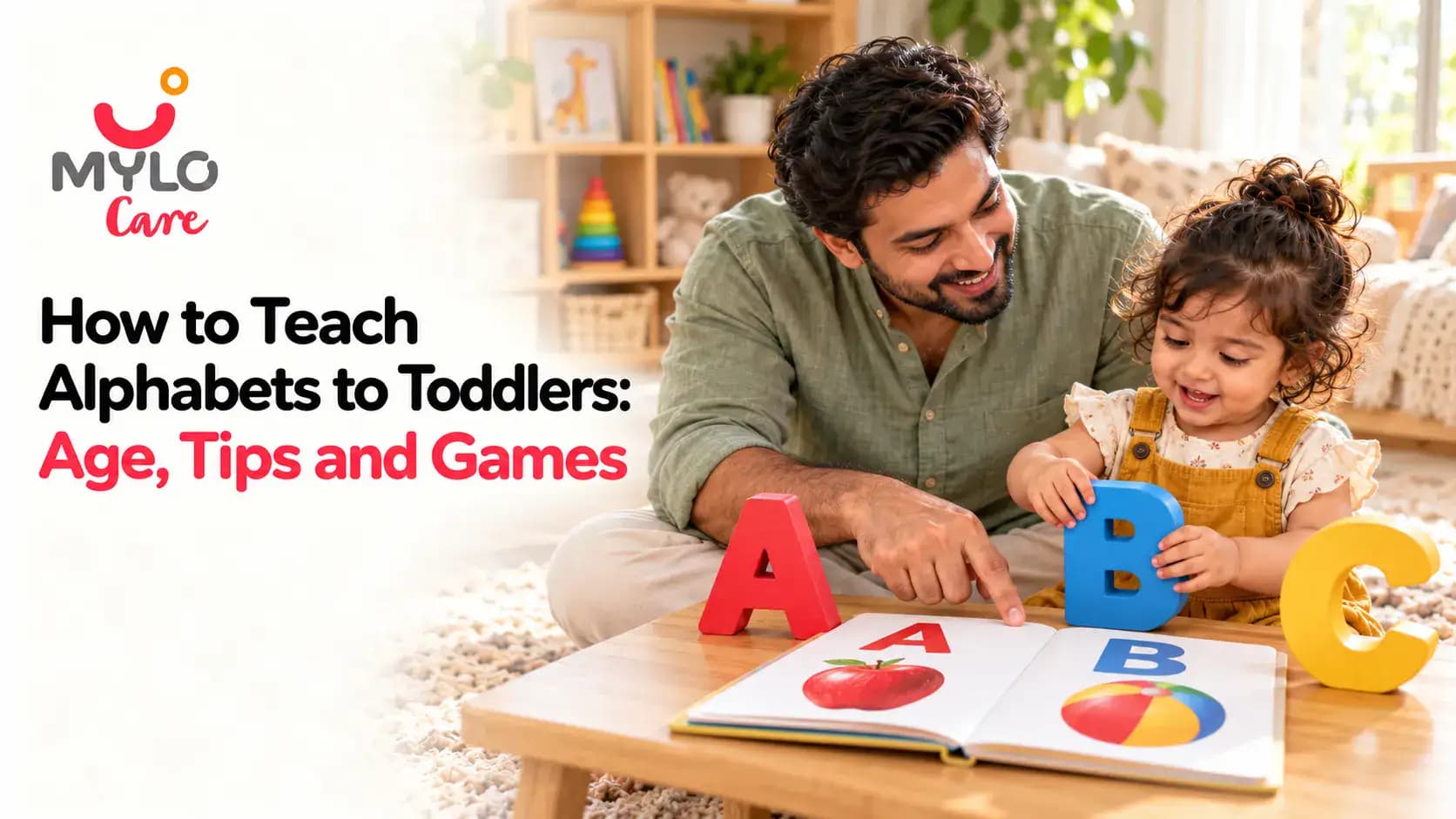
Quick Answer
Teaching alphabets to a toddler means helping them notice letters and their sounds through songs, games and everyday print, not drills. For example, pointing out the M on a milk packet and saying "mmm" is alphabet learning. Most children recognise many letters between 3 and 5 years, so start gently.
At a Glance
Age | What Is Typical | What You Can Do |
|---|---|---|
12 to 18 months | Enjoys books, rhymes and sounds | Sing rhymes, read board books, point at pictures |
18 to 24 months | May sing parts of the ABC song, notices print | ABC song, alphabet board books, name objects |
2 to 3 years | May recognise a few letters, often from their own name | Letters in their name, letter puzzles, sound games |
3 to 5 years | Learns most letter names and many sounds | Letter games, matching sounds to letters, early writing |
Key Facts
Toddlers are not expected to know all the letters. Most children learn the full alphabet between 3 and 5 years.
The first letters a child usually recognises are the ones in their own name.
Hearing sounds in words (rhyming, first sounds) is an important step before reading. This is called phonological awareness.
Pushing flashcards and worksheets before 3 years is not needed and can make learning stressful.
Reading aloud every day is one of the strongest ways to build early reading skills.
What Age Should a Child Know the ABCs?
Short answer: Most children can sing the ABC song by 2 to 3 years, recognise some letters by 3 years, and know most letter names by 4 to 5 years. Every child learns at their own pace.
Skill | Typical Age Range |
|---|---|
Enjoys alphabet books and songs | 18 months to 2 years |
Sings the ABC song (may mix up letters) | 2 to 3 years |
Recognises a few letters, especially from their name | 2.5 to 3.5 years |
Recognises most capital letters | 4 to 5 years |
Knows many letter sounds | 4 to 5 years |
Writes some letters (often their name) | 4 to 5 years |
Singing the ABC song is not the same as knowing letters. It is memorising a tune, which is still a fun first step.
Is My Toddler Too Young to Learn Alphabets?
Short answer: No age is too young to enjoy letters through play, but toddlers should not be drilled. Under 3, focus on talking, rhymes and books. Letter learning comes naturally after that.
Under 3: Do | Under 3: Avoid |
|---|---|
Read and sing daily | Flashcard drills |
Point out letters you see around you | Worksheets and tracing practice |
Rhyming games | Forcing them to say letters |
Alphabet board books and puzzles | Comparing with other children |
Praise interest, not "right answers" | Screen-based alphabet apps for hours |
How to Teach Alphabets to Toddlers at Home
Short answer: Start with the letters in your child's name, use songs and books, point out letters in everyday life, link each letter to a sound and a familiar object, and keep it playful and short.
Step | What to Do | Example |
|---|---|---|
1. Start with their name | Show and say the letters of their name | "A for Aarav! Your letter!" |
2. Sing | ABC song, phonics songs | Sing slowly and point to letters on a chart |
3. Read alphabet books | Simple A to Z picture books | "A, apple. B, ball." |
4. Spot letters everywhere | Milk packets, shop signs, number plates | "Look, there's an M!" |
5. Teach sounds, not just names | Say the sound with the letter | "B says buh, like ball" |
6. Use touch | Trace letters in sand, atta or on a tray of salt | Tracing with a finger |
7. Few at a time | 1 or 2 letters a week | Start with S, A, M, T, or letters from their name |
8. Keep it short | 5 to 10 minutes, stop when interest drops | End while they're still having fun |
Capital or Small Letters First?
Many teachers start with capital letters because they are easier to tell apart and draw. Others teach both together. Either is fine. Children see both in books, so name both when you see them.
Fun Alphabet Games for Toddlers
Short answer: Games like letter hunts, sand tracing, alphabet puzzles, I-spy with sounds and letter matching make learning fun and stick better than drills.
Game | How to Play | Best Age |
|---|---|---|
ABC song with chart | Sing and point to each letter | 18 months and above |
Alphabet board book | Name the letter and the picture | 18 months and above |
Letter puzzle | Chunky A to Z puzzle, fit the letter in its place | 2 years and above |
Letter hunt | Hide foam or wooden letters around the room to find | 2.5 years and above |
I spy sounds | "I spy something that starts with mmm... mango!" | 2.5 years and above |
Sand or atta tracing | Trace a big letter with a finger in a tray | 2.5 years and above |
Letter matching | Match capital letter cards to the same letters | 3 years and above |
Body letters | Make letters with your bodies: arms up for Y | 3 years and above |
Name puzzle | Cut their name into letters and put it together | 3 years and above |

How to Teach Hindi Alphabets (Varnamala) to Toddlers
Short answer: Teach Hindi letters the same way: through rhymes, picture books and everyday words. Start with swar (vowels like अ, आ) and familiar words like आम (aam) and कमल (kamal).
Tip | Example |
|---|---|
Use familiar words | क से कबूतर, ख से खरगोश, ग से गमला |
Varnamala songs and rhymes | Sing the swar and vyanjan with actions |
Hindi picture books | Pratham Books and StoryWeaver have free Hindi books |
Speak Hindi at home | A strong spoken base makes letters easier later |
Don't rush two scripts | Learning Hindi and English letters together is fine if it's playful |
Learning two languages does not confuse children. Read toddler learning two languages.
Colours, Shapes and Numbers: Quick Guide
Short answer: Colours, shapes and numbers are learned the same way as letters: through play, everyday talk and repetition. Most toddlers learn them before letters.
Concept | Typical Age | Quick Tips | Full Guide |
|---|---|---|---|
Colours | Starts matching around 18 to 24 months, often names a few colours by 2.5 to 3 years | Name colours of clothes, fruits and vehicles. Sort by colour | |
Shapes | Fits simple shapes around 18 to 24 months, names circle and square around 3 years | Shape sorters, "find something round", roti is a circle | |
Numbers | Recites 1 to 5 around 2 to 3 years, counts small groups correctly closer to 3 to 4 years | Count stairs, rotis and toys together, number songs | |
Letters | See this guide | Name letters, sound games, letter puzzles | This article |
What Order Should You Teach These In?
Short answer: Let your toddler lead, but a natural order is colours and shapes first, then counting, then letters. Talking and reading support all of them.
Usual Order | Why |
|---|---|
1. Talking and books | Builds vocabulary for everything else |
2. Colours and shapes | Easy to see and touch in daily life |
3. Counting small numbers | Can be practised with real objects |
4. Letters and sounds | Needs more memory and attention |
Do Alphabet Apps and Videos Help Toddlers?
Short answer: Apps and videos can teach toddlers to recite letters, but they don't build understanding like real conversation and play. Screens aren't advised under 2 years.
If you use an app for a child over 2, keep it short, choose slow and simple content, and sit together. Read screen time for toddlers.
When to Talk to Your Paediatrician
Short answer: Letter learning varies a lot. Speak to your doctor if your toddler has delayed speech, doesn't respond to sounds, or shows no interest in books and talking by 3 years.
Age | Check With Your Doctor If |
|---|---|
18 months | No words, not pointing |
2 years | No two-word phrases |
3 years | Hard to understand, not interested in books or stories, can't follow simple instructions |
Any age | Doesn't respond to sounds or their name, or loses words |
Read toddler development 12 to 36 months and when babies start talking.
Indian Context: What Parents Should Know
Playschool pressure: many playschools and nursery admissions in India test ABCD and 1 to 10. Toddlers don't need to be drilled for this. Play-based learning works better long term.
NEP 2020: the National Education Policy puts focus on play-based early learning for ages 3 to 8, not rote learning.
Home language: strong talking skills in your mother tongue help children learn English letters later.
Grandparents: rhymes like "A for Apple" sung by grandparents are a lovely start.
Free books: StoryWeaver offers free alphabet and picture books in many Indian languages.
Myths vs Facts
Myth | Fact |
|---|---|
My 2 year old should know A to Z | Most children learn all letters between 3 and 5 years |
Singing the ABC song means they know letters | It's memorising a tune. Recognising letters comes later |
Earlier letters mean a smarter child | Early letter learning doesn't predict long-term success. Talking and reading do more |
Worksheets help toddlers learn faster | Hands-on play and conversation work better under 3 |
Learning Hindi and English letters together confuses children | Children can learn both if it's playful |
Videos teach letters better than parents | Children learn more from real people |
FAQs
1. At what age should a child know the alphabet?
Most children know most letter names between 4 and 5 years. Many 3 year olds recognise a few letters, especially from their own name.
2. How do I teach ABCD to my 2 year old?
Sing the ABC song, read alphabet books, point out letters around you, and play simple letter puzzles. Keep it short and fun.
3. Should I teach letter names or letter sounds first?
Teach both together: "This is B. B says buh, like ball." Sounds help with reading later.
4. Which letters should I teach first?
Start with the letters in your child's name, then common letters like S, A, M and T.
5. Is it okay if my 3 year old doesn't know letters yet?
Yes. Many 3 year olds know only a few letters. Keep reading and playing, and talk to your doctor only if there are speech or hearing concerns.
6. Should toddlers practise writing letters?
Not yet. Scribbling, drawing and play dough build the hand strength needed for writing later. See toddler drawing stages.
7. 2 saal ke bacche ko ABCD kaise sikhayein?
ABC gaana gaaiye, alphabet ki picture books dikhaiye, aur ghar ya bahar dikhne wale akshar par ungli rakhkar naam bataiye. Roz 5 se 10 minute khel khel mein sikhaiye, zabardasti mat kijiye.
8. Bacche ko Hindi varnamala kab se sikhana chahiye?
2 se 3 saal mein kavitaon aur picture books se shuru kar sakte hain, jaise "क से कबूतर". Akshar pehchanna aam taur par 3 se 5 saal ke beech aata hai, isliye jaldi mat kijiye.
Related Reads
References
American Academy of Pediatrics, HealthyChildren.org. Helping your child learn to read; Language development milestones. https://www.healthychildren.org
National Association for the Education of Young Children (NAEYC). Learning to Read and Write: Developmentally Appropriate Practices for Young Children. https://www.naeyc.org
ZERO TO THREE. Early literacy development. https://www.zerotothree.org
Ministry of Education, Government of India. National Education Policy 2020. https://www.education.gov.in
Centers for Disease Control and Prevention. Milestone checklists. https://www.cdc.gov/ncbddd/actearly
Medical Disclaimer
This article is for general information only and does not replace advice from your paediatrician. Every child learns at their own pace. If you have concerns about your child's speech, hearing or development, please consult your doctor.
Diaper Pants for Active Toddlers
Easy on, easy off, made for little explorers





Article Posted Under
Related Articles
Right Side Abdominal Pain: Common Causes, Home Care and When to See a Doctor
 14 min
 Growth Scan in Pregnancy: When It Is Done, What It Checks and What Your Report Means
 17 min
 Hair Colour During Pregnancy: Is It Safe? Trimester Guide, Mehndi and Safer Options
 14 min
 Mylo: The Made-in-India Pregnancy and Parenting App Built for Indian Parents
 7 min
7 min
Related Topics
.webp&w=32&q=75)
Medical Disclaimer
This content is for informational purposes only and should not replace professional medical advice. Consult with a physician or other health care professional if you have any concerns or questions about your health. If you rely on the information provided here, you do so solely at your own risk.


AWARDS AND RECOGNITION

Mylo wins Forbes D2C Disruptor award

Mylo wins The Economic Times Promising Brands 2022
AS SEEN IN












- Mylo Care: Effective and science-backed personal care and wellness solutions for a joyful you.
- Mylo Baby: Science-backed, gentle and effective personal care & hygiene range for your little one.
- Mylo Community: Trusted and empathetic community of 10mn+ parents and experts.


Product Categories
Baby Carrier | Baby Soap | Baby Wipes | Stretch Marks Cream | Baby Cream | Baby Shampoo | Baby Massage Oil | Baby Hair Oil | Stretch Marks Oil | Baby Body Wash | Baby Powder | Baby Lotion | Diaper Rash Cream | Newborn Diapers | Teether | Baby Kajal | Baby Diapers Pants | Cloth Diapers | Laundry Detergent | Lactation Granules |