


Orders
.png&w=48&q=75 "login")
Profile


Wallet

How to Improve Memory in Toddlers: Memory Development, Memory Games and Brain Foods for 1 to 3 Year Olds (2026)
 19 min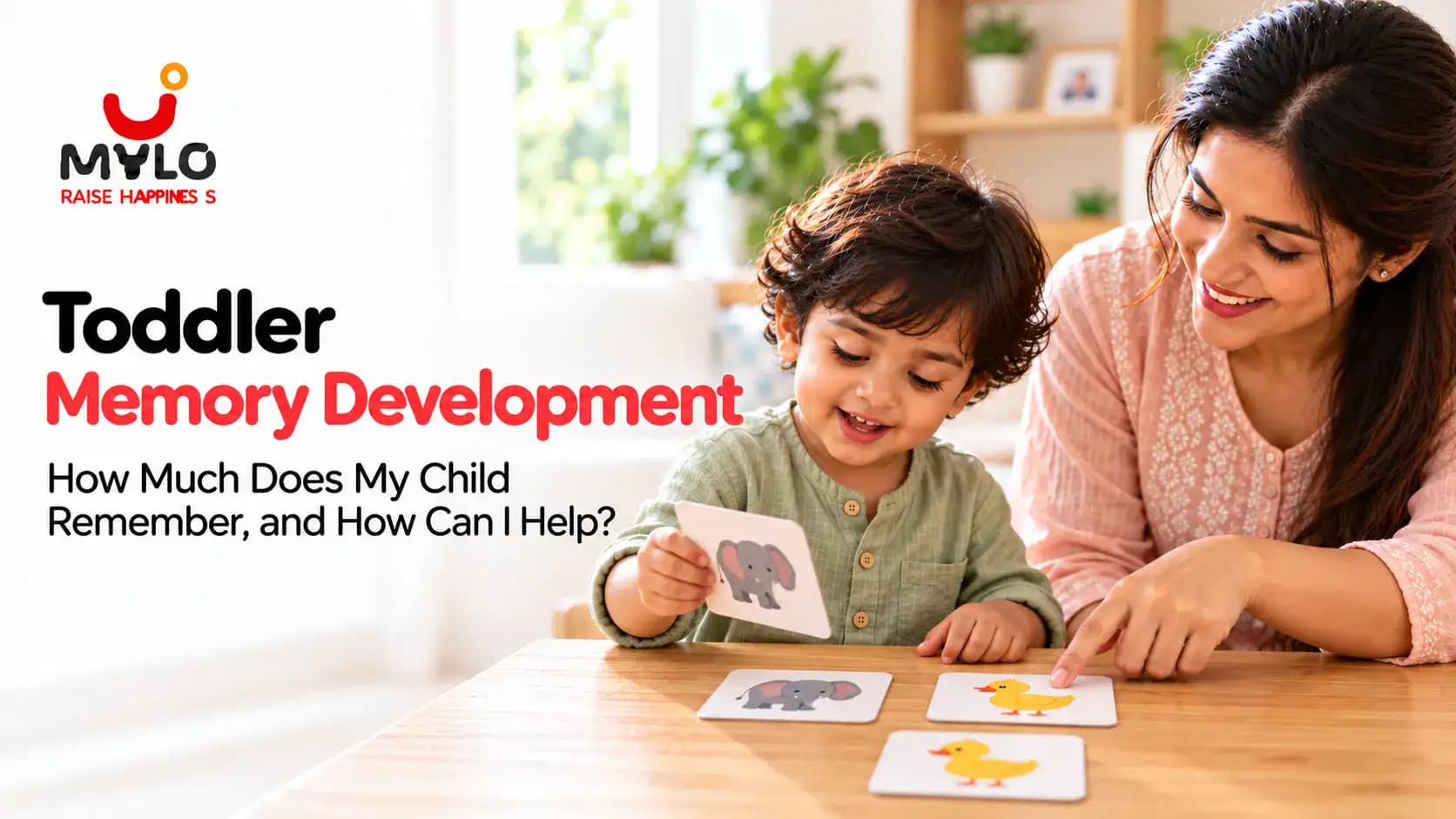
Quick Answer
Toddler memory is your child's growing ability to remember people, routines, words and events between 1 and 3 years. Most toddlers copy what they've seen by 18 months, remember routines by 2, and talk about yesterday by 3. You can boost it with good sleep, iron-rich food, daily stories and simple memory games.
Toddler Memory Development at a Glance (1 to 3 Years)
Age | What Your Toddler Can Usually Remember | Talk to a Doctor If |
|---|---|---|
12 months | Finds a toy hidden under a cloth, remembers games like peek-a-boo, knows familiar people | Doesn't look for a toy that's hidden or dropped |
15 months | Remembers where favourite toys are kept, copies actions they've seen before | Doesn't recognise familiar people or places |
18 months | Copies chores they've seen you do (CDC), points to familiar things when named | Doesn't copy actions or point to familiar things |
2 years | Remembers daily routines, follows simple instructions, recognises people they haven't seen for a while | Can't follow simple 1-step instructions |
2.5 years | Remembers short rhymes and songs, notices when something at home has changed | Doesn't remember any rhymes or routines |
3 years | Talks about what happened earlier today or yesterday, follows 2-step instructions | Can't recall anything that happened earlier in the day |
Ages are typical ranges. Every toddler develops at their own pace.
Before 1 year: Babies recognise their mother's voice from birth and start looking for hidden toys around 9 months. After 3 years: By 4, most children tell what comes next in a story they know well (CDC).
Key Facts Every Parent Should Know
By 18 months: Most toddlers copy chores they've watched you do, which shows they remember what they see (CDC)
2-year-old memory span: Most 2-year-olds can hold 1 or 2 simple steps in mind at a time
Sleep builds memory: Toddlers aged 1 to 2 need 11 to 14 hours of sleep a day, including naps, and 3-year-olds need 10 to 13 hours (WHO)
Iron matters: Iron deficiency anaemia can affect attention, learning and memory, and it's very common in young Indian children (NFHS-5)
Childhood amnesia: Your toddler won't remember most of these years later in life, and that's normal
No magic syrup: There's no good evidence that memory syrups or brain tonics improve memory in toddlers
2 Year Old Memory Development: What to Expect
Short answer: At 2, toddlers remember routines, people, places and simple instructions. Their memory is short, so they need lots of repetition, but they surprise parents by remembering small details that matter to them.
What a 2-year-old usually remembers:
What comes next in daily routines ("After bath comes milk")
Where things are kept, like snacks, shoes or their favourite toy
Family members and familiar people, even after a few weeks apart
Words and actions from favourite rhymes
1-step instructions, and sometimes 2 steps ("Get your shoes and bring them here")
What a 2-year-old usually forgets:
Longer instructions with 3 or more steps
What happened at playschool, unless you ask specific questions
Where they just put something down
How to Improve Memory in Toddlers: 10 Simple Ways
Short answer: Toddler memory grows best through sleep, good food, talk, stories, play and routines. These everyday habits work better than flashcards, apps or supplements.
Make sure your toddler sleeps enough. The brain stores memories during sleep, including naps.
Give iron-rich food every day. Iron deficiency is one of the most common causes of poor attention and learning in Indian toddlers.
Talk about the day at bedtime. Ask "What did we do today? Who did we meet?" and fill in the details. Research shows this helps children remember more.
Read the same books again and again. Pause and let your toddler fill in the next word.
Sing rhymes with actions. Words plus actions are easier to remember.
Play simple memory games. Hide-and-find, "Where's the ball?" and "What's missing?" (see below).
Keep daily routines. Predictable routines help toddlers remember what comes next.
Give short instructions. Start with 1 step, then try 2 steps.
Let your toddler play actively every day. Running, climbing and outdoor play help the brain grow.
Limit screens. The WHO advises no screen time under 2, and no more than 1 hour a day for 2 to 4 year olds.
Memory Games for Toddlers
Short answer: The best memory games for toddlers are short, simple and played with you, using things you already have at home. A few minutes a day is enough.
Age | Memory Games | Household Items to Use |
|---|---|---|
12 to 18 months | Peek-a-boo, hide a toy under a cloth, hide a toy under one of 2 cups | A dupatta or towel, 2 steel tumblers, a ball (not small enough to swallow) |
18 months to 2 years | "Where's the ball?" with 3 cups, find the toy in the box, put toys back in their place | Steel tumblers, a shoebox, a toy basket |
2 to 2.5 years | "What's missing?" with 3 objects, copy-me actions, name the animals in a picture book | Fruits or toys on a plate, a picture book |
2.5 to 3 years | Simple picture matching with 3 to 4 pairs, 2-step instruction games, retelling a very short story | Picture cards, storybooks |
Memory activities for toddlers at home
"Kya gayab hai?" (What's missing?): Put 3 kitchen items on a thaali, cover it, remove one, and ask what's missing
Cup and ball game: Hide a ball under one of 3 steel tumblers and move them slowly
Dadi-nani ki kahaniyan: Ask grandparents to tell the same short story often, then pause and let your toddler say what happens next
Photo album time: Look at family and festival photos and name who's in them
Rhymes and action songs: Repeat the same rhymes daily with actions
Tidy-up game: "Where does the ball live?" Let your toddler put toys back in their places
Sabzi naming: Show 2 or 3 vegetables, put them in the bag, and ask your toddler to name them again
Brain Development Foods for Toddlers (Indian Diet)
Short answer: No single food "increases" memory, but a balanced diet with iron, protein, healthy fats, iodine and vitamins supports a toddler's brain development. Many of the best brain foods are already in Indian kitchens.
Nutrient | Why It Matters for Memory and Learning | Indian Foods for Toddlers |
|---|---|---|
Iron | Carries oxygen to the brain; low iron affects attention and learning | Dal, rajma and chana (well cooked and mashed), palak, methi, ragi porridge, eggs, chicken, fish |
Protein | Builds brain cells and the chemicals they use to communicate | Dal, paneer, curd, milk, eggs, chicken, fish |
Omega-3 fats | Support brain development | Fish (rohu, sardines, mackerel), powdered walnuts, ground flaxseed |
Iodine | Needed for normal brain growth | Iodised salt in family food, milk, curd, eggs |
Vitamin B12 | Supports nerves and the brain | Milk, curd, paneer, eggs, fish, meat |
Zinc | Helps learning and memory | Dals, chana, whole grains, eggs, ground pumpkin seeds |
Vitamin C | Helps the body absorb iron | Amla, guava, oranges, tomatoes |
Tips for toddlers:
Serve a vitamin C food (amla, guava, orange) with iron-rich meals to help absorb iron
Don't give tea or coffee to toddlers, as they reduce iron absorption
Give nuts and seeds powdered or as paste; whole nuts are a choking risk for children under 5
Too much cow's milk (more than about 2 to 3 cups a day) can fill toddlers up and lower iron intake; ask your pediatrician what's right for your child
Ask your pediatrician if your toddler needs a blood test for anaemia
Do Memory Syrups or Brain Tonics Work for Toddlers?
Short answer: There's no good evidence that memory syrups, brain tonics or herbal supplements improve memory in healthy toddlers. Sleep, food, play and talk matter far more. Always ask your pediatrician before giving any syrup or supplement.
Question | What You Should Know |
|---|---|
Are memory syrups tested in toddlers? | Most aren't well studied in young children |
Can they be harmful? | Some herbal products aren't tested for safety in toddlers, and doses can be unclear |
When is a supplement needed? | Only when a doctor finds a real deficiency, like iron, vitamin B12 or vitamin D |
What works better? | Good sleep, a balanced diet, iron if needed, play and daily talk |
Home remedies: what's true?
Home Remedy | What's True | How to Give It Safely to a Toddler |
|---|---|---|
Soaked almonds | Nutritious, but no proof they boost memory on their own | Powdered or as paste; whole almonds are a choking risk |
Walnuts | Contain omega-3 fats | Powdered into porridge or halwa |
Ghee | A source of fat and energy | Small amounts in normal meals |
Brahmi and shankhpushpi | Traditional herbs; not well studied for safety or benefit in toddlers | Ask your doctor first |
Dry fruit ladoo | Good energy and iron | Powdered, as an occasional snack; watch the sugar |
Is It Normal for My Toddler to Forget Things?
Short answer: Yes. Toddlers forget a lot because their memory is still developing. Forgetting instructions, where they put a toy, or what happened last week is completely normal at this age.
What You See | Is It Normal? |
|---|---|
Forgets a 2-step instruction halfway | Yes, very common under 3 years |
Remembers a rhyme perfectly but forgets where their shoes are | Yes, memory for songs and routines is stronger |
Remembers a small detail from weeks ago that you forgot | Yes, toddlers remember things that matter to them |
Can't say what they did at playschool | Yes; ask specific questions like "Who did you play with?" |
Won't remember this year's birthday when they grow up | Yes; early memories usually fade, but the experiences still shape the brain |
Forgets words or skills they had for weeks, and doesn't get them back | No, talk to your doctor |
What Helps and What Hurts Toddler Memory?
Short answer: Good sleep, iron-rich food, play, conversation and loving relationships help memory. Poor sleep, anaemia, too much screen time and stress hold it back.
Helps | Hurts or Slows It Down |
|---|---|
11 to 14 hours of sleep a day (1 to 2 years), including naps | Late bedtimes and skipped naps |
Iron-rich foods every day | Iron deficiency anaemia |
Talking, reading and storytelling | Long hours of screen time |
Active play and outdoor time | Sitting still for long periods |
Predictable routines | Constant chaos and stress at home |
Warm, patient caregivers | Scolding or punishing for forgetting |
When Should I Worry About My Toddler's Memory?
Short answer: Talk to your doctor if your 1-year-old doesn't look for hidden toys, your 18-month-old doesn't copy actions or point to familiar things, your 2-year-old can't follow simple instructions, or your toddler loses words or skills they once had.
Age | Red Flag |
|---|---|
Any age | Loses words, skills or memories they once had (see a doctor right away) |
Any age | Staring spells where your toddler "switches off" and doesn't respond (see a doctor) |
12 months | Doesn't look for a toy that's hidden or dropped |
18 months | Doesn't copy actions or point to familiar things |
2 years | Can't follow simple 1-step instructions, doesn't seem to remember daily routines |
3 years | Can't remember anything from earlier in the day, along with speech delays |
Remember: Memory problems in toddlers are often linked to hearing, vision, speech, sleep or nutrition. A pediatrician will check these first.
Who Can Help?
Professional | How They Help |
|---|---|
Pediatrician | First check-up, checks hearing, vision, sleep, anaemia and overall development |
Developmental pediatrician | Assesses development if there are several concerns |
Pediatric neurologist | Checks staring spells, seizures or loss of skills |
Speech and language therapist | Helps if language delays are affecting memory for words and instructions |
Free government support in India
Service | What It Offers |
|---|---|
Rashtriya Bal Swasthya Karyakram (RBSK) | Free screening for developmental delays |
District Early Intervention Centres (DEIC) | Free assessment and early intervention |
Anemia Mukt Bharat | Free iron and folic acid syrup for children aged 6 to 59 months |
Anganwadi centres | Nutrition, growth monitoring and early learning activities |
What Should Indian Parents Keep in Mind?
Short answer: Toddler memory grows through love, talk, play, sleep and good food. Syrups, flashcards and screens aren't needed.
Common Practice | Better Approach |
|---|---|
Memory syrups or brain tonics for toddlers | Ask your doctor; a healthy diet and iron (if needed) matter more |
Whole soaked almonds "to sharpen the brain" | Powdered almonds in porridge or halwa; no single food is magic |
Flashcards and alphabet drills at 2 | Stories, rhymes and play |
Late bedtimes because the family eats late | An early, regular bedtime and a daily nap |
Scolding a toddler for forgetting | Gentle reminders; forgetting is normal at this age |
Phone videos during meals | Talking about the food, colours and the day |
Comparing with cousins | Every toddler develops at their own pace |
Myths vs Facts About Toddler Memory
Myth | Fact |
|---|---|
"Toddlers don't remember anything" | Toddlers remember routines, people, places, words and rhymes |
"If my toddler won't remember it, it doesn't matter" | Early experiences shape the brain, feelings and skills, even if the memories fade |
"Memory syrups make toddlers sharper" | There's no good evidence; sleep, food, play and talk matter most |
"Soaked almonds boost memory" | Almonds are nutritious, but no single food boosts memory on its own |
"Flashcards are the best memory training for toddlers" | Conversation, stories and play build memory better |
"Brain games apps help toddlers" | The WHO advises no screen time under 2; real play works better |
"A forgetful toddler has a weak memory" | Forgetting is normal; toddler memory is still developing |
Frequently Asked Questions About Toddler Memory
How can I improve my toddler's memory?
Make sure your toddler sleeps well, eats iron-rich food, plays actively, and hears stories and conversation every day. Simple memory games for a few minutes a day also help.
What are the best memory games for toddlers?
Peek-a-boo and hiding a toy under a cloth for 1-year-olds; "Where's the ball?" with cups for 18 months to 2 years; "What's missing?" and simple picture matching for 2 to 3 year olds.
Bacche ka dimag tez kaise kare? (Hinglish)
Toddler ko poori neend aur din mein ek nap dijiye, iron wala khana jaise dal, palak, ragi aur ande khilaiye, roz kahani sunaiye aur din bhar ki baatein kariye. "Kya gayab hai?" jaise chhote khel kheliye aur phone kam dijiye. Memory syrup ki zaroorat nahi hoti.
What is a 2-year-old's memory span?
Most 2-year-olds can hold 1 or 2 simple steps in mind at a time. They remember routines, people and places well, but forget longer instructions.
Which foods help toddler brain development?
Iron-rich foods (dal, palak, ragi, eggs), protein (paneer, curd, fish), omega-3 fats (fish, powdered walnuts), iodised salt, and vitamin C fruits like amla and guava.
Do brain development vitamins or syrups help toddlers?
Not unless your doctor finds a deficiency. There's no good evidence that memory syrups help healthy toddlers. Ask your pediatrician before giving any supplement.
2 saal ke bachche ki yaadasht kitni hoti hai? (Hinglish)
2 saal ka bachcha roz ka routine, ghar ke log, khilone kahan rakhe hain aur chhoti rhymes yaad rakhta hai. Woh 1 ya 2 chhote kaam ek saath yaad rakh sakta hai. Lambi baatein bhool jaana is umar mein normal hai.
Is it normal for my toddler to forget things?
Yes. Toddler memory is still developing. Keep instructions short, use routines, and talk about the day together.
When should I worry about my toddler's memory?
If your 1-year-old doesn't look for hidden toys, your 18-month-old doesn't copy actions, your 2-year-old can't follow simple instructions, or your toddler loses skills they had, speak to your pediatrician.
Related Reads on Mylo
References
Centers for Disease Control and Prevention (CDC). "CDC's Developmental Milestones." https://www.cdc.gov/act-early/milestones/index.html
World Health Organization (WHO). "Guidelines on Physical Activity, Sedentary Behaviour and Sleep for Children Under 5 Years of Age." https://www.who.int/publications/i/item/9789241550536
Ministry of Health and Family Welfare, Government of India. "National Family Health Survey (NFHS-5), 2019 to 2021." https://rchiips.org/nfhs/
Ministry of Health and Family Welfare, Government of India. "Anemia Mukt Bharat." https://anemiamuktbharat.info/
American Academy of Pediatrics (AAP). "Iron Deficiency Anemia" and toddler nutrition guidance. HealthyChildren.org. https://www.healthychildren.org/English/ages-stages/toddler/nutrition/Pages/default.aspx
Fivush R, Haden CA, Reese E. "Elaborating on Elaborations: Role of Maternal Reminiscing Style in Cognitive and Socioemotional Development." Child Development, 2006.
Medical Disclaimer
This article is for information only and does not replace professional medical advice. Every toddler develops at their own pace. Please consult your pediatrician before giving your toddler any supplement, syrup or herbal remedy.


Shop Now
Baby Essentials
Article Posted Under
Related Articles


Related Topics
.webp&w=32&q=75)
Medical Disclaimer
This content is for informational purposes only and should not replace professional medical advice. Consult with a physician or other health care professional if you have any concerns or questions about your health. If you rely on the information provided here, you do so solely at your own risk.


AWARDS AND RECOGNITION

Mylo wins Forbes D2C Disruptor award

Mylo wins The Economic Times Promising Brands 2022
AS SEEN IN













- Mylo Care: Effective and science-backed personal care and wellness solutions for a joyful you.
- Mylo Baby: Science-backed, gentle and effective personal care & hygiene range for your little one.
- Mylo Community: Trusted and empathetic community of 10mn+ parents and experts.


Product Categories
Baby Carrier | Baby Soap | Baby Wipes | Stretch Marks Cream | Baby Cream | Baby Shampoo | Baby Massage Oil | Baby Hair Oil | Stretch Marks Oil | Baby Body Wash | Baby Powder | Baby Lotion | Diaper Rash Cream | Newborn Diapers | Teether | Baby Kajal | Baby Diapers Pants | Cloth Diapers | Laundry Detergent | Lactation Granules |