


Orders
.png&w=48&q=75 "login")
Profile


Wallet

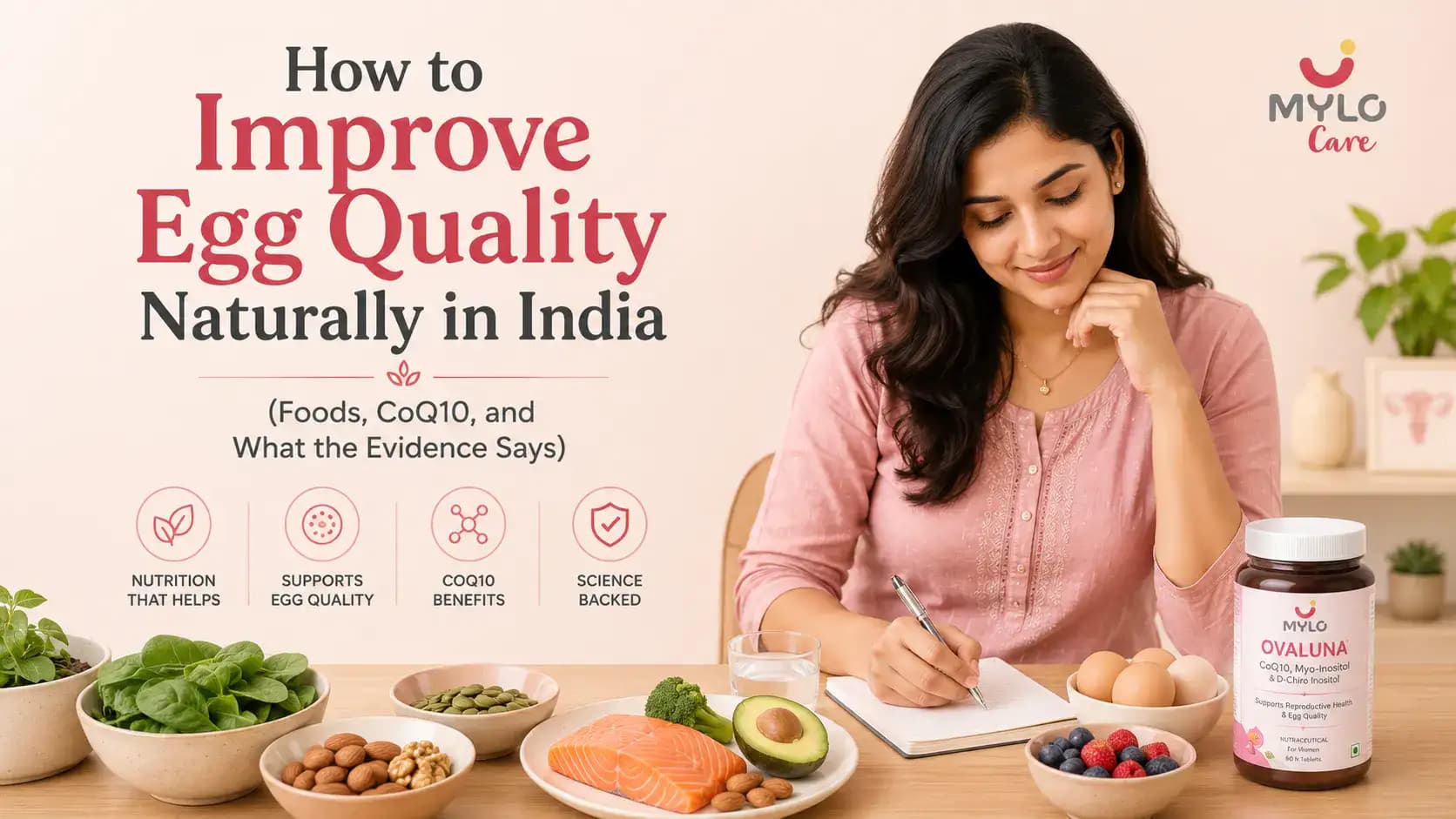
How to Improve Egg Quality Naturally in India (Foods, CoQ10, and What the Evidence Says)


BDS (Gold Medalist), Certified Lactation Consultant – BPNI Delhi, Maternal & Infant Nutrition Expert · 15 years experience
 16 min
You can improve egg quality naturally to a real but limited degree: good nutrition, key nutrients like CoQ10, and steady lifestyle habits support the health of the eggs you already have, but nothing reverses your age or adds to the number of eggs you were born with. Because a follicle takes about 90 days to mature into the egg you release, any change you make needs at least three months to show up, which is why the popular idea of improving egg quality in 30 days overpromises. Egg quality declines with age, mainly due to mitochondrial dysfunction and oxidative stress inside the egg, and this speeds up after 35 (Jiang et al., 2025). The useful news is that this same three-month window is exactly what you can influence.
TL;DR: Egg quality can be supported but not reversed. You cannot make old eggs young or grow more of them, but you can protect the eggs maturing over the next 90 days with antioxidants, a whole-food diet, and evidence-based supplements. CoQ10 is the standout: a 2018 randomised trial and a 2024 meta-analysis of 1,529 women found it improved ovarian response and raised pregnancy rates, mostly in women with diminished ovarian reserve going through IVF. Age is the single biggest factor, and there is no reliable outward "sign" of egg quality, it is inferred from age, ovarian reserve tests, and IVF response. Give any plan three consistent months.
Can You Really Improve Egg Quality Naturally?
You can support egg quality, but you cannot reverse it. A woman is born with all the eggs she will ever have, and both the number and quality fall with age, so no food or supplement makes an older egg young again or increases your egg count (Jiang et al., 2025).
What you can influence is the environment in which your eggs finish maturing. Each egg spends roughly its final 90 days developing before ovulation, and during that window its quality is shaped by oxidative stress, energy supply, and overall health. This is the three-month runway that diet, nutrients, and lifestyle actually reach.
This is also why timelines shorter than three months do not add up. Searches for improving egg quality "in 30 days" or "in 10 days" are common, but the biology of a roughly 90-day maturation cycle means meaningful change takes about three months of consistency. For a structured plan to work through, see Mylo's guide to improving egg quality over the weeks ahead.
Set expectations honestly. Supporting egg quality improves your odds and your general reproductive health, but it is not a guarantee of pregnancy, and anyone with a specific concern should see a fertility specialist rather than rely on self-care alone.
Why Egg Quality Declines with Age, and What "Egg Quality" Means
Egg quality refers to how genetically normal and energy-capable an egg is, which determines whether it can fertilise and develop into a healthy embryo. The main reason quality falls with age is inside the egg: the mitochondria, the tiny structures that produce energy, become less efficient, and oxidative stress accumulates, especially after the age of 35 (Jiang et al., 2025).
Age is the single strongest factor, and it works on two fronts at once. The number of eggs (your ovarian reserve) drops steadily, and the proportion of eggs with the right chromosomes also falls, which is why both getting pregnant and staying pregnant get harder over time.
Indian data show the same steep curve. In a study of 5,525 women seeking fertility care in India, the median AMH, a marker of how many eggs remain, fell from about 4.23 ng/mL at ages 20 to 25 to 1.28 at 36 to 40 and 0.52 by 40 to 44 (Gunasheela et al., 2021).
Some issues are more common than many families realise. Ovulatory and hormonal disorders are frequent enough in India that the Indian Council of Medical Research ran a nationwide study of 7,107 reproductive-age women to map polycystic ovary syndrome and related conditions (ICMR-PCOS study, 2021). Conditions like PCOS affect ovulation and cycle regularity, which is a separate issue from egg quality but often sits alongside it.
Understanding the mechanism points to the fix. If oxidative stress and weak mitochondrial energy drive the decline, then the levers that help are the ones that lower oxidative stress and support cellular energy, which is where diet and CoQ10 come in.
How Do You Check Egg Quality, and Are There Signs of Poor Egg Quality?
There is no simple test that measures egg quality directly, and there are no reliable outward signs you can feel. Egg quality is inferred, not observed, which is important to know before you read lists of supposed symptoms.
Two tests estimate your ovarian reserve, meaning the quantity of eggs, not their quality:
AMH (Anti-Mullerian Hormone) is a blood test that reflects how many eggs remain. A low AMH suggests a smaller reserve, but it does not tell you whether those eggs are good quality, and many women with a low AMH still conceive.
AFC (Antral Follicle Count) is an ultrasound that counts the small follicles at the start of a cycle, another measure of quantity rather than quality.
Reserve can also be lower than age alone suggests. In the same study of Indian women seeking fertility care, 55.7% of those with a low AMH were under 35 (Gunasheela et al., 2021), so an actual test beats assuming your reserve is fine because you are young.
Egg quality itself is judged mainly by age and, when relevant, by how eggs behave during IVF, such as how many fertilise and develop into healthy embryos. So the honest answer to "what are the signs of bad egg quality" is that there usually are none you can notice at home. Irregular cycles, PCOS, or age over 35 are indirect flags worth discussing with a doctor, but they are not proof on their own. If you want your reserve assessed, ask your gynaecologist about AMH and AFC. Mylo's explainer on diminished ovarian reserve covers what low results mean.
Which Foods Support Egg Quality in an Indian Diet?
The best diet for egg quality is an antioxidant-rich, whole-food diet, because antioxidants counter the oxidative stress that damages eggs as they mature (Jiang et al., 2025). No single "superfood" fixes egg quality, but a consistent pattern of nutrient-dense Indian meals gives your eggs a better environment over their 90-day window.
Build your plate around these groups:
Leafy greens and dals. Spinach, methi, and lentils supply folate, iron, and protein. Folate is the established preconception nutrient, and every woman trying to conceive is advised to get enough.
Nuts and seeds. Walnuts, flaxseed, pumpkin and sunflower seeds add omega-3 fats, zinc, and vitamin E, all involved in cell protection and hormone health.
Colourful fruit and vegetables. Berries, pomegranate, carrots, and beetroot are rich in antioxidants that help protect eggs from oxidative damage.
Omega-3 sources. Fatty fish for those who eat it, or flaxseed, walnuts, and algal options for vegetarians, support the anti-inflammatory side of reproductive health.
Whole grains and legumes. Millets, brown rice, rajma, and chana keep blood sugar steady, which matters for hormone balance, particularly in women with PCOS.
It is as useful to trim the foods that add oxidative and metabolic stress. Cut back on ultra-processed foods, trans fats, deep-fried snacks, and excess sugar, and keep caffeine and alcohol moderate. A whole-food Indian diet, not a list of exotic imports, is what the evidence points toward.
CoQ10 and Fertility Supplements: What the Evidence Actually Shows
Of all the supplements marketed for egg quality, coenzyme Q10 (CoQ10) has the most credible evidence. CoQ10 is an antioxidant your cells use to make energy, and it supports the mitochondrial energy production that eggs depend on while reducing oxidative stress (Jiang et al., 2025).
The trial evidence is real, with one important caveat about who it was studied in. A 2018 randomised controlled trial of 186 young women with decreased ovarian reserve found that CoQ10 at 600 mg a day for 60 days before IVF improved ovarian response and embryo quality and lowered the chance of a cancelled cycle (Xu et al., 2018). A 2024 meta-analysis pooling 6 trials and 1,529 women with diminished ovarian reserve went further, finding CoQ10 pretreatment before IVF led to more eggs retrieved and a significantly higher clinical pregnancy rate (Lin et al., 2024).
Read that evidence honestly. It comes mostly from women with diminished ovarian reserve going through IVF, not from healthy women conceiving naturally, so CoQ10 is best seen as promising and mechanistically sound rather than proven for everyone. Discuss dose and suitability with your doctor, especially the pretreatment window, since benefits track that roughly three-month maturation cycle. Folate is the other non-negotiable, recommended for every woman trying to conceive. To go deeper, read Mylo's overview of CoQ10 for men and women.
This is the thinking behind a pre-conception supplement like Mylo Ovaluna, which is a nutraceutical, not a fertility treatment. Ovaluna combines the nutrients studied for egg and reproductive health in one daily capsule, and is designed to support egg quality, ovulation, and hormonal balance rather than to guarantee conception.
Ingredient in Ovaluna | What it is | Why it is included |
CoQ10 | An antioxidant used for cellular energy | Supports the mitochondrial energy that oocytes need, the ingredient with the most trial evidence |
L-Methylfolate | The active, ready-to-use form of folate | The established preconception nutrient for early development |
Zinc | An essential mineral | Supports hormone balance and reproductive health |
Vitamin D2 | A vitamin | Involved in hormonal and ovarian function |
Vitamin B12 | A vitamin | Supports cell development and works alongside folate |
Shatavari | A traditional Ayurvedic women's tonic (Asparagus racemosus) | Included for its long traditional use as a women's tonic, not as a proven egg-quality treatment |
Ovaluna is a 60-capsule, roughly three-month course meant to sit alongside a good diet, not replace it. As with any supplement, run it past your doctor first, particularly if you have a medical condition or take other medication.
Which Lifestyle Habits Protect Egg Quality?
Lifestyle carries as much weight as any supplement, because sleep, stress, weight, and toxins all feed the oxidative stress that ages eggs. These habits work over the same three-month window and cost nothing.
Stop smoking and limit alcohol. Smoking is one of the clearest accelerators of ovarian ageing, and cutting it out is among the highest-value changes you can make for egg health.
Reach a healthy weight gradually. Both very high and very low body weight disrupt hormones and ovulation, so a steady, moderate approach to weight supports a more regular cycle.
Protect your sleep. Aim for 7 to 8 hours, since sleep supports the hormone balance and repair processes that egg maturation relies on.
Manage stress actively. Chronic stress disrupts the hormones that govern ovulation, so light yoga, breathing, or walking are worth building into the day.
Move moderately. Brisk walking and gentle exercise support blood flow and metabolic health, while very intense training can work against a regular cycle, so aim for the middle.
None of these is a quick fix, and that is the point. They work by consistency across a full cycle of egg maturation, so treat them as a routine rather than a sprint. For more on this stage, see Mylo's guide to fertility in your 30s.
Frequently Asked Questions About Improving Egg Quality
Can you really improve egg quality naturally?
You can support egg quality, but you cannot reverse it. Nutrition, antioxidants, CoQ10, and lifestyle protect the eggs maturing over the next 90 days, yet nothing makes an older egg young again or increases your total egg count (Jiang et al., 2025). Age remains the biggest single factor. Think of natural steps as improving the environment your eggs mature in and supporting your overall reproductive health, which is worthwhile, but not a guarantee of pregnancy.
Can egg quality improve in 30 days?
No, 30 days is not enough. An egg takes roughly 90 days to mature before it is released, so changes to diet, supplements, and lifestyle need about three months to affect the eggs you ovulate (Jiang et al., 2025). Claims of results in 30 or 10 days overpromise. Start now, but judge the effort over a full three-month cycle rather than weeks.
How do you check egg quality in a woman?
There is no test that measures egg quality directly. Two tests estimate ovarian reserve, meaning egg quantity: AMH, a blood test, and AFC, an ultrasound count of small follicles. Both tell you roughly how many eggs remain, not how good they are. Egg quality itself is judged mainly by age and, during IVF, by how eggs fertilise and develop. Ask your gynaecologist about AMH and AFC if you want your reserve assessed.
What are the signs of bad egg quality?
There are usually no signs you can feel, because egg quality is not something the body signals outwardly. It is inferred from age, ovarian reserve tests, and IVF outcomes, not from symptoms. Irregular periods, PCOS, or being over 35 are indirect flags worth discussing with a doctor, but none of them proves poor egg quality on its own. Anyone worried should seek a proper assessment rather than rely on symptom checklists.
Does CoQ10 improve egg quality?
The evidence is promising, mainly in one group. A 2018 randomised trial and a 2024 meta-analysis of 1,529 women found CoQ10 before IVF improved ovarian response, egg numbers, and pregnancy rates in women with diminished ovarian reserve (Xu et al., 2018; Lin et al., 2024). CoQ10 works by supporting the mitochondrial energy eggs need. Because most evidence is in IVF and low-reserve patients, treat it as helpful and biologically sound rather than proven for everyone, and confirm the dose with your doctor.
What foods improve egg quality?
An antioxidant-rich, whole-food diet supports egg quality by countering oxidative stress. Prioritise leafy greens and dals for folate, nuts and seeds for omega-3 and zinc, colourful fruit and vegetables like berries and pomegranate for antioxidants, and whole grains for steady blood sugar. Limit ultra-processed foods, trans fats, and excess sugar. No single food is a fix, but a consistent Indian diet built on these groups gives your eggs a better environment over their three-month maturation.
Are fertility supplements like Ovaluna safe, and do they help?
Ovaluna is a pre-conception nutraceutical, not a fertility treatment, and it combines CoQ10, L-methylfolate, zinc, vitamin D2, vitamin B12, and Shatavari to support egg quality, ovulation, and hormonal balance. CoQ10 and folate are the ingredients with the strongest evidence behind them, while Shatavari is included for its traditional use as a women's tonic. Supplements support a good diet rather than replace it, and you should check any supplement with your doctor first, especially if you have a health condition.
At what age does egg quality start to drop?
Egg quality declines gradually through the reproductive years and falls faster after the age of 35, driven by mitochondrial ageing and oxidative stress inside the egg (Jiang et al., 2025). This is normal biology, not something you have done wrong. You cannot stop the decline, but you can support the eggs you have with diet, CoQ10, and lifestyle, and if you are over 35 and trying to conceive, it is reasonable to speak with a fertility specialist sooner rather than later.
Sources
Jiang Y, Han Y, Qiao P, Ren F. "Exploring the protective effects of coenzyme Q10 on female fertility," Frontiers in Cell and Developmental Biology, 2025. https://pmc.ncbi.nlm.nih.gov/articles/PMC12425901/
Xu Y, et al. "Pretreatment with coenzyme Q10 improves ovarian response and embryo quality in low-prognosis young women with decreased ovarian reserve: a randomized controlled trial," Reproductive Biology and Endocrinology, 2018. https://pmc.ncbi.nlm.nih.gov/articles/PMC5870379/
Lin G, Li X, Yie SLJ, Xu L. "Clinical evidence of coenzyme Q10 pretreatment for women with diminished ovarian reserve undergoing IVF/ICSI: a systematic review and meta-analysis," Annals of Medicine, 2024. https://pmc.ncbi.nlm.nih.gov/articles/PMC11321116/
Ganie MA, et al. "Indian Council of Medical Research-Polycystic Ovary Syndrome (ICMR-PCOS) Study," JMIR Research Protocols, 2021. https://www.sciencedirect.com/org/science/article/pii/S1929074821005011
Gunasheela D, et al. "Age-Specific Distribution of Serum Anti-Mullerian Hormone and Antral Follicle Count in Indian Infertile Women," Journal of Human Reproductive Sciences, 2021. https://pmc.ncbi.nlm.nih.gov/articles/PMC8812401/

Shop Now
Rich Picks for Your Pregnancy




Article Posted Under
Related Articles


Related Topics
.webp&w=32&q=75)
Medical Disclaimer
This content is for informational purposes only and should not replace professional medical advice. Consult with a physician or other health care professional if you have any concerns or questions about your health. If you rely on the information provided here, you do so solely at your own risk.


AWARDS AND RECOGNITION

Mylo wins Forbes D2C Disruptor award

Mylo wins The Economic Times Promising Brands 2022
AS SEEN IN













- Mylo Care: Effective and science-backed personal care and wellness solutions for a joyful you.
- Mylo Baby: Science-backed, gentle and effective personal care & hygiene range for your little one.
- Mylo Community: Trusted and empathetic community of 10mn+ parents and experts.


Product Categories
Baby Carrier | Baby Soap | Baby Wipes | Stretch Marks Cream | Baby Cream | Baby Shampoo | Baby Massage Oil | Baby Hair Oil | Stretch Marks Oil | Baby Body Wash | Baby Powder | Baby Lotion | Diaper Rash Cream | Newborn Diapers | Teether | Baby Kajal | Baby Diapers Pants | Cloth Diapers | Laundry Detergent | Lactation Granules |