


Orders
.png&w=48&q=75 "login")
Profile


Wallet

How Often Should You Change Your Baby's Diaper?

 22 min
Quick Answer
Change a newborn's diaper every 2 to 3 hours, which works out to around 10 to 12 times a day. From about 3 months, every 3 to 4 hours is usually enough, so 6 to 8 times a day. Change a soiled diaper immediately, whatever the time. A wet diaper should be changed as soon as you notice it, not at the next scheduled slot.
Key Takeaways
Newborns need 10 to 12 changes a day. That drops to 6 to 8 by 3 months and 5 to 7 in the toddler years, because bladder capacity grows.
Poop always goes immediately. Stool enzymes and the higher pH they create damage the skin barrier faster than urine alone does.
"12 hour protection" is an absorbency rating, not permission to leave a diaper on for 12 hours. No diaper brand intends that reading.
Cloth diapers usually need changing after each pee, because fibres hold moisture against the skin instead of locking it into a gel core.
If you are changing far more often than these numbers because of leaks, the problem is almost always size and fit rather than frequency.
How Often Should a Diaper Be Changed, by Age?
Frequency falls as your baby grows. A newborn passes small amounts of urine very often, while a toddler passes a much larger volume less frequently. The interval changes, but the rule behind it never does: change when wet or soiled, not when the clock says so.
Age | Typical interval | Changes per day | What is driving it |
|---|---|---|---|
0 to 6 weeks | Every 2 to 3 hours | 10 to 12 | Frequent small pees, frequent stools, feeding round the clock |
6 weeks to 3 months | Every 2 to 3 hours | 8 to 10 | Feeds settle into a pattern, stools become less frequent |
3 to 6 months | Every 3 to 4 hours | 6 to 8 | Bladder holds more, so volume per pee rises |
6 to 12 months | Every 3 to 4 hours | 5 to 8 | Solids begin, stools change in texture and smell |
1 to 2 years | Every 3 to 4 hours | 5 to 7 | Fewer but much larger pees, more movement and friction |
2 to 3 years | Every 4 hours, plus after naps | 4 to 6 | Early bladder control, potty learning beginning |
Treat these as ranges rather than targets. Two healthy babies of the same age can sit at opposite ends of them.
Wet Diaper or Soiled Diaper: Which One Can Wait?
Neither should wait long, but a soiled diaper is the more urgent of the two and should be changed as soon as you know about it.
Urine on its own irritates skin mainly by keeping it damp and over hydrated, which makes it fragile and prone to chafing. Stool adds two further problems. It raises the pH of the skin surface, and it brings digestive enzymes that break down the skin barrier directly. Urine and stool together are considerably harder on skin than either alone, which is why a diaper holding both needs immediate attention.
Wet only | Soiled | |
|---|---|---|
How soon to change | As soon as you notice | Immediately |
Main risk to skin | Over hydration and friction | Enzyme damage plus raised pH plus wetness |
Can it wait for a feed to finish? | Usually yes | No |
Overnight, if your baby is asleep | Judgement call, see the night section below | Change, even if it wakes them |
Cleaning needed | Wipe or plain water, front to back | Thorough cleaning of every skin fold, then dry properly |
What Does "12 Hour Protection" Actually Mean?
It describes how long the absorbent core can keep holding liquid without leaking. It is not a recommended wear time, and no manufacturer intends it as one.
This is worth being clear about because it is the single most common misreading of diaper packaging, and it leads directly to rashes. A high absorbency rating tells you the diaper will not leak during a long stretch such as night sleep. It says nothing about whether your baby's skin should be in contact with a full diaper for that long.
Two things a leak protection figure does not tell you:
Whether the diaper contains stool. Absorbency is irrelevant to that. Any soiled diaper needs changing regardless of how much capacity is left.
Whether the diaper is comfortable. A diaper holding several hours of urine is heavier, warmer and bulkier, and it rubs differently against the skin than a fresh one.
The practical reading: use high absorbency for the one stretch you genuinely cannot interrupt, usually night sleep, and change on the normal schedule for the rest of the day.
What Changes the Number for Your Baby?
The age chart is a starting point. Six things move your baby up or down within it.
Factor | Effect on how often you change |
|---|---|
Feeding type | Exclusively breastfed babies often pass looser, more frequent stools in the early months, so more changes. Formula fed babies tend to pass firmer, less frequent stools |
Starting solids | Stools become firmer, smellier and less frequent, so soiled changes drop but each one needs more thorough cleaning |
Diaper type | Cloth needs changing after roughly every pee. A disposable pant with a gel core can hold more than one |
Size and fit | A diaper at the top of its weight range fills faster and leaks sooner. Correct sizing often reduces changes rather than increasing them |
Illness | Diarrhoea can mean a change every 30 to 60 minutes, and the skin needs barrier cream at every single change during it |
Weather and activity | Heat and sweat keep skin damp for longer, so a wet diaper becomes uncomfortable faster in an Indian summer than in winter |
How Long Can a Baby Wear a Diaper at Night?
Most babies over about 3 months can go through one longer overnight stretch in a well fitted, high absorbency diaper, changed once if they wake. Newborns are different: in the first weeks they usually wake to feed every 2 to 3 hours anyway, and that is the natural moment to change them.
Should you wake a sleeping baby to change a wet diaper? Generally no. Sleep matters for growth and for you, and most paediatricians would not have you wake a baby purely because a diaper is wet. Three exceptions:
The diaper is soiled. Change it, even if it wakes them.
Your baby has an active rash. Prolonged contact makes it worse, so during a rash it is worth changing overnight.
The diaper has clearly leaked. Wet clothes and bedding need dealing with anyway.
If overnight leaks are the problem rather than timing, the fix is size, not frequency. Overnight leaks usually escape upwards at the back rather than at the legs, so check that the diaper sits high enough behind and that the elastic is in the thigh crease.
How Do You Know It Is Time, Without Checking Constantly?
Most diaper pants now carry a wetness indicator, a strip that changes colour, usually yellow to blue or green, as it gets wet. It removes almost all the guesswork, and it is the single most useful feature on a modern diaper for exactly this reason.
Beyond the indicator, these are the reliable signals:
What you notice | What it means | What to do |
|---|---|---|
Indicator strip has changed colour along most of its length | Core is well used | Change now |
Diaper feels heavy, or sags away from the body | Core is full or close to it | Change now |
Diaper looks swollen or lumpy between the legs | Gel has expanded fully | Change now, and check the size is still right |
Baby suddenly fussy, squirming, or waking early from a nap | Discomfort, often from a full diaper | Check the diaper before assuming hunger |
Red marks or indentations at the waist or thighs after removal | Fit is too tight, or the size is too small | Move up a size, or loosen the fit |
Repeated leaks in a diaper that is not full | Fit problem, not a capacity problem | Check leg elastic placement and how high the back sits |
Smell before you see anything | Usually stool | Change immediately |
Is Your Diaper Size Actually Right? The Hidden Cause of Extra Changes
If you feel like you are changing constantly and still dealing with leaks, size is the first thing to check, ahead of frequency or brand. A diaper near the top of its weight range runs out of capacity faster and gaps at the legs, which produces exactly the pattern of leaks that makes parents assume they need to change more often.
Mylo Baby Diaper Pants are sized as follows. Weigh your baby rather than guessing, and if they sit between two sizes, the larger one is usually the better choice for overnight.
Size | Weight range | Roughly which age | Where to look |
|---|---|---|---|
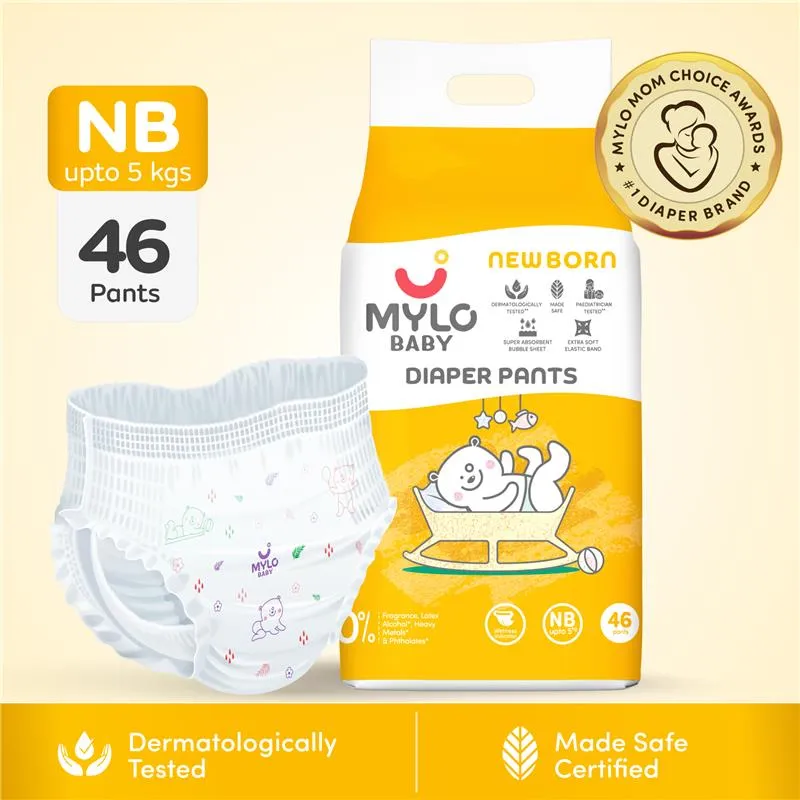
New Born (NB) | Up to 5 kg | Birth to about 6 weeks | |
Small (S) | 4 to 8 kg | About 1 to 4 months | |
Medium (M) | 7 to 12 kg | About 4 to 10 months | |
Large (L) | 9 to 14 kg | About 9 to 18 months | |
Extra Large (XL) | 12 to 17 kg | About 18 months and up | |
XXL | 15 to 25 kg | Older toddlers | See the full diaper pants range |
For the newborn weeks, one practical note: if the umbilical stump is still healing, a New Born tape style diaper is easier to fold below the navel than a pull up pant.
At the other end, the Mylo Airprime Premium Diaper Pants range also extends into the larger sizes, with a colour changing wetness indicator, so a heavier toddler is not forced into a pant that has run out of room. XL covers 12 to 17 kg in 24 count, 48 count and 96 count, and XXL covers 15 to 25 kg in 24 count, 48 count and 96 count.
Does Changing Often Enough Actually Prevent Diaper Rash?
It is the single most effective thing you can do, though nothing prevents rash entirely. Irritant diaper rash develops when skin stays damp and over hydrated, rubs against a wet surface, and sits in urine and stool that raise the pH and activate enzymes. Changing promptly interrupts all three at once, which is why guidance from the NHS, the American Academy of Pediatrics and the Indian Academy of Pediatrics all comes down to the same instruction: change as soon as the diaper is wet or soiled, and keep the area clean and dry.
Alongside frequency, four things help:
Dry the skin properly before the fresh diaper goes on. A clean diaper on damp skin undoes the point of the change.
Use a thin barrier cream if the skin looks pink, and at every change during a bout of diarrhoea.
Allow some nappy free time where the room and the weather allow it.
Skip talcum powder. The American Academy of Pediatrics advises against baby and talcum powders, because inhaled talc can cause serious lung problems in babies.
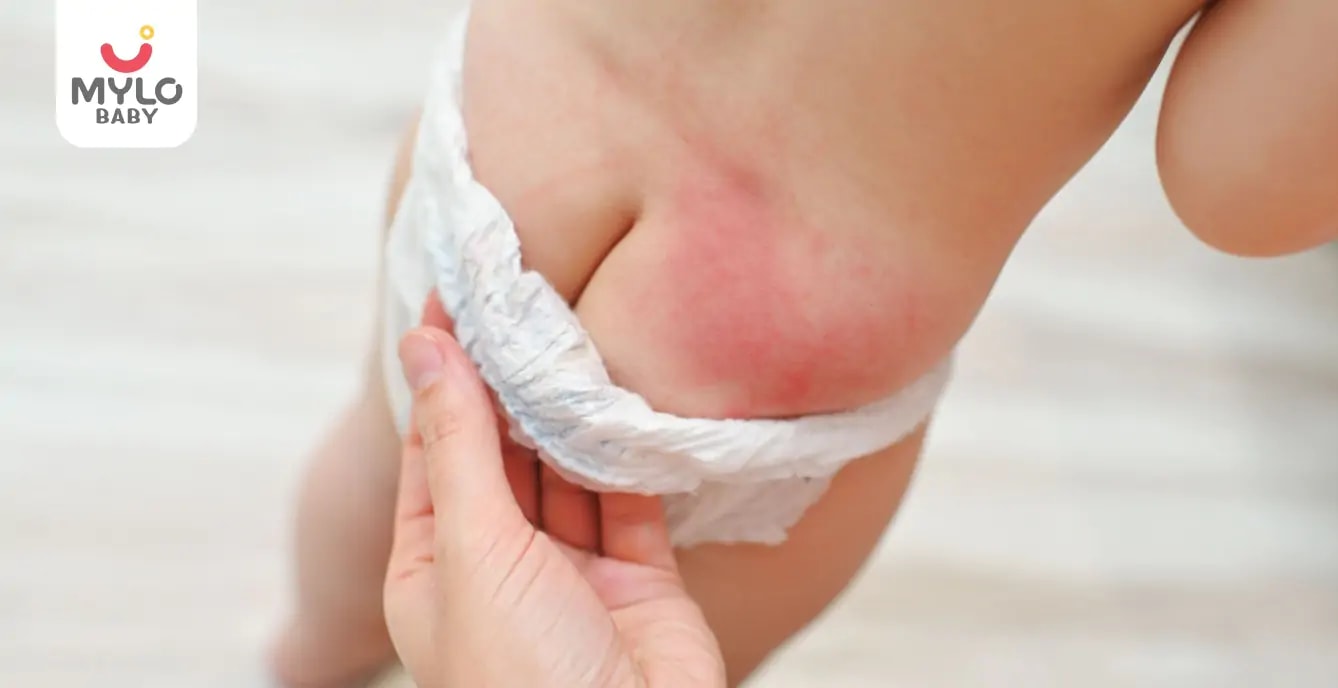
If a rash has not improved within 2 to 3 days of frequent changing and barrier cream, or if it blisters, weeps or comes with fever, that needs a doctor rather than a change of brand.
How to Make Changes Faster, Especially at Night and Away From Home
Frequency is easier to keep up when the change itself takes 90 seconds instead of five minutes.
Set up two stations, one where you sleep and one where you spend the day, each with diapers, wipes, cream, a change of clothes and a bag for waste. Walking to another room at 3 am is what makes overnight changes feel impossible.
Keep night changes dim and quiet. Minimum light, no talking or play, straight back down. The goal is a change that does not end the sleep.
Pre pack a go bag and restock it when you get home rather than before you leave.
Buy the pack size that matches your reality. Jumbo packs cost less per diaper but only if you use them before your baby moves up a size, so buy small packs when a size change is close and large packs when you have just moved up.
In an Indian summer, change in the coolest room you have and let the skin air for a minute before the fresh diaper goes on. In winter, change in a warm room, but do not stretch the interval just because it is cold.
Write the routine down if a grandparent or helper shares the changes. A shared rule beats each person using their own judgement.
How Many Diapers Will You Actually Get Through?
Useful for budgeting and for deciding pack sizes.
Age | Per day | Per month, approximately | Pack size that makes sense |
|---|---|---|---|
0 to 6 weeks | 10 to 12 | 300 to 360 | Smaller packs, because babies leave New Born size fast |
6 weeks to 3 months | 8 to 10 | 240 to 300 | Medium packs, size changes are still frequent |
3 to 12 months | 6 to 8 | 180 to 240 | Jumbo packs, since babies stay in M and L longer |
1 to 3 years | 5 to 7 | 150 to 210 | Jumbo packs, XL and XXL last many months |
The one that catches most families out is New Born size. Babies often outgrow it within 4 to 6 weeks, so a very large pack can go to waste.
What About Cloth Diapers?
Cloth works on a different mechanism, so it works on a different schedule. A cotton or bamboo insert holds urine as liquid in its fibres rather than converting it to gel, which means the wet surface is the surface touching your baby. In practice a cloth diaper usually needs changing after each pee, or at least every 2 to 3 hours.
Boosting the insert raises capacity but does not keep the skin dry, so it solves leaks on a car journey rather than allowing a longer stretch. For insert capacity, the wetness check, drying and rotation in Indian conditions, and how many inserts you need, see whether a cloth diaper needs changing after every pee.
Many families use cloth for the predictable hours at home and a disposable pant for nights, travel and clinic days. That is a sensible allocation rather than a compromise.
Diaper Changing Myths, Corrected
Common belief | What is actually true |
|---|---|
A 12 hour diaper can be worn for 12 hours | That figure describes leak protection, not wear time. Use it for one long stretch such as night sleep, and change normally the rest of the day |
You should never wake a sleeping baby to change them | True for a wet diaper in most cases. Not true for a soiled diaper, an active rash, or a leak |
Talcum powder keeps the diaper area dry | The AAP advises against baby and talcum powders, since inhaled talc can cause serious breathing problems in babies |
Diapers themselves cause rash | Prolonged contact with wetness and stool causes rash. Timing and fit matter far more than the product |
Frequent leaks mean you need a more absorbent diaper | Usually they mean the size or fit is wrong. Check the weight range and the leg elastic before changing brand |
Wipes are harsher than water | Fragrance free, alcohol free wipes are fine for most babies. Fragranced wipes are the ones worth avoiding on sensitive skin |
A tight diaper prevents leaks | Tight diapers cause marks and chafing. Two fingers should slide in at the waist, with the elastic sitting in the thigh crease |
Mylo Parents Asked
Bacche ka diaper kitne ghante mein badalna chahiye?
Naye born bacche ka har 2 se 3 ghante mein, roughly 10 se 12 baar din bhar. 3 mahine ke baad har 3 se 4 ghante kaafi hai. Potty hone par turant badalna chahiye, chahe kitna bhi time ho.
Raat mein diaper kitni der tak rakh sakte hain?
3 mahine se bade bacche ek lambi raat ki neend ek acche fitting, high absorbency diaper mein nikal sakte hain, aur uthne par badal dein. Lekin potty ho jaye ya rash ho, to raat mein bhi badalna zaroori hai.
My baby is 13 kg and the L pant leaks every night. Should I move up a size?
Very likely yes. At 13 kg you are near the top of the L range, so the diaper is running out of capacity before morning. Move to XL, which covers 12 to 17 kg, and check that the back sits high enough, because overnight leaks usually escape upwards rather than at the legs.
Can I leave a wet diaper on for a couple of extra hours if my baby seems comfortable?
Better not to. A baby will not always protest a wet diaper, and skin damage builds up before it becomes visible. If a diaper is wet, change it. The exception people reasonably make is a night time stretch in a high absorbency diaper on a baby with no rash.
My newborn poops after almost every feed. Do I really need a fresh diaper each time?
Yes. Stool is the more damaging of the two, and frequent stools in the early weeks are a good sign that feeding is going well. This is genuinely why newborns need 10 to 12 changes a day.
My baby has diarrhoea. How often now?
Every time, which may be every 30 to 60 minutes. Use plain water and cotton rather than repeated wiping, apply a barrier cream at every change, and watch for signs of dehydration such as fewer wet diapers, a dry mouth or unusual drowsiness. Diarrhoea in a baby under 3 months needs medical advice.
Is it fine to reuse a diaper if my baby only wet it slightly?
No. Once the core has absorbed urine it cannot be reset, and putting it back means putting your baby's skin back against it. If you are trying to reduce waste and cost, cloth for the daytime hours is the option that actually addresses that.
Should I change the diaper before or after a feed?
Before usually works better for newborns, since a change afterwards means moving a full stomach around, which can bring up milk. If your baby soils during a feed, finish the feed first if you can and then change, unless they are distressed.
When Should You Speak to a Doctor?
Contact your paediatrician if you notice:
A rash that has not improved within 2 to 3 days of frequent changing and barrier cream
Blisters, open sores, pus, yellow crusting or bleeding in the diaper area
A bright red rash with a clear border and small spots spreading beyond it, which can indicate a fungal infection needing prescribed treatment
Fever alongside a rash in the diaper area
Far fewer wet diapers than usual, dark or strong smelling urine, or a baby who is unusually drowsy or hard to rouse, which can indicate dehydration and needs same day attention
Diarrhoea in a baby under 3 months, or diarrhoea lasting more than a day in an older baby
Pain, swelling or crying on passing urine
Blood in the urine or stool
This article is general information and does not replace an examination. Any diagnosis or medicine for your baby's skin should come from your own doctor.
Bottom Line
Every 2 to 3 hours for a newborn, every 3 to 4 hours from about 3 months, and immediately for any soiled diaper. Read absorbency ratings as leak protection rather than as wear time, and if leaks are pushing you to change more often than these numbers suggest, check the size and fit before anything else. Prompt changing, a properly dried bottom and a diaper that actually fits do more for your baby's skin than any single product feature.
References
NHS, UK. Nappy rash.
American Academy of Pediatrics, HealthyChildren.org. Common Diaper Rashes and Treatments.
American Academy of Pediatrics, HealthyChildren.org. Make Baby's Room Safe: Parent Checklist.
Stamatas GN, Tierney NK. Diaper dermatitis: etiology, manifestations, prevention, and management. Pediatric Dermatology. 2014;31(1):1-7.
Indian Academy of Pediatrics. Guidelines for Pediatric Skin Care. Indian Pediatrics. 2021.
Indian Academy of Pediatrics. Care of Newborn Skin.
StatPearls, NCBI Bookshelf. Diaper Dermatitis.


Shop Now
New Baby Essentials
.webp&w=1900&q=75)



Article Posted Under
Related Articles



Related Topics
.webp&w=32&q=75)
Medical Disclaimer
This content is for informational purposes only and should not replace professional medical advice. Consult with a physician or other health care professional if you have any concerns or questions about your health. If you rely on the information provided here, you do so solely at your own risk.


AWARDS AND RECOGNITION

Mylo wins Forbes D2C Disruptor award

Mylo wins The Economic Times Promising Brands 2022
AS SEEN IN













- Mylo Care: Effective and science-backed personal care and wellness solutions for a joyful you.
- Mylo Baby: Science-backed, gentle and effective personal care & hygiene range for your little one.
- Mylo Community: Trusted and empathetic community of 10mn+ parents and experts.


Product Categories
Baby Carrier | Baby Soap | Baby Wipes | Stretch Marks Cream | Baby Cream | Baby Shampoo | Baby Massage Oil | Baby Hair Oil | Stretch Marks Oil | Baby Body Wash | Baby Powder | Baby Lotion | Diaper Rash Cream | Newborn Diapers | Teether | Baby Kajal | Baby Diapers Pants | Cloth Diapers | Laundry Detergent | Lactation Granules |