


Orders
.png&w=48&q=75 "login")
Profile


Wallet

Head Circumference Chart for Toddlers: What's Normal From 1 to 3 Years? (WHO Standards, 2026)
 15 min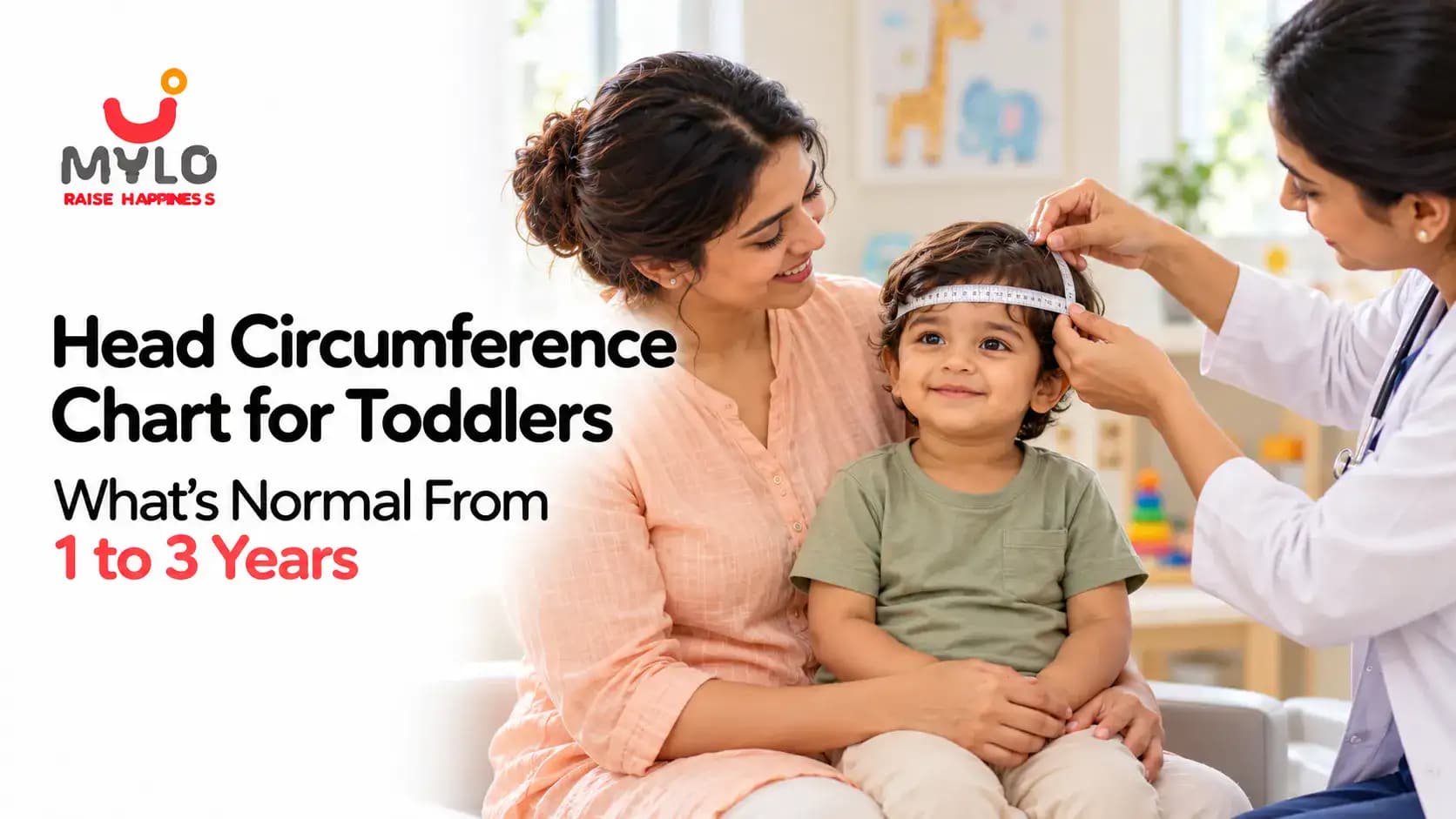
Quick Answer
At 1 year, the average head circumference is about 46.1 cm for boys and 44.9 cm for girls. By 3 years, it's about 49.5 cm for boys and 48.5 cm for girls. Head growth slows a lot after the first birthday. Anything between the 3rd and 97th percentile is usually normal.
Toddler Head Circumference at a Glance (WHO Averages)
Age | Boys (Average) | Girls (Average) |
|---|---|---|
1 year (12 months) | 46.1 cm | 44.9 cm |
1.5 years (18 months) | 47.4 cm | 46.2 cm |
2 years (24 months) | 48.3 cm | 47.2 cm |
2.5 years (30 months) | 48.9 cm | 47.9 cm |
3 years (36 months) | 49.5 cm | 48.5 cm |
Averages are the WHO 50th percentile. Source: WHO Child Growth Standards: Head Circumference-for-Age.
Key Facts Every Parent Should Know
Head growth slows after age 1: Babies' heads grow about 11 to 12 cm in the first year, but only about 2 cm in the second year and just over 1 cm in the third year (calculated from WHO averages)
3rd to 97th percentile: The range where most healthy toddlers fall
Head size reflects brain growth: That's why doctors measure it at check-ups in the early years
Family matters: Many children with a slightly large or small head simply take after a parent
The trend matters most: A head that stays on its own curve is reassuring
India uses WHO charts for children under 5, as recommended by the Indian Academy of Pediatrics
What Is the Head Circumference Chart for Boys From 1 to 3 Years?
Short answer: Most healthy boys aged 1 to 3 years have a head circumference between the 3rd and 97th percentile: about 43.6 to 48.5 cm at 1 year and about 46.8 to 52.1 cm at 3 years.
Age | 3rd Percentile | 50th Percentile (Average) | 97th Percentile |
|---|---|---|---|
12 months | 43.6 cm | 46.1 cm | 48.5 cm |
15 months | 44.3 cm | 46.8 cm | 49.3 cm |
18 months | 44.9 cm | 47.4 cm | 49.9 cm |
21 months | 45.3 cm | 47.8 cm | 50.4 cm |
24 months | 45.7 cm | 48.3 cm | 50.8 cm |
27 months | 46.0 cm | 48.6 cm | 51.2 cm |
30 months | 46.3 cm | 48.9 cm | 51.6 cm |
33 months | 46.6 cm | 49.2 cm | 51.9 cm |
36 months | 46.8 cm | 49.5 cm | 52.1 cm |
Source: WHO Head Circumference-for-Age, Boys (Percentiles).
What Is the Head Circumference Chart for Girls From 1 to 3 Years?
Short answer: Most healthy girls aged 1 to 3 years have a head circumference between the 3rd and 97th percentile: about 42.3 to 47.5 cm at 1 year and about 45.9 to 51.2 cm at 3 years.
Age | 3rd Percentile | 50th Percentile (Average) | 97th Percentile |
|---|---|---|---|
12 months | 42.3 cm | 44.9 cm | 47.5 cm |
15 months | 43.1 cm | 45.7 cm | 48.2 cm |
18 months | 43.6 cm | 46.2 cm | 48.8 cm |
21 months | 44.1 cm | 46.7 cm | 49.4 cm |
24 months | 44.6 cm | 47.2 cm | 49.8 cm |
27 months | 44.9 cm | 47.6 cm | 50.2 cm |
30 months | 45.3 cm | 47.9 cm | 50.6 cm |
33 months | 45.6 cm | 48.2 cm | 50.9 cm |
36 months | 45.9 cm | 48.5 cm | 51.2 cm |
Source: WHO Head Circumference-for-Age, Girls (Percentiles).
How Much Does a Toddler's Head Grow Each Year?
Short answer: Head growth is fastest in the first year and slows down a lot afterwards. Between 1 and 2 years, the head grows about 2.2 cm. Between 2 and 3 years, it grows about 1.2 cm.
Period | Boys (Average Growth) | Girls (Average Growth) |
|---|---|---|
Birth to 1 year | About 11.6 cm (34.5 → 46.1 cm) | About 11.0 cm (33.9 → 44.9 cm) |
1 to 2 years | About 2.2 cm (46.1 → 48.3 cm) | About 2.3 cm (44.9 → 47.2 cm) |
2 to 3 years | About 1.2 cm (48.3 → 49.5 cm) | About 1.3 cm (47.2 → 48.5 cm) |
Calculated from WHO average (50th percentile) values.
Why so slow? By age 2, a child's brain has already reached a large share of its adult size, so head growth naturally slows.
How Do I Measure My Toddler's Head at Home?
Short answer: Use a soft, non-stretchy measuring tape. Wrap it around the widest part of the head, just above the eyebrows and ears and around the back of the head. Measure 2 to 3 times and use the largest reading.
Step | What to Do |
|---|---|
1 | Use a soft cloth or paper tape measure (not a metal one) |
2 | Remove hair clips, bands or caps |
3 | Place the tape just above the eyebrows and above the ears |
4 | Wrap it around the back of the head at the widest point |
5 | Keep the tape snug but not tight |
6 | Measure 2 to 3 times and record the largest number in cm |
Tip: Home readings can vary by up to 1 cm. For accurate tracking, rely on measurements taken by your doctor or Anganwadi worker.
When Should I Worry About My Toddler's Head Size?
Short answer: Talk to your doctor if your toddler's head is below the 3rd percentile (small) or above the 97th percentile (large), crosses percentile lines quickly, stops growing, or comes with developmental delays or other symptoms.
Concern | What It May Mean | See a Doctor If |
|---|---|---|
Small head (below 3rd percentile) | Called microcephaly. It can run in families, or relate to genetic conditions, infections in pregnancy or poor brain growth. | Especially if there are developmental delays or seizures |
Large head (above 97th percentile) | Called macrocephaly. Often simply runs in the family (benign familial macrocephaly), but sometimes relates to extra fluid in the brain (hydrocephalus) or other conditions. | Especially if growing quickly or with symptoms |
Head growing much faster than expected | Can point to fluid build-up | Promptly |
Head not growing at all | Can point to slowed brain growth | Promptly |
Unusual head shape | Can relate to early closure of skull bones (craniosynostosis) | At your next visit, or sooner if it's getting worse |
🚨 Seek Urgent Care If Your Child Has:
A rapidly enlarging head with vomiting, irritability or unusual sleepiness
A bulging soft spot (fontanelle) in a younger toddler
Seizures
Loss of skills they had before
Emergency number: Dial 108 for ambulance services in most states, or 112 for emergencies.
Does a Small or Large Head Mean Something Is Wrong?
Short answer: Usually not. Many children with a head size near the 3rd or 97th percentile are healthy and simply take after their parents. Doctors look at the trend, the parents' head sizes, development and other symptoms before deciding if tests are needed.
Reassuring Signs | Signs That Need a Closer Look |
|---|---|
Head grows steadily along its own percentile curve | Head crosses 2 or more percentile lines |
A parent also has a small or large head | No family history |
Child is meeting milestones | Developmental delays or loss of skills |
No other symptoms | Seizures, vomiting, unusual sleepiness or irritability |
Normal head shape | Unusual or worsening head shape |
What the doctor may do: Measure the parents' heads, track your child's head growth over time, check development and, if needed, suggest an ultrasound, CT or MRI scan, or refer you to a pediatric neurologist.
When Does the Soft Spot on the Head Close?
Short answer: The back soft spot usually closes by about 2 months. The front soft spot (anterior fontanelle) usually closes between 12 and 18 months, though timing varies.
Soft Spot | Usual Closing Age | See a Doctor If |
|---|---|---|
Back (posterior fontanelle) | By about 2 months | Still open much later |
Front (anterior fontanelle) | About 12 to 18 months | Closes very early with an unusual head shape, still wide open after 2 years, or bulging |
What Should Indian Parents Keep in Mind?
Short answer: Ask your doctor to measure head circumference at check-ups until about 2 to 3 years, don't worry over a single reading, and share family head size history with your doctor.
Common Belief | Better Approach |
|---|---|
"A big head means a clever child" | Head size within the normal range isn't linked to intelligence |
"A small head means the child will be slow" | Many children with small heads develop normally; the trend and development matter |
"Massaging or shaping the head changes its size" | Head size depends on brain growth, not massage |
Checking head size every week at home | Doctor measurements at check-ups are enough |
Ignoring a fast-growing head | See a doctor promptly |
Myths vs Facts
Myth | Fact |
|---|---|
"Head size predicts intelligence" | Within the normal range, head size isn't linked to intelligence |
"Every child should be on the 50th percentile" | Anywhere from the 3rd to 97th percentile is usually normal |
"A large head is always a problem" | It's often familial and harmless; doctors check the trend and symptoms |
"Head growth continues at the same speed" | It slows a lot after age 1 |
"Home measurements are as accurate as the doctor's" | Home readings can vary; rely on clinic measurements |
FAQs: Head Circumference Chart 1 to 3 Years
What is a normal head circumference for a 1-year-old?
About 43.6 to 48.5 cm for boys and 42.3 to 47.5 cm for girls (3rd to 97th percentile). The averages are 46.1 cm and 44.9 cm.
What is a normal head circumference for a 2-year-old?
About 45.7 to 50.8 cm for boys and 44.6 to 49.8 cm for girls. The averages are 48.3 cm and 47.2 cm.
What is a normal head circumference for a 3-year-old?
About 46.8 to 52.1 cm for boys and 45.9 to 51.2 cm for girls. The averages are 49.5 cm and 48.5 cm.
2 saal ke bachche ka sir ka size kitna hona chahiye? (Hinglish)
WHO ke anusaar 2 saal ke ladke ka average sir ka gher lagbhag 48.3 cm aur ladki ka 47.2 cm hota hai. Ladkon ke liye 45.7 se 50.8 cm aur ladkiyon ke liye 44.6 se 49.8 cm normal range hai.
How much does a toddler's head grow per year?
About 2 cm between 1 and 2 years, and just over 1 cm between 2 and 3 years.
Is a big head in toddlers normal?
Often yes, especially if a parent also has a large head. See a doctor if it's above the 97th percentile, growing quickly or comes with other symptoms.
Is a small head in toddlers normal?
Sometimes, especially if it runs in the family. See a doctor if it's below the 3rd percentile, not growing or comes with developmental delays.
How do I measure my toddler's head?
Wrap a soft tape around the widest part of the head, just above the eyebrows and ears and around the back. Measure 2 to 3 times and use the largest reading.
When does the soft spot close?
The front soft spot usually closes between 12 and 18 months.
Bachche ka sir bada hai, kya chinta ki baat hai? (Hinglish)
Zyada tar nahi. Kai bachchon ka sir thoda bada hota hai kyunki maa ya papa ka sir bhi bada hota hai. Lekin agar sir tezi se bad raha hai, ya ulti, chidchidapan, zyada neend ya vikas mein der jaise lakshan hain, toh turant doctor se milein.
Related Reads on Mylo
Toddler Growth Chart: Height and Weight 1 to 3 Years (link once live)
Developmental Red Flags From 1 to 3 Years (link once live)
References
World Health Organization (WHO). "Head Circumference-for-Age: Child Growth Standards." https://www.who.int/tools/child-growth-standards/standards/head-circumference-for-age
WHO. "Head Circumference-for-Age Boys, Birth to 5 Years (Percentiles)." cdn.who.int/media/docs/default-source/child-growth/…/boys-table--head-circum…-years-(percentile).pdf?…
WHO. "Head Circumference-for-Age Girls, Birth to 5 Years (Percentiles)." https://cdn.who.int/media/docs/default-source/child-growth/child-growth-standards/indicators/head-circumference-for-age/hcfa_girls_0_5_percentiles.pdf?sfvrsn=127cbaec_7
Indian Academy of Pediatrics. "Revised IAP Growth Charts" (2015), including the recommendation to use WHO standards under 5 years. Indian Pediatrics. https://indianpediatrics.net/jan2015/jan-47-55.htm
Medical Disclaimer
This article is for information only and does not replace professional medical advice. If your child's head is growing unusually fast or slow, has an unusual shape, or comes with developmental or other symptoms, please consult your pediatrician.

Explore Toddler Essentials
Gentle Care for Growing Toddlers





Article Posted Under
Related Articles



Related Topics
.webp&w=32&q=75)
Medical Disclaimer
This content is for informational purposes only and should not replace professional medical advice. Consult with a physician or other health care professional if you have any concerns or questions about your health. If you rely on the information provided here, you do so solely at your own risk.


AWARDS AND RECOGNITION

Mylo wins Forbes D2C Disruptor award

Mylo wins The Economic Times Promising Brands 2022
AS SEEN IN













- Mylo Care: Effective and science-backed personal care and wellness solutions for a joyful you.
- Mylo Baby: Science-backed, gentle and effective personal care & hygiene range for your little one.
- Mylo Community: Trusted and empathetic community of 10mn+ parents and experts.


Product Categories
Baby Carrier | Baby Soap | Baby Wipes | Stretch Marks Cream | Baby Cream | Baby Shampoo | Baby Massage Oil | Baby Hair Oil | Stretch Marks Oil | Baby Body Wash | Baby Powder | Baby Lotion | Diaper Rash Cream | Newborn Diapers | Teether | Baby Kajal | Baby Diapers Pants | Cloth Diapers | Laundry Detergent | Lactation Granules |