


Orders
.png&w=48&q=75 "login")
Profile


Wallet

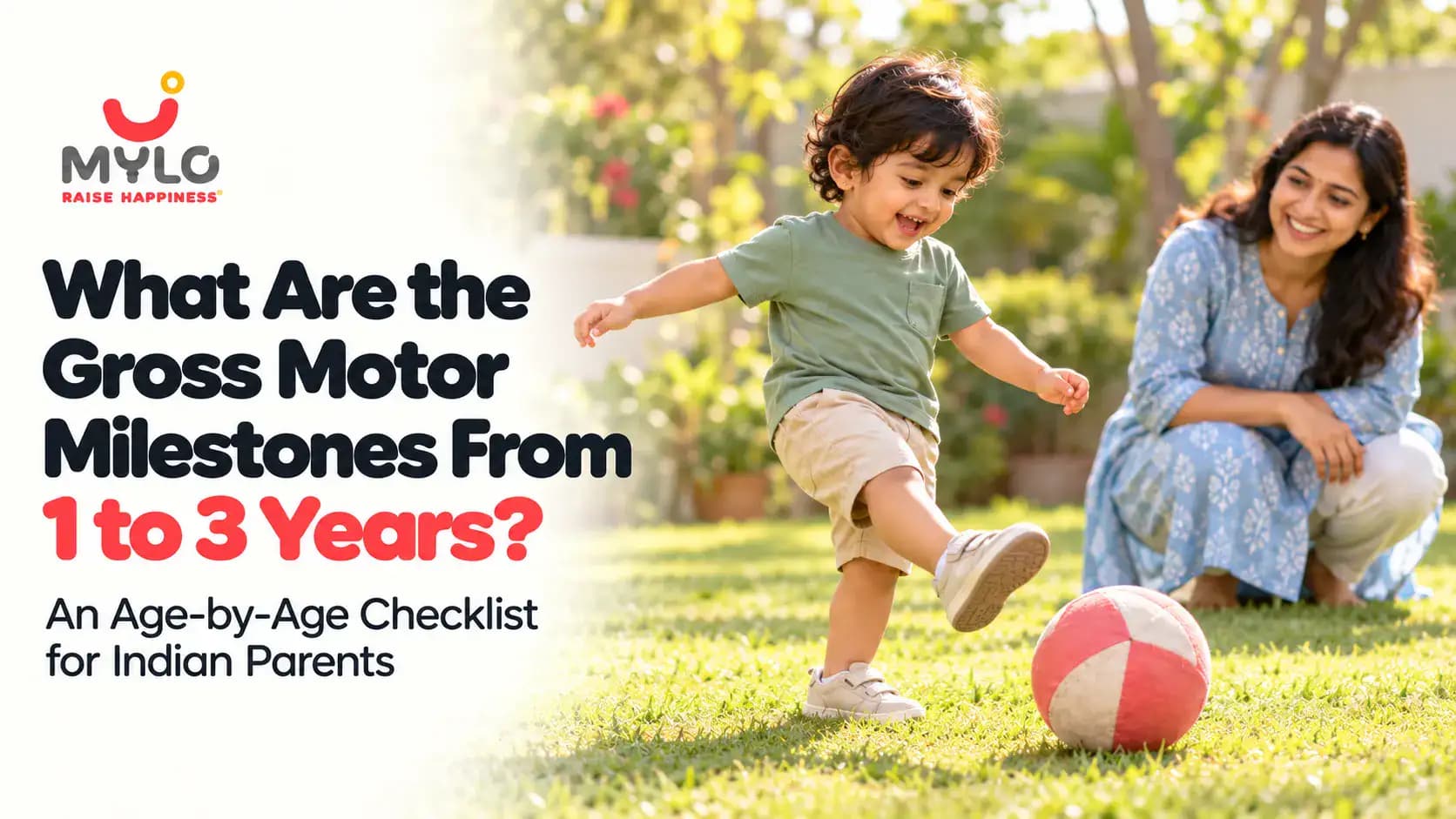
What Are the Gross Motor Milestones From 1 to 3 Years? An Age-by-Age Checklist for Indian Parents (2026)
 23 min
Quick Answer
Gross motor skills are movements that use the large muscles of the arms, legs and body, like walking, running, climbing, jumping and kicking. Between 1 and 3 years, most children go from pulling up to stand (12 months) to walking alone (by about 18 months), running and kicking a ball (by 2 years), jumping with both feet (by 30 months) and pedalling a tricycle and walking up stairs with alternating feet (around 3 years). The normal range is wide. Healthy children start walking alone anywhere between about 8 and 18 months (WHO). See your pediatrician if your child isn't walking by 18 months, loses skills, falls much more than other children or uses one side of the body more than the other.
Gross Motor Milestones 1 to 3 Years at a Glance
Age | Key Gross Motor Milestones | Talk to a Doctor If |
|---|---|---|
12 months | Pulls up to stand, cruises along furniture, may stand alone briefly | Can't stand even with support |
15 months | Takes a few steps alone, stands without holding on, squats to pick up toys | Not bearing weight on legs |
18 months | Walks alone, climbs on and off a sofa, starts to run stiffly, pulls toys while walking | Not walking alone |
21 months | Walks steadily, runs, walks up stairs with help, kicks or throws a ball | Falls very often or walks only on tiptoes |
24 months | Runs, kicks a ball, walks up a few stairs, climbs furniture, stands on tiptoes | Can't run or walk steadily |
30 months | Jumps off the ground with both feet, climbs playground equipment | Can't jump at all or falls a lot |
36 months | Walks up stairs with alternating feet, pedals a tricycle, runs easily, kicks and throws | Falls often, can't manage stairs |
Sources: WHO Motor Development Study, official AAP and CDC milestone checklists (CDC), Nemours KidsHealth.
Key Facts Every Parent Should Know
8.2 to 17.6 months: The normal window for walking alone (WHO)
6.9 to 16.9 months: The normal window for standing alone (WHO)
180 minutes a day: The WHO recommends at least 3 hours of physical activity a day for children aged 1 to 4
Under 1 hour at a time: The WHO advises that young children shouldn't be strapped into prams, strollers or high chairs for more than 1 hour at a time
2022: The year crawling was removed from official milestone checklists
Baby walkers: The AAP advises against them. They cause injuries and don't help walking.
What Are Gross Motor Skills?
Short answer: Gross motor skills are big movements that use the large muscles of the legs, arms and trunk. They include sitting, standing, walking, running, climbing, jumping, kicking, throwing and balancing. They're different from fine motor skills, which use small hand and finger muscles for things like holding a crayon or picking up food.
Gross Motor Skills | Fine Motor Skills |
|---|---|
Use large muscles of the legs, arms and body | Use small muscles of the hands and fingers |
Walking, running, jumping | Picking up small objects, scribbling |
Climbing stairs and furniture | Turning pages, stacking blocks |
Kicking and throwing a ball | Using a spoon or fork |
Balancing and pedalling a tricycle | Threading beads, opening lids |
Why gross motor skills matter:
Independence: Moving around helps children explore and learn
Strength and coordination: They build muscles, balance and body awareness
Brain development: Movement supports learning and attention
Social skills: Running, chasing and ball games help children play with others
Healthy habits: Active toddlers are more likely to become active, healthy children
For drawing and other hand skills, see when your toddler will learn to scribble or draw. For the bigger picture, read physical development in children.
When Do Toddlers Walk?
Short answer: Most children take their first steps between 9 and 15 months and walk well by about 18 months. The WHO Motor Development Study found that healthy children walk alone anywhere between 8.2 and 17.6 months.
Walking Stage | Typical Age | What It Looks Like |
|---|---|---|
Pulls to stand | By 12 months | Holds furniture to stand up |
Cruises | By 12 months | Walks sideways holding furniture |
Stands alone | 7 to 17 months | Stands without support for a few seconds |
First steps | 9 to 15 months | Wobbly steps with arms up and legs wide |
Walks alone | By about 18 months | Walks across a room without falling |
Walks steadily | 18 to 24 months | Fewer falls, arms down, can carry toys |
Walks backwards and sideways | Around 2 years | Pulls toys while walking backwards |
Is your child a late walker? Read reasons for late walking in babies.
When Do Toddlers Start Running?
Short answer: Most toddlers start running stiffly around 18 months and run well by 2 years. By 3, most children run easily, start and stop smoothly and can change direction.
Running Stage | Typical Age |
|---|---|
Fast walking, stiff "run" | 16 to 18 months |
Runs, but falls often | 18 to 24 months |
Runs well | By 2 years |
Runs easily, stops and turns | Around 3 years |
When Do Toddlers Climb Stairs?
Short answer: Many toddlers crawl up stairs from around 15 months, walk up stairs holding a hand or rail by about 2 years, and walk up stairs with alternating feet (one foot per step) around 3 years. Going down stairs usually comes later than going up.
Stairs and Climbing Stage | Typical Age |
|---|---|
Crawls up stairs | 12 to 15 months |
Climbs on and off a sofa without help | By 18 months |
Walks up stairs holding a hand, two feet per step | 18 months to 2 years |
Walks up a few stairs, with or without help | By 2 years |
Climbs playground equipment | 2 to 3 years |
Walks up stairs with alternating feet | Around 3 years |
Walks down stairs with alternating feet | 3.5 to 4 years |
Safety tip: Always use stair gates at the top and bottom of stairs until your child can manage stairs safely.
When Do Toddlers Jump?
Short answer: Many toddlers try to jump around 2 years, and most can jump off the ground with both feet by 30 months. By 3, many can jump forward and jump down from a low step.
Jumping Stage | Typical Age |
|---|---|
Bounces up and down on the spot (feet stay down) | 18 to 24 months |
Tries to jump, one foot may leave the ground first | Around 2 years |
Jumps off the ground with both feet | By 30 months |
Jumps down from the bottom step | 2 to 3 years |
Jumps forward with both feet | Around 3 years |
Hops on one foot | 4 years and older |
When Do Toddlers Kick and Throw a Ball?
Short answer: Many toddlers throw a ball (often underhand or while sitting) from about 18 months and kick a ball by 2 years. By 3, many throw overhand and kick with more force.
Ball Skill | Typical Age |
|---|---|
Rolls a ball back to you while sitting | 12 to 15 months |
Throws a small ball, often without direction | 15 to 18 months |
Kicks a ball by walking into it | 18 to 24 months |
Kicks a ball forward | By 2 years |
Throws a ball overhand | 2 to 3 years |
Catches a large ball with arms and body | 3 years and older |
When Do Toddlers Pedal a Tricycle?
Short answer: Most children learn to pedal a tricycle around 3 years. Before that, many toddlers enjoy ride-on toys they push with their feet from about 18 months.
Riding Skill | Typical Age |
|---|---|
Sits on a ride-on toy and pushes with feet | 18 months to 2 years |
Steers a ride-on toy | 2 to 2.5 years |
Pedals a tricycle | Around 3 years |
Rides a balance bike | 2.5 to 4 years |
Always use a helmet on tricycles, balance bikes and scooters.
What Activities Build Gross Motor Skills at Each Age?
Short answer: Simple, active play at home and outdoors builds gross motor skills best. Let your child walk, climb, run and play barefoot indoors, and give them lots of floor time instead of long periods in a pram, walker or high chair.
Age | Best Activities | Household Items to Use |
|---|---|---|
12 to 18 months | Cruising along furniture, pushing a sturdy cart, climbing onto cushions, rolling a ball, walking on grass | Sofa, cushions, a cardboard box to push, a soft ball |
18 to 24 months | Walking up small slopes, pulling toys, dancing, kicking a big ball, climbing on and off low furniture | Pull toys, a big light ball, music |
2 to 2.5 years | Running games, jumping on the spot, stepping over pillows, ride-on toys, playground slides | Pillows, a ride-on toy, a playground |
2.5 to 3 years | Jumping with both feet, walking on a line, obstacle courses, throwing into a bucket, tricycle | Chalk or tape lines, a bucket, cushions, a tricycle |
Fun Indian-Style Movement Games
Pakdam-pakdai (chasing): Great for running and stopping
Kho-style tag for little ones: Taking turns and running
Ghar-ghar obstacle course: Crawl under a table, climb over cushions, walk along a dupatta laid on the floor
Dancing to rhymes: "Machli Jal Ki Rani Hai" or "Head, Shoulders, Knees and Toes"
Kite and bubble chasing: Running, reaching and jumping outdoors
Walking in the park or on the terrace: Uneven ground builds balance
How Much Activity Do Toddlers Need?
The WHO guidelines for children under 5 recommend:
Age | Physical Activity | Sitting and Screens |
|---|---|---|
1 to 2 years | At least 180 minutes a day of any activity, spread through the day | Don't strap them in (pram, high chair) for more than 1 hour at a time. No screen time for 1-year-olds; no more than 1 hour for 2-year-olds, and less is better. |
3 to 4 years | At least 180 minutes a day, including at least 60 minutes of energetic play | No more than 1 hour of screen time; less is better |
What Helps and What Hurts Gross Motor Development?
Short answer: Floor time, barefoot play, outdoor play and safe climbing help. Baby walkers, too much time in prams, car seats or high chairs, and too much screen time can slow down practice.
Helps | Hurts or Slows It Down |
|---|---|
Barefoot play indoors | Stiff, heavy shoes indoors |
Lots of floor time | Long hours in prams, bouncers or car seats |
Push toys and ride-on toys | Baby walkers (AAP advises against them) |
Outdoor play on grass, sand and uneven ground | Carrying the child everywhere |
Safe climbing on cushions and playground equipment | Too much screen time |
Dancing, chasing and ball games | Constant "no running, no climbing" |
Are Bow Legs, Flat Feet and Tiptoe Walking Normal?
Short answer: Many "funny walks" are a normal part of development. Bow legs are common until about 2 years, knock knees are common between 3 and 5 years, and flat feet are normal in toddlers because the arch develops later. Tiptoe walking is common in new walkers, but should be checked if it continues all the time after age 2 to 3.
What You See | Usually Normal? | See a Doctor If |
|---|---|---|
Bow legs | Yes, until about 2 years | Getting worse after 2, only on one side, or with pain or limping |
Knock knees | Yes, often between 3 and 5 years | Very severe, only on one side, or with pain |
Flat feet | Yes, arches develop by around 5 to 6 years | Painful, stiff feet, or affecting walking |
In-toeing (pigeon toes) | Often yes | Causes frequent tripping or doesn't improve |
Tiptoe walking | Common in new walkers | Walks only on tiptoes after 2 to 3 years, or can't stand flat-footed |
Wide, wobbly walk | Yes, in new walkers | Still very unsteady after several months of walking |
W-sitting | Common | Always sits this way and has other motor concerns |
Bowed legs with other signs? Very bowed legs, delayed walking, thick wrists or bone pain can be signs of vitamin D deficiency (rickets). Talk to your pediatrician.
When Should I Worry About My Toddler's Gross Motor Skills?
Short answer: Talk to your doctor if your child isn't walking by 18 months, loses skills they had, falls much more than other children, uses one side of the body more than the other, walks only on tiptoes after 2 to 3 years, or seems very floppy or very stiff. Early physiotherapy works well.
Age | Red Flag |
|---|---|
Any age | Loses motor skills they once had (see a doctor right away) |
Any age | Uses one arm or leg much more than the other |
Any age | Very floppy (low muscle tone) or very stiff |
12 months | Can't stand even with support |
15 months | Not bearing weight on legs |
18 months | Not walking alone |
2 years | Can't walk steadily, doesn't try to run, can't climb onto furniture |
2 to 3 years | Walks only on tiptoes, or falls very often |
3 years | Can't jump, can't manage stairs even with help, very clumsy compared with peers |
Who Can Help?
Professional | How They Help |
|---|---|
Pediatrician | First check-up, rules out medical causes, refers you |
Pediatric physiotherapist | Exercises to build strength, balance and coordination |
Occupational therapist | Helps with coordination, sensory issues and daily skills |
Developmental pediatrician | Assesses overall development if there are several concerns |
Orthopaedic specialist | For bone, joint or leg shape concerns |
Free Government Support in India
Service | What It Offers |
|---|---|
Rashtriya Bal Swasthya Karyakram (RBSK) | Free screening for developmental delays |
District Early Intervention Centres (DEIC) | Free assessment, physiotherapy and occupational therapy |
Anganwadi centres | Growth monitoring and referrals |
Read our guide on identifying developmental disorders in toddlers.
How Can I Keep My Active Toddler Safe?
Short answer: As toddlers walk, run and climb, falls become the most common injury. Use stair gates, window and balcony guards, soft surfaces for play, helmets on ride-on toys and close supervision near roads and water.
Risk | How to Prevent It |
|---|---|
Falls on stairs | Stair gates at the top and bottom |
Falls from windows and balconies | Grills and guards; move furniture away from windows |
Tipping furniture | Anchor furniture and TVs to the wall |
Playground falls | Soft ground, age-appropriate equipment and supervision |
Ride-on toy accidents | Helmet every time; keep away from roads and stairs |
Drowning | Supervise near buckets, tanks and pools |
Emergency number: Dial 108 for ambulance services in most states, or 112 for emergencies.
What Should Indian Parents Keep in Mind?
Short answer: Give your child plenty of safe floor and outdoor time, skip the baby walker, avoid carrying them everywhere, and don't compare with other children.
Common Practice | Better Approach |
|---|---|
Baby walkers to "help" walking | Push toys and cruising along furniture |
Carrying the toddler everywhere | Let them walk, even if it's slow |
Keeping the child indoors on the bed | Floor play and outdoor time daily |
"Don't run, you'll fall!" | Safe spaces to run and climb |
Comparing with cousins | Every child has their own timeline |
Tight shoes or sandals all day | Barefoot indoors, soft shoes outdoors |
Screens to keep them still | Dancing, chasing and active play |
Myths vs Facts About Gross Motor Milestones
Myth | Fact |
|---|---|
"Baby walkers help babies walk sooner" | Walkers cause injuries and don't speed up walking (AAP) |
"All babies must crawl before walking" | Crawling was removed from official milestones in 2022; some babies skip it |
"Early walkers are smarter" | Walking age isn't linked to intelligence |
"Bow legs mean my child will walk badly" | Bow legs are normal until about 2 years |
"Flat feet need special shoes" | Flat feet are normal in toddlers; arches develop by 5 to 6 years |
"Toddlers get enough exercise just playing indoors" | The WHO recommends at least 180 minutes of activity a day, including outdoor play (WHO) |
"Shoes help babies learn to walk" | Barefoot is best for learning to walk indoors |
Frequently Asked Questions About Gross Motor Milestones
What are gross motor skills?
Movements that use the large muscles of the legs, arms and body, like walking, running, climbing, jumping, kicking and balancing.
Gross motor skills kya hote hain? (Hinglish)
Gross motor skills woh harkatein hain jismein pairon, haathon aur sharir ki badi maanspeshiyan kaam aati hain, jaise chalna, daudna, chadhna, koodna, ball ko laat maarna aur santulan banana.
At what age should a toddler walk?
Most children walk alone between 9 and 18 months. See your doctor if your child isn't walking by 18 months.
When do toddlers start running?
Many start running stiffly around 18 months and run well by 2 years.
When can a toddler jump with both feet?
Most children can jump off the ground with both feet by 30 months.
When do toddlers climb stairs?
Many walk up stairs holding a hand by 2 years and walk up with alternating feet around 3 years.
When can a child pedal a tricycle?
Most children learn to pedal a tricycle around 3 years.
Mera bachcha 18 mahine ka hai aur nahi chalta, kya karein? (Hinglish)
Zyada tar bachche 18 mahine tak khud chalne lagte hain. Agar aapka bachcha abhi tak nahi chalta, toh doctor se milein. Kai baar koi badi problem nahi hoti, lekin jaanch zaroori hai. Physiotherapy se bahut madad milti hai. Baby walker ka use na karein.
Are baby walkers good for walking?
No. The AAP advises against baby walkers because they cause injuries and don't help children walk sooner.
Is it normal for my toddler to have bow legs?
Yes, bow legs are normal until about 2 years. See a doctor if they get worse after 2, affect only one side, or come with pain.
Is tiptoe walking normal?
It's common in new walkers. See a doctor if your child walks only on tiptoes after 2 to 3 years.
How much physical activity does a toddler need?
The WHO recommends at least 180 minutes of physical activity a day for children aged 1 to 4.
When should I worry about my toddler's gross motor skills?
If your child isn't walking by 18 months, loses skills, falls much more than other children, uses one side more than the other, or seems very floppy or stiff, speak to your pediatrician.
Related Reads on Mylo
References
World Health Organization (WHO). "WHO Motor Development Study: Windows of Achievement for Six Gross Motor Development Milestones." cdn.who.int/media/docs/default-source/child-growth/…/who-motor-development-s…elopment-milestones.pdf?…
World Health Organization (WHO). "Guidelines on Physical Activity, Sedentary Behaviour and Sleep for Children Under 5 Years of Age." NCBI Bookshelf. https://www.ncbi.nlm.nih.gov/books/NBK541173/
World Health Organization (WHO). "Guidelines on Physical Activity, Sedentary Behaviour and Sleep for Children Under 5 Years of Age" (publication page). https://www.who.int/publications/i/item/9789241550536
American Academy of Pediatrics (AAP). "Where We Stand: Baby Walkers." HealthyChildren.org. https://www.healthychildren.org/English/safety-prevention/at-home/Pages/Where-We-Stand-Baby-Walkers.aspx
Nemours KidsHealth. "3-Year Well-Child Checkup." https://kidshealth.org/en/parents/checkup-3yrs.html
Nemours KidsHealth. "30-Month Well-Child Checkup." https://kidshealth.org/en/parents/checkup-30mos.html
Cleveland Clinic. "When Do Babies Start Walking?" https://health.clevelandclinic.org/when-do-babies-start-walking
Centers for Disease Control and Prevention (CDC). "CDC's Developmental Milestones." https://www.cdc.gov/act-early/milestones/index.html
Medical Disclaimer
This article is for information only and does not replace professional medical advice. Every child develops at their own pace. If you have concerns about your child's movement, walking, balance or leg shape, please consult your pediatrician.


Shop Now
Baby Essentials





Article Posted Under
Related Articles
What Is the Significance of Motor Skills in Children & How to Develop Them?
 606·
606· 5 min
5 min Late Walking in Toddlers: Why Is My Toddler Not Walking and When Should I Worry? (2026)
 63·14 min
 A New Parent's Guide to Baby Language Skills
 6 min
6 min Baby Milestones: A Week-By-Week Guide to Your Baby’s Development in the First Year
 60·5 min
Related Topics
.webp&w=32&q=75)
Medical Disclaimer
This content is for informational purposes only and should not replace professional medical advice. Consult with a physician or other health care professional if you have any concerns or questions about your health. If you rely on the information provided here, you do so solely at your own risk.


AWARDS AND RECOGNITION

Mylo wins Forbes D2C Disruptor award
Mylo wins The Economic Times Promising Brands 2022
AS SEEN IN













- Mylo Care: Effective and science-backed personal care and wellness solutions for a joyful you.
- Mylo Baby: Science-backed, gentle and effective personal care & hygiene range for your little one.
- Mylo Community: Trusted and empathetic community of 10mn+ parents and experts.


Product Categories
Baby Carrier | Baby Soap | Baby Wipes | Stretch Marks Cream | Baby Cream | Baby Shampoo | Baby Massage Oil | Baby Hair Oil | Stretch Marks Oil | Baby Body Wash | Baby Powder | Baby Lotion | Diaper Rash Cream | Newborn Diapers | Teether | Baby Kajal | Baby Diapers Pants | Cloth Diapers | Laundry Detergent | Lactation Granules |