


Orders
.png&w=48&q=75 "login")
Profile


Wallet

How to Teach Your Toddler to Calm Down and Manage Feelings
 18 min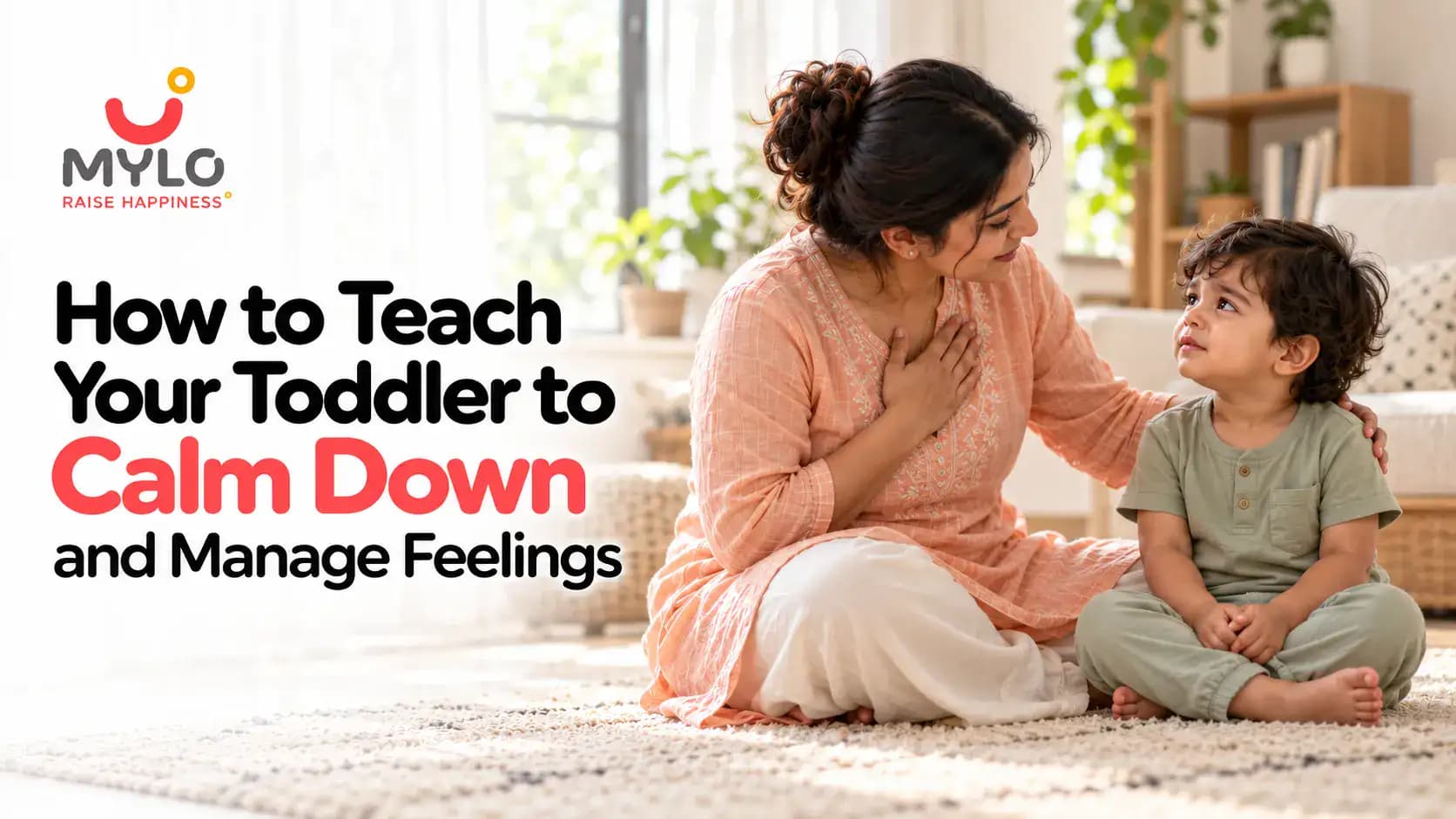
Quick Answer
Emotional regulation is the ability to notice big feelings and calm down. Toddlers can't do this alone yet. They learn it from calm adults who stay close, name their feelings and help them settle, often called "time in". With practice, most children calm down more easily by 3 to 4 years.
Emotional Regulation at a Glance
Question | Short Answer |
|---|---|
What is emotional regulation? | The ability to notice feelings, handle them and calm down |
Can toddlers calm down on their own? | Not yet. They need a calm adult to help them |
What is "time in"? | Staying close to your upset toddler and helping them calm down, instead of sending them away |
How to help in the moment | Stay calm, keep them safe, name the feeling, offer comfort |
Simple calm-down tools | Hugs, rocking, singing, deep breaths, squeezing a pillow, a calm corner |
When does it get easier? | Most children calm down more easily by 3 to 4 years |
When to worry | Very long or very frequent meltdowns, hurting themselves, or not being able to calm down at all |
Key Facts Every Parent Should Know
The "calm brain" grows slowly: The part of the brain that controls feelings and impulses keeps developing into the 20s
Toddlers borrow your calm: Helping a child calm down by staying calm yourself is called co-regulation. It comes before self-regulation
Big feelings are normal: Anger, frustration and sadness are part of healthy development
Naming feelings helps: Putting a feeling into words helps children calm down faster
It's a skill, not a personality: Every child can learn to manage feelings with practice
By 3 years: The CDC lists "calms down within 10 minutes after you leave", like at a daycare drop-off, as a milestone
What Is Emotional Regulation in Toddlers?
Short answer: Emotional regulation means being able to notice a feeling, handle it without hurting anyone, and calm down. For toddlers, it starts with an adult's help.
It includes:
Noticing feelings: "I feel angry"
Handling feelings safely: Stamping feet instead of hitting
Calming down: Taking a breath, getting a hug, moving to a quiet place
Bouncing back: Going back to play after being upset
Toddlers aren't being "naughty" when they can't do this. Their brains are still learning.
How Does Emotional Regulation Develop by Age?
Short answer: Babies and young toddlers need adults to calm them. Between 2 and 4 years, children slowly learn words for feelings and simple ways to calm down, with lots of help.
Age | What It Usually Looks Like |
|---|---|
12 to 18 months | Needs an adult to calm down. Comfort objects, rocking and feeding help. Cries or tantrums when frustrated |
18 months to 2 years | Tantrums are common. Starts to show feelings with a few words or gestures. Still needs lots of comfort |
2 to 3 years | Starts to name simple feelings like happy, sad and angry. Can calm down with your help. Can wait for a short time |
3 to 4 years | Uses more words for feelings. Can try simple calm-down tools, like deep breaths, with reminders |
4 to 5 years | Begins to calm down alone sometimes. Can talk about what happened after |
Before 1, babies rely fully on parents for comfort. After 3, children still need help, but they can start to use simple tools on their own.
Why Do Toddlers Have Such Big Feelings?
Short answer: Toddlers feel strongly but have little control, few words and little understanding of time. Hunger, tiredness and change make feelings even bigger.
Reason | What It Means |
|---|---|
The thinking brain isn't ready | They can't stop and think before reacting |
Few words | They can't say "I'm frustrated", so they cry or hit |
Wanting independence | They want to do things themselves but often can't |
Hunger and tiredness | Low energy makes feelings harder to manage |
Too much going on | Noise, crowds, screens and visitors can overwhelm them |
Changes | A new sibling, a move or starting daycare |
What Is Time In, and How Is It Different From Time Out?
Short answer: Time in means staying with your upset toddler and helping them calm down. Time out means a short break away from the situation. For toddlers, time in usually works better because they can't calm down alone yet.
Time In | Time Out | |
|---|---|---|
What happens | You stay close and help your child calm down | Your child sits away from the activity for a short time |
Best for | Toddlers and any child who is very upset | Some children from around 3 years, for clear rule-breaking |
What it teaches | How to calm down with help, and that feelings are okay | That some actions have a short pause as a consequence |
Example | "You're angry. I'm here. Let's take a breath together." | "Hitting means a short break. You can come back when you're calm." |
Both can work as part of positive discipline. Many experts suggest starting with time in for toddlers, and using short, calm time outs, if at all, for older children. Never use time out to shame or scare a child.
How to do a time in: 5 simple steps
Stay calm: Take a breath yourself. Lower your voice and get down to your toddler's level.
Keep everyone safe: Gently stop hitting or throwing, and move away from danger.
Name the feeling: "You're really angry because the tower fell."
Comfort: Offer a hug, hold their hand or just sit nearby if they don't want to be touched.
Reconnect and solve: When they're calm, talk briefly: "That was hard. Next time, you can say 'help'."
How Can I Teach My Toddler to Calm Down? 10 Simple Ways
Short answer: Stay calm yourself, name feelings every day, practise calm-down tools when your toddler is happy, and keep routines steady.
Be the calm: Your calm voice and body help your toddler calm down. This is co-regulation.
Name feelings all day: "You're happy at the park!" "You look sad that Papa left."
Name your own feelings: "I'm feeling cross. I'm going to take a deep breath."
Use a feelings chart: Pictures of happy, sad, angry and scared faces help toddlers point to how they feel.
Practise breathing as a game: "Smell the flower, blow out the candle." Practise when calm, so it's easier when upset.
Make a calm corner: A cosy spot with cushions, soft toys and books where your toddler can go with you to settle.
Offer safe ways to let out anger: Stamping feet, squeezing a pillow, tearing paper or jumping.
Read books about feelings: Stories help toddlers understand what feelings look like.
Give warnings before changes: "Five more minutes, then bath time."
Offer small choices: "Red cup or blue cup?" Feeling in control can prevent meltdowns.
Calm-down tools by age
Age | Tools That Help |
|---|---|
1 to 2 years | Hugs, rocking, singing, a comfort toy, moving to a quieter place, water play |
2 to 3 years | Naming feelings, a calm corner with you, squeezing a soft toy, counting together |
3 to 4 years | Deep breathing games, a feelings chart, stamping feet, drawing how they feel |
How Can I Prevent Meltdowns Before They Start?
Short answer: Most meltdowns happen when toddlers are hungry, tired, bored or overwhelmed. Regular meals, naps and routines prevent many of them.
Trigger | What Helps |
|---|---|
Hunger | Offer meals and snacks at regular times. Carry a snack when you go out |
Tiredness | Keep naps and bedtime regular |
Sudden changes | Give warnings and use the same routine every day |
Too much noise or crowds | Take breaks in a quiet place at weddings, malls or festivals |
Boredom | Keep a few small toys or books handy |
Too much screen time | Screens can make it harder to switch off. Keep screen time short and avoid using the phone to stop crying |
How Does Encouragement Help?
Short answer: Noticing when your toddler manages a feeling well helps them do it again. Be specific about what they did.
"You were so angry, and you stamped your feet instead of hitting. Well done."
"You waited for your turn on the swing. That was hard!"
"You took a big breath and felt better."
For more on praise, rules and consequences, read our guide on rule setting, discipline and consequences.
What Not to Do
Short answer: Don't shout, hit, mock, ignore distress or punish feelings. These make it harder for toddlers to learn calm.
Avoid | Why | Try Instead |
|---|---|---|
"Stop crying right now!" | Feelings don't switch off on command | "You're sad. I'm here." |
"Boys don't cry" or "Ladke rote nahi" | Teaches children to hide feelings | "It's okay to cry" |
Shouting or hitting | Makes the child more upset. The AAP advises against spanking | Stay calm and lower your voice |
Giving a phone every time they cry | Doesn't teach them to calm down | Try a hug, song or calm corner first |
Giving in to stop the crying | Teaches that meltdowns get results | Stay kind and keep the limit |
Punishing feelings | Children learn feelings are bad | Accept the feeling, limit the action: "You can be angry, but I won't let you hit" |
What About My Own Feelings?
Short answer: It's hard to stay calm when your toddler is screaming. Taking care of your own feelings helps you help your child.
Take a slow breath before you respond
It's okay to step away for a minute if your toddler is safe
Ask your partner or family to take over when you need a break
Repair after you lose your temper: "I shouted. I'm sorry. I was angry, and I'm calm now."
If you feel stressed or low most days, call Tele-MANAS (14416) for free support
When Should I Worry?
Short answer: Big feelings and tantrums are normal for toddlers. Talk to your pediatrician if meltdowns are very long, very frequent, involve hurting themselves, or your toddler can't calm down even with help.
Sign | Why It Matters |
|---|---|
Meltdowns often last more than 25 minutes | May need extra help |
More than 5 meltdowns a day on most days | May need extra help |
Hurts themselves during meltdowns, like head banging or biting themselves | Talk to your pediatrician |
Can't calm down at all, even with comfort | Needs a check |
Meltdowns still very frequent after 4 to 5 years | May need support |
Loses words or skills they had before | Always worth a check |
Very upset by everyday sounds or textures, along with few words or little eye contact | Ask for a development check |
Who Can Help?
Short answer: Start with your pediatrician. They can check your toddler's development and refer you to a child psychologist if needed.
Who | When to See Them |
|---|---|
Pediatrician | First stop for any worry about feelings or behaviour |
Child psychologist | Very frequent meltdowns, aggression or behaviour that's hard to manage |
Developmental pediatrician | If there are also concerns about speech, social skills or sensory issues |
Occupational therapist | If your toddler is very upset by sounds, touch or textures |
Free government support in India
RBSK (Rashtriya Bal Swasthya Karyakram): Free health and development checks for children from birth to 18 years
DEIC (District Early Intervention Centre): Free development checks and therapy, at district hospitals
Tele-MANAS (14416): Free mental health helpline for parents
Emergency: Call 108 or 112
What Should Indian Parents Keep in Mind?
Short answer: In many Indian homes, children are told to stop crying or are given a phone to calm down. Gently teaching your toddler about feelings works better in the long run.
"Rona band karo": Instead, try "Tum dukhi ho. Main yahin hoon" (You're sad. I'm here)
Boys and feelings: Let boys cry and talk about feelings too
Joint families: Different adults may react in different ways. Agree on a calm way to respond
Phones as pacifiers: It's common to hand a phone to stop crying. Try comfort first, and keep screens limited
Festivals and weddings: Loud music, late nights and crowds can overwhelm toddlers. Plan quiet breaks
Grandparents: Grandparents often give in to stop crying. Share simple time in steps with them
Myths vs Facts
Myth | Fact |
|---|---|
Toddlers throw tantrums to manipulate parents | Most tantrums happen because toddlers can't manage big feelings yet |
Time in spoils children | Time in teaches calm and still keeps limits |
Children should be able to calm down alone | Toddlers need adult help to learn to calm down |
Ignoring feelings makes children tough | Accepting feelings helps children manage them better |
Boys shouldn't cry | All children need to learn to manage sadness and anger |
Giving a phone is a good way to calm a child | It may stop crying, but it doesn't teach calm |
Frequently Asked Questions
1. What is emotional regulation in toddlers?
It's the ability to notice big feelings and calm down. Toddlers learn it slowly with help from calm adults.
2. At what age can a toddler calm down on their own?
Most children start to calm down more easily by 3 to 4 years, but they still need help often. By 3, many can calm down within about 10 minutes after a parent leaves.
3. Is time in better than time out?
For toddlers, time in usually works better because they can't calm down alone. Short, calm time outs may work for some older children.
4. How do I teach my 2-year-old to calm down?
Stay calm, name the feeling, offer a hug, and practise simple tools like singing or squeezing a soft toy when they're calm.
5. Does time in mean giving in?
No. You stay close and kind, but you still keep the limit. "You're angry, and the answer is still no."
6. What if my toddler doesn't want a hug when upset?
That's okay. Sit nearby and say "I'm here when you're ready."
7. How do I stay calm when my toddler is screaming?
Take a slow breath, remind yourself it's a phase, and step away for a moment if your toddler is safe.
8. Baccha bahut gussa karta hai, use shaant kaise karein?
Pehle khud shaant rahiye, bacche ke paas baithiye aur uski feeling ka naam lijiye: "Tumhe gussa aa raha hai." Gale lagaiye, aur jab woh shaant ho jaye tab pyaar se baat kijiye.
9. Time in kya hota hai?
Time in ka matlab hai gusse ya rone ke samay bacche ko akela chhodne ke bajay uske saath rehna aur use shaant hone mein madad karna.
Related Reads on Mylo
Rule Setting, Discipline and Consequences: A Guide for Indian Parents
Parenting Styles Explained: Authoritative and Gentle Parenting
References
Centers for Disease Control and Prevention (CDC). "CDC's Developmental Milestones: 3 Years." https://www.cdc.gov/act-early/milestones/index.html
American Academy of Pediatrics (AAP). "Where We Stand: Spanking." HealthyChildren.org. https://www.healthychildren.org/English/family-life/family-dynamics/communication-discipline/Pages/Where-We-Stand-Spanking.aspx
Sege RD, Siegel BS, AAP Council on Child Abuse and Neglect. "Effective Discipline to Raise Healthy Children." Pediatrics, 2018.
Harvard Center on the Developing Child. "Executive Function and Self-Regulation." https://developingchild.harvard.edu
ZERO TO THREE. "Self-Control and Emotional Regulation." https://www.zerotothree.org
Belden AC, Thomson NR, Luby JL. "Temper tantrums in healthy versus depressed and disruptive preschoolers." Journal of Pediatrics, 2008.
Ministry of Health and Family Welfare, Government of India. "Tele-MANAS" (14416). https://telemanas.mohfw.gov.in/
Medical Disclaimer
This article is for information only and does not replace professional medical advice. Every toddler is different. If you're worried about your toddler's feelings, behaviour or development, please consult your pediatrician.


Shop Now
Baby Essentials
Article Posted Under
Related Articles

Related Topics
.webp&w=32&q=75)
Medical Disclaimer
This content is for informational purposes only and should not replace professional medical advice. Consult with a physician or other health care professional if you have any concerns or questions about your health. If you rely on the information provided here, you do so solely at your own risk.


AWARDS AND RECOGNITION

Mylo wins Forbes D2C Disruptor award

Mylo wins The Economic Times Promising Brands 2022
AS SEEN IN













- Mylo Care: Effective and science-backed personal care and wellness solutions for a joyful you.
- Mylo Baby: Science-backed, gentle and effective personal care & hygiene range for your little one.
- Mylo Community: Trusted and empathetic community of 10mn+ parents and experts.


Product Categories
Baby Carrier | Baby Soap | Baby Wipes | Stretch Marks Cream | Baby Cream | Baby Shampoo | Baby Massage Oil | Baby Hair Oil | Stretch Marks Oil | Baby Body Wash | Baby Powder | Baby Lotion | Diaper Rash Cream | Newborn Diapers | Teether | Baby Kajal | Baby Diapers Pants | Cloth Diapers | Laundry Detergent | Lactation Granules |