


Orders

Profile


Wallet

What Is an NT Scan During Pregnancy and When Is It Done? NT, Nasal Bone and Your Report
 5 Likes|
 10 min

MBBS, DGO · 38 years experience
Key Takeaways
Quick overview in 30 seconds
- An NT scan is an ultrasound done between 11 weeks and 13 weeks 6 days that measures fluid at the back of your baby's neck to screen for Down's syndrome.
- A nasal bone 'not seen' is common in healthy babies, especially in Asian mothers and early in the scan window, so doctors often ask for a repeat scan.
- The NT scan with the double marker blood test is a screening test, not a diagnosis; only CVS, amniocentesis or NIPT can give more definite answers.
- Consult your healthcare provider for personalized advice.

 4.7
 4.4
Quick Answer
An NT scan is an ultrasound done between 11 and 13 weeks 6 days that measures fluid at the back of the baby's neck. With a blood test, it estimates the chance of Down's syndrome. It is a screening test, not a diagnosis. A nasal bone not seen is common in healthy babies, so doctors often repeat the scan.
If your NT scan report says something unexpected, or the doctor has asked you to come back for a repeat scan, the waiting days can feel very long. Please know that a screening result is only a first step, and many "not seen" or borderline findings turn out normal on a second look. Here is what the NT scan checks, what the nasal bone means, and what usually happens next.
What is an NT scan?
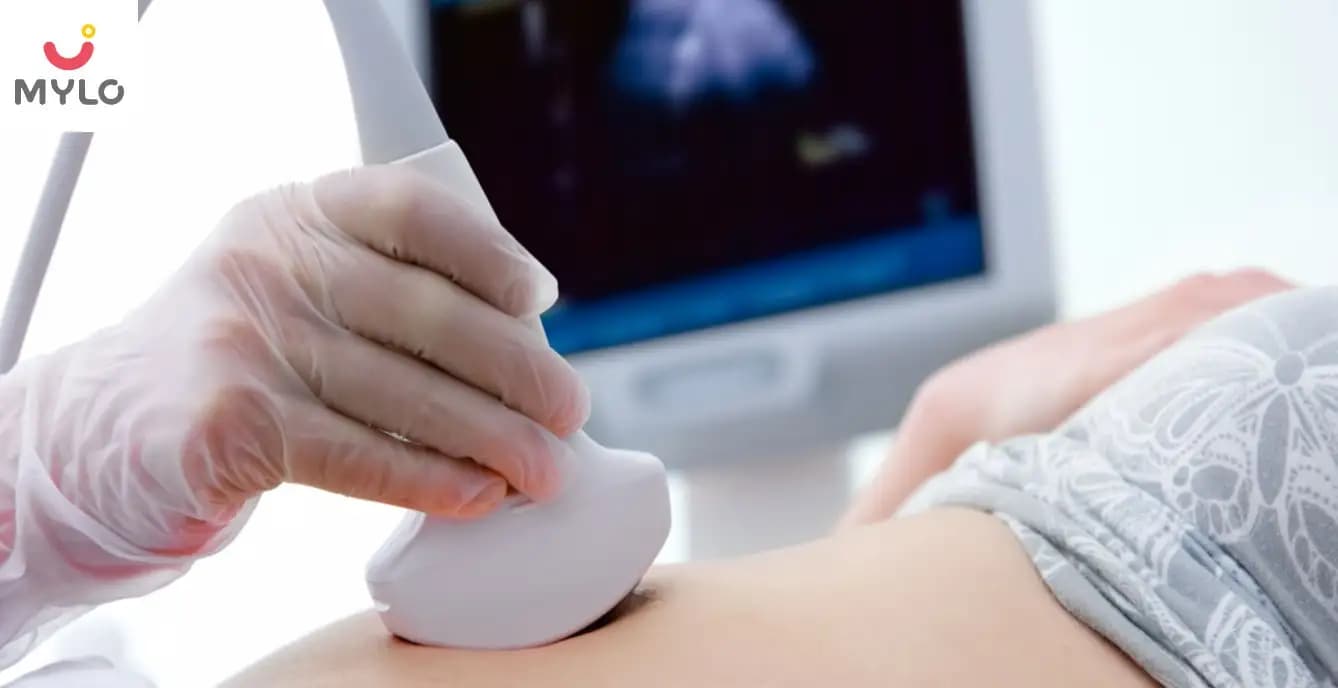
NT stands for nuchal translucency, a small pocket of fluid under the skin at the back of your baby's neck. During the NT scan, the sonographer measures this fluid on ultrasound. The measurement is combined with a blood test to work out the chance of certain chromosomal conditions (NHS).
Together, the scan and the blood test are called the combined test. It screens for Down's syndrome (trisomy 21), Edwards' syndrome (trisomy 18) and Patau's syndrome (trisomy 13) (NHS). In India, the blood test part is often called the double marker test. Read more in our guide to the double marker test.
When is the NT scan done?
The NT scan is done in a narrow window, between 11 weeks and 13 weeks 6 days of pregnancy. At this stage the baby's crown to rump length (CRL) is about 45 to 84 mm (Cicero et al., 2004). The NHS says screening is usually done between 10 and 14 weeks, and the neck fluid can be measured at the same time as the dating scan (NHS).
If your first scan happens after 14 weeks, the combined test is not offered, and a different blood test (the quadruple test) may be used instead, which is not as accurate (NHS). So book this scan on time.
What does the NT scan check?
Along with the neck fluid, many centres also look at:
the baby's size (CRL), to confirm your dates
the heartbeat
the nasal bone (NB), the small bone at the bridge of the baby's nose
early signs of major structural problems
Your report may show "NT 1.4 mm, NB present" or "NB not visualised". The doctor reads these alongside your age and blood test results to give an overall chance, not a yes or no answer.
What does it mean if the nasal bone is not seen?
A nasal bone that is not seen is one of several markers that can change the chance of Down's syndrome. It is not a diagnosis on its own, and it is common in healthy babies.
Research from the Fetal Medicine Foundation team in London found that in babies with normal chromosomes, the nasal bone was absent in 2.2% of Caucasian, 5.0% of Asian and 9.0% of Afro-Caribbean mothers (Cicero et al., 2004). It was also more often not seen earlier in the window: in 4.7% of normal babies with a CRL of 45 to 54 mm, compared with 1% at 75 to 84 mm. In other words, at the start of week 13 the nasal bone may simply not have hardened enough to show clearly yet.
At the same time, the nasal bone is absent in about 69% of babies with Down's syndrome at this stage (Cicero et al., 2004). That is why doctors take the finding seriously and look again rather than ignore it.
Why has my doctor asked for a repeat scan?
A repeat scan in a week or two is a common and sensible next step. Your baby will be a little bigger, the nasal bone may be easier to see, and the baby may be lying in a better position. If the nasal bone is clearly present on the repeat scan, that is reassuring.
If it is still not seen, your doctor will look at your full picture: the NT measurement, your blood test result, your age, and any other scan findings. A study of babies with an absent or small nasal bone found that a third had it as the only finding, and that extra scan abnormalities raised the chance of problems much more than the nasal bone alone (Karner et al., 2025). The same study advised a detailed scan and genetic testing when the nasal bone is absent.
What happens if my screening result is "higher chance"?
A higher chance result does not mean your baby definitely has the condition (NHS). Your doctor will explain your options, which may include:
Option | What it is | What it tells you |
|---|---|---|
NIPT (non invasive prenatal testing) | A blood test from the mother that looks at the baby's DNA | A more accurate screening result. Read our NIPT guide |
CVS (chorionic villus sampling) | A small sample from the placenta, usually from 11 to 14 weeks | A diagnostic (definite) answer |
Amniocentesis | A small sample of the fluid around the baby, usually from 15 weeks | A diagnostic (definite) answer |
No further tests | You can choose not to have more tests |
Source: NHS. CVS and amniocentesis carry a small risk of miscarriage, so ask your doctor to explain it before deciding.
The choice is always yours, and it is fine to take time, ask questions and talk it over with your family.
How should I prepare for the NT scan?
Book the scan for between 11 weeks and 13 weeks 6 days. Ideally aim for 12 to 13 weeks.
Ask your doctor whether to come with a full or empty bladder; this varies by centre.
Carry your earlier scan reports and blood test results.
Ask whether the blood test (double marker) will be done on the same day.
In India, the PCPNDT Act does not allow the sex of the baby to be told during any scan, so do not expect this information.
Myths vs facts about the NT scan
Myth | Fact |
|---|---|
A nasal bone that is not seen means the baby has Down's syndrome. | It is common in healthy babies, especially in Asian mothers and earlier in the scan window (Cicero et al., 2004). |
The NT scan gives a definite answer. | It is a screening test that gives a chance. Only CVS or amniocentesis give a definite answer (NHS). |
The scan can be done any time in the first 4 months. | The combined test works only between about 10 and 14 weeks (NHS). |
Ultrasound scans harm the baby. | The NHS says there are no known risks from the scans or blood tests used for screening (NHS). |
When should you call your doctor?
Follow your doctor's plan for the repeat scan or further tests, and ask them to explain any term on your report you do not understand. Contact your doctor or hospital straight away if you have vaginal bleeding, severe tummy pain, fever, or fluid leaking from the vagina at any point in pregnancy.
If the wait is making you very anxious or you cannot sleep, tell your doctor. Talking it through often helps, and you do not have to carry the worry alone.
Frequently asked questions
Is it normal if the nasal bone is not seen at 13 weeks?
It can be. In babies with normal chromosomes, the nasal bone is not seen in about 5% of Asian mothers and more often early in the scan window (Cicero et al., 2004). That is why a repeat scan is common.
What is a normal NT measurement?
Your report will compare the measurement with what is expected for your baby's size. Doctors look at the NT together with your age and blood test, so ask your doctor what your own number means rather than comparing it with someone else's.
Can the nasal bone appear on the repeat scan?
Yes. As the baby grows, the nasal bone often becomes easier to see, and a better position also helps. A clearly present nasal bone on the repeat scan is reassuring.
Is NIPT better than the NT scan?
NIPT is a more accurate screening blood test for Down's syndrome, but it does not replace the scan, which also checks your baby's growth and structure. Your doctor may suggest NIPT after a higher chance result.
Does a higher chance result mean I should end the pregnancy?
No. A higher chance result is not a diagnosis (NHS). Only a diagnostic test can confirm a condition, and every decision after that is yours, made with your doctor's support.
Is the NT scan painful?
No. It is usually an ordinary ultrasound on your tummy. Sometimes a vaginal scan is used for a clearer view, which may feel a little uncomfortable but is not harmful.
Related Articles
References
NHS. Screening for Down's syndrome, Edwards' syndrome and Patau's syndrome. https://www.nhs.uk/pregnancy/your-pregnancy-care/screening-for-downs-edwards-pataus-syndrome/
NHS. 12-week scan. https://www.nhs.uk/pregnancy/your-pregnancy-care/12-week-scan/
Cicero S, Rembouskos G, Vandecruys H, Hogg M, Nicolaides KH. Likelihood ratio for trisomy 21 in fetuses with absent nasal bone at the 11-14-week scan. Ultrasound Obstet Gynecol. 2004;23(3):218-23. https://pubmed.ncbi.nlm.nih.gov/15027007/
Karner E, et al. Outcomes of pregnancies with absent or hypoplastic fetal nasal bone. Life (Basel). 2025;15(8):1215. https://pubmed.ncbi.nlm.nih.gov/40868863/
Medical disclaimer: This article is for general information only and does not replace advice from your doctor or fetal medicine specialist. Please discuss your own scan results with your doctor.
প্রথম ট্রাইমেস্টারের যত্নশীল মায়েদের বিশ্বস্ত সঙ্গী
এনটি স্ক্যানের যাত্রায় আপনার আরাম এবং পুষ্টি বজায় রাখতে সাহায্যকারী প্রসব পূর্ববর্তী যত্নের পণ্যগুলি বেছে নিন।






Article Posted Under
Related Articles
সদ্যোজাতকে সঙ্গে নিয়ে ভ্রমণ : নিরাপত্তার গুরুত্বপূর্ণ টিপস
 106·4 min
ব্রেস্ট ক্যান্সারের প্রতিরোধ এবং চিকিৎসা।
 9·6 min
আপনার নবজাতককে বেবি ক্যারি নেস্ট/স্লিপিং ব্যাগে নিয়ে যাওয়া কি নিরাপদ?
 5 min
গর্ভাবস্থায় নিরাপদ যৌনমিলনের জন্য সেরা ৭টি পজিশন (২০২৬ গাইড) | 7 Best Safe Sex Positions During Pregnancy (2026 Guide)
 159·11 min
Related Topics

Medical Disclaimer
This content is for informational purposes only and should not replace professional medical advice. Consult with a physician or other health care professional if you have any concerns or questions about your health. If you rely on the information provided here, you do so solely at your own risk.


AWARDS AND RECOGNITION

Mylo wins Forbes D2C Disruptor award

Mylo wins The Economic Times Promising Brands 2022
AS SEEN IN













- Mylo Care: Effective and science-backed personal care and wellness solutions for a joyful you.
- Mylo Baby: Science-backed, gentle and effective personal care & hygiene range for your little one.
- Mylo Community: Trusted and empathetic community of 10mn+ parents and experts.


Product Categories
Baby Carrier | Baby Soap | Stretch Marks Cream | Baby Cream | Baby Shampoo | Baby Massage Oil | Baby Hair Oil | Stretch Marks Oil | Baby Body Wash | Baby Powder | Baby Lotion | Diaper Rash Cream | Teether | Baby Kajal |