


Orders

Profile


Wallet

How Can I Tell Whether My Baby Is Getting Enough Milk?
 10 min


MBBS, DCH, DNB (Pediatrics), FICM (Fellowship in Intensive Care Medicine), FIDM (Fellowship in Diabetes Mellitus), MNAMS · 18 years experience
Key Takeaways
Quick overview in 30 seconds
- Your baby is getting enough milk if they have at least 6 heavy wet nappies daily, gain weight steadily, and seem content and settled after most feeds.
- Short feeds, softer breasts, no let-down sensation, low pump output, and fewer poos after 6 weeks are NOT reliable signs of low milk supply.
- If nappies drop, weight stalls, or baby seems very sleepy or dehydrated, check the latch and see a lactation consultant or paediatrician early.
- Looking for gentle support for your milk supply? Explore our MamaGro™ Protein Diskettes - High Protein & No Added Sugar - 250gm (50 Vanilla Diskettes).

 4.6
 4.8
 4.2
 4.4
Quick Answer
Your baby is getting enough milk if they have at least 6 heavy wet nappies a day, gain weight steadily and seem content after most feeds. Short feeds, burping and fewer poos after 6 weeks are often normal. If you want extra support for your supply, Lactomama Lactation Granules can be part of your routine.
You cannot see how much milk your baby drinks from the breast, so it is completely natural to wonder whether it is enough, especially when your baby feeds for a few minutes, pulls away, and then wants more. The good news is that your baby's nappies, weight and behaviour tell you far more than the clock does. Here is what to look for at each age, which worries you can let go of, and when to get help.

What are the signs that my baby is getting enough milk?
The most reliable signs are what goes in, what comes out, and how your baby grows. The NHS lists these signs that breastfeeding is going well (NHS):
Your baby starts a feed with a few rapid sucks, then long, rhythmic sucks and swallows with occasional pauses.
You can hear and see your baby swallowing.
Your baby's cheeks stay rounded, not hollow, while sucking.
Your baby seems content and satisfied after most feeds.
Your breasts feel softer after feeds.
Your baby gains weight steadily after the first few days.
How many wet and dirty nappies should my baby have?
Nappies are one of the clearest ways to check, and what is normal changes with age.
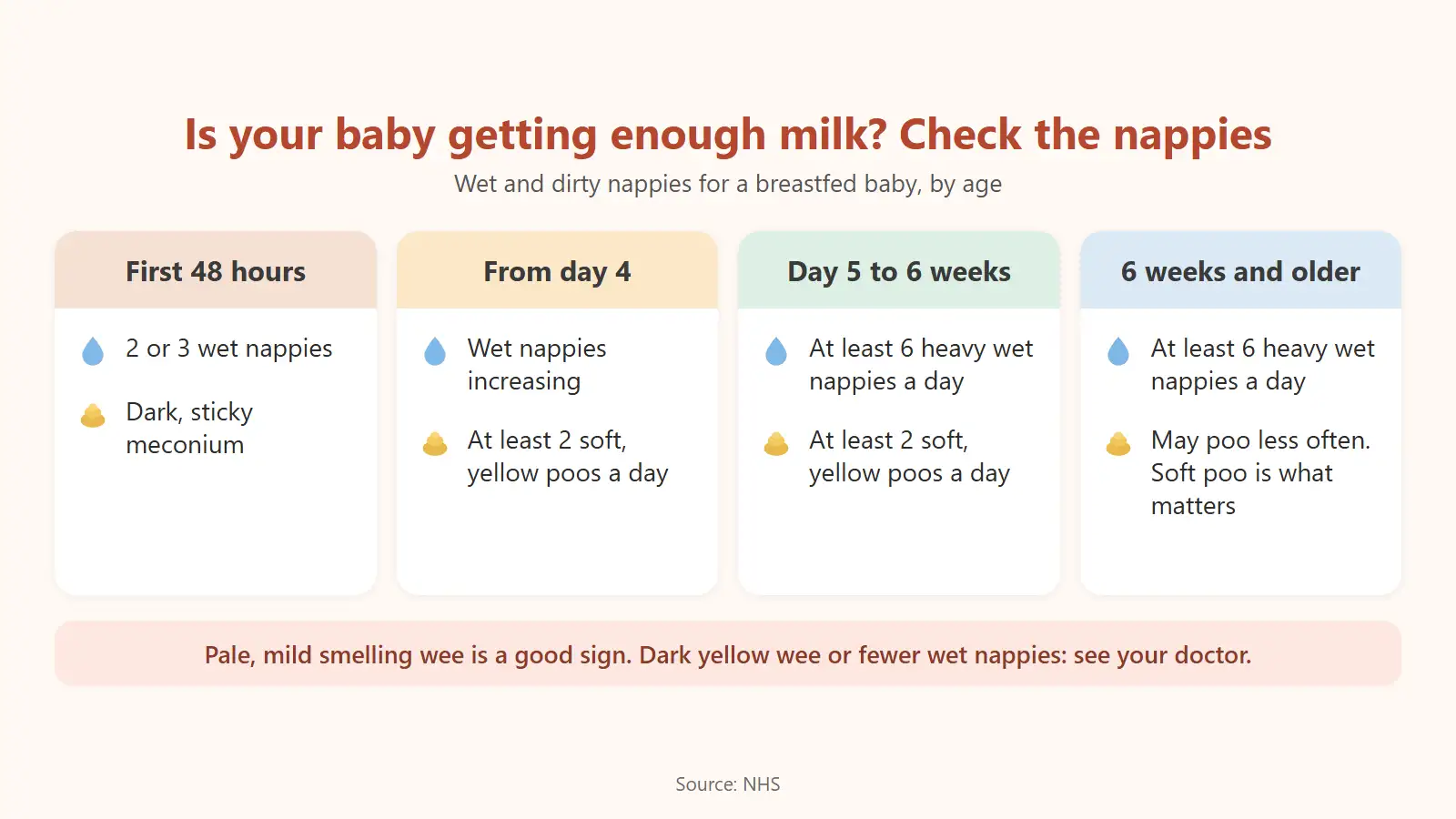
Wet and dirty nappies by age
Age | Wet nappies | Dirty nappies |
|---|---|---|
First 48 hours | Usually only 2 or 3 | Dark, sticky meconium |
From day 4 | Getting more frequent | At least 2 soft, yellow poos a day, roughly the size of a 2 rupee coin |
From day 5 to 6 weeks | At least 6 heavy, wet nappies every 24 hours | At least 2 soft, yellow poos a day |
6 weeks and older | At least 6 heavy, wet nappies every 24 hours | May poo less often; soft poos every few days can be normal |
Wee should be pale and mild smelling. Dark yellow wee or fewer wet nappies than usual can be a sign of dehydration and needs checking (NHS).
My older baby poos only every few days. Is that enough milk?
Often, yes. Breastmilk is a natural laxative, and a baby between 4 days and 6 weeks old who is breastfeeding well should pass at least 2 yellow poos a day. Breastfed babies aged 6 weeks or older may poo less often (NHS).
So a 3 or 4 month old who poos 2 or 3 times one day and not at all the next can be perfectly normal, as long as the poo is soft, wet nappies are plentiful and weight is rising. Hard, pellet like poo, straining with pain, or a baby who seems unwell is different and needs a doctor's check.
Why does my baby drink a little, pull away and then feed again?
From around 3 months, babies can see further and become curious about everything around them. Your baby may get distracted more easily and come off the breast to look around or to communicate (Sussex Community NHS). Many babies then come back and feed well, just as you describe.
A few things can help a distracted feeder:
Feed in a quiet, dim room, away from the TV and chatter.
Offer a feed when your baby is drowsy, such as just after waking or before sleep.
Let your baby finish the first breast before offering the second.
Burp in between if your baby pulls away fussing. A burp after a feed is normal, and it does not mean your baby is still hungry or already full.
What matters is not how long each feed lasts but whether the nappies and weight are on track.
Which signs do not mean low milk supply?
Many things that worry parents are not, on their own, signs that your baby is not getting enough. Judge by nappies, weight and feeding instead.
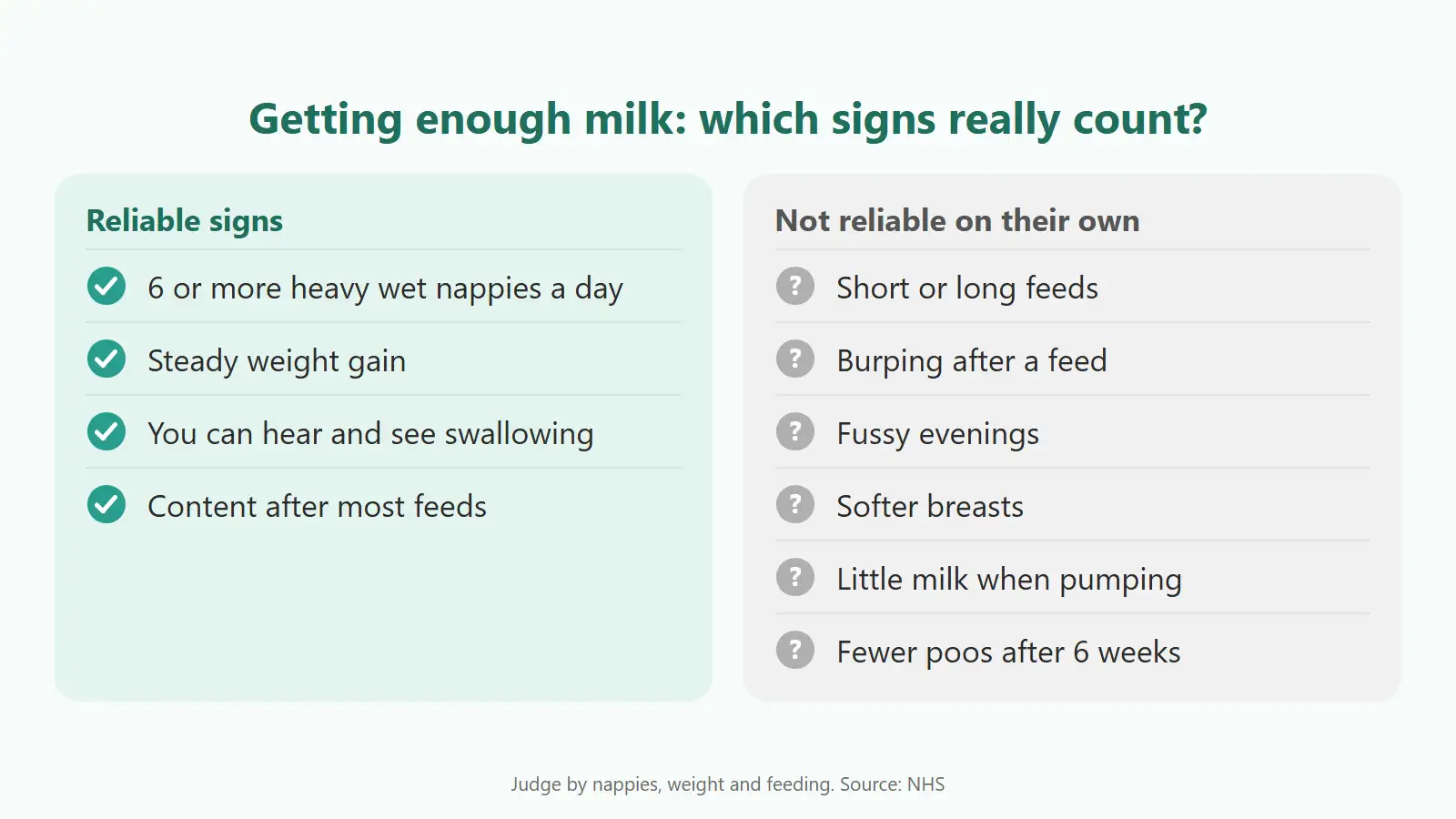
Short or long feeds: babies feed at different speeds.
Fussiness or frequent feeding in the evening: cluster feeding is common, especially in the early weeks. Read more about cluster feeding.
Softer breasts after the early weeks: this happens as your supply settles. The NHS lists softer breasts after feeds as a good sign (NHS).
Not feeling a let down: many mothers never feel it.
How little you can pump: a pump removes milk less well than a baby who is feeding well.
Fewer poos after 6 weeks: this can be normal if the poo is soft (NHS).
What if the signs suggest my baby is not getting enough?
Ask for help early. Common reasons include a shallow latch, feeding too rarely, a tongue tie, or illness in the baby or mother (NHS). A lactation consultant or your paediatrician can watch a feed, check the latch and weigh your baby.
Check the latch first: a deep latch lets your baby remove milk well. Our guide on shallow vs deep latch shows how.
Feed often and let your baby feed for as long as they want (NHS).
Look after yourself: eat regular meals, drink enough water and rest when you can. Our guide on how to increase breast milk supply naturally has more ideas, and some mothers add Lactomama Lactation Granules to their routine.
Keep your baby's weight record and compare it with the baby weight chart by month.
When should you see a doctor?
Contact your paediatrician or a lactation consultant promptly if your baby:
has fewer wet nappies than usual, or dark yellow wee (NHS)
is not gaining weight, or weighs less than the normal range for their age
is still passing dark meconium after day 4 or 5, with no soft yellow poos
is very sleepy, floppy or hard to wake for feeds
has a sunken soft spot on the head, a dry mouth or few or no tears when crying (NHS)
has hard poo, strains with pain, or seems unwell
Getting enough milk: myths or facts?
Does a short feed mean my baby is still hungry?
No. Babies feed at different speeds, and older babies often feed faster. Nappies and weight tell you more than the length of a feed.
Does a burp after a feed mean my baby's tummy is full?
No. Burping only releases swallowed air. Judge fullness by contentment after feeds, wet nappies and weight gain.
If my baby does not poo every day, is my milk not enough?
Not necessarily. After 6 weeks, breastfed babies may poo less often, and that is normal if the poo is soft (NHS).
Do soft breasts mean I have run out of milk?
No. Breasts usually feel softer once supply settles, and softer breasts after a feed are a good sign (NHS).
Does a fussy baby always mean low supply?
No. Fussiness and frequent evening feeds are common and do not, on their own, mean your baby is not getting enough.
Frequently Asked Questions
How do I know my baby's tummy is full after breastfeeding?
A baby who has had enough usually comes off the breast on their own, looks relaxed and content, and often falls asleep. Over the day, at least 6 heavy wet nappies and steady weight gain confirm it (NHS).
Is a 10 to 15 minute feed enough for a 4 month old?
It can be. Many older babies feed faster than newborns. If your baby has plenty of wet nappies, seems content and is gaining weight, the feed length is usually fine.
How many wet nappies should a 4 month old have?
At least 6 heavy, wet nappies in 24 hours, with pale, mild smelling wee (NHS).
Is it normal for my breastfed baby to poo 3 times one day and not at all the next?
Yes, after about 6 weeks this can be normal, as long as the poo is soft and your baby is feeding and gaining weight well (NHS).
Baby ka pet bhara hai ya nahi, kaise pata karein? (Hinglish)
Agar baby din mein kam se kam 6 bhari geeli nappy karta hai, feed ke baad shaant aur khush dikhta hai, aur weight dheere dheere badh raha hai, to use kaafi doodh mil raha hai. Feed chhota ho ya dakar aaye, isse pet bhara ya khaali hone ka pata nahi chalta. Weight na badhe ya nappy kam ho, to doctor ko dikhayein.
Should I give my baby water or formula if I think my milk is not enough?
Fully breastfed babies do not need any water until they have started eating solid foods; in hot weather they may simply want to breastfeed more (NHS). Talk to your paediatrician or a lactation consultant before starting formula, so they can check feeding and weight first.
Related Articles
References
NHS. Breastfeeding: is my baby getting enough milk? https://www.nhs.uk/baby/breastfeeding-and-bottle-feeding/breastfeeding-problems/enough-milk/
NHS. Breastfeeding: the first few days. https://www.nhs.uk/baby/breastfeeding-and-bottle-feeding/breastfeeding/the-first-few-days/
NHS Best Start in Life. Constipation and breastfeeding. https://www.nhs.uk/best-start-in-life/baby/feeding-your-baby/breastfeeding/breastfeeding-challenges/constipation/
NHS. Dehydration. https://www.nhs.uk/conditions/dehydration/
Sussex Community NHS Foundation Trust. Usual breastfeeding behaviour. https://www.sussexcommunity.nhs.uk/patients-and-visitors/resources/patient-resources/usual-breastfeeding-behaviour
NHS. Drinks and cups for babies and young children. https://www.nhs.uk/baby/weaning-and-feeding/drinks-and-cups-for-babies-and-young-children/
Medical disclaimer: This article is for general information only and does not replace advice from your paediatrician or a lactation consultant.
Trusted by breastfeeding mamas nurturing their little ones
A little extra lactation support can help you feed confidently while your baby thrives on your milk.
MamaGro™ Protein Diskettes - 250gm - Vanilla
Supports Healthy Placenta | Supports Fetal Development



Anti Colic Slow (S) Flow Grooved Baby Nipple - Pack of 2
BPA Free | Breast-Like Nipple | Food Grade Material | Wide Base for Better Latch | Can be Sterilized | Microwave Safe | Fits Most Standard Bottles


Bra Extenders (Skin) - Pack of 3
Makes Bra Comfortable | Increases Bra Band Strength


Organic Aloe Vera (300 ml)
Nurtures Skin & Hair | Reduces Suntan | Soothes Burns | Enhances Hair Resilience


Article Posted Under
Related Articles
Watery Eyes in Babies: Blocked Tear Duct Causes, Care and When to See a Doctor
 9 min
Second Baby Planning: How Long Should You Wait Between Pregnancies?
 11 min
Baby Kidney Swelling on Ultrasound (Antenatal Hydronephrosis): Will It Go Away?
 8 min
Foods for Height Growth in Toddlers and Kids: What Really Helps (Indian Guide)
 11 min
Related Topics

Medical Disclaimer
This content is for informational purposes only and should not replace professional medical advice. Consult with a physician or other health care professional if you have any concerns or questions about your health. If you rely on the information provided here, you do so solely at your own risk.


AWARDS AND RECOGNITION

Mylo wins Forbes D2C Disruptor award

Mylo wins The Economic Times Promising Brands 2022
AS SEEN IN













- Mylo Care: Effective and science-backed personal care and wellness solutions for a joyful you.
- Mylo Baby: Science-backed, gentle and effective personal care & hygiene range for your little one.
- Mylo Community: Trusted and empathetic community of 10mn+ parents and experts.


Product Categories
Baby Carrier | Baby Soap | Stretch Marks Cream | Baby Cream | Baby Shampoo | Baby Massage Oil | Baby Hair Oil | Stretch Marks Oil | Baby Body Wash | Baby Powder | Baby Lotion | Diaper Rash Cream | Teether | Baby Kajal |