


Orders

Profile


Wallet

Watery Eyes in Babies: Blocked Tear Duct Causes, Care and When to See a Doctor
 9 min


MBBS, DCH, DNB (Pediatrics), FICM (Fellowship in Intensive Care Medicine), FIDM (Fellowship in Diabetes Mellitus), MNAMS · 18 years experience
Key Takeaways
Quick overview in 30 seconds
- Watery eyes in babies are most often caused by a blocked tear duct, a common drainage problem that usually starts in the first month of life.
- Signs include tears spilling onto the cheek, crusting or yellow-green discharge, and eyelids sticking together after sleep, sometimes worsening with colds.
- Most cases clear on their own within the first year with gentle cleaning using cooled boiled water and tear duct massage shown by your doctor.
- What helps keep your baby's eyes gently clean? Explore our 100% Plant-based Premium Wipes with 99.5% Pure Water - Pack of 1.
Quick Answer
Watery eyes in babies are most often caused by a blocked tear duct. It is common, usually starts in the first month, and most cases clear on their own in the first year. Gentle cleaning and massage can help. See a doctor if the eye is red, swollen or has sticky discharge, or if watering continues after 12 months.
If your baby's eye always looks wet, with tears rolling down the cheek even when they are not crying, you are not alone in worrying about it. In most babies this is a simple drainage problem that gets better with time. Here is what causes it, how to care for your baby's eyes at home, and the signs that need an eye check.
Why do babies have watery eyes?
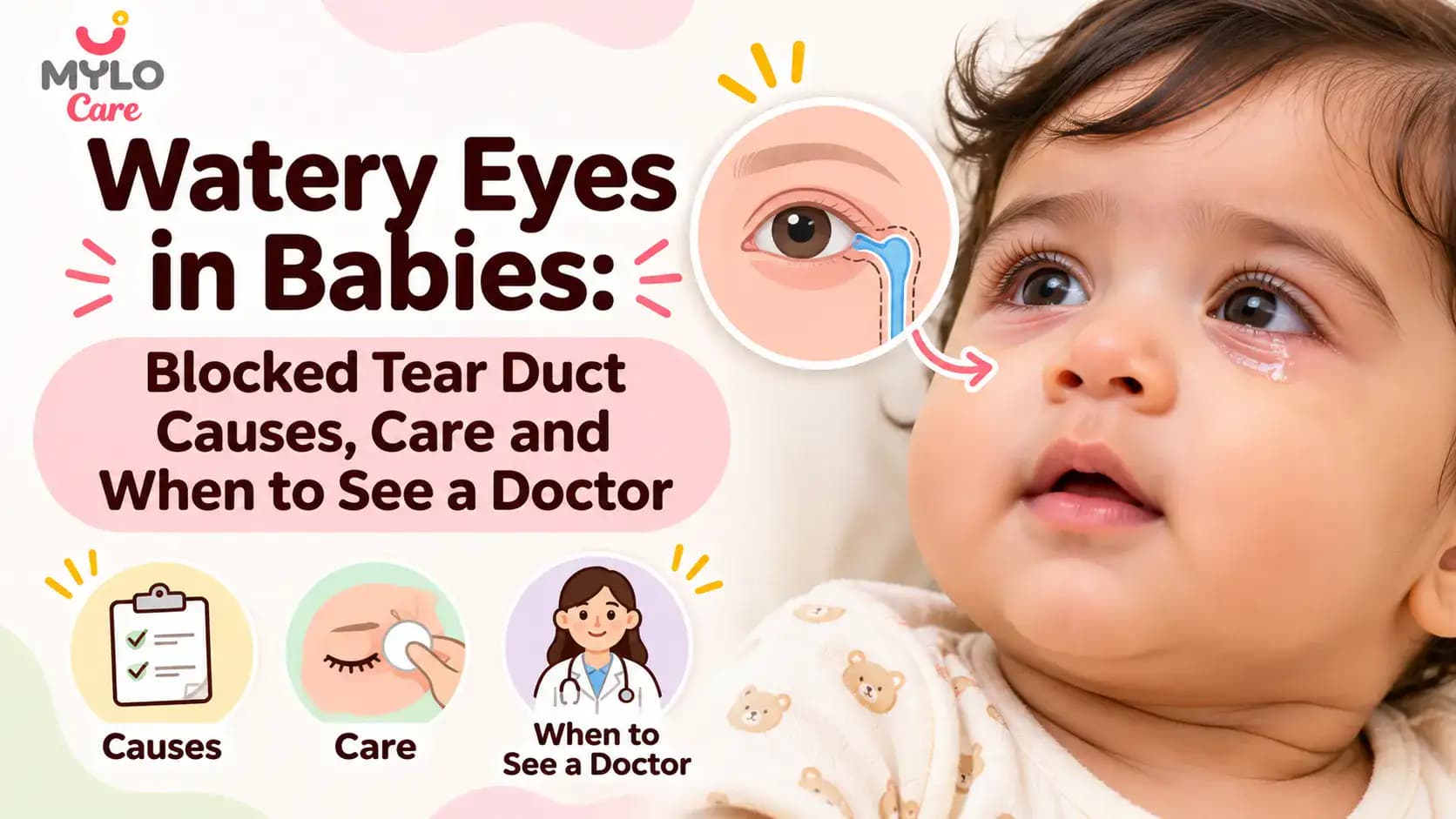
The most common reason is a blocked tear duct. Tears are made above the eye, wash over it, and then drain through tiny openings in the inner corner of the eyelids into a small tube called the nasolacrimal duct, which empties into the nose. When this tube is blocked, tears cannot drain, so they collect on the eye and spill onto the cheek.
According to the American Association for Pediatric Ophthalmology and Strabismus (AAPOS), the usual cause in babies is a thin membrane at the end of the duct that has not opened yet. This membrane is present in about half of newborns and usually opens on its own soon after birth.
Other, less common causes of watery eyes include:
an eye infection, such as conjunctivitis
an allergy
an eyelash or a speck of dust in the eye
cold or windy weather
rarely, raised pressure in the eye (childhood glaucoma)
How common is a blocked tear duct in babies?
Very common. AAPOS says more than 5% of infants have symptoms of a blocked tear duct in one or both eyes, while the American Academy of Ophthalmology puts it at about 1 in 5 newborns. The figures differ, but both agree it is common and usually harmless.
What are the signs of a blocked tear duct?
Blocked tear ducts usually show up in the first month of life. Signs listed by AAPOS include:
tears pooling in the eye and spilling onto the cheek
crusting or yellow green discharge on the eyelids and lashes
eyelids stuck together, especially after sleep
eyelids that look red or swollen
The discharge happens because normal germs on the eyelid are not washed away down the duct. In rare cases, the tear duct itself can get infected, which needs a doctor.
Can watering come and go?
Yes. Symptoms can come and go, and they often get worse when a baby has a cold, an allergy or a blocked nose, because swelling inside the nose makes it harder for tears to drain. Wind and cold weather can also increase watering.
So a baby whose eye watered in the first few months, settled, and then started again during a cold may still have the same tear duct problem.
When does a blocked tear duct go away?
Most cases clear on their own. AAPOS says about 90% get better during the first year of life, and the American Academy of Ophthalmology says it often clears by 4 to 6 months.
If your baby's eye is still watering at around 12 months, an eye doctor may suggest a simple procedure called probing to open the duct.
How can you care for your baby's watery eyes at home?
Home care keeps the eye clean and comfortable while the duct opens.
What to do | How to do it |
|---|---|
Wash your hands | Wash with soap and water before and after touching your baby's eyes |
Clean crusts gently | Boil water and let it cool. Dip a clean cotton wool pad and wipe gently from the inner corner outwards. Use a fresh pad for each eye, as the NHS advises for sticky eyes |
Tear duct massage | AAPOS describes using firm pressure with a finger in a downward motion over the inner corner of the eye. Ask your doctor to show you how and how often |
Keep nails short | Short, clean nails make massage safer and gentler |
Avoid home remedies | Do not put any drops, kajal, surma, oil or breast milk in your baby's eye unless your doctor advises it |
Antibiotic eye drops are only needed if there is a lot of discharge or an infection, and only when a doctor prescribes them. AAPOS notes they help control infection but do not open the duct.
Can watery eyes affect my baby's eyesight?
A blocked tear duct is a drainage problem, not a problem with how the eye sees. But constant watering can sometimes come with other eye problems, so it should be checked.
Childhood glaucoma is rare, but it can also cause a lot of tearing. According to AAPOS, the most common signs are:
too much tearing
eye pain with bright light
a large or cloudy cornea (the clear front part of the eye)
If your baby has any of these, see an eye specialist (paediatric ophthalmologist) soon. If you have any worry about how your baby sees, an eye doctor can check a baby's eyes at any age.
When should you see a doctor?
See your doctor or an eye specialist if your baby:
still has a watery eye at around 12 months
has red, sticky eyes (get an urgent appointment if your baby is under 30 days old, as the NHS advises)
has yellow or green discharge that keeps coming back
has a red, swollen or painful bump at the inner corner of the eye
seems to have eye pain in bright light, or the front of the eye looks cloudy or large
has a bluish swelling near the inner corner of the eye
seems to have trouble seeing, or you notice any change in the eyes
Get urgent medical help the same day if there is a painful, red, swollen bump near the inner corner of the eye with discharge and your baby has a fever or seems unwell. AAPOS describes this tear duct infection, called dacryocystitis, as a medical emergency that needs antibiotics.
Myths vs facts
Myth | Fact |
|---|---|
Watery eyes mean the baby has weak eyesight | Most watery eyes in babies are caused by a blocked tear duct, which is a drainage problem. Get any eyesight worry checked by an eye doctor |
Kajal or surma keeps a baby's eyes clean | Do not put kajal, surma or any home remedy in a watering eye. Clean with cooled boiled water and cotton wool instead |
Antibiotic drops will open the blocked duct | Drops only treat infection. Most ducts open on their own, and massage may help |
A blocked tear duct always needs surgery | About 90% clear on their own in the first year. Probing is only considered if it does not improve |
Frequently Asked Questions
1. Why is only one of my baby's eyes always watery? A blocked tear duct can affect one or both eyes. If one eye waters all the time, ask your doctor to check whether the tear duct is blocked.
2. Can I do tear duct massage at home? Yes, AAPOS says parents can do it at home. Ask your doctor to show you the right spot, pressure and how often to do it.
3. Is the yellow discharge from my baby's eye an infection? Some crusting and discharge is common with a blocked tear duct. If your baby has red, sticky eyes, swollen eyelids or a fever, see a doctor.
4. What is probing for a blocked tear duct? Probing is a simple procedure in which an eye doctor passes a thin probe through the tear duct to open the blockage. It is usually considered if the blockage has not improved after 12 months.
5. Can a cold make my baby's watery eyes worse? Yes. A cold, allergy or blocked nose can make tears drain less well, so watering can get worse for a while.
6. Should I put breast milk in my baby's eye? Do not put breast milk or any home remedy in your baby's eye unless your doctor advises it. Gently clean the eye with cooled boiled water and cotton wool.
Related Articles
References
American Association for Pediatric Ophthalmology and Strabismus. Nasolacrimal duct obstruction (updated July 2026). https://aapos.org/glossary/nasolacrimal-duct-obstruction
American Academy of Ophthalmology. What is a blocked tear duct? (October 2026). https://www.aao.org/eye-health/diseases/what-is-blocked-tear-duct
American Association for Pediatric Ophthalmology and Strabismus. Glaucoma in children. https://aapos.org/glossary/glaucoma-in-children
NHS. Watering eyes. https://www.nhs.uk/conditions/watering-eyes/
NHS. Conjunctivitis. https://www.nhs.uk/conditions/conjunctivitis/
American Association for Pediatric Ophthalmology and Strabismus. Conjunctivitis. https://aapos.org/glossary/conjunctivitis
Medical disclaimer: This article is for general information only and is not a substitute for advice from your child's doctor or eye specialist. If your baby's eye is red, swollen, painful or has discharge, please see a doctor.
Article Posted Under
Related Articles
Watery Eyes in Babies: Blocked Tear Duct Causes, Care and When to See a Doctor
9 min Second Baby Planning: How Long Should You Wait Between Pregnancies?
 11 min
Baby Kidney Swelling on Ultrasound (Antenatal Hydronephrosis): Will It Go Away?
 8 min
Foods for Height Growth in Toddlers and Kids: What Really Helps (Indian Guide)
 11 min
Medical Disclaimer
This content is for informational purposes only and should not replace professional medical advice. Consult with a physician or other health care professional if you have any concerns or questions about your health. If you rely on the information provided here, you do so solely at your own risk.


AWARDS AND RECOGNITION

Mylo wins Forbes D2C Disruptor award

Mylo wins The Economic Times Promising Brands 2022
AS SEEN IN













- Mylo Care: Effective and science-backed personal care and wellness solutions for a joyful you.
- Mylo Baby: Science-backed, gentle and effective personal care & hygiene range for your little one.
- Mylo Community: Trusted and empathetic community of 10mn+ parents and experts.


Product Categories
Baby Carrier | Baby Soap | Stretch Marks Cream | Baby Cream | Baby Shampoo | Baby Massage Oil | Baby Hair Oil | Stretch Marks Oil | Baby Body Wash | Baby Powder | Baby Lotion | Diaper Rash Cream | Teether | Baby Kajal |