


Orders
.png&w=48&q=75 "login")
Profile


Wallet

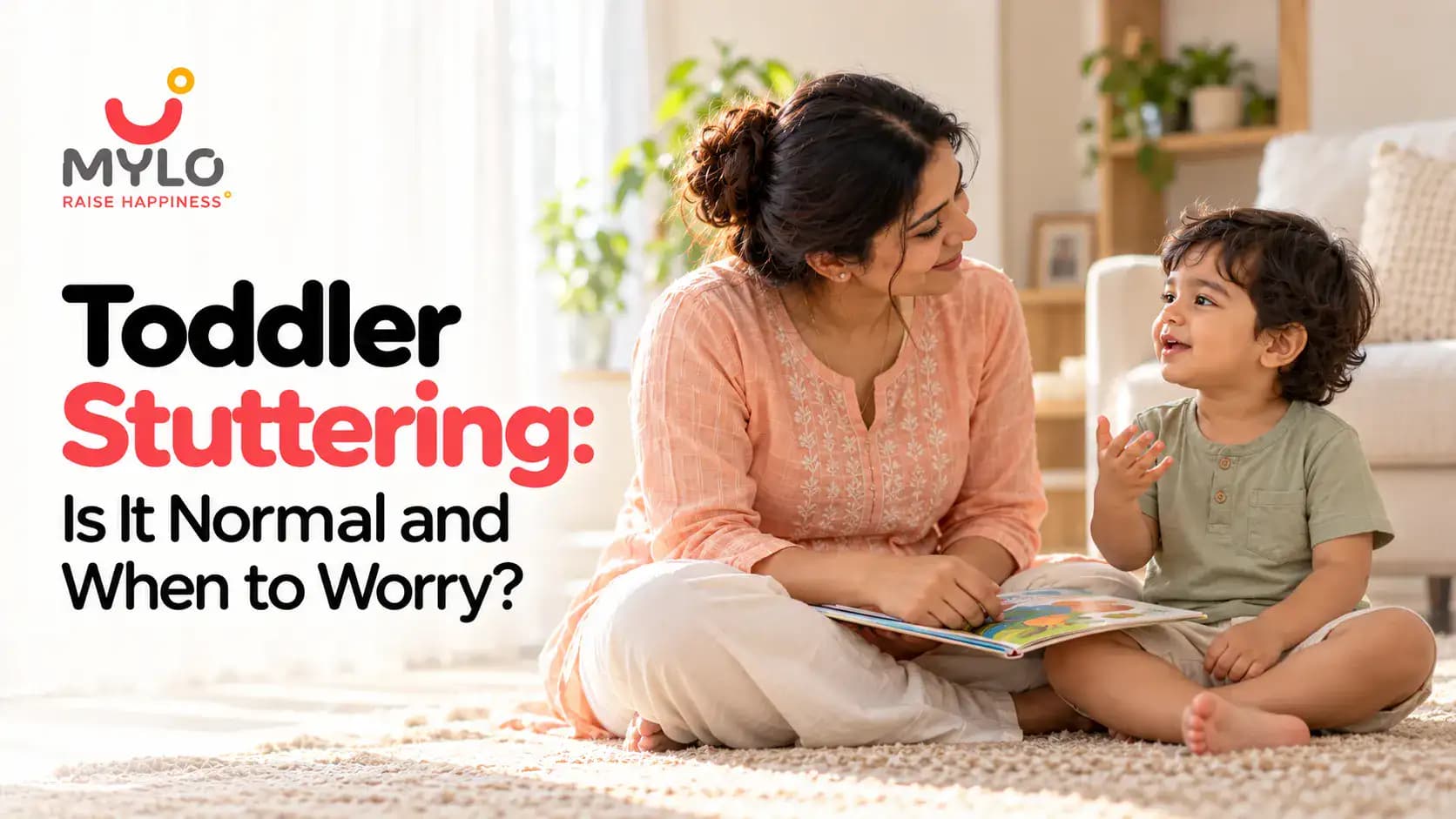
Toddler Stuttering: Is It Normal and When to Worry?
 14 min
Quick Answer
Toddler stuttering means a young child repeats sounds or words, stretches sounds, or gets stuck while talking. It often starts suddenly between 2 and 4 years, when language grows fast. Most children stop on their own. Talk slowly and calmly, don't rush them, and see a speech therapist if it lasts over 6 months.
Toddler Stuttering at a Glance
Question | Short Answer |
|---|---|
Is stuttering normal in toddlers? | Some repeating is very common between 2 and 5 years |
When does it usually start? | Between 2 and 4 years, often suddenly |
Will my toddler grow out of it? | Most children who stutter stop on their own, often within months |
What does normal repeating sound like? | "I want, I want the ball" or "Mumma, Mumma, look" |
What may need a check? | "B-b-b-ball", stretched sounds, getting stuck, tense face, frustration |
What helps at home | Talk slowly, wait patiently, don't finish their words, give full attention |
When to see a speech therapist | Lasts more than 6 months, gets worse, shows tension or frustration, or you're worried |
Key Facts Every Parent Should Know
It's common: About 5 in 100 children go through a period of stuttering, usually in the toddler and preschool years
Most children recover: Around 75 to 80 in 100 children who start stuttering stop on their own
It's not caused by parents: Stuttering is linked to how the brain handles speech, and it often runs in families
It often comes and goes: A toddler may stutter for weeks, then speak smoothly, then stutter again
Excitement and tiredness make it worse: It often shows up when children are rushed, excited or tired
Early help works well: If stuttering continues, speech therapy for young children is very effective
What Is Stuttering in Toddlers?
Short answer: Stuttering (haklana) is when the flow of speech is broken by repeated sounds, stretched sounds or blocks where no sound comes out.
Type | What It Sounds Like |
|---|---|
Sound or syllable repeats | "B-b-b-ball", "Ma-ma-ma-mango" |
Whole-word repeats | "I-I-I want milk" |
Stretched sounds | "Ssssssun", "Mmmmmumma" |
Blocks | Mouth open, trying to speak, but no sound comes out |
Fillers | "Um", "uh" used a lot |
Is It Normal Repeating or True Stuttering?
Short answer: Many toddlers repeat whole words or phrases without any tension. This is normal. Repeating parts of words, stretching sounds, getting stuck, or showing tension and frustration may be true stuttering.
Usually Normal (Developmental Disfluency) | May Be True Stuttering |
|---|---|
Repeats whole words or phrases: "I want, I want juice" | Repeats parts of words: "j-j-j-juice" |
A few repeats, now and then | Many repeats in a row, often |
Relaxed, doesn't notice | Tense face, blinking, head or body movements while talking |
Uses "um" sometimes | Gets stuck with no sound coming out |
Keeps talking happily | Gets upset, avoids words or stops talking |
Comes and goes, fades with time | Lasts more than 6 months or gets worse |
Why Has My Toddler Started Stuttering Suddenly?
Short answer: Sudden stuttering often happens when a toddler's language is growing faster than their speech muscles can keep up. Excitement, stress and big changes can make it more noticeable.
Possible Reason | What It Means |
|---|---|
Fast language growth | Their brain has more to say than their mouth can manage |
Family history | Stuttering often runs in families |
Excitement or rushing | Trying to talk fast to get attention or keep up |
Tiredness | Speech gets harder at the end of the day |
Big changes | A new sibling, moving house or starting playschool |
Feeling pressured to talk | Being asked many questions or asked to "say it properly" |
Stuttering after a new baby is common. Read our guide on preparing your toddler for a new baby.
Will My Toddler Grow Out of Stuttering?
Short answer: Most toddlers do. Many stop within a few months, and most stop within a few years. Some children are more likely to keep stuttering and should be checked early.
Children more likely to keep stuttering:
A parent, brother, sister or close relative still stutters
Stuttering has lasted more than 6 months
Stuttering started after about 3 and a half years
There are other speech or language delays
Boys are more likely to keep stuttering than girls
If any of these apply, see a speech therapist early. You don't need to wait.
How Can I Help My Toddler at Home?
Short answer: Make talking feel easy and relaxed. Slow down your own speech, give your toddler time, and listen to what they say, not how they say it.
Speak slowly yourself: A slow, calm voice helps your toddler slow down too, without being told.
Wait before you answer: Pause for a second or two before replying. It makes the conversation feel less rushed.
Don't finish their words: Let them say it themselves, even if it takes longer.
Don't say "slow down" or "take a breath": These make children more aware and more anxious.
Give full attention: Look at your toddler and show you're listening. Put the phone away.
Ask fewer questions: Comment instead. "You built a tall tower!" instead of "What did you build?"
Take turns talking at home: Make sure everyone gets a turn, so your toddler doesn't need to rush.
Have daily one-on-one time: 5 to 10 minutes of calm play where your toddler leads.
Keep routines calm: Regular sleep and fewer rushed mornings help.
Stay calm yourself: If you look worried, your toddler will notice. Praise what they say, not how smoothly they say it.
What to say and what to avoid
Avoid Saying | Try Instead |
|---|---|
"Slow down!" | Speak slowly yourself |
"Take a deep breath and try again" | Wait calmly and keep eye contact |
"Say it properly" | "I'm listening. Take your time." |
Finishing their sentence | Let them finish |
"Stop stuttering" | Respond to what they said: "Yes, the dog is big!" |
Can Learning Two Languages Cause Stuttering?
Short answer: No. There's no good evidence that learning two languages causes stuttering. A child who stutters may stutter in one or both languages. Keep speaking your home language.
Read more: Toddler Learning Two Languages: Does It Cause Speech Delay?
When Should I See a Speech Therapist?
Short answer: See a speech therapist if stuttering lasts more than 6 months, gets worse, comes with tension or frustration, or if you're worried at any time.
Sign | Why It Matters |
|---|---|
Lasts more than 6 months | Less likely to go away on its own |
Repeats parts of words often, or gets stuck | May be true stuttering |
Tense face, blinking or body movements while talking | Needs a check |
Avoids talking, says "I can't say it" or gets upset | Stuttering is affecting confidence |
Started after about 3 and a half years | More likely to continue |
Family history of stuttering | More likely to continue |
Other speech or language delays | Needs a full speech check |
You or your child are worried | It's always okay to ask |
What Happens in Speech Therapy?
Short answer: A speech therapist (speech-language pathologist) listens to your toddler, checks their speech and language, and teaches you simple ways to help at home. Therapy for young children is usually play-based.
The therapist will listen to your toddler talk and play
They will ask about family history and when the stuttering started
For young children, parents are often trained to do short daily practice at home
Programmes like the Lidcombe Program are often used for children under 6
Many children need only a few months of therapy
In India: Look for a speech therapist registered with the Rehabilitation Council of India (RCI).
Who Can Help?
Short answer: A speech therapist is the main expert for stuttering. Your pediatrician can also check your toddler and refer you.
Who | When to See Them |
|---|---|
Speech therapist (speech-language pathologist) | Main expert for stuttering checks and therapy |
Pediatrician | First check and referral |
Audiologist | If there are any hearing concerns |
Child psychologist | If stuttering is causing strong anxiety or avoiding talking |
Free or low-cost support in India
DEIC (District Early Intervention Centre): Free speech checks and therapy at district hospitals
RBSK (Rashtriya Bal Swasthya Karyakram): Free health and development checks for children from birth to 18 years
All India Institute of Speech and Hearing (AIISH), Mysuru: A government institute for speech and hearing services
Tele-MANAS (14416): Free mental health helpline for parents who feel stressed
What Should Indian Parents Keep in Mind?
Short answer: In India, stuttering is often blamed on copying others or on tongue tie, and children are sometimes teased. Stay calm, protect your child from teasing, and get expert advice instead of home remedies.
"Kisi ki nakal karne se haklaata hai": Stuttering isn't caught by copying someone. It's linked to how the brain plans speech
Tongue tie: Tongue tie doesn't cause stuttering. A doctor can check for tongue tie separately
Herbal remedies: Don't give herbs or powders for speech without a doctor's advice. Some can be harmful for young children
Teasing: Ask family members, cousins and neighbours not to tease, copy or laugh at your toddler's speech
Forcing the right hand: Forcing a left-handed child to use their right hand doesn't cause stuttering, but it can cause stress. Let your child use whichever hand they prefer
Joint families: Many people talking at once can make toddlers rush. Help everyone take turns
Myths vs Facts
Myth | Fact |
|---|---|
Parents cause stuttering | Stuttering is linked to the brain and genes, not bad parenting |
Stuttering is caught by copying someone | It isn't caught from others |
Telling a child to slow down helps | It often makes them more anxious |
All toddlers who stutter need therapy | Most stop on their own, but some need early help |
Two languages cause stuttering | There's no good evidence of this |
Children who stutter are less intelligent | Stuttering has nothing to do with intelligence |
Frequently Asked Questions
1. Why has my 3-year-old started stuttering suddenly?
Stuttering often starts suddenly between 2 and 4 years, when language grows quickly. Excitement, tiredness or a big change can make it more noticeable.
2. Is stuttering normal for a 2-year-old?
Repeating whole words is very common at 2. If your child repeats parts of words, gets stuck or seems tense, ask a speech therapist.
3. Will my toddler's stuttering go away?
Most children stop on their own. See a speech therapist if it lasts more than 6 months or you're worried.
4. Why does my toddler stutter when excited?
When excited, toddlers try to talk fast. Their speech can't keep up with their thoughts.
5. Should I correct my toddler when they stutter?
No. Don't correct or say "slow down". Speak slowly yourself, wait patiently, and respond to what they said.
6. Can stress cause stuttering?
Stress doesn't cause stuttering, but it can make it worse. Calm routines help.
7. Does a new sibling cause stuttering?
A new baby can make stuttering more noticeable for a while because of stress and change. Extra one-on-one time helps.
8. Baccha haklata hai to kya karein?
2 se 4 saal ke bacchon mein thoda haklana aam baat hai. Khud dheere aur aaram se boliye, bacche ki baat beech mein mat kaatiye, aur "dheere bolo" mat kahiye. Agar 6 mahine se zyada chale, to speech therapist se milein.
9. Kya haklana apne aap theek ho jata hai?
Haan, zyada tar bacchon mein haklana apne aap theek ho jata hai. Lekin agar baccha atakta hai, chehra tight hota hai, ya bolne se ghabrata hai, to jaldi speech therapist ko dikhaiye.
Related Reads on Mylo
References
American Speech-Language-Hearing Association (ASHA). "Stuttering." https://www.asha.org/public/speech/disorders/stuttering/
The Stuttering Foundation. "If You Think Your Child Is Stuttering." https://www.stutteringhelp.org
National Institute on Deafness and Other Communication Disorders (NIDCD). "Stuttering." https://www.nidcd.nih.gov/health/stuttering
Yairi E, Ambrose N. "Epidemiology of stuttering: 21st century advances." Journal of Fluency Disorders, 2013.
All India Institute of Speech and Hearing (AIISH), Mysuru. https://aiishmysore.in
Rehabilitation Council of India (RCI). https://rehabcouncil.nic.in
Medical Disclaimer
This article is for information only and does not replace professional medical advice. Every child is different. If you're worried about your toddler's speech, please consult a speech therapist or your pediatrician.


Article Posted Under
Related Articles
Toddler Stuttering: Is It Normal and When to Worry?
 14 min
 Toddler Behaviour Red Flags: When to See a Pediatrician
 17 min
 Toddler Throwing Things: Why It Happens and What to Do
 20 min
 How to Handle a Toddler Tantrum in Public: What to Do in a Shop, Restaurant, Shaadi or While Travelling, and How to Prevent It (2026)
 17 min
Related Topics
.webp&w=32&q=75)
Medical Disclaimer
This content is for informational purposes only and should not replace professional medical advice. Consult with a physician or other health care professional if you have any concerns or questions about your health. If you rely on the information provided here, you do so solely at your own risk.


AWARDS AND RECOGNITION

Mylo wins Forbes D2C Disruptor award

Mylo wins The Economic Times Promising Brands 2022
AS SEEN IN













- Mylo Care: Effective and science-backed personal care and wellness solutions for a joyful you.
- Mylo Baby: Science-backed, gentle and effective personal care & hygiene range for your little one.
- Mylo Community: Trusted and empathetic community of 10mn+ parents and experts.


Product Categories
Baby Carrier | Baby Soap | Baby Wipes | Stretch Marks Cream | Baby Cream | Baby Shampoo | Baby Massage Oil | Baby Hair Oil | Stretch Marks Oil | Baby Body Wash | Baby Powder | Baby Lotion | Diaper Rash Cream | Newborn Diapers | Teether | Baby Kajal | Baby Diapers Pants | Cloth Diapers | Laundry Detergent | Lactation Granules |