


Orders

Profile


Wallet

Speech Articulation and Speech Abnormalities in Children: A Complete Guide for Indian Parents (2026 Complete Guide)
 13 min


BDS (Gold Medalist), Certified Lactation Consultant – BPNI Delhi, Maternal & Infant Nutrition Expert · 15 years experience
TL;DR
Speech articulation is how clearly a child produces speech sounds, and it develops gradually, so young children naturally mispronounce many sounds and become clearer with age (ASHA, CDC). By about age 4, most children are nearly fully understandable, though some sounds like "r", "s" and "th" can stay tricky until 5 to 7 years, which is normal. Speech abnormalities, such as articulation or phonological disorders, stuttering or childhood apraxia, are when speech errors are more than expected for a child's age. A hearing check is often the important first step. Much improves with everyday talking, reading and patience, and speech therapy works well when needed. See a professional if your child is hard to understand for their age, loses speech skills, or stutters with effort.
Quick Answer
Speech articulation is how clearly a child says sounds, and it develops with age, so early mispronunciation is normal. By about age 4, most children are nearly fully understandable, though sounds like "r" and "s" can stay tricky. Speech abnormalities are errors beyond what is expected, and speech therapy helps when needed.
Author: Mylo Editorial Team, Mylo Parenting Desk Medically reviewed by: Mylo Editorial Board, aligned with ASHA, CDC, AAP and IAP guidance Last updated: 22 June 2026
Medical Disclaimer: This article is for informational purposes only and is not a substitute for professional medical advice. Children develop speech at different rates. If you are concerned about your child's speech or hearing, speak to your pediatrician or a speech-language pathologist for an assessment.
Key Takeaways
Speech articulation is how clearly a child produces speech sounds (ASHA)
It develops gradually, so early mispronunciation is completely normal
By about age 4, most children are nearly fully understandable to strangers
Sounds like "r", "s", "sh" and "th" can normally stay tricky until 5 to 7 years
Speech abnormalities are errors beyond what is expected for a child's age
A hearing check is often the important first step, since hearing affects speech
Everyday talking, reading and patience support speech, and therapy helps when needed
See a professional if your child is hard to understand for their age or loses skills
What Is Speech Articulation?
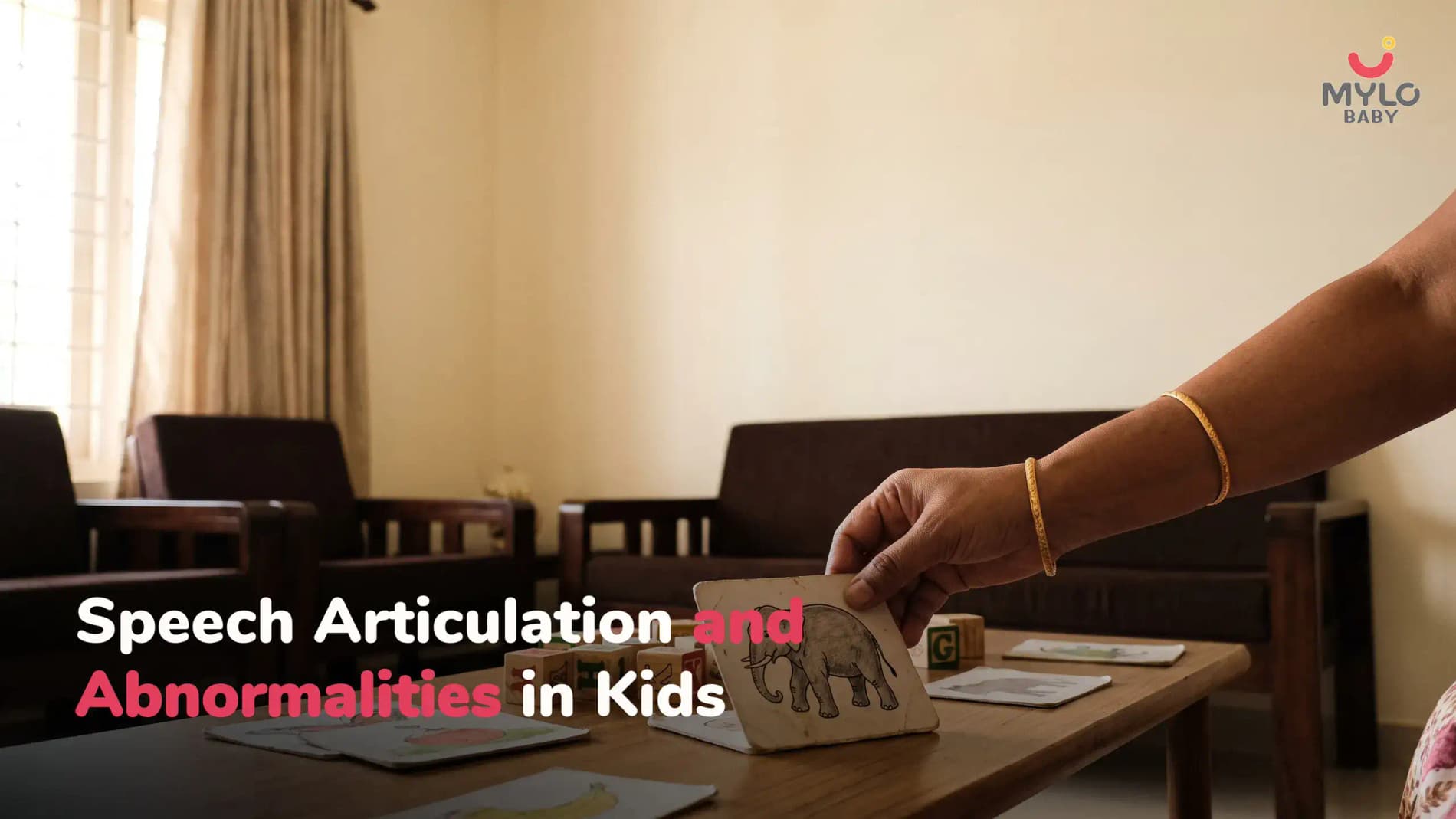
Speech articulation means how a child physically produces speech sounds using the lips, tongue and mouth (ASHA). It is part of speech, which is different from language. Speech is about how sounds come out, while language is about words, meaning and understanding. Young children naturally make many sound errors as their mouths and skills develop, and their speech becomes clearer year by year. Knowing what is typical at each age helps you tell normal development from a real concern.
Featured answer: Speech articulation is how clearly a child produces speech sounds. It develops gradually, so mispronouncing sounds is normal in young children. By about age 4 most children are nearly fully understandable, though sounds like "r", "s" and "th" can stay tricky until 5 to 7 years. Speech abnormalities are errors beyond what is expected for the age, and speech therapy helps when needed.
How Clear Should My Child's Speech Be by Age?
A helpful way to track speech is intelligibility, meaning how much of your child's speech a stranger can understand (ASHA, CDC).
Age | How much a stranger understands |
|---|---|
18 months | About 25 percent |
2 years | About 50 percent |
3 years | About 75 percent |
4 years | Nearly all (close to 100 percent) |
So if your three-year-old is half to mostly understandable, that is on track, even with plenty of sound errors.
Which Sounds Develop at Which Age?
Children master speech sounds in a fairly predictable order, with some sounds normally taking years longer than others (ASHA).
Sounds | Usually mastered by |
|---|---|
p, b, m, n, h, w, d | About 3 years |
k, g, f, t, ng, y | About 3 to 4 years |
l, s, z, sh, ch, j | About 4 to 6 years |
r, v, th | About 5 to 7 years |
This is why a four-year-old saying "wabbit" for "rabbit" or lisping on "s" is usually normal, not a problem.
What Are the Common Speech Abnormalities?
When speech errors are more than expected for a child's age, or follow unusual patterns, it may be a speech disorder (ASHA, Mayo Clinic).
Type | What it is |
|---|---|
Articulation disorder | Trouble making specific sounds (such as distorting "s") beyond the expected age |
Phonological disorder | Patterns of errors, like dropping all final sounds |
Stuttering (disfluency) | Repeating, prolonging or getting stuck on sounds |
Childhood apraxia of speech | Difficulty planning mouth movements; inconsistent errors and groping |
Is Stuttering Normal in Young Children?
Often, yes. Many children between about 2 and 5 years go through a phase of normal disfluency, repeating words or phrases as their language races ahead of their speech (ASHA, NHS). This usually passes. However, speak to a professional if the stuttering lasts more than about 6 months, comes with visible effort or tension, facial grimacing, or avoiding talking, starts after age 3 with a struggle, or runs in the family. Early help is very effective.
What Causes Speech Difficulties?
Speech problems can have several causes, and sometimes no clear cause is found (ASHA, IAP). Importantly, undetected hearing loss is a common and treatable cause, so hearing is usually checked first.
Hearing problems, even mild or temporary ones
Differences in the muscles or movements of the mouth
Structural issues, such as a cleft palate
Developmental or neurological factors
Limited talking and interaction in the early years
Often, simply individual variation in development
How Can You Support Your Child's Speech at Home?
Everyday interaction is the most powerful tool for building clear speech (ASHA, CDC).
🗣️ How to Support Your Child's Speech at Home
Keep it warm, natural and pressure-free:
Talk and read every day: Lots of conversation and stories build sounds and words
Model, do not correct harshly: If your child says "wabbit", gently say "yes, a rabbit", without making them repeat it
Get down to their level: Speak slowly and clearly, facing your child
Expand on what they say: If they say "ball", reply "yes, a big red ball"
Do not force repetition: Constant "say it properly" adds pressure, especially with stuttering
For stuttering, give time: Do not rush them or say "slow down" repeatedly; listen patiently
Limit screens: Real talk teaches speech far better than a screen
Praise communication, not perfection: Celebrate that they are talking
Your calm, encouraging attention helps far more than correction. Make talking fun, and clarity grows with time.
When Should You See a Doctor or Speech Therapist?
Much sound error is normal, but some signs warrant an assessment, ideally including a hearing check (ASHA, CDC). See your pediatrician or a speech-language pathologist if your child:
Is hard to understand for their age (for example, not half understandable by 2, or mostly understandable by 3 to 4)
Has many sound errors well beyond the expected age
Stutters with effort or tension, or for more than about 6 months
Has inconsistent errors and seems to grope for sounds
Loses speech skills they once had
Does not respond to sounds or your voice, which may suggest a hearing problem
Gets very frustrated at not being understood
What Does Speech Support Cost in India?
Everyday support at home is free, and government programmes screen and help children at no cost. Private therapy is also available.
Item | Typical cost (₹) | Note |
|---|---|---|
Talking, reading and play at home | Free | The most effective everyday support |
Government screening (RBSK) | Free | Screens for speech and hearing issues (NHM) |
Hearing test | ₹500 to ₹2,000 | Often the important first step |
Pediatrician consultation | ₹500 to ₹1,500 | Free at government centres |
Speech therapy session (private) | ₹500 to ₹2,000 | Frequency as advised |
Indian Context: What Indian Parents Should Know
Bilingualism does not cause speech disorders: Growing up with several languages does not delay or disorder speech; a real problem shows across all the child's languages, so assess in every language (ASHA)
Get hearing checked early: Newborn hearing screening and early hearing checks are important, as undetected hearing loss is a common, treatable cause of speech problems
Use government screening: The RBSK programme screens children for speech, hearing and developmental issues free of cost (NHM)
Be cautious about quick tongue-tie surgery: Tongue-tie is sometimes blamed too readily; get a proper assessment before any procedure
Reduce stigma: Speech difficulties are common and treatable; seeking a speech therapist is a positive, caring step, not a stigma
Speak in your mother tongue: Rich talk in your home language strongly supports speech and language
Emergency number: Dial 108 for ambulance services across most states
Myths vs Facts About Children's Speech
Myth | Fact | Source |
|---|---|---|
"A 4-year-old should say every sound perfectly" | Sounds like "r" and "th" normally develop up to age 7 | ASHA |
"Bilingual children have more speech problems" | Bilingualism does not cause speech disorders | ASHA |
"All stuttering needs urgent treatment" | Some disfluency is a normal phase, though persistent stuttering needs help | NHS |
"Constantly correcting will fix speech" | Gentle modelling works better than pressure and correction | CDC |
"Speech problems will always fix themselves" | Some do, but real disorders improve faster with therapy | ASHA |
FAQs: Speech Articulation and Abnormalities
When should my child's speech be clear? A stranger should understand about half of a 2-year-old, about three-quarters of a 3-year-old, and nearly all of a 4-year-old (ASHA). Plenty of sound errors before this are normal.
Bachche ki saaf bolne ki umar kya hai? (Hinglish) Lagbhag 2 saal mein ek anjaan vyakti bachche ki aadhi baat samajh leta hai, 3 saal mein teen-chauthai, aur 4 saal mein lagbhag poori. Is se pehle galat ucharan (pronunciation) bilkul normal hai. "r", "s", "th" jaise sounds 5 se 7 saal tak mushkil rehna bhi normal hai.
Is it normal for my 4-year-old to say "wabbit" for "rabbit"? Yes. The "r" sound often develops up to age 6 or 7, so saying "wabbit" at 4 is usually normal (ASHA). Gently model the correct word without forcing your child to repeat it.
Mera bachcha haklata (stutter) hai, kya yeh chinta ki baat hai? (Hinglish) 2 se 5 saal ke kai bachche thodi disfluency (shabd dohrana) se guzarte hain, jo aksar apne aap theek ho jata hai. Lekin agar haklana 6 mahine se zyada chale, isme tanaav ya chehre par zor dikhe, ya family history ho, to speech therapist se milein. Jaldi madad bahut faydemand hoti hai.
What is the difference between speech and language? Speech is how sounds are produced, while language is about words, meaning and understanding (ASHA). A child can have clear speech but a language delay, or good language with sound errors. This article focuses on speech and articulation.
Could a hearing problem be affecting my child's speech? Yes. Even mild or temporary hearing loss can affect speech, which is why a hearing check is often the first step (ASHA). If your child does not respond well to sounds, get their hearing tested.
Does being bilingual cause speech problems? No. Growing up with more than one language does not cause speech disorders or delays (ASHA). A genuine speech problem appears across all of a child's languages, so assessment should consider every language they speak.
When should I take my child to a speech therapist? See a speech-language pathologist if your child is hard to understand for their age, has many errors beyond the expected age, stutters with effort or for over 6 months, loses skills, or seems not to hear well (CDC). Early help works best.
References
American Speech-Language-Hearing Association (ASHA). "Speech Sound Disorders and Development." https://www.asha.org
Centers for Disease Control and Prevention (CDC). "Language and Speech Milestones." https://www.cdc.gov
American Academy of Pediatrics (AAP). "Healthy Children: Speech and Language." https://www.healthychildren.org
NHS UK. "Speech and Language Development and Stammering." https://www.nhs.uk
Mayo Clinic. "Speech Disorders in Children." https://www.mayoclinic.org
Indian Academy of Pediatrics (IAP). "Child Development and Hearing." https://www.iapindia.org
Ministry of Health and Family Welfare / National Health Mission. "Rashtriya Bal Swasthya Karyakram (RBSK)." https://nhm.gov.in

Medical Disclaimer
This content is for informational purposes only and should not replace professional medical advice. Consult with a physician or other health care professional if you have any concerns or questions about your health. If you rely on the information provided here, you do so solely at your own risk.


AWARDS AND RECOGNITION

Mylo wins Forbes D2C Disruptor award

Mylo wins The Economic Times Promising Brands 2022
AS SEEN IN












- Mylo Care: Effective and science-backed personal care and wellness solutions for a joyful you.
- Mylo Baby: Science-backed, gentle and effective personal care & hygiene range for your little one.
- Mylo Community: Trusted and empathetic community of 10mn+ parents and experts.


Product Categories
Baby Carrier | Baby Soap | Baby Wipes | Stretch Marks Cream | Baby Cream | Baby Shampoo | Baby Massage Oil | Baby Hair Oil | Stretch Marks Oil | Baby Body Wash | Baby Powder | Baby Lotion | Diaper Rash Cream | Newborn Diapers | Teether | Baby Kajal | Baby Diapers Pants | Cloth Diapers | Laundry Detergent | Lactation Granules |