


Orders
.png&w=48&q=75 "login")
Profile


Wallet

Toddler Defiance, Whining and Screaming: What Helps
 18 min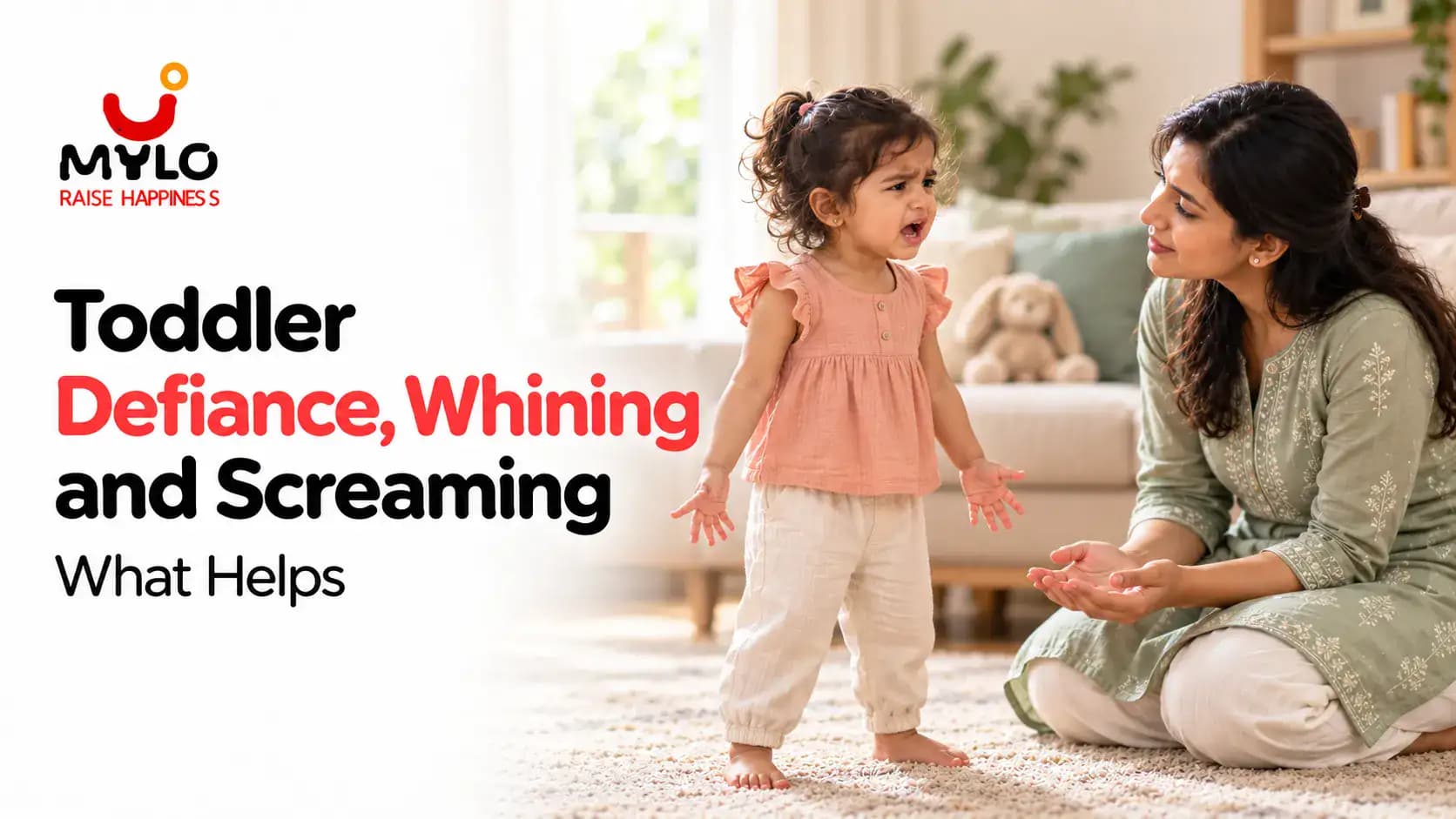
Quick Answer
Toddler defiance, whining and screaming are normal between about 18 months and 4 years. Toddlers want independence but can't yet handle big feelings or say what they need. Stay calm, give simple choices, praise good behaviour, don't give in to whining, and teach a calm voice. Most children improve as their speech grows.
Defiance, Whining and Screaming at a Glance
Behaviour | What It Looks Like | Why It Happens | What Helps Most |
|---|---|---|---|
Defiance | Saying "no" to everything, not listening, doing the opposite | Wanting independence and control | Simple choices, clear short instructions, praise for listening |
Whining | A high, crying voice to ask for things | Tiredness, hunger, wanting attention, not having the words | Calmly ask for a normal voice; don't give in to whining |
Screaming | Loud shrieks when excited, angry or for no clear reason | Exploring their voice, excitement, frustration, attention | Stay calm, teach "inside voice", give attention for quiet asking |
Key Facts Every Parent Should Know
"No" is a milestone: Saying "no" shows your toddler is learning they're a separate person with their own wishes
Peak years: Defiance and whining are most common between about 18 months and 4 years
Attention is powerful: Toddlers repeat what gets your attention, so notice and praise good behaviour often
Don't give in to whining: If whining works, it happens more
Never hit: The American Academy of Pediatrics (AAP) advises against spanking and harsh punishment, because they make behaviour worse
Check hearing: A toddler who doesn't listen or speaks very loudly should have their hearing checked if you're unsure
Why Do Toddlers Become Defiant?
Short answer: Toddlers become defiant because they're discovering independence. They want to choose, do things themselves and test what happens when they say "no". This is a normal and healthy part of growing up.
Reason | What It Looks Like |
|---|---|
Wanting independence | "Me do it!" or refusing help |
Wanting control | Saying "no" even to things they like |
Testing limits | Looking at you and doing the thing you just said not to do |
Not understanding long instructions | Ignoring you when there are too many words |
Being busy playing | Not hearing you when focused on a toy |
Tiredness, hunger or illness | More "no" when they're not feeling their best |
Big changes | A new sibling, starting playschool, moving house |
Why Does My Toddler Say "No" to Everything?
Short answer: Saying "no" is one of the first ways toddlers show they have their own mind. Many toddlers say "no" even when they mean "yes", simply because they like having a choice.
What helps:
Ask fewer yes or no questions: Instead of "Do you want to wear your shoes?", say "Red shoes or blue shoes?"
Save your own "no" for important things: Safety and health first
Say what to do instead: "Walk, please" works better than "Don't run"
Make it playful: "Can you put your shoes on before I count to 5?"
My Toddler Is Not Listening. What Should I Do?
Short answer: Toddlers often don't listen because instructions are too long, they're busy playing, or they want control. Get down to their level, use a few clear words, and follow through calmly.
Bacha baat nahi manta to kya kare? Shout less, connect more. Go close, make eye contact, say one short instruction, and help your toddler do it.
Instead of | Try |
|---|---|
Shouting from another room | Go close, touch their shoulder, make eye contact |
"Put your toys away, wash your hands and come for dinner" | One step at a time: "Put the cars in the box." |
"Don't throw the ball inside!" | "Balls stay on the floor inside. We throw outside." |
"Will you come for your bath?" | "Bath time now. Do you want to walk or hop like a frog?" |
Repeating 10 times | Say it once, then calmly help them do it |
"Do it or no TV!" | "When the toys are in the box, then we'll read a story." |
Why Is My Toddler Whining All the Time?
Short answer: Toddlers whine when they're tired, hungry, bored, want attention, or can't find the words for what they need. Whining often increases when it works, so stay calm and ask for a normal voice before you help.
Why Toddlers Whine | What Helps |
|---|---|
Tired or hungry | Keep naps, meals and snacks on time |
Wanting attention | Give 10 to 15 minutes of daily one-to-one time with full attention |
Not having the words | Teach words: "Say 'Help please'" |
Whining worked before | Calmly wait for a normal voice before helping |
Bored | Offer a simple activity or take them outside |
Feeling unwell | Check for a cold, teething or ear pain |
What to say when your toddler whines
Situation | What to Say |
|---|---|
Whining for a snack | "I can't understand the whiny voice. Can you ask in your big voice?" |
Asks nicely after whining | "Thank you for asking in your big voice! Here's your snack." |
Whining for the phone | "I hear you want the phone. It's not phone time. Let's read a book." |
Whining at bedtime | "You're tired. Let's do our bedtime story and sleep." |
Why Does My Toddler Scream for No Reason?
Short answer: Toddlers often scream to explore their voice, show excitement, get attention, or let out frustration. To you it may seem like no reason, but to your toddler it's a big feeling or a fun new sound.
Why Toddlers Scream | What Helps |
|---|---|
Discovering their voice (common at 12 to 24 months) | Play "loud voice outside, quiet voice inside" games |
Excitement | Calmly say, "You're so excited! Let's use a happy inside voice." |
Frustration or anger | Name the feeling and help them calm down |
Wanting attention | Give attention when they're quiet, not only when they scream |
Too much noise or crowd | Move to a quieter place |
Tired or hungry | Check sleep and meals first |
Screaming at night or in sleep? That's usually a different issue, like night terrors or nightmares. Talk to your pediatrician if it happens often.
Defiance, Whining and Screaming by Age
Short answer: These behaviours usually start around 15 to 18 months, peak between 2 and 3 years, and slowly improve by 4 to 5 as children learn to talk, wait and manage feelings.
Age | What You Might See |
|---|---|
12 to 18 months | Screaming to explore their voice, first "no", pushing your hand away |
18 months to 2 years | "No" to everything, running away, whining when tired or hungry |
2 to 3 years | Strong defiance, testing limits, whining and screaming when frustrated |
3 to 4 years | Arguing and whining, but more able to listen and use words |
4 to 5 years | Most children listen better, whine less and can calm down with help |
What Helps: 10 Simple Strategies
Short answer: Connect before you correct, keep instructions short and clear, give choices, praise good behaviour, and stay calm and consistent. These work better than shouting or punishment.
Give daily one-to-one time. 10 to 15 minutes of play where your toddler leads can reduce attention-seeking whining and screaming.
Get down to their level. Eye contact helps your toddler actually hear you.
Use few words. One short instruction at a time.
Say what to do, not what not to do. "Feet on the floor" instead of "Don't climb."
Offer two choices. "Do you want to brush teeth first or put on pyjamas first?"
Use "when, then". "When your shoes are on, then we'll go to the park."
Give warnings before changes. "Two more minutes, then bath time."
Praise good behaviour right away. "You came when I called. Thank you!"
Ignore minor whining calmly. Respond once your toddler uses a normal voice.
Follow through calmly. If you say it, gently help them do it, every time.
What about time-out?
For toddlers under 3, staying with them while they calm down (time-in) usually works best. For children 3 and older, a short, calm time-out (about 1 minute per year of age) can help, as long as it's never used to shame or frighten them.
What Not to Do
Don't | Why |
|---|---|
Shout or scream back | Your toddler learns that screaming is how we talk when upset |
Hit or slap | Increases aggression and doesn't teach self-control (AAP) |
Give in to whining or screaming | Teaches that whining and screaming work |
Bribe with the phone or sweets | Your toddler learns to whine for rewards |
Make threats you won't keep | Your toddler learns your words don't mean much |
Give long lectures | Toddlers can't take in long explanations |
Label them "ziddi", "rona-dhona" or "naughty" | Labels stick and don't help them change |
When Should I Worry?
Short answer: Most defiance, whining and screaming is normal. Talk to your pediatrician if it's extreme, constant, getting worse after age 4, or comes with other concerns like speech delay or not responding to their name.
Red Flag | Why It Matters |
|---|---|
Doesn't respond to their name or to sounds | Possible hearing problem or other concern; get a hearing check |
Speaks very loudly all the time | Can be a sign of hearing loss |
Very few words for their age | Frustration from a speech delay; a speech assessment may help |
Poor eye contact, doesn't point, repeats the same actions | May point to a developmental concern, like autism |
Extreme defiance, aggression or long tantrums most days, after 4 years | A child psychologist can help |
Screams or whines constantly and seems unwell or in pain | Check for illness, ear infection or other pain |
Sudden change in behaviour or loss of skills | See a doctor promptly |
About "defiance disorder": Oppositional defiant disorder (ODD) is a real condition, but it's usually diagnosed in older children, not toddlers. Saying "no", not listening and testing limits are normal toddler behaviour. Only a professional can assess whether there's more going on.
Who Can Help?
Professional | How They Help |
|---|---|
Pediatrician | Checks hearing, health, sleep and development |
Child psychologist | Helps with behaviour and teaches parenting strategies |
Speech and language therapist | Helps if a speech delay is causing frustration |
Audiologist | Tests hearing |
Developmental pediatrician | Assesses development if there are several concerns |
Free government support in India
Service | What It Offers |
|---|---|
Rashtriya Bal Swasthya Karyakram (RBSK) | Free screening for developmental delays, including hearing |
District Early Intervention Centres (DEIC) | Free assessment and therapy |
Tele-MANAS (14416) | Free mental health support for parents who feel stressed or overwhelmed |
What Should Indian Parents Keep in Mind?
Short answer: Defiance, whining and screaming are part of growing up. Agree on the same simple rules as a family, avoid giving in or shouting, and don't use the phone to stop whining.
Common Practice | Better Approach |
|---|---|
"Bachcha baat nahi manta" so we shout louder | Go close, use a few words, and help them follow through |
Grandparents giving whatever the toddler whines for | Agree on the same rules as a family |
Giving the phone to stop whining or screaming | Comfort, redirect, and wait for a calm voice |
Comparing with a cousin who "listens so well" | Every toddler has their own temperament |
Long lectures about respect | Show respect by speaking calmly; toddlers copy what they see |
A slap when the child says "no" | Calm, firm limits work better; hitting teaches hitting |
Scolding a screaming toddler at a function | Take them to a quieter place to calm down |
Myths vs Facts
Myth | Fact |
|---|---|
"A toddler who says 'no' is disrespectful" | Saying "no" is a normal sign of growing independence |
"Whining means my child is spoilt" | Whining usually means tired, hungry, bored or needing attention |
"Shouting makes toddlers listen" | Shouting often makes toddlers louder; calm, close instructions work better |
"Giving in once won't matter" | Giving in teaches that whining and screaming work |
"Defiant toddlers will grow into difficult children" | Most toddlers grow out of it with calm, consistent parenting |
"Toddlers scream for no reason" | There's usually a reason: excitement, frustration, tiredness or exploring their voice |
Frequently Asked Questions
Why is my toddler so defiant?
Because they're learning independence and want control. Saying "no" and testing limits are normal, especially between 18 months and 3 years.
Why does my toddler say no to everything?
Saying "no" is a way of showing they have their own mind. Give choices instead of yes or no questions, and save your own "no" for safety.
Bacha baat nahi manta to kya kare? (Hinglish)
Door se chillane ke bajaye bachche ke paas jaiye, aankhon mein dekh kar ek chhoti si baat kahiye, jaise "Khilone dabbe mein rakho," aur zaroorat ho toh saath mein karwaiye. Do vikalp dijiye, achhe vyavhaar ki tareef kariye aur maar-peet ya dhamki se bachiye.
Why is my toddler whining all the time?
Usually because of tiredness, hunger, boredom, wanting attention, or not having the words. Keep routines regular, give daily one-to-one time, and ask for a "big voice".
How do I stop my toddler from whining?
Stay calm, say "I can't understand the whiny voice," and help them as soon as they use a normal voice. Don't give in to whining.
Why does my toddler scream for no reason?
Toddlers scream to explore their voice, show excitement, get attention or let out frustration. Teach "inside voice" and give attention when they're calm.
Mera bachcha bahut chillata aur rota hai, kya karein? (Hinglish)
Pehle dekhiye ki kahin woh thaka, bhookha ya beemar toh nahi. Shaant rahiye, uski feeling ko naam dijiye aur dheemi awaaz mein baat karna sikhaiye. Jab woh aaram se maange, tab turant tareef kariye. Agar bachcha naam pukarne par jawab nahi deta ya bahut kam bolta hai, toh doctor se milein.
Is my toddler's defiance a disorder?
Usually not. Defiance is normal in toddlers. Oppositional defiant disorder is usually diagnosed in older children. Talk to your doctor if defiance is extreme or comes with other concerns.
Should I use time-out for a defiant toddler?
For toddlers under 3, staying with them while they calm down (time-in) works best. A short, calm time-out can help children 3 and older.
When will my toddler stop whining and saying no?
Most children improve between 4 and 5 years, as their speech and self-control grow.
When should I worry about my toddler's behaviour?
If your toddler doesn't respond to their name, has very few words, speaks very loudly all the time, has extreme behaviour most days after 4, or loses skills, talk to your pediatrician.
Related Reads on Mylo
References
American Academy of Pediatrics (AAP). "Where We Stand: Spanking." HealthyChildren.org. https://www.healthychildren.org/English/family-life/family-dynamics/communication-discipline/Pages/Where-We-Stand-Spanking.aspx
Sege RD, Siegel BS, AAP Council on Child Abuse and Neglect. "Effective Discipline to Raise Healthy Children." Pediatrics, 2018.
Centers for Disease Control and Prevention (CDC). "Positive Parenting Tips." https://www.cdc.gov/child-development/positive-parenting-tips/index.html
Centers for Disease Control and Prevention (CDC). "CDC's Developmental Milestones." https://www.cdc.gov/act-early/milestones/index.html
NHS (UK). "Temper Tantrums." https://www.nhs.uk/conditions/baby/babys-development/behaviour/temper-tantrums/
Ministry of Health and Family Welfare, Government of India. "Tele-MANAS" (14416). https://telemanas.mohfw.gov.in/
Medical Disclaimer
This article is for information only and does not replace professional medical advice. Every toddler is different. If you're worried about your toddler's behaviour, hearing or development, please consult your pediatrician.


Shop Now
Baby Essentials
Article Posted Under
Related Articles



Related Topics
.webp&w=32&q=75)
Medical Disclaimer
This content is for informational purposes only and should not replace professional medical advice. Consult with a physician or other health care professional if you have any concerns or questions about your health. If you rely on the information provided here, you do so solely at your own risk.


AWARDS AND RECOGNITION

Mylo wins Forbes D2C Disruptor award

Mylo wins The Economic Times Promising Brands 2022
AS SEEN IN













- Mylo Care: Effective and science-backed personal care and wellness solutions for a joyful you.
- Mylo Baby: Science-backed, gentle and effective personal care & hygiene range for your little one.
- Mylo Community: Trusted and empathetic community of 10mn+ parents and experts.


Product Categories
Baby Carrier | Baby Soap | Baby Wipes | Stretch Marks Cream | Baby Cream | Baby Shampoo | Baby Massage Oil | Baby Hair Oil | Stretch Marks Oil | Baby Body Wash | Baby Powder | Baby Lotion | Diaper Rash Cream | Newborn Diapers | Teether | Baby Kajal | Baby Diapers Pants | Cloth Diapers | Laundry Detergent | Lactation Granules |