


Orders
.png&w=48&q=75 "login")
Profile


Wallet

Taped Diapers in the First 8 Weeks: A Newborn Parent's Practical Guide
 16 min
Key Takeaways
Quick overview in 30 seconds.webp&w=32&q=75)
- Taped diapers feature adhesive tabs on both sides, allowing parents to fasten and adjust them snugly around their baby's waist for a comfortable, leak-proof fit.
- Different types include standard taped diapers, stretchable diapers, diapers with wetness indicators, and high-absorbency diapers designed for longer-lasting dryness and protection.
- Key benefits include a secure fit, easy fastening, leak prevention, versatile sizing options, and disposable convenience that saves time during frequent newborn diaper changes.
- Looking for soft, leak-proof taped diapers for your newborn? Explore our Adjustable & Reusable Cloth Diaper - Red & Blue - Pack of 2.
Quick Answer
Lay the diaper with the tabs at the back, bring the front up, fold the front edge down below the umbilical cord stump, then fasten both tabs symmetrically so two fingers slide flat at the waist. Finally, run a finger around both leg cuffs to pull them outward. That last step is what stops most thigh leaks, and it is the one most parents skip.
Key Takeaways
The leg cuffs are the whole game. A cuff tucked inward is the most common cause of thigh leaks, and it takes one second to fix.
Fold the front below the cord stump until it dries and falls off, usually within one to three weeks, or use a diaper cut with a naval notch.
Tabs fail for a reason. Barrier cream on the landing panel, or re-sticking the same tab repeatedly, is almost always why.
Mylo's New Born tape diaper covers up to 5 kg, and most babies outgrow it in four to eight weeks. Buy one large pack, not four.
Mobility, not a date, ends the tape stage.
Why does the newborn stage still start with tape?
Because a newborn's body changes shape faster than any fixed waistband can follow, and because almost every change in the first two months happens with your baby lying down.
The waist is adjustable. A newborn's tummy circumference changes noticeably between a full feed and an empty one. Tabs let you set the waist for the baby in front of you, not for an average.
You do not lift both legs. With a pull-on pant you have to raise both legs and thread them through. With tape you slide the diaper underneath. That matters more than it sounds when you are recovering from a C-section and when your baby's neck control is still developing.
The cord stump stays clear. You can fold the front edge to whatever height you need, and change that height daily as the stump shrinks.
None of this makes tape universally better. It makes tape well matched to a stage that lasts about eight weeks.
The four kinds of taped diaper, and who each one suits
Type | What it does | Suits |
|---|---|---|
Standard | Adhesive tabs on both sides, fixed side panel | Everyday newborn use |
Stretchable | Elastic side panels that give as your baby moves | Slim babies, and babies who wriggle hard |
With wetness indicator | A strip that changes colour when wet | Night checks, and the first few weeks while you learn the rhythm |
Extra absorbency | More absorbent layers | Nights, long journeys |
One thing to be clear about: "extra absorbency" describes a particular product, not the taped category. Read the pack, not the format.
Which size, and how long will it last?
Go by your baby's current weight, never their age. Two babies born the same day can be 2.6 kg and 3.8 kg.
Size | Mylo weight band | Typically lasts |
|---|---|---|
New Born | Up to 5 kg | 4 to 8 weeks from birth |
S | 4 to 8 kg | Roughly 2 to 6 months |
M | 7 to 12 kg | Roughly 5 to 10 months |
Mylo's taped option: New Born tape diapers, up to 5 kg, 26 count, cut with a naval notch and carrying a wetness indicator.
For the full range, see the diaper size and weight chart.
A larger newborn may skip New Born entirely and start at S, so do not stock up before your baby arrives. If your baby was born preterm or weighs under 2.5 kg, ask your pediatrician or NICU nurse before choosing.
The seven-step fasten
Position the diaper. Tabs at the back, laid flat under your baby's bottom. The top edge of the back panel should reach roughly waist level, not lower.
Bring the front up between the legs and lay it flat against the tummy without tugging.
Set the height. For a healing cord stump, fold the front edge down now, before you fasten anything.
Fasten the first tab, angled slightly downward across the hip rather than straight across.
Fasten the second tab to match. Symmetry matters, because an uneven waist twists the diaper and opens a gap on one side.
Check the waist. Two fingers, laid flat, should slide between the waistband and the tummy.
Sweep both leg cuffs outward. Run a finger all the way around each leg opening. This is the step that decides whether you have a leak.
The cord stump fold, done properly
Fold the front edge down so the top of the diaper sits below the stump. Do not fold so far that the absorbent core bunches under your baby.
Re-check the fold height every day. The stump shrinks, so what was right on day three is too low on day nine.
Do not tape over the stump to hold the fold. Let the fold sit naturally.
A naval notch does this for you. Some newborn diapers are cut with a semicircle at the front, so no folding is needed.
Watch the area. Redness spreading onto the belly, oozing, a foul smell, or a stump still attached at around three to four weeks all warrant a call to your pediatrician.
Tab problems nobody warns you about
What is happening | Why | Fix |
|---|---|---|
Tab will not stick at all | Barrier cream or oil has transferred onto the front landing panel | Keep cream off that strip. Wipe your hands before fastening |
Tab held, then let go an hour later | It was re-stuck two or three times while you adjusted | Fasten once, cleanly. Adhesive weakens each time it is peeled |
Tabs will not reach the front panel | Size is too small | Move up a size. Do not stretch the diaper to make it reach |
Tabs meet in the middle, overlapping | Size is too big | Size down |
Tab grip is poor in hot weather | The front panel is damp with sweat | Pat the area dry before fastening |
Tab tore off the diaper | Pulled straight out rather than peeled | Peel at an angle, slowly |
Tab left a red mark on the hip | Fastened too tight, or angled upward | Loosen and angle slightly downward |
Leak diagnosis by location
Leak location | What it means | Fix |
|---|---|---|
Up the back, along the spine | Diaper sitting too low, or one size too small | Raise the back panel, re-check the weight band |
One thigh only | Leg cuff tucked inward on that side | Sweep both cuffs outward every change |
Both thighs, core still dry | Diaper is too big | Size down |
Front, in a boy | Not pointed downward when fastened | Point downward before closing the tabs |
Everywhere, diaper heavy and sagging | Change interval too long | Shorten the interval, do not size up |
Only in a car seat or carrier | The core compresses while seated | Change right before travel |
Morning bed soaked, dry all day | Overnight capacity, not size | Change right before the last feed, or use a higher absorbency variant |
Worth repeating: a bigger size does not stop leaks. A too-big diaper gaps at the thigh, and the gap is where the leak escapes.
Night changes without fully waking your baby
Set up before you feed, not after. Fresh diaper open, wipes out, cream within reach.
Use dim, warm light. Overhead white light wakes a baby much more thoroughly.
Change before the last part of the feed, so your baby falls back to sleep on a full stomach.
Skip the change if the diaper is only wet and your baby is deeply asleep, unless there is rash. A poo always needs changing, at any hour.
Room-temperature wipes. A cold wipe wakes a baby instantly.
Keep talking to a minimum.
Heat, humidity and taped diapers in India
Change more often in hot, humid weather. Trapped moisture raises rash risk faster than in a dry climate.
Fasten to a dry panel. Sweat on the front of the diaper weakens tab grip, a specifically Indian summer problem.
Build in nappy-free air time on a waterproof mat every day.
Store packs sealed and off the floor during the monsoon.
Skip talcum powder in the diaper area.
Buy from the brand or an authorised seller. Counterfeit diapers are a real problem in Indian marketplaces, and the usual tell is weak tabs.
When does the tape stage end?
Your baby arches and rolls the moment you lay them down to change.
They can push up on their arms or are starting to crawl.
The diaper twists during the day because they are moving so much.
You are chasing them around the mat.
Tabs come undone during play rather than during a change.
When two or more are true, pull-on pants will be quicker and will stay put better. For most babies this lands between 6 and 12 months. See taped diapers vs diaper pants.
Sealing and binning a used tape diaper
Knock any solid stool into the toilet. Never flush the diaper or the wipes.
Roll the diaper front to back, tucking the used wipes inside the roll.
Wrap the tabs around and stick them down to seal the roll.
Into a covered bin, and empty it daily in hot or humid weather.
Wash your hands with soap for at least 20 seconds.
What experienced parents wish they had known
The belief | What actually holds up |
|---|---|
Tape diapers are leak-proof by design | Leak protection comes from size and fit, not the fastening |
A bigger size means fewer leaks | A too-big diaper gaps at the thigh and leaks more |
Tape keeps skin drier than a pant | Dryness comes from the absorbent core and your change interval |
Powder keeps the area dry | Talc is not recommended for babies. Use a zinc oxide barrier cream if needed |
You need cream at every change | Only when there is redness, or where your pediatrician advises it |
Stock up on newborn size before the birth | Birth weight is unpredictable and most babies leave NB within eight weeks |
Tape is only for the first month | It works as long as the fit is right. Mobility ends the stage, not the calendar |
Mylo Parents Asked
The tabs keep coming undone. What am I doing wrong?
Almost always barrier cream or oil on the front landing panel, which stops the adhesive gripping. Keep cream off that strip and wipe your hands before fastening. Re-sticking the same tab two or three times while adjusting also weakens it.
How high should the diaper sit with the cord stump still attached?
Fold the front edge down so the top of the diaper is clearly below the stump, leaving it open to air. Re-check the height every day, because the stump shrinks as it dries.
My newborn is 4.8 kg at three weeks. Should I move to S already?
Mylo's New Born covers up to 5 kg, so you are close. Buy an S pack now and finish the New Born pack first. Watch for tabs struggling to reach and for red marks lasting past 20 minutes.
Leaks up the back every morning. Size or fit?
Fit first. Back leaks almost always mean the diaper is sitting too low. Raise the back panel to waist level before you buy a different size.
Do I have to change a wet diaper at 3 am if my baby is fast asleep?
If it is only wet and your baby is settled with no rash, many parents leave it until the next feed. A poo should be changed straight away at any hour.
Can I use powder to keep the area dry?
No. Talcum powder is not recommended for babies because the fine particles can be inhaled. Dry the skin by patting, and use a thin layer of zinc oxide barrier cream if your pediatrician suggests it.
How many newborn packs should I buy before the birth?
One. Birth weight is hard to predict, a bigger baby may skip New Born entirely, and most babies who do use it leave within four to eight weeks.
Is a wetness indicator worth paying for?
Useful in the first few weeks while you are learning your baby's rhythm, and at night. It tells you nothing about a poo, so you still need to check.
When to speak to your doctor
Redness, oozing or a foul smell around the umbilical cord stump, or a stump still attached at around three to four weeks
Rash that is severe, blistering, bleeding or spreading
Rash not improving within a few days, or rash with fever
Bright red patches with small spots at the edges, which can suggest a fungal infection
Skin broken by a pressure mark from a tight tab
Fewer wet diapers than expected, along with a dry mouth, a sunken soft spot or unusual sleepiness
Bottom Line
The first eight weeks in tape diapers come down to four habits: fold below the cord stump and re-check it daily, fasten both tabs symmetrically to two fingers at the waist, sweep both leg cuffs outward every single time, and change every 2 to 3 hours. Get those right and the format does the rest.
Shop on Mylo
Taped diapers
Mylo New Born tape diapers, up to 5 kg, 26 count
Newborn pull-on pants, if you prefer
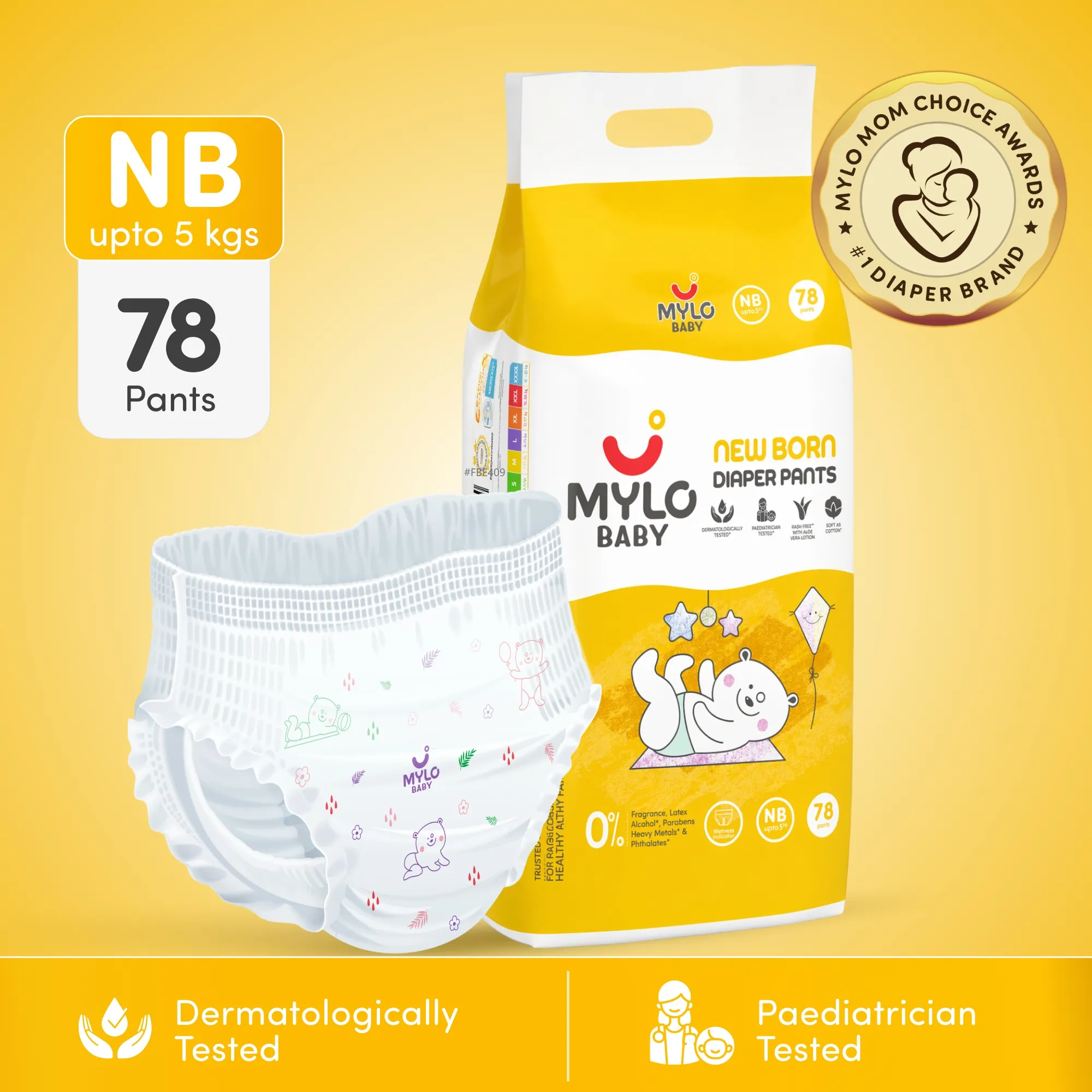
Mylo New Born diaper pants, up to 5 kg, 78 count
After the newborn stage
S | M | L | XL | XXL
Premium range AirPrime | All baby diapers | Mylo gentle baby wipes
Medical disclaimer: This article is for informational purposes only and is not a substitute for professional medical advice. If your baby has a rash that is severe, blistering, bleeding, spreading, not improving in a few days, or accompanied by fever, please consult your pediatrician.


Article Posted Under
Related Articles




Related Topics
.webp&w=32&q=75)
Medical Disclaimer
This content is for informational purposes only and should not replace professional medical advice. Consult with a physician or other health care professional if you have any concerns or questions about your health. If you rely on the information provided here, you do so solely at your own risk.


AWARDS AND RECOGNITION

Mylo wins Forbes D2C Disruptor award

Mylo wins The Economic Times Promising Brands 2022
AS SEEN IN













- Mylo Care: Effective and science-backed personal care and wellness solutions for a joyful you.
- Mylo Baby: Science-backed, gentle and effective personal care & hygiene range for your little one.
- Mylo Community: Trusted and empathetic community of 10mn+ parents and experts.


Product Categories
Baby Carrier | Baby Soap | Baby Wipes | Stretch Marks Cream | Baby Cream | Baby Shampoo | Baby Massage Oil | Baby Hair Oil | Stretch Marks Oil | Baby Body Wash | Baby Powder | Baby Lotion | Diaper Rash Cream | Newborn Diapers | Teether | Baby Kajal | Baby Diapers Pants | Cloth Diapers | Laundry Detergent | Lactation Granules |