


Orders
.png&w=48&q=75 "login")
Profile


Wallet

Is Your Toddler Ignoring You or Not Hearing You? A Parent's Guide to Hearing Checks
 16 min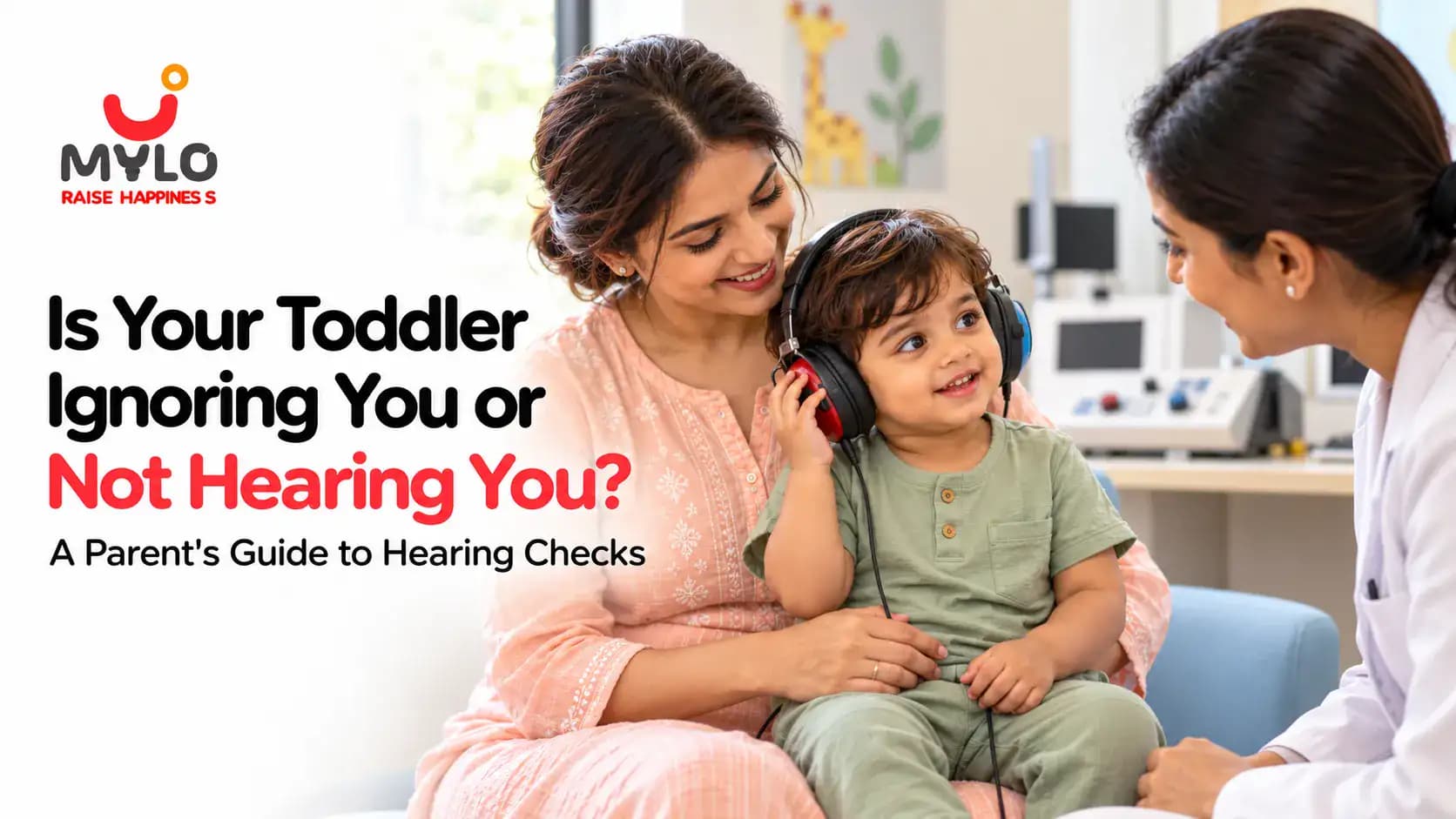
Quick Answer
Is your toddler ignoring you, or not hearing you? From the outside, the two can look the same. Try simple listening games at home, and get a hearing test if your toddler is late to talk, misses sounds or turns the volume up. Tests like OAE and BERA are painless at any age. Loud DJ music and firecrackers can harm little ears.
Why does hearing matter so much for toddlers?
Short answer: Toddlers learn to talk by hearing words. Even mild or temporary hearing loss can slow speech.
The first 3 years are the busiest time for language learning. A child who can't hear clearly may seem "stubborn", "late to talk" or "not listening". The World Health Organization notes that early detection and support make a big difference to a child's language and learning.
Is my toddler ignoring me, or not hearing me?
Short answer: If your toddler responds to a whispered "chocolate?" or "park chalein?" but not to "come here", they're probably hearing fine and just choosing not to listen.
Selective listening (normal toddler) | Possible hearing problem |
|---|---|
Ignores "bath time" but hears the snack packet open | Misses sounds even when they're fun or rewarding |
Responds once you stand in front of them | Responds only when they can see your face |
Hears the doorbell from another room | Doesn't notice the doorbell, pressure cooker or phone ringing |
Copies new words easily | Speech is unclear or not growing |
Same response every day | Hearing seems worse after every cold |
If you're unsure, a hearing test gives you a clear answer.
What hearing signs should my toddler show by age?
Short answer: Responding to their name, understanding simple words and following short instructions.
Age | Hearing and listening signs | Check hearing if... |
|---|---|---|
12 months | Turns to their name, babbles, enjoys sound toys, understands "no" | No response to their name, no babbling |
18 months | Points to a body part when asked, says several words, follows "give me the ball" | No words, or only notices sounds they can see |
2 years | Follows 2-step instructions, has many words, starts 2-word phrases | Very few words, no word pairs |
3 years | Understands most daily talk, uses short sentences, hears you from another room | Speech is very unclear, or they often say "what?" |
The American Speech-Language-Hearing Association lists similar signs.
Which listening games can I try at home?
Short answer: These 5 quick games show how your toddler responds to sound. They're a starting point, not a substitute for a real test.
Game | How to play | Good sign |
|---|---|---|
Whisper challenge | Stand behind your toddler and whisper their name or "toffee" | They turn around |
Hidden phone | Hide a ringing phone under a cushion | They search towards the sound |
Animal sounds | Make "moo" or "meow" without showing a picture | They point to the right animal (from about 18 months) |
Freeze dance | Play music, then pause it suddenly | They stop when the music stops (from about 2 years) |
Left or right? | Shake a rattle on one side, out of sight | They turn to the correct side each time |
Try each game on a few different days. If your toddler often misses the sound, book a hearing test.
What are the warning signs of hearing loss in toddlers?
Sign at home | Why it matters |
|---|---|
Doesn't startle at loud sounds | Possible significant hearing loss |
Responds only when they can see your face | May be lip reading or using visual cues |
Turns the TV or phone volume up high | Possible mild to moderate loss |
Speaks very loudly or very softly | Can't judge their own voice |
Pulls at the ears, has ear discharge or repeated ear infections | Fluid behind the eardrum can block sound |
Speech stopped growing or went backwards | Always needs a prompt review |
Hears well on some days, not others | Often glue ear after colds |
Which hearing tests can toddlers have?
Short answer: All of them are painless. The audiologist picks one based on your child's age and how well they can cooperate.
Test | Best age | What happens |
|---|---|---|
OAE (otoacoustic emissions) | Any age | A soft earpiece plays sounds and measures the echo from the inner ear. Takes a few minutes. |
BERA / ABR (brainstem response) | Any age, often while sleeping | Small stickers on the head record the brain's response to sounds |
Visual reinforcement audiometry | About 6 months to 2.5 years | Your toddler turns to a sound and is rewarded with a light-up toy |
Play audiometry | About 2.5 to 5 years | Your child drops a block in a bucket each time they hear a beep |
Tympanometry | Any age | Checks the eardrum and looks for fluid behind it |
Some toddlers need mild sedation for BERA if they won't sleep. Your doctor will explain this if it's needed.
When should my toddler get a hearing check?
Short answer: Straight away if you see a warning sign, if your toddler is late to talk, or if they have a risk factor.
Risk factor | Action |
|---|---|
Missed or failed newborn hearing screening | Get a full hearing test now |
NICU stay, very early birth or jaundice that needed treatment | Get a hearing check and repeat it if advised |
Family history of childhood hearing loss | Get a hearing check |
Meningitis, mumps or measles | Get a hearing test after recovery |
Repeated ear infections or ear discharge | Ear check, then a hearing test |
Late talking at any age | A hearing test comes first, before speech therapy |
Global guidance from the Joint Committee on Infant Hearing recommends screening by 1 month, diagnosis by 3 months and support by 6 months. If your child missed this, testing now is still worthwhile. For more on delays, read baby developmental delay: what you should know.
What is glue ear, and can it affect toddler speech?
Short answer: Glue ear is fluid behind the eardrum after colds or ear infections. It can muffle sound for weeks.
It's very common between ages 1 and 3. It often clears by itself, but if it lasts or affects speech, an ENT doctor may suggest treatment. Get a check if your toddler seems to hear less after every cold.
Can screens cause speech delay in toddlers?
Short answer: Lots of screen time is linked to slower talking, but it doesn't cause deafness. A toddler who is late to talk always needs a hearing test first.
What parents notice | What may be happening | What to do |
|---|---|---|
Talks back to cartoons but not to you | Copies the screen and gets less real chat | Cut down screens and talk face to face more |
Doesn't respond while watching phone videos | Deep focus on the screen, not hearing loss | Test them with the screen off |
TV always on in the background | Parents talk less, so the child hears fewer words | Switch the background TV off |
Using earphones for rhymes | Risk of loud volume | No earphones for toddlers |
You may see the term "virtual autism" on social media. It's not a medical diagnosis. If your toddler isn't talking or responding, ask a paediatrician for a hearing and development check instead of guessing.
The Harvard Center on the Developing Child calls back-and-forth chatting "serve and return". It's one of the strongest drivers of early language, and a screen can't replace it.
How loud is too loud for toddler ears?
Short answer: If you need to shout to be heard at arm's length, it's too loud for your toddler.
Sound | Approximate loudness | Is it safe for toddlers? |
|---|---|---|
Normal conversation | About 60 dB | ✅ Safe |
Mixer grinder, busy traffic | About 80 to 90 dB | ⚠️ Fine for short periods only |
Car horns at close range | About 100 to 110 dB | ⚠️ Keep distance |
Wedding DJ, baraat band, festival speakers | About 100 to 120 dB | ❌ Use ear muffs or move away |
Firecrackers close by | Can go above 120 dB | ❌ Keep toddlers far away and indoors |
The WHO's safe listening standard sets a lower weekly sound limit for children than for adults, because young ears are more sensitive.
Tip: most phones have a free sound meter app. Check the noise level at your next function before you bring your toddler close.
Wedding and festival kit:
Toddler-sized ear muffs. Look for "kids hearing protection" with a noise rating. Never use foam earplugs, which are a choking risk.
Stay at least a room's distance from the speakers
Take breaks in a quiet room every 30 minutes
How can I protect my toddler's hearing every day?
✅ Do | ❌ Avoid |
|---|---|
Keep toddlers away from firecrackers, DJ speakers and loud functions | Earphones or headphones for toddlers |
Use toddler ear muffs at weddings and festivals | Putting mustard oil, garlic oil or drops in the ears without a doctor's advice |
Wipe only the outer ear with a cloth | Cotton buds, hairpins or matchsticks inside the ear |
Keep up with vaccines (measles, mumps, Hib, pneumococcal) | Ignoring ear discharge or ear pain |
See a doctor for ear pain, discharge or fever with ear pulling | Home remedies for ear infections |
Can toddlers with hearing loss learn to talk?
Short answer: Yes. With early hearing aids or cochlear implants and therapy, many children develop strong speech.
You may have seen videos of toddlers hearing their mother's voice for the first time. Those moments come from early testing and timely support. Hearing aids work for babies and toddlers too, and cochlear implants give the best results when fitted early.
What free hearing support is available in India?
RBSK (Rashtriya Bal Swasthya Karyakram) covers hearing impairment and congenital deafness. Ask at your Anganwadi, government hospital or DEIC (District Early Intervention Centre) for free screening and referral.
National institutes: the All India Institute of Speech and Hearing, Mysuru and the Ali Yavar Jung National Institute of Speech and Hearing Disabilities, Mumbai offer hearing assessment and therapy.
ADIP scheme: the government supports hearing aids and cochlear implants for eligible young children. Ask at your district hospital.
Emergencies: call 108 or 112 for a sudden high fever with a stiff neck, or any head injury with ear bleeding.
Myths vs facts
Myth | Fact |
|---|---|
"Wo sunta hai, bas dhyan nahi deta." (He hears, he just doesn't listen.) | Selective listening and hearing loss can look the same. Only a test can tell. |
Toddlers are too young for a hearing test. | Painless tests like OAE and BERA work at any age. |
Oil in the ears keeps them clean. | It can cause infection and doesn't clean wax. |
Late talking always fixes itself. | A hearing test should come first, then a speech review. |
Earphones at low volume are fine for rhymes. | Toddlers can't control the volume. Use speakers at a low level instead. |
Firecrackers are only loud for a second, so they're harmless. | One very loud blast close to the ear can damage hearing. |
If they dance to music, their hearing is perfect. | Children with partial hearing loss can still enjoy loud music. |
Hearing aids are only for older people. | Babies and toddlers can use hearing aids. |
FAQs
1. Bachche ki sunne ki jaanch kab karani chahiye?
Straight away if your toddler doesn't respond to their name, is late to talk or has repeated ear infections.
2. Bachcha naam lene par nahi sunta, par TV ki awaaz sun leta hai, kya normal hai?
It could be selective listening or partial hearing loss. Try the whisper game, and get a hearing test if you're unsure.
3. BERA test kya hota hai, kya dard hota hai?
It's a painless test that records the brain's response to sound with small stickers on the head, often while your child sleeps.
4. 2 saal ka bachcha nahi bolta, pehle kya karein?
Get a hearing test first, then a speech assessment.
5. Kya mobile dekhne se bachche bolna late karte hain?
Heavy screen time is linked to slower speech. Get a hearing test first, then cut down screens and talk with your toddler more.
6. Shaadi mein DJ ke paas bachche ko le jaana safe hai?
No. Stay well away from the speakers and use toddler ear muffs.
7. Kya Diwali patakhon se bachche ke kaan kharab ho sakte hain?
Yes. Very loud bursts close by can harm hearing, so keep toddlers indoors or far away.
8. Kya kaan mein tel daalna chahiye?
No. Don't put oil or drops in the ears without a doctor's advice.
9. Sardi ke baad bachcha kam sunta hai, kyun?
It may be glue ear, which is fluid behind the eardrum. See a doctor if it lasts more than a few weeks.
10. Kya free hearing test hota hai?
Yes. RBSK, government hospitals and DEIC centres offer free screening.
Related reads on Mylo
References
World Health Organization. Deafness and hearing loss fact sheet.
World Health Organization. New standard for safe listening, 2022.
American Speech-Language-Hearing Association. Hearing loss in children.
Joint Committee on Infant Hearing. Year 2019 position statement.
Harvard Center on the Developing Child. Serve and return.
All India Institute of Speech and Hearing. AIISH Mysuru.
Ministry of Health and Family Welfare. Rashtriya Bal Swasthya Karyakram (RBSK).
Medical disclaimer
This article is for general information only and does not replace advice from your paediatrician, ENT doctor or audiologist. If you're worried about your toddler's hearing or speech, please get them tested. Early help works best.


Shop Now
Baby Essentials





Article Posted Under
Related Articles

Related Topics
.webp&w=32&q=75)
Medical Disclaimer
This content is for informational purposes only and should not replace professional medical advice. Consult with a physician or other health care professional if you have any concerns or questions about your health. If you rely on the information provided here, you do so solely at your own risk.


AWARDS AND RECOGNITION

Mylo wins Forbes D2C Disruptor award

Mylo wins The Economic Times Promising Brands 2022
AS SEEN IN












- Mylo Care: Effective and science-backed personal care and wellness solutions for a joyful you.
- Mylo Baby: Science-backed, gentle and effective personal care & hygiene range for your little one.
- Mylo Community: Trusted and empathetic community of 10mn+ parents and experts.


Product Categories
Baby Carrier | Baby Soap | Baby Wipes | Stretch Marks Cream | Baby Cream | Baby Shampoo | Baby Massage Oil | Baby Hair Oil | Stretch Marks Oil | Baby Body Wash | Baby Powder | Baby Lotion | Diaper Rash Cream | Newborn Diapers | Teether | Baby Kajal | Baby Diapers Pants | Cloth Diapers | Laundry Detergent | Lactation Granules |