


Orders
.png&w=48&q=75 "login")
Profile


Wallet

Baby Carrier Safety: The 4 Positions and What Age Each One Suits
 11 min
TL;DR
-
Front-inward: newborn to about 6 months. Primary safe position. Airway checks required.
-
Front-outward: from 5 to 6 months, after independent head control. Short periods only.
-
Hip carry: from about 6 months, once your baby sits unassisted.
-
Back carry: from 6 to 12 months, after strong trunk control.
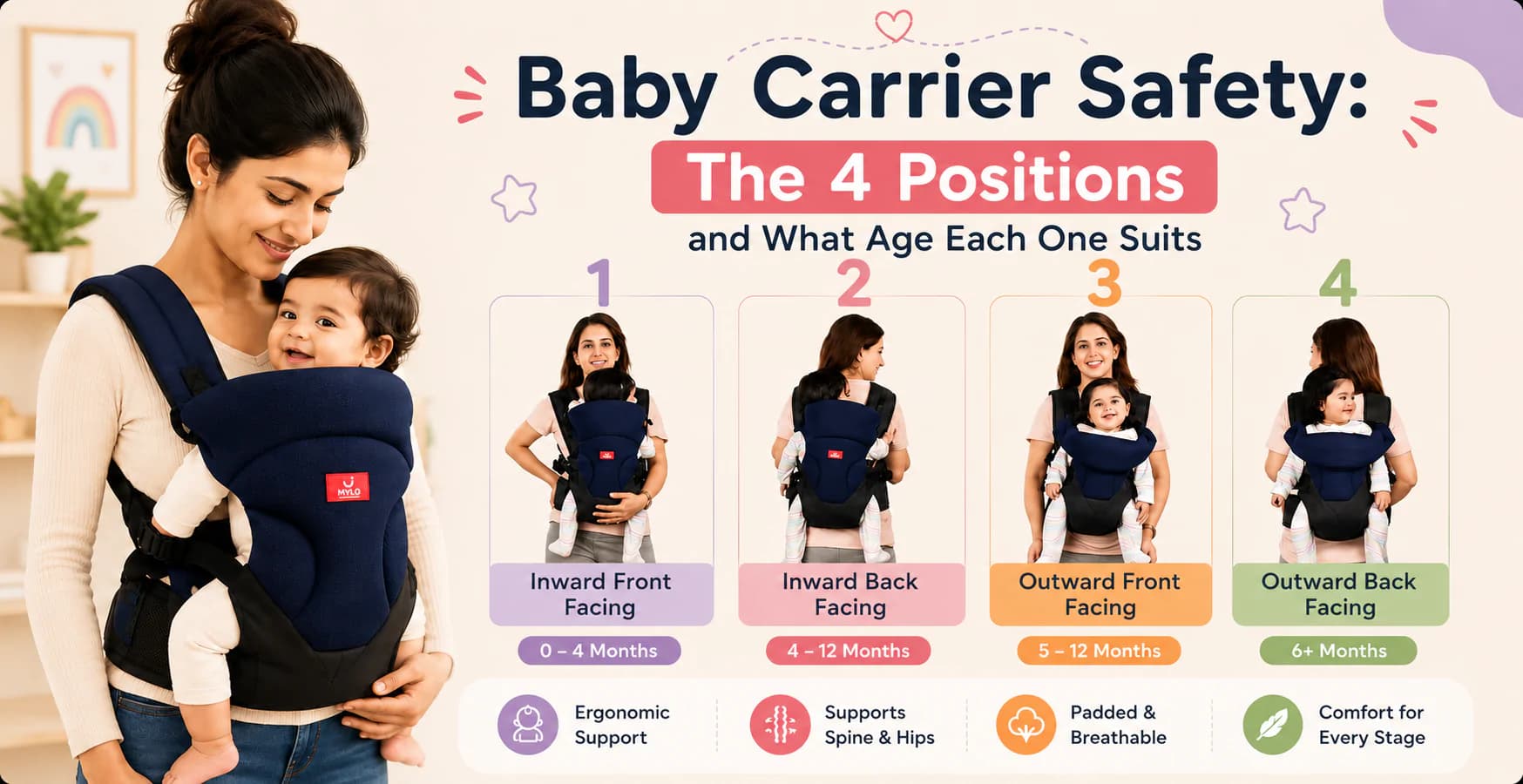
Baby carriers have four carrying positions, and each suits a different stage of your baby's development. Front-inward works from the first weeks to about six months. Front-outward needs independent head and neck control, usually 5 to 6 months at the earliest. Hip and back carry wait until your baby sits unassisted, typically 6 months and beyond. Getting position and age wrong is one reason carrier-related incidents send babies to emergency rooms, per a 2022 Pediatrics analysis, so it is worth knowing the right time for each. If you are new to babywearing, this pairs well with Mylo's guide on when to use a baby carrier.
What are the 4 baby carrier positions, and what age does each one suit?
|
Position |
Suitable age |
Milestone needed |
Carrier type |
|
Front-inward |
Newborn to ~6 months |
Head control (~4 months) for structured carriers |
Stretchy wrap (0 to 4 months), structured 4-in-1 from 4 months |
|
Front-outward |
From 5 to 6 months |
Independent head and neck control |
Structured 4-in-1 or 6-in-1 |
|
Hip carry |
From ~6 months |
Baby sits unassisted |
Hip seat or structured carrier with hip mode |
|
Back carry |
From 6 to 12 months |
Strong head, neck and trunk control |
Structured carrier with back-carry mode |
When is the front-inward position safe to use?
Front-inward is the position your baby starts in. It works from the first weeks to roughly six months. It suits the youngest babies because your baby's airway stays in your line of sight, the hips fall into the M-position (knees higher than the bottom, thighs supported knee to knee), and your body heat helps regulate temperature.
The risk to watch is curl. The American Academy of Pediatrics (AAP) warns that a newborn in a sling can fall into a C-shape, chin pressed to chest, restricting the airway. AAP guidance is to keep your baby's face visible, chin off chest, and breathing checked often. Preterm, low-birth-weight, or respiratory-compromised babies need paediatric clearance before any upright carrier.
When can a baby be carried front-facing outward?
Not before strong, independent head and neck control. For most babies that arrives around 5 to 6 months, but go by your baby's development, not a calendar date. The signal is a head held steady through tummy time, brief sitting with light support, and tracking movement without head bobbing.
Two boundaries apply. Keep outward-facing time short, around 20 to 30 minutes at a stretch, because the position offers no neck support and can overstimulate younger babies. And the M-position still applies: if the legs dangle straight down, the carrier is not supporting hip development.
At what age is the hip carry position safe?
From around 6 months, once your baby sits unassisted. The position spreads weight on your hip rather than your shoulders, making longer outings easier on your back. Older babies enjoy it because they see both you and the world without the visual overload of full outward-facing.
When can you start back-carrying your baby?
Back carry needs full head, neck, and trunk control. Most babies are ready between 6 and 12 months. Some brands recommend waiting until 12 months; others allow back carry from 6 months with a structured carrier. The International Hip Dysplasia Institute (IHDI) cites research from traditional baby-wearing populations suggesting that back-carrying with hips in the M-position may be associated with lower rates of developmental dysplasia of the hip (DDH), not higher.
How does the TICKS rule keep your baby safe in any carrier?
TICKS is the UK Sling Consortium's safety checklist, used by paediatric bodies worldwide:
-
Tight: the carrier hugs your baby close without slack.
-
In view at all times: you can see your baby's face by glancing down.
-
Close enough to kiss: head near enough to your chin.
-
Keep chin off the chest: a fingertip should fit between chin and chest.
-
Supported back: back held in a natural, slightly curved position.
If any of these fail, adjust before walking. Mylo's baby carrier safety guide covers the same checks for slings and backpacks.
Why does baby carrier position matter for hip development?
The M-position (spread-squat or jockey position) is the natural posture a baby's hips settle into when carried correctly: thighs spread around the parent's torso, knees higher than the bottom, hips flexed at 90 to 110 degrees and abducted at 40 to 55 degrees. The IHDI calls this the "cone of stability."
DDH matters in India. A 2022 Indian Pediatrics consensus from eight Indian medical societies (POSI, IAP, NNF India, IRIA, IFUMB, FOGSI, IOA) flagged that DDH in India is often not diagnosed until walking age, with Indian studies placing incidence between 1.0 and 9.2 per 1000 live births. Carriers that force legs into a straight-down position do not preserve the M-position; carriers that support the thigh from knee to knee do.
What are the common baby carrier mistakes Indian parents make?
Three patterns recur. First, hip-tight swaddling combined with long carrying hours: a 2021 Indian Journal of Orthopaedics survey by Pinto and Aroojis found that about 90% of Indian caregivers swaddle traditionally for roughly 10 hours a day until about 4.2 months, and tight swaddling that pins the legs straight is a known DDH risk factor. Second, turning a young baby outward before sustained head control develops. Third, using one carrier for every stage, when a wrap for a 3-month-old is not the carrier you want at 20 months.
What should you look for when choosing a baby carrier in India?
A few practical checks, and Mylo's article on the 5 qualities to look for when choosing a baby carrier goes deeper:
-
An age range that matches your baby's stage. For 0 to 4 months, a soft stretchy wrap or newborn ring sling. From around 4 months, a structured 4-in-1 or 6-in-1.
-
Padded shoulder straps and a waist belt to distribute weight, which helps in Indian summers.
-
Material that breathes. Honeycomb mesh and polycotton handle Indian heat better than dense cotton.
-
True M-position preservation, not just legs out of the bottom.
The Mylo Buddy 4-in-1 Baby Carrier is built for the 4-month-and-older window, and its product page states plainly that it is not recommended for newborns, who lack head and neck control. From 4 months it offers four carrying positions, a maximum weight of 15 kg, padded shoulder straps, a padded waist belt, and a bottle holder, in premium micro polycotton honeycomb material. For 0 to 4 months, a soft stretchy wrap from a specialist newborn-wrap brand is the safer choice. You can see the full Mylo baby carrier range here.
Frequently Asked Questions
Can a newborn use a baby carrier? A newborn can use a soft stretchy wrap or ring sling designed for newborns, but not a structured 4-in-1 carrier. Structured carriers need independent head and neck control, which usually develops around 4 months, which is why the Mylo Buddy carrier is rated from 4 months and not for newborns.
What age can a baby face outward in a carrier? Around 5 to 6 months, once your baby has strong, independent head and neck control. Paediatric bodies go by milestone, not a fixed age, and outward-facing periods should be kept short because the position gives no neck support.
Is back-carrying safe for babies in India? Yes, once your baby sits unassisted with strong trunk control, typically from around 6 months. The IHDI cites research suggesting back-carrying in the M-position may be linked to lower DDH risk in populations that practise it traditionally.
How long can a baby stay in a carrier at one time? There is no fixed time limit. As a practical rule, take your baby out for nappy changes, feeds, and to vary position every 1.5 to 2 hours.
Does baby-wearing cause hip dysplasia? No. Baby-wearing in the M-position does not cause DDH and is endorsed by the IHDI as hip-healthy. Risk rises only when a carrier forces the legs straight down, or when babies are tightly hip-swaddled for long hours.
Should I use a soft wrap or a structured carrier for my newborn? For 0 to 4 months, a soft stretchy wrap is the safer choice. Wraps mould around the newborn's body, support the natural C-curve of the spine, and offer better airway visibility than a structured carrier.
When should I stop using a baby carrier? Most parents stop between 24 and 36 months, or when the baby outgrows the weight limit; the Mylo Buddy is rated up to 15 kg. Mylo covers this in detail at what age you should stop using a baby carrier.
Is it safe to breastfeed while baby-wearing? Yes, with care. AAP guidance is to return your baby to the upright position after feeding, ensure the chin stays off the chest, and watch the airway throughout.
Healthcare disclaimer
This article is for general informational purposes and is not a substitute for individual medical advice. Speak to your paediatrician about your baby's development and the right time to introduce each carrying position. If your baby was born preterm, had low birth weight, or has any respiratory or hip concern, get medical clearance before using a carrier.
Medically reviewed by Dr. Shruti Tanwar, MBBS, MD (Obstetrics & Gynaecology) on 27 June 2026
Last updated: 30 June 2026
Sources
-
American Academy of Pediatrics, Babywearing: Tips to Keep Your Baby Safe, HealthyChildren.org.
-
International Hip Dysplasia Institute, Baby Carriers, Seats, and Other Equipment.
-
AAP News (referencing Rowe et al., Pediatrics 2022 emergency-room injury data), Keep babies safe while in carriers, slings.
-
Aroojis A, et al., Indian Academy of Pediatrics and Pediatric Orthopaedic Society of India Consensus Statement on DDH, Indian Pediatrics 2022;59:626-635.
-
Pinto DA, Aroojis A, Traditional Baby Swaddling Practices in India: A Survey of Caregivers, Indian Journal of Orthopaedics 2021.
-
Vaidya S, Aroojis A, Mehta R, Baby Wearing and Hip Health, Indian Journal of Orthopaedics 2021;55:1410-1416.
-
Hooper N, Aroojis A, et al., Developmental Dysplasia of the Hip in India, Indian Journal of Orthopaedics 2020 (PMC7851210).
-
UK Sling Consortium, TICKS Babywearing Safety Guidelines, 2010.
-
US Consumer Product Safety Commission, Federal Mandatory Standard for Infant Sling Carriers, 2017 (updated 2022).
-
Mylo resources: when to use a baby carrier, 5 qualities to look for, when to stop using a baby carrier, baby carrier safety guide, Mylo Buddy 4-in-1 Carrier, and the Mylo baby carrier range.
Related Articles
HairVivine Pro: What This Pumpkin Seed Hair Active Does and What the Studies Show
 15 min
 Copper Peptides for Hair: What Copper Tripeptide-1 (GHK-Cu) Really Does
 11 min
 How Long Does Postpartum Hair Loss Last? A Month-by-Month Recovery Timeline
 16 min
 Why Is My Hair Falling Out 3 Months After Delivery? Postpartum Hair Loss Explained
 16 min
Related Topics
.webp&w=32&q=75)
Medical Disclaimer
This content is for informational purposes only and should not replace professional medical advice. Consult with a physician or other health care professional if you have any concerns or questions about your health. If you rely on the information provided here, you do so solely at your own risk.


AWARDS AND RECOGNITION

Mylo wins Forbes D2C Disruptor award

Mylo wins The Economic Times Promising Brands 2022
AS SEEN IN













- Mylo Care: Effective and science-backed personal care and wellness solutions for a joyful you.
- Mylo Baby: Science-backed, gentle and effective personal care & hygiene range for your little one.
- Mylo Community: Trusted and empathetic community of 10mn+ parents and experts.


Product Categories
Baby Carrier | Baby Soap | Baby Wipes | Stretch Marks Cream | Baby Cream | Baby Shampoo | Baby Massage Oil | Baby Hair Oil | Stretch Marks Oil | Baby Body Wash | Baby Powder | Baby Lotion | Diaper Rash Cream | Newborn Diapers | Teether | Baby Kajal | Baby Diapers Pants | Cloth Diapers | Laundry Detergent | Lactation Granules |