


Orders
.png&w=48&q=75 "login")
Profile


Wallet

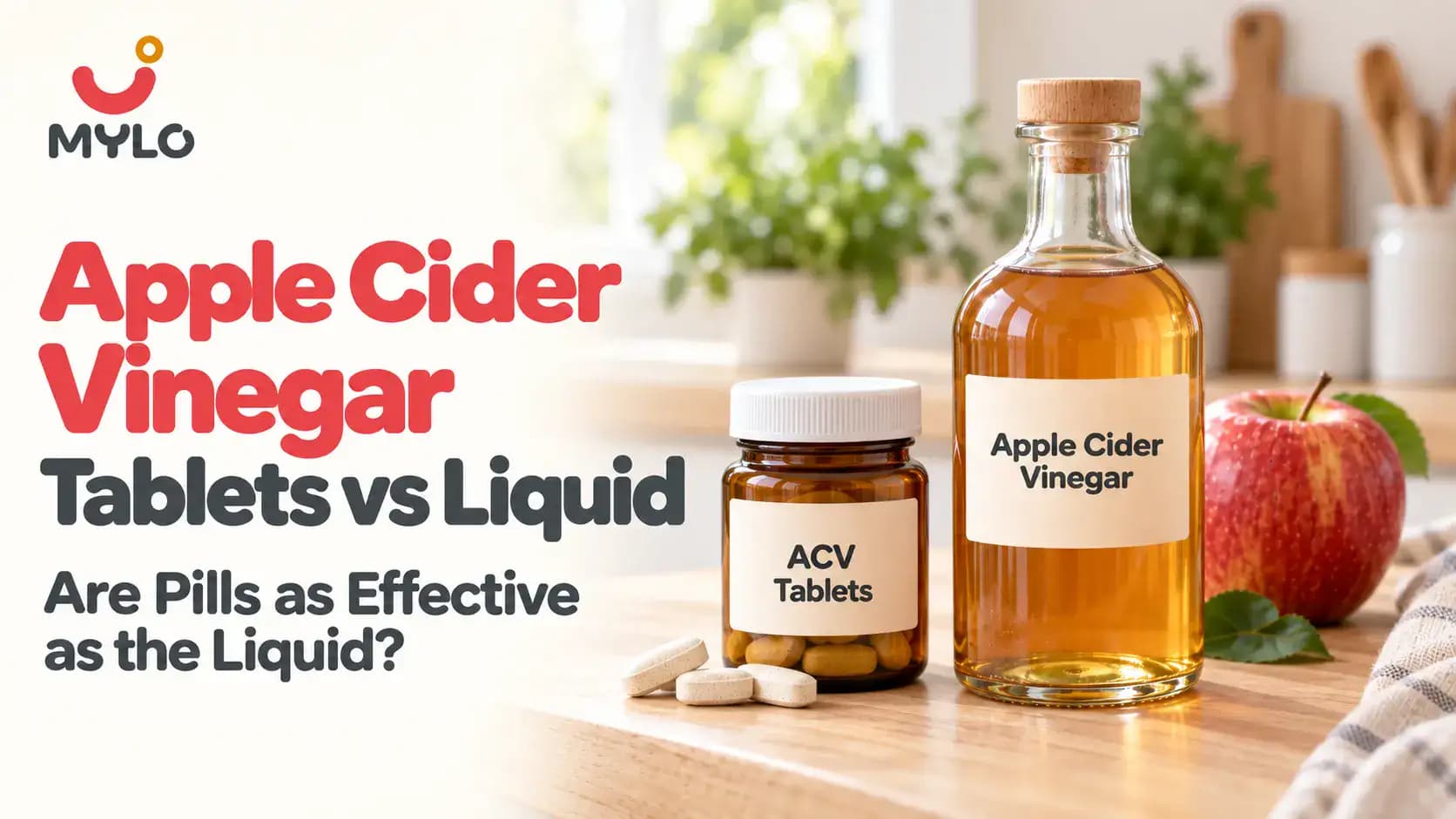
Apple Cider Vinegar Tablets vs Liquid: Are the Pills as Effective as the Juice?
 2 Likes|
 9 min
9 minQuick Answer
Not clearly, no. Apple cider vinegar (ACV) tablets are far less studied than the liquid, and the small benefits people associate with ACV, mainly a modest effect on blood sugar, come from research on the liquid or its active ingredient, acetic acid. ACV pills also vary enormously in how much acetic acid they actually contain, and their labels are not always accurate. Tablets are more convenient and gentler on your teeth, but "convenient" is not the same as "as effective".
Key Takeaways
The evidence is for the liquid, not the pills. Studies used liquid vinegar or acetic acid, so the benefits attributed to ACV do not automatically transfer to tablets (Healthline).
Pill acetic acid content varies wildly, from very little to a lot, and is often lower than a serving of liquid, whose acetic acid is more consistent.
Supplement labels can be inaccurate. One analysis found a product claiming 35% acetic acid actually contained about 3.2%.
Tablets win only on convenience and teeth. No acidic taste, easy to carry, and gentler on enamel.
In any form, ACV is not a proven weight-loss, detox or disease treatment. Keep expectations realistic.
What Is Apple Cider Vinegar, and What Makes It "Work"?
Apple cider vinegar is made by fermenting apple juice, first into alcohol, then into vinegar. The compound that gives ACV its tang and its studied effects is acetic acid. Most bottled apple cider vinegars contain about 4 to 5% acetic acid, which works out to roughly 700 to 800 mg of acetic acid per tablespoon-sized serving (ConsumerLab).
When people talk about ACV "benefits", they are really talking about acetic acid. That matters a lot when comparing pills to liquid, because the key question is simple: does the tablet actually deliver a comparable amount of acetic acid, and has it been shown to work?
Are Apple Cider Vinegar Tablets as Effective as the Liquid?
Here is the honest, evidence-based answer.
1. The research is on the liquid. Almost all of the (already modest) studies on ACV used liquid vinegar or pure acetic acid, not tablets. There is very little research directly on ACV pills, so we cannot assume they do the same thing (Healthline).
2. Pills vary hugely in acetic acid content. When ACV supplements have been tested, their acetic acid per serving ranged enormously, in one review from about 27 mg to 882 mg, and many contained much less than a serving of liquid vinegar (Healthline). So two ACV tablets from different brands can be worlds apart.
3. Labels are not always trustworthy. An analysis of eight ACV pills found their labels were inconsistent and inaccurate. In one striking example, a product that claimed 35% acetic acid actually contained only about 3.2% (Healthline). Supplements are not regulated as strictly as medicines, so there is no guaranteed dose.
4. There is a hint they may be weaker for blood sugar. What limited comparison exists suggests tablets may not match the liquid for the one effect ACV is best known for, blunting blood sugar.
The verdict: ACV tablets are not established as being as effective as the liquid. If you want the modest, better-studied effects of ACV, diluted liquid vinegar is the more evidence-based choice. Tablets are mainly about convenience.
Tablets vs Liquid: A Clear Comparison
Factor | Liquid ACV | ACV tablets/gummies |
|---|---|---|
Evidence | What little research exists used this form | Very little direct research |
Acetic acid content | Fairly consistent (~4 to 5%, ~700 to 800 mg/serving) | Varies widely, often lower, sometimes mislabelled |
Convenience | Needs diluting, has a strong taste | Easy, portable, no taste |
Effect on teeth | Acidic, can erode enamel | Gentler on enamel |
Throat/stomach | Can irritate if undiluted | Can irritate or, rarely, injure the throat if a tablet lodges |
Dose certainty | You know what you are getting | Depends entirely on the brand's quality |
Cost | Usually cheaper | Usually more expensive per equivalent dose |
What Does ACV Actually Do, In Any Form?
It is worth being realistic, because ACV is marketed for far more than it can deliver.
A modest effect on blood sugar after meals is the best-supported benefit, and even this is small and studied mostly with the liquid (systematic review, PubMed Central).
Appetite and small effects on weight are possible but minor. ACV is not a weight-loss solution.
"Detox", "boosts metabolism", "boosts immunity", "cures" conditions: these are marketing claims, not established facts. Your liver and kidneys handle detoxification; a supplement does not.
If you have a specific health goal, such as managing PCOS or blood sugar, ACV is at most a very minor extra, not a treatment, and proven approaches should come first.
If You Choose to Use ACV: How to Do It Safely
If you use the liquid:
Dilute 1 to 2 teaspoons (up to a maximum of 1 to 2 tablespoons, 15 to 30 mL) in a large glass of water. Never drink it neat.
Drink through a straw, rinse your mouth afterward, and wait at least 30 minutes before brushing, to protect enamel.
If you use tablets:
Choose a reputable brand that states its acetic acid content, and be sceptical of vague labels.
Take with a full glass of water so the tablet does not lodge in your throat.
Do not exceed the recommended dose.
For everyone: start small, and stop if it causes discomfort.
Safety, Side Effects and Interactions
ACV is not risk-free in either form (Healthline):
Tooth enamel erosion (liquid, from acidity)
Throat or stomach irritation (both forms)
Low potassium (hypokalemia) with excessive or long-term use
Blood sugar dropping too low if combined with diabetes medicines like metformin or insulin
Interactions with diuretics and heart medicines such as digoxin
Check with your doctor before regular use if you take diabetes medication or diuretics, have low potassium or kidney issues, have acid reflux or ulcers, or are pregnant.
ACV Tablets vs Liquid: Frequently Asked Questions
"Are apple cider vinegar pills as good as the liquid?"
Not proven to be. The research is on liquid vinegar, pills vary a lot in acetic acid content and are often lower, and their labels are not always accurate. Tablets are more convenient and easier on your teeth, but that is not the same as being as effective.
"Do ACV tablets help with weight loss?"
Not meaningfully, in either form. Any effect on appetite or weight is small. ACV is not a weight-loss product, whatever the packaging suggests.
"Are ACV gummies effective?"
Gummies share the same issues as tablets: little direct research, variable acetic acid content, and often added sugar. Convenience is their main selling point, not proven effectiveness.
"Which is better for blood sugar, pills or liquid?"
The modest blood-sugar effect of ACV is best documented with the diluted liquid, and limited evidence hints tablets may be weaker. If blood sugar is your concern, speak to your doctor, and do not rely on any ACV product.
"Are ACV tablets safe for teeth?"
Yes, tablets avoid the enamel erosion that the acidic liquid can cause, which is a genuine advantage. Just take them with water so they do not irritate your throat.
"How do I pick a good ACV supplement?"
Choose a reputable brand that clearly states its acetic acid content, since testing has shown huge variation and some inaccurate labels. And remember that even a good tablet is not a proven treatment for anything.
Bottom Line
If your question is whether ACV tablets are as effective as the juice, the honest answer is that this has not been shown. The limited research behind ACV used the liquid, tablets vary widely in how much acetic acid they actually contain, and their labels cannot always be trusted. Tablets do have real advantages in convenience and being gentler on your teeth, so if you value those, a reputable one is a reasonable choice. Just keep your expectations grounded: in either form, apple cider vinegar is a minor addition at most, not a weight-loss aid, a detox or a treatment, and anything you are hoping it will fix is better discussed with your doctor.
References
All links verified live on 17 September 2026.
Apple Cider Vinegar Pills: Should You Take Them? — Healthline (medically reviewed). Source for the lack of research on pills, the wide variation in acetic acid content, and the inaccurate-label findings.
Apple Cider Vinegar Review — ConsumerLab. Source for typical acetic acid content of liquid vinegar and testing of supplements.
7 Potential Side Effects of Apple Cider Vinegar — Healthline. Source for enamel erosion, potassium, and medication interactions.
Effects of apple cider vinegar on glycemic control: a systematic review and meta-analysis — PubMed Central. Source for the modest blood-sugar effect.

Article Posted Under
Related Articles




Medical Disclaimer
This content is for informational purposes only and should not replace professional medical advice. Consult with a physician or other health care professional if you have any concerns or questions about your health. If you rely on the information provided here, you do so solely at your own risk.


AWARDS AND RECOGNITION

Mylo wins Forbes D2C Disruptor award

Mylo wins The Economic Times Promising Brands 2022
AS SEEN IN













- Mylo Care: Effective and science-backed personal care and wellness solutions for a joyful you.
- Mylo Baby: Science-backed, gentle and effective personal care & hygiene range for your little one.
- Mylo Community: Trusted and empathetic community of 10mn+ parents and experts.


Product Categories
Baby Carrier | Baby Soap | Baby Wipes | Stretch Marks Cream | Baby Cream | Baby Shampoo | Baby Massage Oil | Baby Hair Oil | Stretch Marks Oil | Baby Body Wash | Baby Powder | Baby Lotion | Diaper Rash Cream | Newborn Diapers | Teether | Baby Kajal | Baby Diapers Pants | Cloth Diapers | Laundry Detergent | Lactation Granules |